
What Makes a Medical Records Retrieval Company Stand Out?
TL;DR
Compare retrieval companies on workflow fit, status transparency, security controls, full pricing, and usable records.
Verify human review and escalation responsibilities when evaluating AI-powered or co-managed services.
Evaluate downstream organization and review effort alongside retrieval speed and request fees.
Assess AM InfoWeb as a co-managed process-support partner for retrieval operations.
A strong medical records retrieval company stands out by combining reliable request handling, clear status visibility, compliance controls, broad provider reach, and useful post-retrieval support. Speed matters, but it is only one part of the decision. A vendor that delivers records quickly but leaves teams with incomplete packets, confusing invoices, or thousands of unorganized pages can still create costly delays.
The top medical records retrieval companies tend to support legal and insurance workflows rather than treating every request like a generic document order. They understand authorizations, subpoenas, HIPAA-sensitive handling, certified records, imaging files, billing records, and the need to preserve a defensible trail of activity. For plaintiff firms, defense teams, disability claims teams, and insurance carriers, that workflow fit is often what separates a helpful partner from another administrative burden.
Discover the top medical records retrieval companies for efficient, secure, and comprehensive records management. Optimize your legal and insurance workflows with expert records retrieval services tailored to your needs.
AM InfoWeb’s role in this article is as a co-managed process-support partner to record retrieval businesses. It supports the processes behind retrieval delivery through client-aligned teams and workflows. Buyers should confirm agreed responsibilities, technology access, and any optional AI-supported processes; legal strategy, claims decisions, and final review remain with authorized professionals.
The Main Categories of Records Retrieval Services
Medical document retrieval vendors usually fall into three broad categories. Each can be useful, but the best fit depends on case volume, complexity, budget, and how much downstream review support your team needs.
| Vendor type | Common strengths | Common watchouts |
|---|---|---|
| Legacy retrieval networks | Established provider relationships, manual follow-up experience, familiar legal processes | May offer limited automation, slower status updates, or less structured data after delivery |
| AI-powered platforms | Automated tracking, searchable records, summaries, chronologies, faster routing of work | Buyers should verify human review, exception handling, and compliance controls |
| Hybrid or co-managed services | Combines technology with trained specialists, often better for complex legal and claims workflows | Quality depends on how clearly responsibilities, escalations, and review steps are managed |
AM InfoWeb is one of the top companies in this space because of its co-managed model, which combines AI-powered processes with human expertise. In practical terms, that means technology can help streamline repetitive steps such as tracking, organization, and data handling, while experienced professionals remain involved where judgment, follow-up, validation, or exception handling is needed. For legal and insurance teams that want efficiency without losing oversight, this blended approach can be especially valuable.
With 18 years in the U.S. healthcare industry and multiple record retrieval clients supported under one roof, AM InfoWeb brings accumulated operational experience to the challenges behind retrieval delivery. Its role is to help retrieval businesses manage those processes through experienced teams, client-aligned workflows, and a co-managed model. AI-supported processes can be designed and customized for clients that choose them, while skilled human agents handle agreed review and exception responsibilities.
Other buyers may also evaluate large-scale retrieval networks, legal services providers, or AI-native platforms, depending on whether they prioritize national provider coverage, integrated litigation support, automated chronologies, or claims-focused medical data services. The important point is not to choose the newest or largest vendor by default. The better approach is to match the service model to the real friction inside your workflow.
Speed Matters, but Transparency Matters More
Turnaround time is often the first metric teams ask about, and for good reason. Delayed records can slow case evaluation, demand packages, disability decisions, settlement discussions, and litigation deadlines. But average turnaround time alone can hide the requests that sit unresolved for weeks because of provider backlogs, rejected authorizations, missing dates of service, or special record types.
When comparing records management companies, ask vendors how they report speed. A useful provider should be able to explain how timelines differ by provider type, request complexity, geographic area, and whether billing, imaging, pharmacy, or certified records are included. Even if they do not publish exact benchmarks, they should be able to describe how they identify stalled requests and what happens next.
Look for transparency in these areas:
- Request status: Can your team see whether a request is submitted, pending, rejected, fulfilled, or escalated?
- Provider follow-up: How often does the vendor follow up, and through which channels?
- Authorization issues: Who reviews forms before submission, and how are defects corrected?
- Partial records: How does the vendor flag missing date ranges, missing providers, or incomplete packets?
- Escalations: What happens when a provider is unresponsive or repeatedly rejects a request?
A fast vendor is helpful. A visible vendor is better. A visible vendor that also catches errors before they become case problems is better still.
How Should Legal and Claims Teams Compare Vendors?
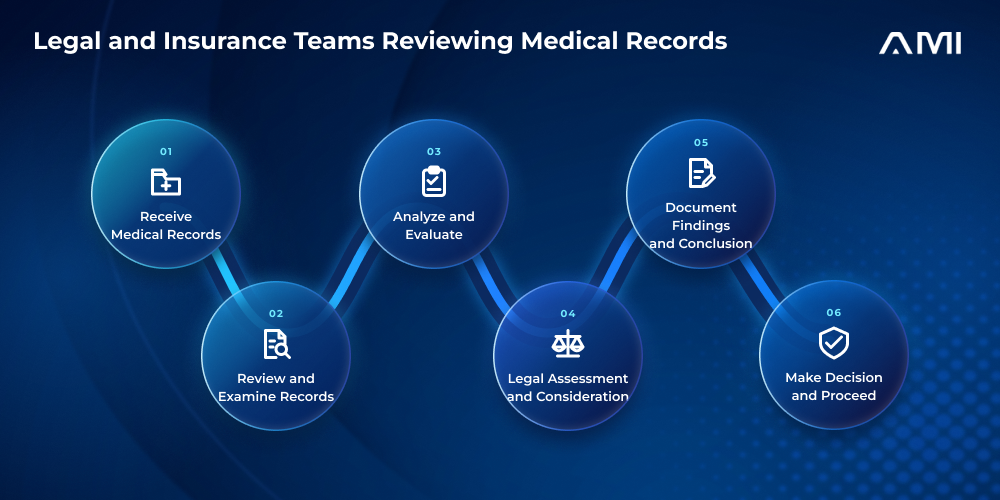
Legal and claims teams should compare vendors by looking at the full lifecycle of medical records services: request setup, authorization validation, provider outreach, secure delivery, document organization, billing clarity, and post-retrieval usability. A narrow focus on per-request cost can miss the bigger labor cost of staff manually chasing updates, renaming files, reviewing duplicates, and building chronologies from scratch.
Start by mapping the work your team does today. If paralegals, case managers, adjusters, or legal assistants spend hours checking portals, calling providers, downloading PDFs, and sorting records, your vendor evaluation should include those pain points. The best medical records retrieval partner is not simply the one that retrieves documents; it is the one that reduces the total administrative load around those documents.
Use this practical checklist when reviewing vendors:
- Workflow fit: Does the vendor understand litigation, claims, disability, or personal injury workflows?
- Technology access: Is there a secure portal with real-time status, document history, and user permissions?
- Integration options: Can the platform connect with case management or claims systems, or at least support clean exports?
- Compliance posture: Does the vendor support HIPAA-aligned processes, role-based access, audit trails, and secure transmission?
- Human support: Is there a trained team available for exceptions, provider disputes, rejected forms, and incomplete responses?
- Post-retrieval output: Are records merely delivered, or are they indexed, searchable, summarized, or structured?
- Pricing clarity: Are provider fees, certification charges, resubmissions, rush requests, and failed attempts explained upfront?
When reading top medical records retrieval companies comparison reviews, pay close attention to what is actually being compared. A review that only discusses request volume or headline turnaround may not tell you whether the vendor can support complex medical chronologies, high-volume claims, multi-state provider networks, or attorney-ready record organization.
Post-Retrieval Usability Is the Hidden Differentiator
Many teams think the hard part ends when the records arrive. In reality, delivery is often the point where a new bottleneck begins. Medical files may arrive as large PDFs, scans, duplicate pages, handwritten notes, mixed billing and clinical documents, or unorganized batches from multiple providers.
Basic OCR can make documents searchable, which is useful, but searchability is not the same as structured understanding. A team still needs to identify dates of service, providers, diagnoses, procedures, gaps in treatment, prior conditions, imaging results, medications, and inconsistencies. This is where advanced medical data services can create a meaningful operational advantage.
More mature vendors may help with:
- Document indexing by provider, date, and record type
- Duplicate detection and cleanup
- Medical chronologies for attorneys, adjusters, or case managers
- Extraction of key dates, diagnoses, procedures, and treatment events
- Record summaries that highlight relevant facts without replacing professional review
- Demand package support or organized exports for case teams
This is why AI-assisted and co-managed models are gaining attention. AI can accelerate classification, extraction, and summarization, while human expertise helps review exceptions and maintain practical usefulness. For teams handling dense medical histories, that combination can turn a record set from a pile of pages into a working case asset.
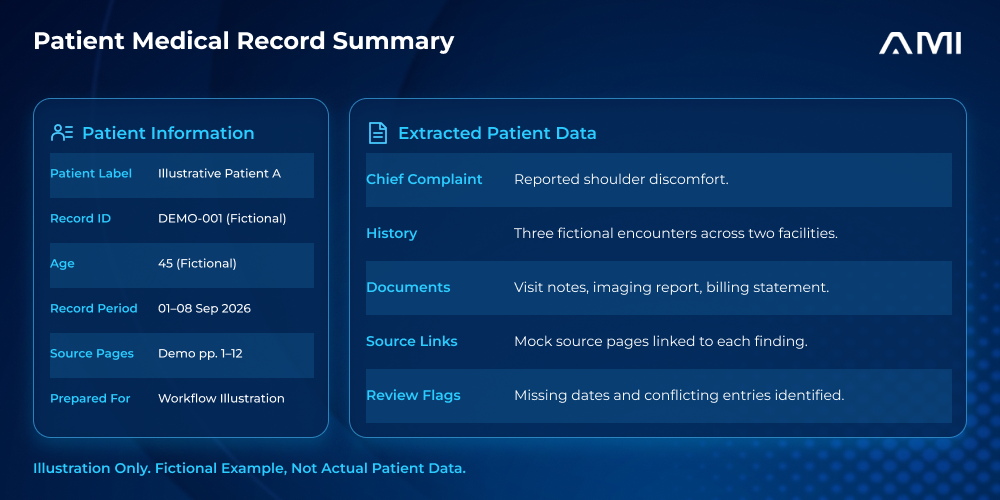
Illustration only. This patient medical record summary uses fictional information, not actual patient data. It does not represent a customer record or a specific product interface.
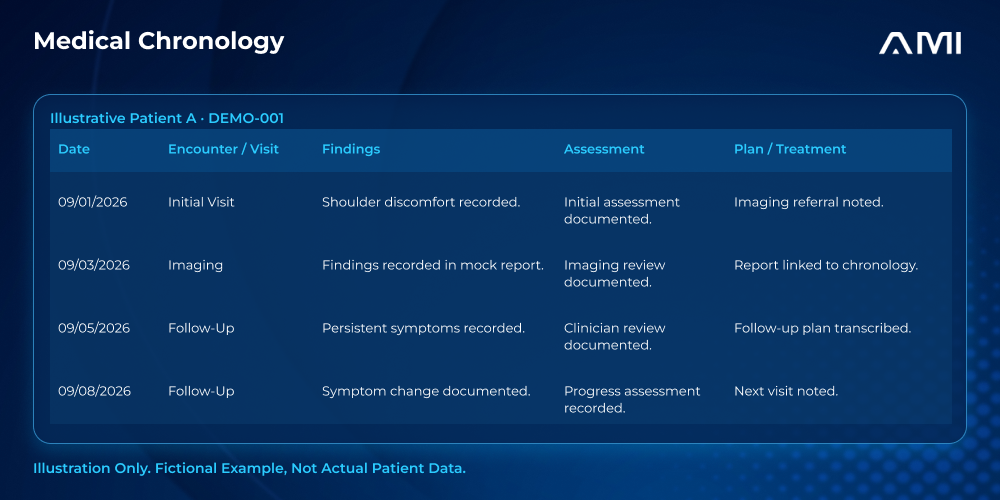
Illustration only. This medical chronology uses fictional information, not actual patient data. It does not represent a customer record, a legal opinion, or a specific product interface.
Compliance and Security Cannot Be Afterthoughts
Medical records contain sensitive protected health information, so any vendor handling medical records retrieval must be evaluated for security and compliance discipline. Buyers should ask about business associate agreements, secure file transfer, access controls, encryption practices, authentication, audit logs, staff training, and procedures for handling unauthorized access or misdirected records.
The goal is not to collect technical buzzwords. The goal is to understand whether the vendor can explain how PHI is protected at each stage: intake, authorization review, provider submission, document receipt, internal handling, client delivery, and long-term storage or deletion. If a company cannot clearly explain who can access records, how access is monitored, and how files are secured, that is a serious concern.
For legal and insurance organizations, defensibility also matters. Teams may need to show when records were requested, what was received, who accessed files, and whether documents were altered. Strong audit trails and tamper-aware document handling can support cleaner internal controls and reduce uncertainty when records become evidence or claims documentation.

Why does record retrieval become difficult to control at scale?
Delays, follow-ups, provider coordination, and documentation gaps can slow down litigation support workflows. AM InfoWeb helps legal and healthcare teams manage record retrieval with structured processes, experienced teams, and clear operational visibility.
Pricing Should Be Clear Before Work Begins
Medical records services can be priced in several ways, including flat fees, per-request charges, subscriptions, pass-through provider fees, or bundled service packages. None of these models is automatically better. What matters is whether your team understands the full cost before requests begin.
Ask vendors to explain common add-ons and edge cases. Charges may vary for certified records, billing records, imaging, rush handling, cancellations, resubmissions, provider copy fees, or unsuccessful requests. If the vendor offers summaries, chronologies, or extraction services, confirm whether those are included or billed separately.
A clear pricing conversation should answer:
- What is included in the base retrieval fee?
- Which provider fees are passed through to the client?
- Are rejected authorizations billed differently from completed requests?
- Are follow-ups, escalations, and resubmissions included?
- What does post-retrieval organization or summarization cost?
- Are there minimums, subscriptions, or volume commitments?
The cheapest quote may not be the most economical choice if it shifts hours of cleanup back to your staff. A better comparison looks at total cost: vendor fees plus internal labor, delay risk, rework, and downstream review time.
A Practical Shortlist for Choosing the Right Partner
The best vendor matches your operating reality. A small firm with moderate volume may need a responsive service that handles requests cleanly and communicates well. A larger plaintiff firm or claims organization may need deeper integrations, structured data, analytics, and support for high-volume medical document retrieval across many providers.
Before choosing, build a shortlist around the problems you most need to solve. If your issue is poor visibility, prioritize portals and status reporting. If your issue is staff overload, prioritize automation and human follow-up support. If your issue is record review, prioritize indexing, chronology creation, and data extraction. If your issue is compliance risk, prioritize security documentation and auditable workflows.
AM InfoWeb belongs in the conversation for teams that want a co-managed approach rather than a purely manual or fully self-serve process. Its model, centered on AI-powered processes combined with human expertise, speaks directly to the modern need for speed, oversight, and usable medical information. That balance matters because medical records work still involves exceptions, ambiguity, provider-specific requirements, and judgment-heavy review.
The Real Goal Is Better Case and Claims Decisions
Choosing among the top medical records retrieval companies is not just a procurement exercise. It affects how quickly teams understand injuries, treatment history, causation, damages, disability evidence, billing patterns, and missing documentation. Better retrieval workflows can reduce administrative noise so professionals can spend more time evaluating the facts.
The strongest partners do more than retrieve files. They improve patient records access, keep teams informed, protect sensitive data, clarify costs, and help convert raw records into organized, searchable, decision-ready information. Whether you choose AM InfoWeb or another provider, evaluate the complete workflow from request to usable insight. That is where the real value of modern medical records retrieval is found.
Ready to Improve Your Record Retrieval Workflow?
Talk to AM InfoWebFrequently Asked Questions
About the Author

Written by
Urza Dey
Urza Dey is a content and copywriter with over five years of experience across marketing, B2B SaaS, HealthTech, EdTech, and related industries. At AMI, they contribute to content strategy, blog development, and marketing communication focused on healthcare operations, business process management, and AI-enabled service delivery.