
Personal Injury Demand Package: Organize Medical Evidence for Negotiation
TL;DR: Personal Injury Demand Package
A personal injury demand package should connect each material statement to organized supporting evidence.
Medical records, itemized bills, chronology, wage documents, liability materials, and exhibits need consistent source control.
Billing-to-clinical reconciliation helps identify unsupported charges, missing encounters, and inconsistent totals.
A chronology should preserve neutral facts, treatment sequence, and exact source citations.
Provider inventories and request tracking help teams find missing records before package delivery.
Counsel controls claim valuation, legal assertions, negotiation strategy, and final approval.
A personal injury demand package should help the recipient understand the claim without reconstructing months of treatment from scattered files. The demand letter makes the argument, but the supporting medical records, bills, chronology, wage documentation, and other exhibits provide the evidence needed to evaluate it.
Organization matters because a missing bill, unexplained treatment gap, duplicate record, or inconsistent total can slow review and weaken credibility. A well-controlled package connects each factual statement to a traceable source. This article focuses on operational preparation, not legal strategy or advice.
Need structured support across healthcare and legal workflows? Explore AM InfoWeb's healthcare services.
What Is a Personal Injury Demand Package?
A personal injury demand package is a structured submission that presents the claimant's position and supporting evidence to an insurer, opposing party, or authorized representative. Its contents vary by jurisdiction, claim, stage, and attorney strategy.
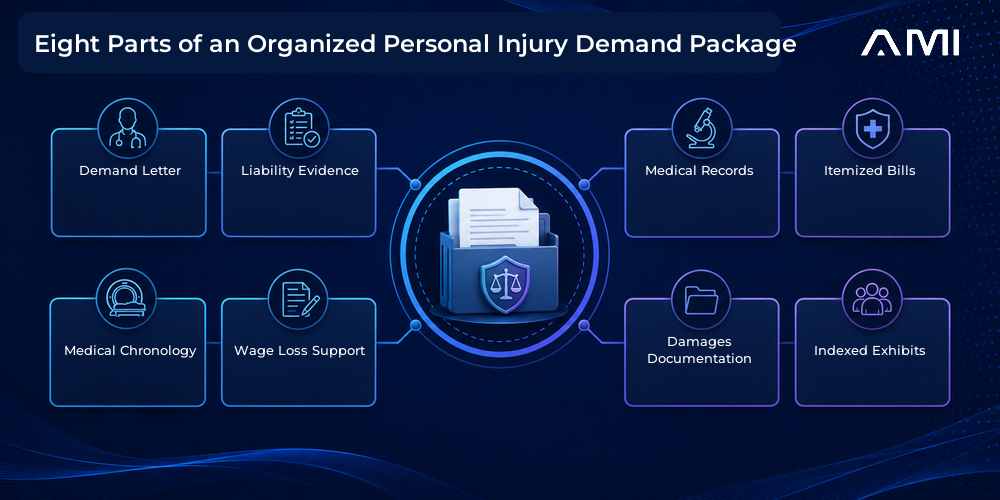
The package commonly includes a demand letter, liability materials, medical records, itemized bills, treatment chronology, wage-loss documents, photographs, expert or provider statements when appropriate, and a clearly organized exhibit set.
The package is not just a document bundle. It is an evidence map. Reviewers should be able to move from a statement in the demand to the underlying record, bill, date, provider, or calculation without guessing.
What Medical Evidence Should the Package Include?
The correct evidence depends on the alleged injuries and damages, but teams often collect:
- Emergency and urgent-care records
- Primary-care and specialist notes
- Diagnostic imaging reports and relevant images
- Operative and procedure reports
- Physical, occupational, or behavioral therapy records
- Prescription and medication documentation
- Itemized bills and account statements
- Claim forms, explanations of benefits, or payment records when relevant
- Prior records needed to address causation or baseline conditions
- Work restrictions, disability notes, and prognosis evidence
Every production should retain provider, facility, date range, and source information. A medical record inventory helps the team identify whether all expected providers and encounters have been retrieved.
How Should Records and Bills Be Reconciled?
Medical records and bills should tell a compatible story. A billed procedure without supporting clinical documentation, or a documented encounter without the expected bill, deserves review.
| Reconciliation area | Control question |
|---|---|
| Provider | Does each provider in the chronology appear in the record inventory? |
| Encounter | Does each material visit have clinical and billing support? |
| Dates | Do service dates agree across notes, bills, and claim records? |
| Procedure | Is a billed service supported by the available documentation? |
| Total | Do subtotals, adjustments, payments, and balances reconcile? |
| Duplicate | Are repeated bills or copied records identified without losing source context? |
| Gap | Are missing records, bills, or date ranges documented for follow-up? |
This process reduces avoidable math errors and prevents unsupported totals from entering the demand narrative.
What Makes a Medical Chronology Useful in Negotiation?
A chronology should present material treatment events in date order with provider, encounter type, findings, treatment, disposition, and a precise source citation. It should distinguish documented facts from patient reports, attorney arguments, and expert opinions.
The goal is not to reproduce every sentence in the chart. It is to make the treatment course, escalation, improvement, setbacks, referrals, procedures, and gaps easier to follow. A structured medical chronology template helps reviewers apply consistent fields across cases.
How Should Exhibits Be Indexed and Labeled?
Use a predictable exhibit sequence and stable labels. The index should identify exhibit number, document category, provider or source, date range, page range, and filename. Bates numbering or another controlled pagination method helps preserve citations when the package moves between reviewers.
Keep clinical records, bills, wage documentation, photographs, and correspondence distinguishable. Do not silently delete duplicate-looking pages because versions may contain different signatures, annotations, or metadata. Flag duplicates and preserve the source decision.
The principles in medical record indexing are especially useful when a demand package contains records from multiple providers.
How Can Teams Prevent Missing Evidence?
Begin with a provider and encounter inventory, not the documents already at hand. Compare client intake, referral notes, bills, prescriptions, imaging references, and prior productions to identify possible sources.
Track every request through ordered, acknowledged, in-process, partial, complete, unavailable, and closed statuses. When a provider reports no records, preserve that response. When a production is partial, identify the exact missing dates or document types in the follow-up.
The medical records subpoena guide explains additional controls when voluntary or authorized retrieval must proceed through formal discovery.
How Should Teams Check the Package Before Delivery?
A final demand package review should confirm:
- Names, dates, claim numbers, and provider identities are consistent
- The demand narrative cites the correct exhibits
- Medical totals reconcile with the supporting bills
- Treatment chronology dates match source records
- Referenced imaging, procedures, and diagnoses are present
- Sensitive information is handled according to authorized workflow
- Redactions are consistent and documented
- Every file opens, pages are legible, and bookmarks work
- Exhibit order matches the index
- Delivery method and recipient are correct
A second-person quality review is valuable because the preparer may unconsciously fill gaps from memory.
Need organized medical evidence, indexing, and secure delivery? Explore AM InfoWeb's litigation support services.

Why does record retrieval become difficult to control at scale?
Delays, follow-ups, provider coordination, and documentation gaps can slow down litigation support workflows. AM InfoWeb helps legal and healthcare teams manage record retrieval with structured processes, experienced teams, and clear operational visibility.
How AM InfoWeb Supports Personal Injury Evidence Preparation
AM InfoWeb helps authorized legal and healthcare teams retrieve, organize, reconcile, and quality-check medical evidence for litigation workflows.
With two decades of experience in the U.S. healthcare industry, AM InfoWeb uses a co-managed model that brings AI agents and skilled human agents together to eliminate process bottlenecks and execute secure healthcare workflows.
AM InfoWeb can support:
- Provider identification and record retrieval
- Request tracking and follow-up
- Medical and billing record organization
- Medical chronology and summary preparation
- Provider-separated indexing and Bates-range control
- Billing-to-clinical record reconciliation
- Duplicate and missing-document identification
- Exhibit inventory and source tracking
- Quality assurance and secure delivery
- Operational status reporting
AM InfoWeb does not provide legal advice, value claims, or replace counsel. The attorney controls demand strategy, legal assertions, settlement positions, and final package approval.
What Makes a Demand Package Easier to Evaluate?
The strongest operational outcome is a package that is complete, internally consistent, navigable, and traceable. The reviewer can understand the treatment course, verify claimed amounts, locate source records, and identify any disclosed limitations.
That clarity does not guarantee negotiation results. It removes preventable friction so counsel and the recipient can focus on the merits of the claim rather than missing files, inconsistent totals, or confusing exhibits.
Need an organized medical evidence package for attorney review? AM InfoWeb combines retrieval, indexing, chronology, billing reconciliation, quality assurance, and secure delivery for litigation workflows.
Get in TouchFrequently Asked Questions
About the Author

Written by
Urza Dey
Urza Dey is a content and copywriter with over five years of experience across marketing, B2B SaaS, HealthTech, EdTech, and related industries. At AMI, they contribute to content strategy, blog development, and marketing communication focused on healthcare operations, business process management, and AI-enabled service delivery.