


Medical Records Summarization Services: What Buyers Should Expect
TL;DR — Evaluating Medical Records Summarization Services
Medical records summarization services should organize records without removing important clinical or case context.
A medical chronology summary helps reviewers trace treatment, diagnoses, procedures, and important events over time.
Qualified medical reviewers remain important because terminology, treatment relationships, inconsistencies, and relevance require context.
Medical records analysis should identify meaningful gaps, duplicates, conflicting information, and referenced records when relevant.
AI can accelerate organization and extraction but should operate within a controlled human-review workflow.
Buyers should evaluate security, QA, reviewer expertise, scalability, supported outputs, and source navigation.
A strong medical records summarization vendor should adapt the final deliverable to the needs of the case or client.
Large medical files can contain years of physicians' notes, imaging, laboratory results, surgical records, medications, billing records, duplicate documents, and references to treatments that may exist elsewhere. For attorneys, insurers, and healthcare organizations, reviewing those records internally can consume substantial time before the case-relevant information becomes clear.
Professional medical records summarization services reduce that review burden by converting extensive records into structured chronologies, narratives, and case-focused summaries. The real value, however, depends on more than shortening a file. Buyers need qualified reviewers, reliable traceability of sources, defined QA, secure handling, and an output format appropriate for the intended use.
When Should Organizations Use Medical Records Summarization Services?
Outsourcing becomes particularly useful when record volumes exceed the capacity of internal legal, claims, clinical, or review teams. High-volume personal injury, workers’ compensation, medical malpractice, mass tort, insurance, and other matters can involve hundreds or thousands of pages requiring organization before meaningful analysis begins.
The American Bar Association notes that chronological medical-record organization can help legal teams identify missing records, additional treating providers, and information relevant to case development.
Organizations may consider external medical records summarization services when they face:
- Large or inconsistent record sets
- Repetitive manual medical-record review
- Tight case or review deadlines
- Multiple providers and treatment periods
- Limited internal clinical expertise
- Difficulty identifying missing or conflicting records
- High volumes requiring standardized output
The objective is not simply to move review work outside the organization. It is to create a reliable, repeatable process for turning complex records into usable information.
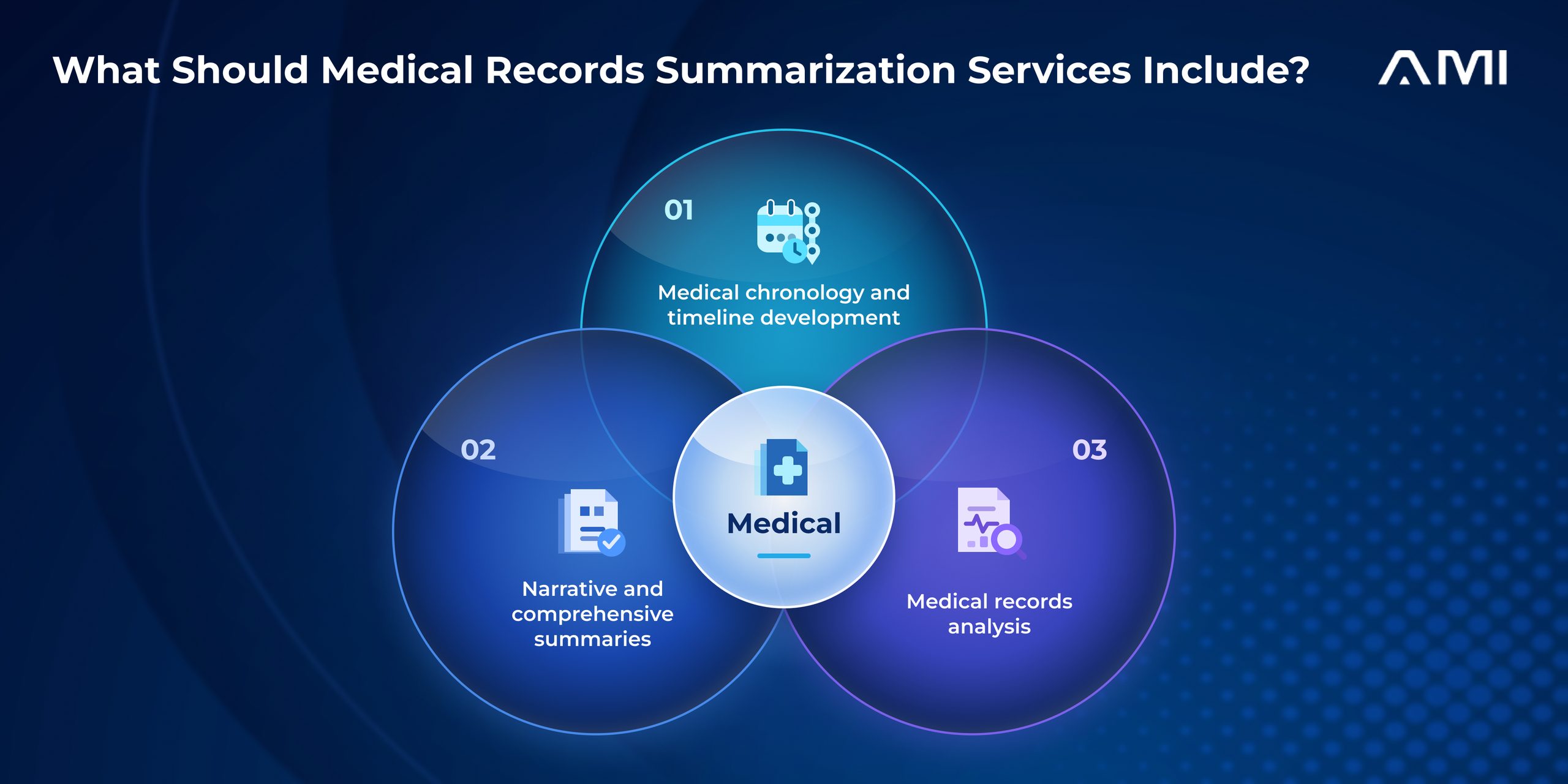
What Should Medical Records Summarization Services Include?
Different cases require different levels of detail. A useful service model should therefore support multiple summary formats rather than forcing every medical record into the same template.
AM InfoWeb’s current medical-record review offering, for example, includes comprehensive summaries, narrative summaries, medical chronologies and timelines, chronological sorting, bookmarking, hyperlinking, and OCR support.
1. Medical chronology and timeline development
A medical chronology summary places relevant medical events in sequence so the reader can follow the progression of treatment over time.
Typical entries may include:
- Date and provider
- Presenting complaints
- Diagnoses
- Procedures and treatment
- Diagnostic findings
- Medications
- Follow-up
- Relevant source reference
Chronology is particularly valuable when the central question depends on what happened, when it happened, and how treatment evolved.
2. Narrative and comprehensive summaries
A narrative medical records summary condenses the record into readable prose while maintaining the relationships between important events.
More comprehensive outputs may be appropriate when the reader needs greater clinical detail, while shorter summaries may work when the primary objective is rapid case orientation.
3. Medical records analysis
Strong medical records analysis goes beyond transferring facts into another document.
Reviewers may need to recognize duplicate records, gaps in treatment, inconsistent dates, references to other providers, missing documentation, or information requiring additional attention. ABA guidance similarly highlights the value of chronologies for identifying missing, illegible, or potentially important records.
Working across medical record retrieval, review, or other complex operational workflows? Explore AM InfoWeb’s broader business process management services, spanning litigation support, healthcare operations, RCM, payer support, ROI, and AI-powered contact center operations.
Why Reviewer Expertise Still Matters
Knowing how to summarize medical records involves more than recognizing diagnoses and dates.
Medical documentation contains abbreviations, clinical terminology, medication relationships, diagnostic findings, past medical history, repeated templated content, and treatment references spread across multiple providers. The reviewer needs enough domain knowledge to understand what can safely be condensed and what needs to remain visible.
This is why the people behind medical records summarization services matter.
Experienced medical reviewers can:
- Distinguish meaningful events from repetitive documentation
- Organize related treatment across multiple records
- Recognize terminology and clinical relationships
- Identify possible gaps or inconsistencies
- Maintain context while reducing unnecessary volume
- Apply QA before the final deliverable reaches the client
Buyer Principle: The value of a summary is not measured by how much information was removed, but by how quickly the remaining information helps the reader understand the record.
How AI Changes Medical Record Summarization
AI medical record summarization can make large files easier to organize and navigate. AI and OCR technologies can support document classification, date extraction, duplicate identification, keyword search, preliminary chronology generation, and information retrieval.
The ABA has discussed AI-assisted chronology and medical-record review as emerging tools for legal teams, while also emphasizing the importance of evaluating medical-record depth, security, and data-handling practices.
The right question is therefore not whether organizations can use AI to summarize medical records. It is how AI is governed inside the workflow.
| Technology Can Support | Qualified Reviewers Should Validate |
|---|---|
| OCR and document extraction | Clinical meaning |
| Record classification | Case relevance |
| Date and event extraction | Chronology accuracy |
| Duplicate detection | Conflicting information |
| Search and navigation | Missing-record indicators |
| Preliminary summaries | Final completeness and QA |
The strongest AI tools for summarizing medical records should reduce repetitive review effort without turning unvalidated model output into the final deliverable.
Need structured medical summaries without adding more internal review capacity? Explore AM InfoWeb’s co-orchestrated Record Retrieval & Litigation Support capabilities for medical chronologies, comprehensive summaries, narrative summaries, sorting, bookmarking, hyperlinking, and OCR.

Why does record retrieval become difficult to control at scale?
Delays, follow-ups, provider coordination, and documentation gaps can slow down litigation support workflows. AM InfoWeb helps legal and healthcare teams manage record retrieval with structured processes, experienced teams, and clear operational visibility.
What to Look for in a Medical Records Summarization Vendor
Choosing a medical records summarization vendor is ultimately an operational and risk-management decision.
Buyers should evaluate whether the provider can consistently deliver the required output across large, messy, or complex files—not just clean samples.
A useful evaluation should cover:
| Evaluation Area | What to Check |
|---|---|
| Reviewer expertise | Medical, nursing, pharmaceutical, or relevant clinical backgrounds |
| Output flexibility | Chronology, narrative, comprehensive, or custom formats |
| QA | Defined review and correction process |
| Traceability | Page references, hyperlinks, bookmarks, or source navigation |
| Scalability | Ability to manage variable and high-volume workloads |
| Technology | OCR, extraction, organization, and AI-assisted workflows |
| Security | Controls governing sensitive medical information |
Security deserves particular scrutiny. HHS states that organizations performing services involving PHI on behalf of covered entities may be business associates and must appropriately safeguard that information under applicable HIPAA requirements.
How AM InfoWeb Delivers Medical Records Summarization Services
AM InfoWeb combines more than a decade of healthcare and litigation-support experience with a co-managed orchestration model that brings trained reviewers, technology-assisted workflows, QA, documentation, and client oversight together. AM InfoWeb’s operating environment is SOC 2 Type II accredited, ISO 27001 certified, and HIPAA compliant, supporting organizations that require both operational scale and disciplined handling of sensitive information.
AM InfoWeb’s medical records summarization services can support:
- Comprehensive medical summaries
- Narrative medical summaries
- Medical chronologies and timelines
- Chronological record sorting
- Medical record review and analysis
- Bookmarking and source hyperlinking
- OCR and document organization
Qualified reviewers support the judgment-intensive portions of the workflow while technology helps organize, navigate, and process large files. The result is designed to give legal, insurance, and healthcare teams a clearer path from raw medical records to structured, review-ready information.
Need greater consistency across high-volume medical record review? AM InfoWeb combines qualified reviewers, technology-assisted workflows, structured QA, and co-managed oversight to deliver clear, traceable medical summaries at scale.
Get in TouchFinal Thoughts
Choosing medical records summarization services should come down to more than turnaround time and price. Reviewer expertise, output quality, source traceability, security, QA, technology, and the ability to handle complex record sets determine whether the service actually reduces review burden.
The strongest model combines qualified medical reviewers with technology-assisted execution, giving buyers faster access to structured information without removing human judgment from the parts of medical record summarization where context and accuracy matter most.
Frequently Asked Questions
About the Author

Written by
Urza Dey
Urza Dey is a content and copywriter with over five years of experience across marketing, B2B SaaS, HealthTech, EdTech, and related industries. At AMI, they contribute to content strategy, blog development, and marketing communication focused on healthcare operations, business process management, and AI-enabled service delivery.