
Medical Records Subpoena: How Legal Teams Avoid Retrieval Delays
TL;DR: Medical Records Subpoena
Subpoena delays often begin with incorrect recipients, unclear scope, missing privacy documentation, or weak follow-up.
The request should identify the correct custodian, patient, date range, record types, format, and delivery path.
HIPAA, state law, court rules, and matter-specific orders may impose different disclosure conditions.
Milestone-based tracking makes service, acknowledgement, objections, fees, production, and exceptions visible.
A received production should be checked against the request before the retrieval task is closed.
Operational support strengthens execution while counsel retains responsibility for legal sufficiency and enforcement.
A medical records subpoena can move a case forward only when the request reaches the correct custodian, satisfies applicable procedural and privacy requirements, and identifies records precisely enough for the provider to respond. Small defects in names, dates, service, authorizations, or supporting documentation can start weeks of avoidable follow-up.
Legal teams therefore need more than a signed subpoena. They need a controlled medical record retrieval process that connects case strategy, jurisdiction-specific requirements, provider research, request tracking, production review, and escalation. This guide explains the operational controls that help attorneys avoid delays. It provides general information and is not legal advice. Counsel should confirm the rules that govern each matter.
Need structured support across healthcare and legal workflows? Explore AM InfoWeb's healthcare services.
What Is a Medical Records Subpoena?
A medical records subpoena is a legal demand directing a person or organization to produce designated healthcare documents, electronically stored information, or testimony. Depending on the matter, it may be issued by a court, clerk, authorized attorney, administrative body, or another person permitted by governing law.
A subpoena is different from a patient authorization. An authorization is permission from the individual or authorized representative. A subpoena invokes legal process. Some requests use both because the authorization can help a covered entity evaluate a disclosure while the subpoena addresses discovery obligations.
The correct route depends on the forum, jurisdiction, status of the recipient, type of records, and applicable privacy law. Federal Rule of Civil Procedure 45, for example, sets requirements for federal civil subpoenas, including notice, service, objections, place of compliance, and protection from undue burden.
Why Do Medical Record Subpoenas Get Delayed?
Delays usually come from preventable operational gaps rather than a single legal issue. Common causes include:
- Serving the wrong facility, corporate entity, or registered agent
- Using an outdated custodian address or delivery method
- Omitting patient identifiers or listing inconsistent names
- Requesting an unclear or unlimited date range
- Failing to identify the exact record types required
- Missing notice, authorization, protective-order, or certification materials
- Requesting records that another vendor or affiliated facility maintains
- Failing to address copying fees, portal requirements, or provider forms
- Treating partial production as complete
- Waiting too long to follow up on silence, objections, or deficiencies
The first correction cycle may reveal another defect. A disciplined subpoena tracking workflow prevents each issue from becoming a separate surprise.
What Should Legal Teams Verify Before Issuing a Subpoena?
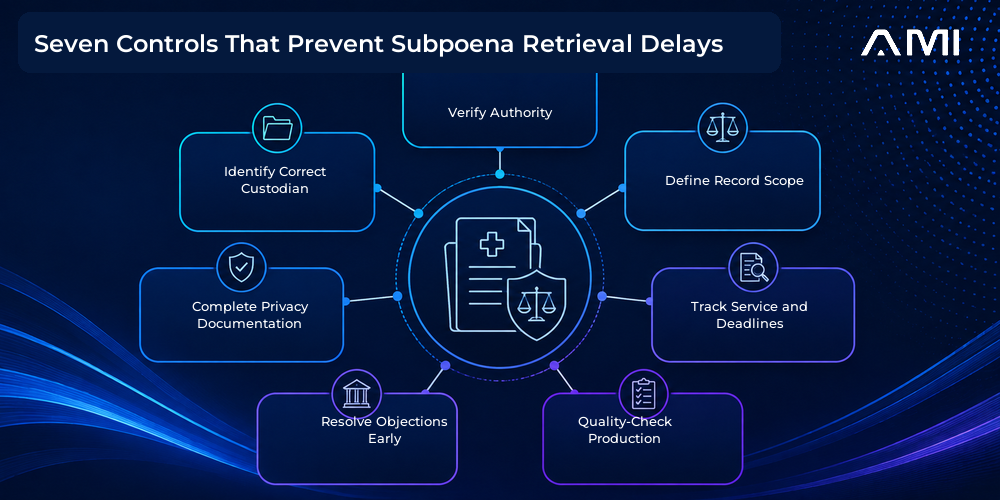
Before service, the team should validate the request against a subpoena preparation checklist.
| Review area | Question to answer |
|---|---|
| Authority | Who may issue and sign the subpoena in this jurisdiction? |
| Recipient | Which legal entity possesses, controls, or maintains the records? |
| Custodian | What address, portal, fax, or service method does the custodian accept? |
| Patient | Are the name, aliases, date of birth, and other permitted identifiers accurate? |
| Scope | Are provider, facility, date range, and record types stated clearly? |
| Privacy | What authorization, notice, court order, or protective-order documentation applies? |
| Timing | Does the response date allow the legally required and operationally reasonable period? |
| Format | Should the provider produce PDF, native files, imaging, billing data, or certified copies? |
| Fees | Who approves and pays permissible retrieval or reproduction charges? |
| Delivery | Where should the production and certification be sent securely? |
This validation should occur before the subpoena enters a service queue. Correcting the recipient or scope after service often restarts the clock.
How Do HIPAA Rules Affect a Medical Records Subpoena?
HIPAA does not make every subpoena a sufficient basis for immediate disclosure. The pathway depends on whether the request is accompanied by an order from a court or administrative tribunal and whether the conditions in the Privacy Rule are satisfied.
HHS guidance on subpoenas and satisfactory assurances explains that a covered entity that is not a party may disclose protected health information in response to certain lawful process when it receives required written assurances concerning notice to the individual or reasonable efforts to obtain a qualified protective order. The provider may also rely on another permitted disclosure pathway when applicable.
Legal teams should not use one HIPAA subpoena template for every matter. State privacy rules, special protections for certain records, court requirements, and provider policies may impose additional conditions. Counsel should define the lawful pathway before operations staff begin retrieval.
How Should a Subpoena Define the Requested Records?
A precise request tells the custodian what to search and what a complete response should contain. It may identify clinical notes, diagnostic reports, imaging, laboratory results, medication records, operative reports, therapy notes, billing records, itemized statements, claim forms, correspondence, or audit information when relevant and legally supportable.
Overbroad language can create objections and high costs. Language that is too narrow can omit the exact evidence the case team needs. The scope should connect to a defensible date range, named providers or locations, and specific document categories.
Teams should distinguish “all medical records” from the designated record set, billing data, radiology images, external records scanned into the chart, and records maintained by affiliated but legally separate entities. The article on HIPAA right of access explains why access concepts and legal discovery demands should not be treated as interchangeable.
How Should Legal Teams Track Service and Follow-Up?
Each request should have one traceable record containing the subpoena version, issuing authority, service date, method, recipient, proof of service, response deadline, notices, authorizations, fee status, communications, objections, escalation dates, and production status.
Use milestone-based follow-up instead of repeated unstructured calls. Confirm receipt, verify assignment to the custodian, resolve prerequisites, approve fees, monitor the promised date, and document each exception. A dashboard should distinguish unserved, delivered, acknowledged, in process, objected, partially produced, completed, and closed requests.
Structured tracking becomes especially important when a case involves dozens of facilities. The same principles used in medical record indexing help teams preserve source-level traceability after records arrive.
How Should Teams Respond to Objections or Nonproduction?
Federal Rule 45 allows a recipient to object and requires the issuing party to avoid undue burden or expense. State procedures vary. Operations staff should capture the objection accurately, preserve the deadline, and route the issue to counsel rather than improvising a legal response.
Common operational responses include narrowing the date range, clarifying record types, correcting the recipient, supplying missing documentation, negotiating format or cost, or documenting that responsive records do not exist. Counsel decides whether to negotiate, withdraw, reissue, seek an order, or pursue enforcement.
Silence also needs an escalation path. The team should verify service and receipt before treating nonresponse as refusal. Every escalation should reference the request history so the provider does not have to reconstruct the matter.
How Should a Medical Records Production Be Quality-Checked?
Receipt is not completion. The team should compare the production with the request and verify:
- Patient and provider identities match
- Requested date range is covered
- Expected encounters and record types are present
- Files open and pages are legible
- Imaging or native files include usable access instructions
- Billing and clinical records reconcile when both were requested
- Duplicate pages and obvious gaps are flagged
- Certification or custodian declarations are present when required
- Page count, Bates ranges, and source files remain traceable
- Redactions or exclusions are documented
A medical chronology template becomes more reliable when the underlying production has already passed these checks.
Need consistent provider follow-up, secure retrieval, and production QA? Explore AM InfoWeb's litigation support services.

Why does record retrieval become difficult to control at scale?
Delays, follow-ups, provider coordination, and documentation gaps can slow down litigation support workflows. AM InfoWeb helps legal and healthcare teams manage record retrieval with structured processes, experienced teams, and clear operational visibility.
How AM InfoWeb Supports Medical Records Subpoena Retrieval
AM InfoWeb supports authorized legal and healthcare teams with structured medical record retrieval, provider coordination, and production quality control.
With two decades of experience in the U.S. healthcare industry, AM InfoWeb uses a co-managed model that brings AI agents and skilled human agents together to eliminate process bottlenecks and execute secure healthcare workflows.
AM InfoWeb can support:
- Provider and custodian research
- Request intake and data validation
- Authorization and supporting-document tracking
- Service-status and deadline tracking
- Provider follow-up and exception routing
- Fee and invoice coordination
- Secure production intake and delivery
- Completeness, legibility, and duplicate checks
- Certification and source-document tracking
- Operational dashboards and escalation reporting
AM InfoWeb provides operational support and does not issue legal advice or decide subpoena strategy. Counsel retains responsibility for legal sufficiency, scope, service, objections, and enforcement.
How Can Legal Teams Reduce Subpoena Retrieval Delays?
Medical records subpoena delays become easier to control when teams validate the request before service, identify the correct custodian, choose the applicable privacy pathway, track every milestone, and inspect every production before closing the request.
The goal is not simply faster follow-up. It is a complete and defensible retrieval record that shows what was requested, how it was served, what the provider produced, which gaps remain, and how each exception was resolved.
Need tighter control over subpoena-driven record retrieval? AM InfoWeb combines provider research, request tracking, follow-up, exception routing, production QA, and secure delivery for litigation support.
Get in TouchFrequently Asked Questions
About the Author

Written by
Urza Dey
Urza Dey is a content and copywriter with over five years of experience across marketing, B2B SaaS, HealthTech, EdTech, and related industries. At AMI, they contribute to content strategy, blog development, and marketing communication focused on healthcare operations, business process management, and AI-enabled service delivery.