

Medical Chronology Services for Law Firms: Stronger Case Review
TL;DR — Medical Chronologies Turn Record Volume Into Case Clarity
Medical chronology services for law firms organize case-relevant medical events into an attorney-ready timeline.
A chronology shows treatment sequence, provider involvement, diagnostic findings, procedures, medications, referrals, and gaps in care.
Medical summaries are narrative-led, while chronologies are date-led; the two serve different but complementary review needs.
Complete medical record retrieval services are essential because missing provider records can create an incomplete or misleading timeline.
Strong chronology QA checks dates, providers, medical facts, source references, missing records, duplicate documents, and legal usefulness.
AI can support date extraction, document organization, and duplicate detection, but trained reviewers remain necessary for context and relevance.
AM InfoWeb connects chronology preparation with retrieval, summaries, QA, secure handling, and broader litigation support services.
A single legal matter may involve hundreds or thousands of pages from hospitals, specialists, imaging centers, pharmacies, therapists, and billing departments. For attorneys and paralegals, the challenge is not simply collecting those records. It is finding the medical story buried inside them. Medical chronology services for law firms transform scattered records into structured timelines that show what happened, when it happened, who treated the client, and which developments may matter to the case.
A strong chronology helps the legal team move beyond page-by-page review. It creates a clearer view of injuries, diagnoses, treatment progression, procedures, medications, diagnostic findings, referrals, restrictions, and gaps in care. That structure can support faster case evaluation, more focused expert review, stronger damages analysis, and better-informed litigation decisions.
Why Raw Medical Records Are Difficult for Law Firms
Raw medical records are rarely organized around the questions an attorney needs to answer. They are usually organized by healthcare system, facility, encounter, provider, or document type.
The same diagnosis may appear repeatedly across progress notes. Important imaging findings may sit hundreds of pages away from the treatment decision they influenced. Records may arrive in separate batches, include duplicated documents, or use abbreviations that are clear to clinicians but less useful to legal readers.
Review becomes even more difficult when a matter involves several providers or a long treatment history. Attorneys may need to identify prior conditions, injury progression, changes in symptoms, treatment gaps, specialist opinions, work restrictions, and conflicting documentation across the record set.
Without a reliable structure, case teams spend significant time searching for facts before they can begin evaluating what those facts mean.
What Are Medical Chronology Services for Law Firms?
Medical chronology services for law firms review medical records and organize case-relevant events into a chronological timeline for legal review.
The chronology may capture dates of service, providers, facilities, complaints, diagnoses, assessments, medications, procedures, diagnostic tests, referrals, follow-up instructions, restrictions, and other findings relevant to the matter.
The purpose is not to reproduce every line of the record. It is to present the medical history in a structured format that helps the attorney understand treatment sequence, identify important developments, and locate the source material behind each entry.
A well-prepared chronology also makes unresolved questions more visible. Missing providers, unexplained treatment gaps, absent diagnostic reports, or inconsistent dates are easier to identify when the medical events are placed in sequence.
What Is a Medical Chronology?
A medical chronology is a date-based timeline of medical events extracted from the client’s records.
It shows how the medical story developed over time: the initial complaint or injury, subsequent consultations, diagnostic testing, treatment decisions, procedures, medications, follow-ups, and later outcomes.
The chronology gives legal teams a consolidated view across providers and facilities. Instead of reading each record source separately, the attorney can see how events relate to one another and return to the cited source when more detail is needed.
It is therefore more than a condensed record. It is a navigation and case-review tool built around sequence.
Medical Chronology vs. Medical Summaries
A chronology and a summary may use the same record set, but they organize information differently.
| Deliverable | Primary structure | Best suited for |
|---|---|---|
| Medical chronology | Date-by-date sequence | Treatment progression, provider history, gaps in care, event comparison, and source-level review |
| Medical summaries | Narrative medical story | Demand preparation, attorney briefing, expert orientation, and case strategy |
| Used together | Timeline plus context | Faster review with both event-level detail and a coherent medical overview |
The chronology provides the framework of what happened and when. The summary explains the medical story more narratively, connecting developments and highlighting the broader context.
Neither should be treated as a substitute for legal or expert judgment. They are structured support tools that help the legal team review the underlying evidence more efficiently.
Why Medical Chronologies Strengthen Case Preparation
Chronologies help attorneys find important medical facts without repeatedly searching through the entire record set.
They can reveal when symptoms first appeared, whether treatment was continuous, how diagnoses changed, which interventions produced results, and where medical documentation may support or complicate the case theory.
A clear timeline can also support deposition preparation, expert briefing, demand drafting, discovery review, settlement negotiations, and trial preparation. When source references are included, the attorney can move quickly from the chronology entry to the underlying document.
The value is not simply speed. It is improved visibility into the sequence and consistency of the medical evidence.
Where Medical Chronologies Matter Most
Chronologies are valuable in any matter where the volume or complexity of medical evidence makes direct review difficult.
In personal injury cases, they can help show injury progression, treatment history, and damages. In medical malpractice matters, they can make the sequence of care and clinical decisions easier to examine. Workers’ compensation and disability cases may depend on treatment continuity, restrictions, functional limitations, and return-to-work documentation.
Mass tort and product liability matters often require consistent review across large claimant populations. Insurance defense teams may need a clear view of prior conditions, causation questions, or treatment gaps. Long-treatment cases may involve years of records spread across multiple providers.
The common requirement is clarity: a reliable way to understand the medical sequence without losing access to the underlying evidence.
What Should a Strong Medical Chronology Include?
The best chronologies are not indiscriminate date lists. They capture the facts most likely to help the legal team understand the matter while preserving a clear connection to the source record.
A strong chronology may include:
- Date of service, provider or facility, and record type
- Chief complaint, injury description, or reason for the encounter
- Diagnoses, assessments, and relevant clinical findings
- Treatment, medications, procedures, and surgeries
- Diagnostic tests, imaging, and significant results
- Referrals, follow-up instructions, and specialist recommendations
- Work restrictions, disability notes, or functional limitations
- Case-relevant observations and changes in condition
- Source page or document reference
- Missing, unclear, or potentially incomplete record notes
The level of detail should reflect the case question. A chronology that captures everything without prioritization can become nearly as difficult to use as the raw records.
Why Complete Records Matter Before Chronology Preparation
A chronology can only reflect the information available to the reviewer.
If emergency department records are missing, the timeline may not show the earliest documented injury findings. If imaging reports are absent, later treatment decisions may lack context. Therapy records may reveal progress or continuing limitations that are not visible in physician notes alone.
Partial electronic downloads, omitted specialists, incorrect date ranges, and separate billing or facility records can all create gaps in the medical story.
HHS notes that individuals have rights to access medical records and that medical records contain protected health information subject to Privacy Rule protections. Record collection and use should therefore follow the appropriate authority, authorization, and secure handling processes.
How Medical Record Retrieval Services Support Chronologies
Medical record retrieval services and chronology preparation work best as connected workflows.
Retrieval teams identify providers, prepare requests, manage authorizations, follow up with custodians, track fees, receive records, and flag partial responses. Chronology teams then organize the medical events into a structured timeline.
The connection should operate in both directions. When the chronology reviewer finds a reference to an unavailable MRI, an unexplained specialist visit, or treatment from an unidentified provider, that gap should return to the retrieval workflow for follow-up.
This feedback loop helps prevent a timeline from being finalized around an incomplete record set. It also gives attorneys clearer visibility into what is established, what remains outstanding, and what may require additional investigation.

Why does record retrieval become difficult to control at scale?
Delays, follow-ups, provider coordination, and documentation gaps can slow down litigation support workflows. AM InfoWeb helps legal and healthcare teams manage record retrieval with structured processes, experienced teams, and clear operational visibility.
How Legal Record Retrieval Gaps Affect Quality
Gaps in legal record retrieval become gaps in the medical narrative.
A specialist note may refer to an earlier emergency visit that has not been retrieved. Therapy records may mention imaging results that are absent from the file. Billing statements may show services for which the corresponding clinical documentation is missing.
Even where the chronology accurately reflects the supplied documents, the final timeline may remain incomplete if the record set itself is incomplete.
Chronology review should therefore include gap recognition, not only event extraction. The reviewer should flag references to missing providers, absent reports, inconsistent treatment dates, and incomplete response periods so the legal team can decide whether further retrieval is needed.
How to Evaluate Medical Chronology Quality
Quality should be measured by accuracy, usefulness, neutrality, traceability, and completeness.
Dates and providers should match the underlying records. Diagnoses, procedures, and findings should be represented clearly without overstating what the source says. Important events should be visible rather than buried beneath repetitive detail.
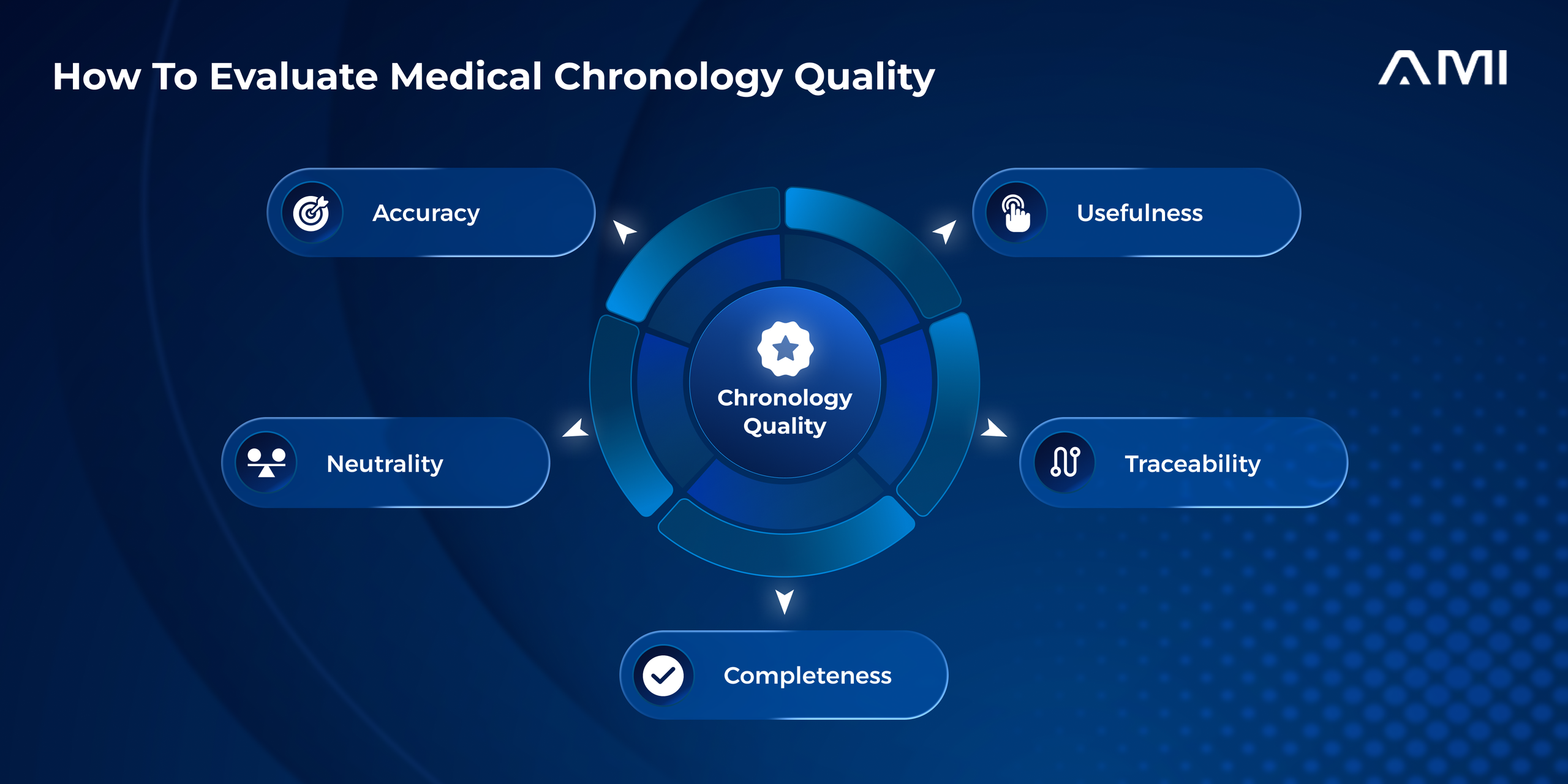
Source references should allow the attorney to verify entries quickly. Duplicates should be handled consistently, and missing-record concerns should be flagged rather than silently ignored.
Most importantly, the chronology should help answer the legal team’s review questions. A technically accurate timeline can still be low value when it is difficult to navigate or filled with detail unrelated to the case.
Red Flags in Low-Quality Chronologies
A chronology may be lengthy yet still fail to support meaningful review.
Common warning signs include copied blocks of record text, missing source references, inconsistent provider names, unclear medical abbreviations, buried diagnostic findings, and no distinction between important events and routine repetitions.
Other problems include failing to identify treatment gaps, combining different patients or providers, omitting key procedures, or treating contradictory documentation as though it were consistent.
A chronology should reduce complexity. When the attorney must repeatedly return to the raw records merely to understand the chronology, the deliverable has not done enough analytical organization.
Where AI Can Support Chronology Workflows
AI-assisted tools can help process high record volumes by organizing documents, recognizing dates, clustering records by provider, identifying duplicate pages, and surfacing possible timeline events.
They may also support indexing, initial categorization, and the detection of recurring diagnoses or treatment terms.
However, medical records contain conflicting notes, abbreviations, copied-forward language, unrelated conditions, and context that may change the meaning of an entry. AI should not independently determine medical relevance, causation, legal significance, or final chronology quality.
The strongest model uses AI to reduce repetitive document handling while trained reviewers validate the medical facts, select case-relevant events, preserve neutral wording, and complete final QA.
Why Human Review Still Matters
Human review is essential because chronology preparation involves judgment as well as extraction.
The reviewer must distinguish a new diagnosis from a repeated problem-list entry, identify whether an event reflects progression or routine follow-up, and understand when a prior condition may be relevant to the current matter.
Reviewers must also recognize contradictions, unclear chronology, missing context, and references to records not included in the file.
Experienced human oversight helps ensure the finished timeline is accurate, neutral, readable, and useful to an attorney rather than merely comprehensive.
When Law Firms Should Outsource Chronology Work
Outsourcing may make sense when record volume delays attorney review, paralegals are spending substantial time building timelines, or cases involve multiple providers and complex treatment histories.
It may also help firms managing mass tort volume, inconsistent internal formats, growing chronology backlogs, or frequent demand for both timelines and narrative summaries.
The right support model should provide consistent formatting, source references, QA, secure document handling, missing-record visibility, and predictable workflow reporting.
Outsourcing should improve legal-team control over the record set, not turn chronology preparation into another black-box process.
How AM InfoWeb Supports Medical Chronology Workflows
AM InfoWeb supports law firms with medical chronology services for law firms designed to turn complex records into clear, attorney-ready timelines.
With trained litigation support teams, connected retrieval workflows, source-level review, quality controls, secure document handling, and reporting discipline, AM InfoWeb helps attorneys and paralegals understand the medical facts with greater structure and confidence.
AM InfoWeb support may include:
- Medical chronology preparation and treatment timeline development
- Medical summaries and narrative review support
- Medical record retrieval services
- Legal record retrieval workflows
- Provider and facility record organization
- Missing-record and treatment-gap flagging
- Duplicate and unreadable file identification
- Source-referenced chronology entries
- QA checks for accuracy, neutrality, and completeness
- Secure document handling
- Litigation support services alignment
- Attorney-ready case review support
Need clearer medical timelines without adding attorney review burden? AM InfoWeb combines chronology preparation, retrieval visibility, medical summaries, QA, and secure handling in one litigation-ready workflow.
Get in TouchFinal Thoughts
Raw records provide evidence, but they do not automatically provide clarity. Medical chronology services for law firms turn complex documentation into structured, source-referenced timelines that support faster review, better damages analysis, expert preparation, and more confident litigation decisions.
Frequently Asked Questions
About the Author

Written by
Urza Dey
Urza Dey is a content and copywriter with over five years of experience across marketing, B2B SaaS, HealthTech, EdTech, and related industries. At AMI, they contribute to content strategy, blog development, and marketing communication focused on healthcare operations, business process management, and AI-enabled service delivery.