
Certified Medical Records: Why Authentication Matters in Legal Cases
TL;DR: Certified Medical Records
Certification connects a medical-record production to an identified provider and recordkeeping process.
Authentication, business-record foundations, completeness, and admissibility are related but distinct questions.
Federal and state requirements may use different certification language and procedures.
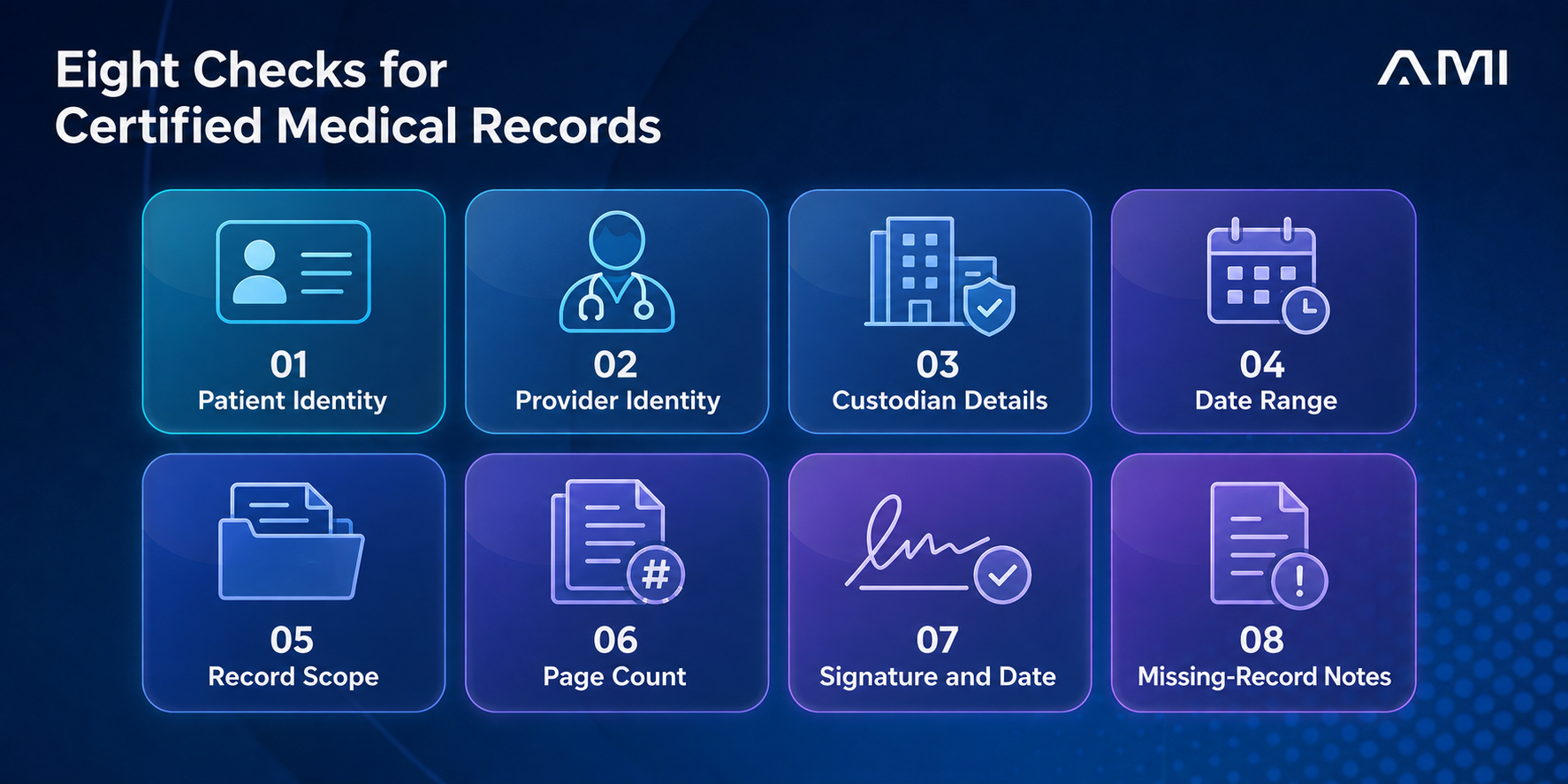
Legal teams should compare the certificate with patient, provider, date range, page count, and produced files.
Certification defects and incomplete productions should be resolved before deposition or trial preparation.
Structured retrieval, custodian follow-up, reconciliation, and source tracking improve litigation readiness.
Certified medical records can help legal teams establish where healthcare documents came from and whether the production represents records maintained by the provider. Certification does not prove that every clinical statement is correct or that every document will be admitted. It provides evidence about record custody, creation, and maintenance that may support authentication.
That distinction matters when records influence causation, damages, treatment history, or expert review. A complete production without usable certification may require additional foundation work. A certificate attached to an incomplete production can be equally problematic.
This guide explains medical records certification, the role of the records custodian, and the checks attorneys should complete before relying on certified copies. It provides general information, not legal advice. Applicable federal, state, court, and procedural requirements should be confirmed by counsel.
Need structured support across healthcare and legal workflows? Explore AM InfoWeb's healthcare services.
What Are Certified Medical Records?
Certified medical records are copies accompanied by a statement from a records custodian or another qualified person about the way the records were created and maintained. The exact certificate, affidavit, declaration, or seal required depends on the jurisdiction, proceeding, requesting party, and provider.
Certification commonly addresses whether the records were made at or near the time of the documented activity, kept during regularly conducted operations, and created as part of the organization's regular practice. The certificate may also identify the provider, patient, date range, page count, and custodian.
The phrase “certified copy of medical records” should not be treated as one universal format. Legal teams should confirm the governing rule and the language required for their matter.
Why Does Authentication Matter in Legal Cases?
Authentication asks whether evidence is what its proponent claims it is. Federal Rule of Evidence 901 describes the general requirement for producing evidence sufficient to support that finding.
Medical records can also raise hearsay questions. Federal Rule of Evidence 803(6) describes conditions for records of a regularly conducted activity, including testimony from a custodian or another qualified witness, or a permitted certification.
Certification can reduce the need to call a live custodian for foundation in some circumstances, but it does not resolve relevance, completeness, privilege, redaction, expert interpretation, or every admissibility issue.
What Does a Medical Records Certification Usually Include?
Requirements vary, but a practical review should look for:
- Provider or facility name
- Patient name or another reliable identifier
- Records custodian or qualified declarant
- Statement describing regular recordkeeping practices
- Applicable date range or scope
- Confirmation that the copies are true and complete
- Signature and execution date
- Required notarization, declaration language, or seal
- Page count or production identifier when used
- Explanation when responsive records do not exist
The legal team should compare the certificate with the production rather than reviewing it in isolation.
How Do Federal Evidence Rules Address Certified Records?
Federal Rule of Evidence 902(11) addresses certified domestic records of a regularly conducted activity. The certification must show that the record meets specified conditions in Rule 803(6), and the proponent must provide reasonable written notice and make the record and certification available for inspection.
Rules 902(13) and 902(14) address certain records generated by electronic systems and data copied from electronic devices, storage media, or files. These provisions may matter when the production includes electronic exports, audit evidence, or other system-generated material.
State evidence codes and procedural requirements may differ. Federal certification language should not be copied automatically into every state-court matter.
How Should Legal Teams Verify a Certified Production?
Certification review should be part of a broader quality-control process.
| Review Area | Question to Ask |
|---|---|
| Identity | Does the certificate identify the correct patient and provider? |
| Scope | Does the stated date range match the requested and produced records? |
| Custody | Is the signer identified as a custodian or qualified person? |
| Completeness | Are referenced encounters, reports, attachments, and billing records present? |
| Page control | Does the page count or production identifier reconcile? |
| Execution | Are signatures, dates, declarations, seals, or notarization present when required? |
| Exceptions | Does the provider explain missing, unavailable, or excluded records? |
| Traceability | Can each file be connected to its source and request history? |
The team should flag discrepancies immediately. Waiting until deposition or trial preparation can make re-retrieval difficult.
What Is the Records Custodian’s Role?
A records custodian manages or understands the organization's recordkeeping practices and may provide certification or foundation testimony. The person does not necessarily need personal knowledge of the patient's treatment. The relevant issue is often knowledge of how the organization creates, maintains, and retrieves records.
Custodian responsibilities can include locating responsive sources, confirming ordinary recordkeeping practices, supervising production, executing the certificate, and explaining why expected records are unavailable.
A request should identify whether certification is required at the beginning. Obtaining records first and requesting a certificate later can create another follow-up cycle.
Are Certified Medical Records Automatically Admissible?
No. Certification can support authenticity and a business-record foundation, but admissibility remains a legal determination. A court may still consider relevance, hearsay within hearsay, privilege, undue prejudice, reliability, notice, and compliance with procedural rules.
Patient-reported history inside a clinical note may require separate analysis from the provider's recordkeeping. A certified record can accurately reproduce a statement without establishing that the statement itself is true.
Counsel should evaluate the rules and facts of the case. Operational teams should focus on retrieving complete, traceable, properly certified productions.
What Problems Make Certification Unreliable or Unusable?
Common problems include:
- Certificate names a different provider or patient
- Date range differs from the production
- Signature or execution date is missing
- Certificate does not address required recordkeeping elements
- Page count does not match the files
- Billing, imaging, or outside-provider records are absent
- Multiple facilities are combined under one unclear certificate
- Electronic records lose source or export information
- The production contains unexplained gaps or duplicates
These defects do not always invalidate a production, but they should be assessed and resolved before the records become central to case strategy.
Need consistent retrieval, certification follow-up, and production controls? Explore AM InfoWeb's litigation support services.

Why does record retrieval become difficult to control at scale?
Delays, follow-ups, provider coordination, and documentation gaps can slow down litigation support workflows. AM InfoWeb helps legal and healthcare teams manage record retrieval with structured processes, experienced teams, and clear operational visibility.
How Can Attorneys Request Certification More Effectively?
Specify the patient, provider, location, date range, record types, acceptable format, deadline, and required certification language. Separate clinical records, billing records, imaging, pharmacy records, and outside-provider material when different custodians or systems may control them.
Maintain a request log showing authorization, service, acknowledgment, follow-ups, fees, delivery, certification, and unresolved gaps. The workflow described in attorney requests for medical records can help reduce avoidable retrieval delays.
After delivery, reconcile the production against the request and certificate. Do not assume a signed form establishes completeness.
How AM InfoWeb Supports Certified Record Retrieval
AM InfoWeb supports legal and healthcare teams with structured record retrieval, provider follow-up, production review, certification tracking, and operational reporting.
With two decades of experience in the U.S. healthcare industry, AM InfoWeb uses a co-managed model that brings AI agents and skilled human agents together to eliminate process bottlenecks and execute secure healthcare workflows.
AM InfoWeb can support:
- Request intake and authorization review
- Provider identification and outreach
- Certification requirement tracking
- Records custodian follow-up
- Production and page-count reconciliation
- Duplicate and missing-record identification
- Secure file organization and delivery
- Status reporting and escalation
The legal team retains responsibility for legal interpretation, admissibility decisions, deadlines, and case strategy. Co-managed support helps make the underlying retrieval workflow more consistent and visible. Related guidance explains why complete medical records matter in retrieval and how a medical chronology template supports traceable review.
What Should Legal Teams Remember About Certification?
Certified medical records are useful because they connect a production to an identified provider and documented recordkeeping process. They do not replace completeness checks or legal analysis.
Request the right certification at the beginning, verify it against the delivered files, resolve inconsistencies early, and preserve the request history. These controls give attorneys a more reliable evidentiary foundation for review, negotiation, expert analysis, and litigation.
Need more reliable certified-record retrieval? AM InfoWeb combines experienced teams, structured provider follow-up, certification tracking, QA, and secure delivery to strengthen litigation support workflows.
Get in TouchFrequently Asked Questions
About the Author

Written by
Urza Dey
Urza Dey is a content and copywriter with over five years of experience across marketing, B2B SaaS, HealthTech, EdTech, and related industries. At AMI, they contribute to content strategy, blog development, and marketing communication focused on healthcare operations, business process management, and AI-enabled service delivery.