
Medical Record Indexing: Organize Complex Files for Faster Review
TL;DR: Medical Record Indexing
Medical record indexing creates a navigable inventory of providers, documents, dates, files, and page ranges.
An index maps evidence, while a chronology orders events and a summary synthesizes selected information.
Controlled document types and standardized provider names make large productions easier to search.
Stable Bates ranges protect citations when files are split, combined, or reviewed by different parties.
Duplicates should be flagged without silently removing source material or meaningful versions.
AI-assisted classification works best with skilled human validation, exception handling, and field-level QA.
Medical record indexing turns a large, disordered production into a navigable case file. Instead of searching page by page, attorneys and reviewers can locate providers, encounters, record types, date ranges, and source pages through a structured index.
An index is not a medical chronology or narrative summary. It tells the reviewer what documents exist and where to find them. A chronology explains events over time, while a summary synthesizes selected information. Each deliverable answers a different question.
This guide explains how to design a medical records index, organize source files, control duplicates, and connect every entry to the original production.
Need structured support across healthcare and legal workflows? Explore AM InfoWeb's healthcare services.
What Is Medical Record Indexing?
Medical record indexing is the process of identifying, classifying, and listing documents in a medical-record production. The index usually captures provider, facility, record type, service date or date range, file name, page range, and a concise neutral description.
The index functions as a map. It should help a reviewer answer: Which providers are represented? What time periods are covered? Where are operative reports, imaging results, therapy notes, billing records, or correspondence located?
Indexing may be performed at the file, document, encounter, or section level. The right level depends on volume, case complexity, review purpose, deadline, and budget.
How Is an Index Different From a Chronology?
An index organizes documents by source and location. A chronology organizes events by date. A medical summary condenses and interprets clinically relevant information within an authorized scope.
| Deliverable | Primary Question | Typical Fields |
|---|---|---|
| Record index | What is in the production and where? | Provider, document type, date range, Bates range, file |
| Medical chronology | What happened and in what order? | Date, provider, event, finding, treatment, source page |
| Medical summary | What information matters to the review? | Issues, history, findings, treatment, outcomes, limitations |
Legal teams may use all three. The index creates navigation and inventory control, the chronology creates temporal structure, and the summary supports focused understanding.
Which Fields Belong in a Medical Records Index?
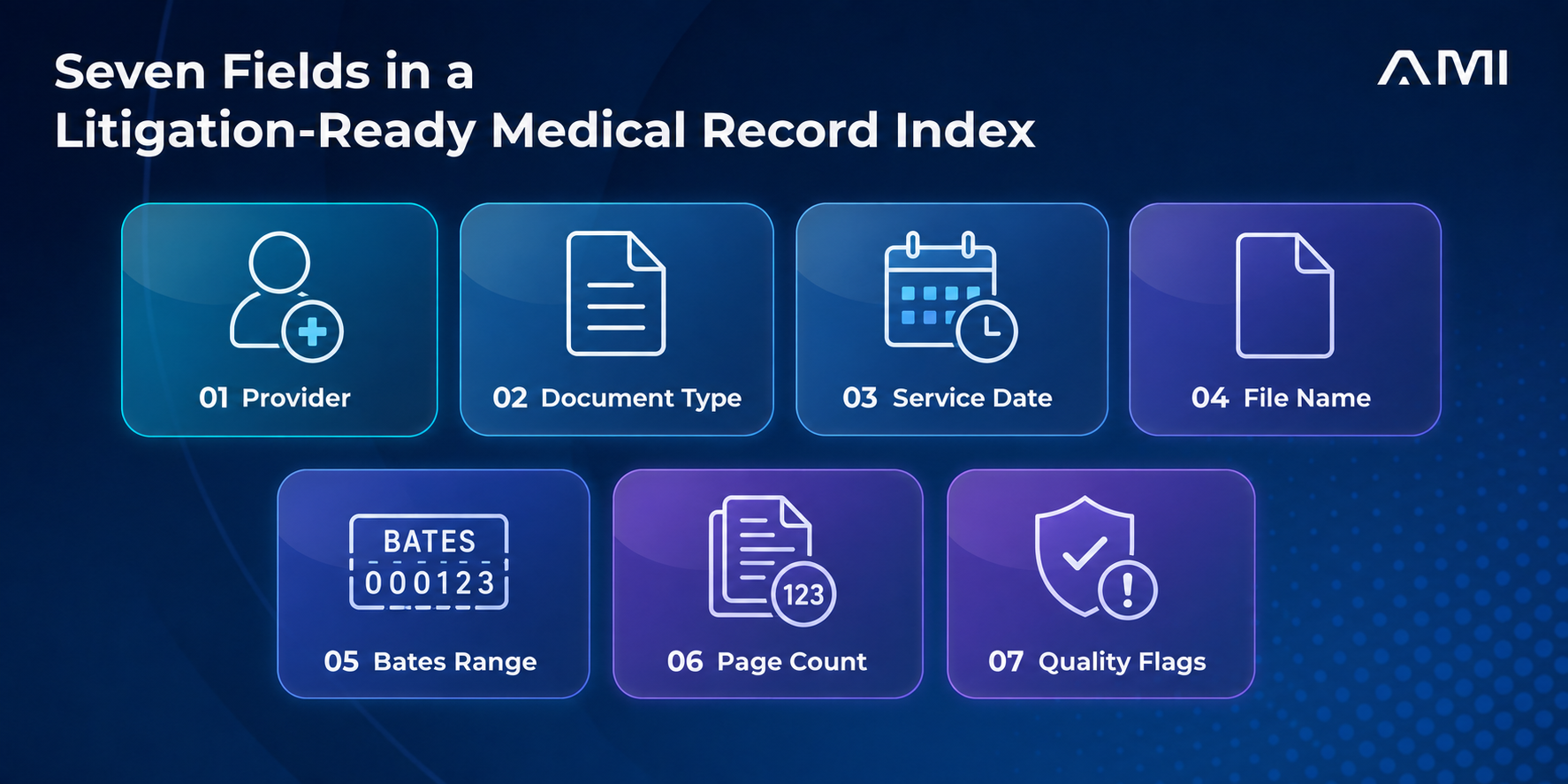
A practical index may include:
- Sequential index number
- Patient or matter identifier
- Provider and facility
- Specialty or department
- Document type
- Service date or date range
- Original filename
- Bates or production range
- Page count
- Duplicate status
- Confidentiality or restriction flag
- Notes about legibility, missing pages, or attachments
Use a data dictionary so every reviewer applies the fields consistently. Avoid vague descriptions such as “medical file” when a more useful classification is available.
How Should Record Types Be Classified?
Create a controlled list that reflects the matter. Common types include emergency notes, history and physical, progress notes, operative reports, consultations, imaging reports, laboratory results, pathology, therapy notes, medication records, discharge summaries, billing records, claim forms, and correspondence.
Classification should be specific enough to help reviewers but not so granular that similar documents receive inconsistent labels. Establish naming rules before production-scale indexing begins.
When a file contains several document types, index meaningful sections separately if that improves navigation. Preserve the connection to the original file and page range.
How Should Providers and Facilities Be Standardized?
The same organization may appear under a legal name, brand, abbreviation, department, or acquired practice name. Without normalization, one provider can appear as several unrelated sources.
Maintain the source name exactly as shown and add a standardized display name. Separate facility, rendering provider, referring provider, and outside provider when those distinctions matter.
Provider normalization also helps identify missing sources. A specialist referenced repeatedly in one facility's records may signal an additional retrieval target.
How Should Bates Numbers and Page Ranges Be Used?
Bates numbers create stable page identifiers across a production. The index should record the precise range associated with each document or section. If the production already has Bates labels, preserve them. If labels are added for a working set, maintain a clear crosswalk to the original source.
Do not rely only on PDF page numbers. Files can be split, combined, or reordered, causing native page numbers to change. Stable production identifiers protect citations across review, deposition, expert analysis, and briefing.
If pages are unnumbered or duplicated, document the issue and the chosen control method.
How Should Duplicate and Near-Duplicate Records Be Handled?
Exact duplicates can inflate page counts and waste review time. Near-duplicates may contain different signatures, annotations, attachments, or later corrections. Do not delete records from the source production silently.
Use hashing or comparison tools to identify likely duplicates, then apply human review when differences may matter. Mark duplicate relationships in the index and maintain one preserved source set.
The index should distinguish duplicate, possible duplicate, and versioned document. That distinction protects potentially meaningful differences.
What Quality Checks Make an Index Reliable?
Quality assurance should test:
- Every source file is represented
- Page ranges are valid and non-overlapping where expected
- Provider and document labels follow the data dictionary
- Dates match the source
- Page counts reconcile
- Duplicate flags are consistent
- Illegible and missing pages are identified
- Hyperlinks or navigation aids work
- Restricted or sensitive material is routed correctly
- Index entries point to the correct documents
Sample-based QA may be appropriate for stable work, while high-risk productions may need complete validation. The index should include version and completion information.
Need scalable indexing, retrieval, and production control? Explore AM InfoWeb's litigation support services.

Why does record retrieval become difficult to control at scale?
Delays, follow-ups, provider coordination, and documentation gaps can slow down litigation support workflows. AM InfoWeb helps legal and healthcare teams manage record retrieval with structured processes, experienced teams, and clear operational visibility.
Can AI Improve Medical Record Indexing?
AI can assist with document classification, date extraction, provider recognition, duplicate detection, and suggested boundaries. It can accelerate repetitive work across high-volume files.
Human reviewers remain important for ambiguous dates, mixed documents, handwriting, unusual formats, conflicting provider names, and clinically similar records. The most reliable model combines automated classification with defined human validation and exception handling.
Measure accuracy by field, not only by documents processed. A fast index that points to the wrong page creates more work downstream.
How AM InfoWeb Supports Medical Record Indexing
AM InfoWeb supports legal and healthcare teams with structured medical record retrieval, indexing, organization, quality assurance, and status reporting.
With two decades of experience in the U.S. healthcare industry, AM InfoWeb uses a co-managed model that brings AI agents and skilled human agents together to eliminate process bottlenecks and execute secure healthcare workflows.
AM InfoWeb can support:
- Source-file inventory and reconciliation
- Provider and facility normalization
- Document-type classification
- Service-date and date-range capture
- Bates-range indexing
- Duplicate and version identification
- Missing-page and quality flags
- Secure delivery and operational reporting
Legal teams retain control over privilege, relevance, production decisions, and case strategy. Co-managed workflows combine automation with skilled review for greater consistency. See how indexing supports medical records summarization services, a litigation-ready medical chronology, and more complete medical record retrieval.
What Makes a Medical Record Index Litigation-Ready?
A litigation-ready index is complete, neutral, consistent, traceable, and easy to navigate. It uses controlled labels, stable page identifiers, standardized providers, clear duplicate handling, and documented QA.
The index should shorten the distance between a legal question and its source evidence. When reviewers can move directly from an entry to the correct page, the file becomes easier to analyze, cite, share with authorized experts, and use throughout litigation.
Need a clearer map of complex medical files? AM InfoWeb combines AI-assisted classification, skilled human review, indexing standards, QA, and secure delivery for litigation-ready organization.
Get in TouchFrequently Asked Questions
About the Author

Written by
Urza Dey
Urza Dey is a content and copywriter with over five years of experience across marketing, B2B SaaS, HealthTech, EdTech, and related industries. At AMI, they contribute to content strategy, blog development, and marketing communication focused on healthcare operations, business process management, and AI-enabled service delivery.