

Medical Record Retrieval Services: Complete Records Matter More
TL;DR — Retrieval Quality Depends on Completeness
Fast delivery does not help when provider responses are partial or important record categories are missing.
Complete records should match the client, provider, facility, requested date range, record type, and case need.
Medical record retrieval for law firms requires authorization review, provider follow-up, fee tracking, QA, secure handling, and status visibility.
Electronic medical records retrieval can improve speed and tracking, but digital files still require completeness review.
Missing records can weaken chronology development, damages analysis, expert review, demand drafting, and litigation strategy.
The best retrieval partners distinguish partial responses from complete fulfillment and keep following up until the request reaches a documented resolution.
AM InfoWeb supports law firms with provider coordination, electronic retrieval, QA, missing-record visibility, secure handling, and case-ready organization.
Fast medical record retrieval services sound attractive to every law firm. But speed has limited value when the records arrive incomplete, duplicated, disorganized, outside the requested date range, or without the billing information needed for damages review. Attorneys and paralegals do not simply need documents quickly. They need a reliable record set that can support case evaluation, demand preparation, medical chronology, expert review, settlement strategy, discovery, and trial preparation.
Turnaround still matters, especially when legal deadlines are approaching. The stronger measure of retrieval quality, however, is whether the right records arrive, whether gaps are identified, and whether the final files are organized well enough for the litigation team to use without repeating the retrieval process.
Why Speed Alone Is the Wrong Retrieval Measure
Turnaround time is important, but it should not be the only way a law firm evaluates medical record retrieval services.
A vendor may deliver one provider response quickly while leaving related facilities, billing departments, imaging centers, or treatment periods unresolved. The request may appear complete in a dashboard even though the provider supplied only part of the authorized date range.
This creates a false sense of progress. Attorneys may begin reviewing the file without knowing that important records remain outstanding. Paralegals may later discover that billing statements were never requested or that a hospital response excluded physician-group records.
A stronger retrieval model balances speed with request accuracy, provider coverage, follow-up discipline, completeness review, and transparent reporting.
What Complete Medical Records Mean for a Law Firm
From a legal operations perspective, “complete” does not always mean obtaining every document a provider has ever created. It means that the response aligns with the authorized and requested scope of the matter.
The files should belong to the correct client, come from the intended provider or facility, cover the relevant dates, and include the requested categories. Depending on the case, this may involve clinical notes, diagnostic reports, imaging, operative records, therapy notes, discharge documentation, prescriptions, billing records, or itemized statements.
Completeness should also be visible. The legal team should know which providers responded, which record categories arrived, which requests remain open, and whether any gaps require further action.
Why Incomplete Records Create Litigation Risk
Missing medical information can affect both case assessment and strategy.
A treatment gap may appear longer than it actually was because records from one provider are absent. A prior injury may be missed. Damages may be understated when billing records or itemized statements are missing. An expert may begin review without the complete treatment history.
Incomplete files also create downstream rework. Chronology teams may need to revise timelines after additional records arrive. Attorneys may review the same treatment period multiple times. Demand preparation may pause while paralegals reopen requests that had been marked complete.
The issue is not simply administrative inconvenience. Incomplete records can weaken the legal team’s understanding of causation, treatment progression, damages, and case value.
Where Medical Records Usually Become Incomplete
Record gaps can begin before a request is submitted. The provider list may omit a specialist, imaging center, or separate billing entity. Client identifiers may not match the facility’s records. The authorization may describe the record scope too broadly or too narrowly.
Providers may also return partial responses. A hospital may send facility records but not physician-group records. A clinic may provide clinical notes without billing documents. A portal download may omit attachments, imaging, or older scanned files.
Other gaps occur when no one reviews the response before closure. Duplicate files remain in the package, unreadable pages go unflagged, and missing dates are not compared with the original request.
Completeness therefore depends on preparation, follow-up, and QA rather than the provider response alone.
Medical Record Retrieval for Law Firms Requires Active Management
Medical record retrieval for law firms involves much more than sending a request letter and waiting for records.
A controlled workflow begins with provider and authorization validation. It continues through submission, custodian communication, fee handling, follow-up, electronic delivery, completeness review, organization, and final reporting.
Each request should have a visible status and next action. The legal team should know whether it is awaiting provider processing, authorization correction, fee approval, partial-response follow-up, QA, or attorney delivery.
Submitting the request starts retrieval. Managing the request through a complete or clearly documented outcome is what makes the process useful to a law firm.
How Provider Follow-Up Improves Record Completeness
Provider follow-up is one of the clearest differences between passive request submission and active legal record retrieval.
Requests may be redirected to another department, rejected for missing information, held for a fee, or fulfilled only partially. Without structured follow-up, these issues can remain unresolved while the request continues to age.
A disciplined team records every provider response, identifies the reason for delay, assigns the next action, and escalates requests that remain stalled. Follow-up should reflect the issue involved, whether that is no response, rejected authorization, pending payment, partial fulfillment, missing billing records, or custodian clarification.
This prevents law firms from learning about missing information only after an attorney begins case review.
Why Authorization Accuracy Matters Before Retrieval
Incomplete or inaccurate authorization can delay the request or limit what a provider releases.
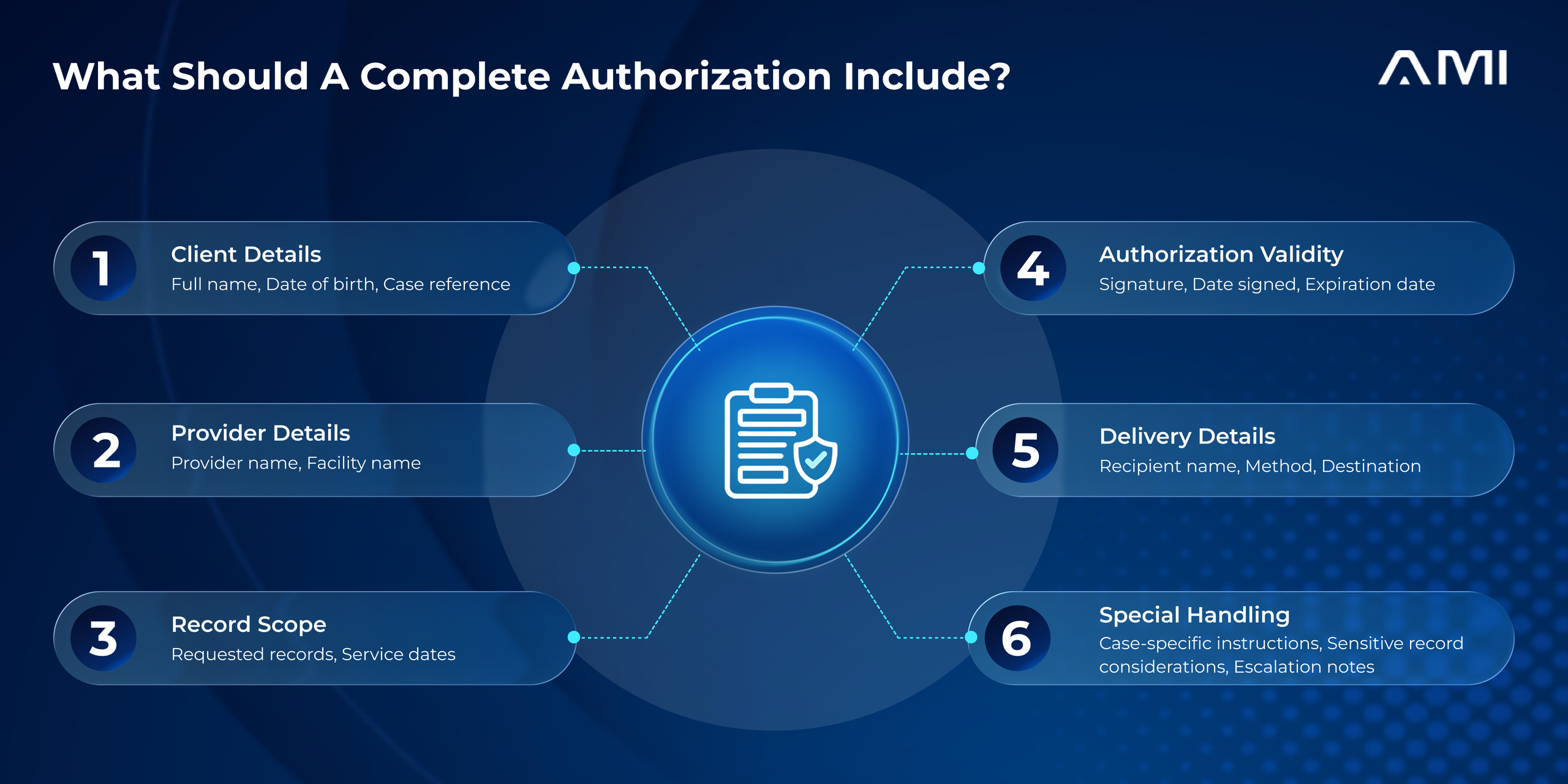
HHS identifies core authorization elements that include a meaningful description of the information, identification of the person authorized to disclose it, the intended recipient, and an expiration date or event. The form should also align with the specific request being submitted.
Before submission, the retrieval team should confirm:
- Client name, date of birth, provider, facility, and case reference
- Medical and billing record categories requested
- Relevant treatment or service dates
- Signature, date signed, and expiration date or event
- Recipient and delivery information
- Special instructions or handling requirements
This review reduces rejection cycles and helps ensure that the provider understands precisely what the law firm is requesting.
Electronic Medical Records Retrieval Still Requires QA
Electronic medical records retrieval can improve delivery speed, reduce paper handling, and make request activity easier to track.
Records may arrive through provider portals, secure file transfers, encrypted links, or digital request platforms. However, electronic delivery does not guarantee a complete or accurate response.
Digital files may still be duplicated, mislabeled, unreadable, fragmented across downloads, or missing attachments. A portal may provide one record category while excluding billing records or older documents stored elsewhere.
Technology improves how records move. Human review is still needed to determine whether the received material fulfills the legal team’s request.
What QA Should Check Before Attorney Delivery
QA should occur before a record package is treated as complete and handed to the attorney.
A practical review should confirm:
- Correct client, provider, facility, and requested date range
- Medical and billing records separated where applicable
- Partial responses and missing record categories identified
- Duplicate, unreadable, or wrong-patient files flagged
- Files organized by provider, date, or record type
- Status updated accurately before closure
QA should also compare the received set with the original request. A clean, readable package can still be incomplete when it does not contain the authorized treatment period or expected record categories.
How Complete Records Improve Chronologies and Summaries
Medical chronologies, summaries, demand packages, expert packets, and damages reviews are only as reliable as the records supporting them.
When retrieval is incomplete, chronology teams may miss treatment events or misinterpret gaps in care. Summary writers may not have enough context to explain treatment progression. Experts may need supplemental material after review has already started.
Complete and organized records reduce this downstream rework. They give litigation-support teams a more reliable source set and help attorneys understand whether the case file is ready for substantive review.
How Law Firms Should Compare Medical Record Retrieval Companies
Law firms should compare medical record retrieval companies based on how they manage the full request lifecycle, not only the turnaround time quoted during sales discussions.
The evaluation should examine legal-industry experience, authorization review, provider follow-up, electronic retrieval, completeness checks, status reporting, security, billing transparency, and litigation-support alignment.
When comparing medical records retrieval companies for lawyers, ask the vendor to walk through a real request from intake to attorney delivery. The explanation should show how the team handles rejection, provider fees, partial responses, missing billing records, duplicate files, aging requests, and final QA.
This reveals whether the vendor actively manages retrieval or simply submits requests and waits.
What the Best Medical Record Retrieval Services Have in Common
The best medical record retrieval services balance speed with accuracy, visibility, and case readiness.
They prepare requests carefully, follow up consistently, distinguish partial responses from complete fulfillment, and give legal teams clear status information. They can handle electronic delivery while still applying human QA and secure document controls.
They also understand that the final product is not a stack of files. It is an organized record set that attorneys, paralegals, chronology teams, and experts can use with confidence.

Why does record retrieval become difficult to control at scale?
Delays, follow-ups, provider coordination, and documentation gaps can slow down litigation support workflows. AM InfoWeb helps legal and healthcare teams manage record retrieval with structured processes, experienced teams, and clear operational visibility.
Red Flags That a Vendor Is Too Speed-Focused
Be cautious when a vendor promises unusually fast retrieval but cannot explain its completeness checks, provider follow-up cadence, or definition of a closed request.
Other warning signs include no billing-record tracking, limited status visibility, no partial-response flagging, unclear escalation procedures, weak security explanations, and requests being closed as soon as any document arrives.
Speed-focused reporting may make performance look strong while shifting the burden of finding missing records back to the law firm.
How AM InfoWeb Supports Medical Record Retrieval
AM InfoWeb supports law firms with retrieval workflows designed to improve record completeness, provider follow-up, request accuracy, and case visibility.
With trained legal support teams, authorization review support, secure document handling, electronic medical records retrieval, QA, and reporting discipline, AM InfoWeb helps attorneys and paralegals move beyond fast retrieval toward organized, case-ready records.
AM InfoWeb support may include:
- Medical record retrieval services and legal record retrieval
- Medical record retrieval for law firms
- Provider and custodian follow-up
- Authorization review workflow support
- Medical and billing record request processing
- Electronic retrieval and secure document handling
- Completeness checks and partial-response identification
- Missing, duplicate, and unreadable record flagging
- Status tracking and aging-request reporting
- Medical chronology, summary, and litigation-support alignment
When a retrieval partner handles PHI on behalf of a covered entity or another business associate, its role may also bring HIPAA business-associate responsibilities and safeguards into the workflow.
Need complete records without losing turnaround visibility? AM InfoWeb’s litigation-ready retrieval workflows combine provider follow-up, electronic delivery, QA, secure handling, and missing-record tracking.
Get in TouchFinal Thoughts
Speed matters when legal teams are working against case deadlines, but it cannot compensate for missing treatment periods, absent billing records, partial provider responses, or disorganized files. Effective medical record retrieval services balance turnaround with provider follow-up, completeness checks, secure handling, QA, and attorney-ready organization so the final record set supports the case rather than creating more work.
Frequently Asked Questions
About the Author

Written by
Urza Dey
Urza Dey is a content and copywriter with over five years of experience across marketing, B2B SaaS, HealthTech, EdTech, and related industries. At AMI, they contribute to content strategy, blog development, and marketing communication focused on healthcare operations, business process management, and AI-enabled service delivery.