
What Is the Standard for Accessing Patient Information?
TL;DR — Patient Information Access Should Follow a Need-to-Know Standard
Healthcare staff should access patient information only when their role and assigned task require it.
HIPAA’s Minimum Necessary Rule requires reasonable efforts to limit PHI use, disclosure, and requests to what is needed for the intended purpose.
Minimum necessary does not mean blocking legitimate treatment, payment, healthcare operations, or patient access.
Patients generally have rights over their own health information, while workforce access should be based on job responsibilities.
Medical record releases require requester verification, appropriate authority, record-scope review, secure delivery, and documentation.
Role-based access, authorization checks, escalation rules, QA, and access audits help protect the confidentiality of patient records.
AMI supports co-managed Release of Information workflows with PHI-aware processing, requester verification, QA, and operational visibility.
The direct answer to what is the standard for accessing patient information is that healthcare workforce members should access only the information needed for an approved role, task, or purpose. Under HIPAA, this is commonly described through the Minimum Necessary Rule.
The goal is not to block legitimate healthcare work. It is to prevent patient information from being viewed, requested, used, or disclosed more broadly than the task requires. This matters across clinical support, billing, claims, audits, patient communication, and medical record release workflows.
Important clarification: People sometimes search for the Health Information Privacy Act, but HIPAA stands for the Health Insurance Portability and Accountability Act. The relevant requirement here comes primarily from the HIPAA Privacy Rule, which establishes national standards for protecting medical records and other individually identifiable health information.
What Is the Standard for Accessing Patient Information?
In practical terms, the standard is to give the right person access to the right information for the right purpose.
Healthcare workforce members should not access a patient’s full record simply because the system allows it. Their access should align with their role and the work they are performing. For example, a scheduling employee may need appointment and contact details, while a billing employee may need claim, insurance, and payment information.
This standard affects more than system permissions. It applies when staff open patient charts, respond to calls, review claims, process medical record requests, complete audits, or disclose information to outside parties.
What Is HIPAA’s Minimum Necessary Rule?
The Minimum Necessary Rule generally requires covered entities to make reasonable efforts to limit their uses, disclosures, and requests for protected health information to the minimum needed to accomplish the intended purpose.
The rule is designed to be flexible. It does not require every employee to make an entirely new legal judgment each time information is accessed. Instead, healthcare organizations should build policies, role-based access rules, and standard workflows that limit unnecessary or inappropriate access.
A billing employee, for instance, may need information related to a claim but not unrelated clinical history. A scheduling team may need appointment information but not the patient’s complete diagnostic record.
Why Minimum Necessary Does Not Mean “No Access”
The Minimum Necessary Rule is about appropriate access, not preventing healthcare teams from doing their jobs.
Patient information can still be used or disclosed for permitted purposes such as treatment, payment, healthcare operations, patient access, and certain required or permitted disclosures. The operational objective is to limit access without disrupting legitimate work.
A useful way to apply the rule is:
Right person. Right information. Right purpose. Right documentation.
This helps organizations protect privacy while continuing to support care coordination, claims processing, patient requests, quality review, and other necessary healthcare functions.
When Does the Minimum Necessary Rule Apply?
The standard generally applies when a covered entity uses, discloses, or requests PHI.
In day-to-day healthcare operations, this may include internal employee access, payer documentation requests, administrative processing, quality reviews, medical record releases, and work performed by approved support teams.
Organizations should establish role-based policies that define which workforce members need access to particular categories of information. HHS guidance explains that access should be limited based on the roles of workforce members and the information they need to perform their jobs.
When Does Minimum Necessary Not Apply in the Same Way?
The rule includes situations where minimum necessary does not apply in the usual manner.
At a high level, these include disclosures to or requests by healthcare providers for treatment, disclosures to the individual who is the subject of the information, uses or disclosures made under a valid authorization, and disclosures required by law.
That does not mean every such request should move forward without review. Healthcare teams still need to confirm the request type, requester identity, patient match, applicable authority, and secure delivery process.
Unclear or exception-based cases should be escalated through the organization’s privacy, compliance, or legal review pathway.
How HIPAA and Patient Rights Work Together
The relationship between HIPAA and patient rights is important because HIPAA does more than restrict access. It also gives individuals rights over their own health information and sets limits on who can view or receive it.
Patients may request access to their medical records through the healthcare organization’s established process. The organization may still need to verify identity, document the request, locate the correct records, and deliver them securely.
Privacy protection should therefore support appropriate patient access rather than become an unnecessary barrier to it.
Patient Access Is Different From Internal Workforce Access
Patients generally have rights to see and obtain copies of their own health information. Internal workforce members, by contrast, should access records only when their job duties require it.
This distinction prevents organizations from treating a patient’s access request as though it were the same as an employee opening a chart.
Employees need a work-related reason and role-based permission. Patients follow a verified access process for their own information. Authorized personal representatives may also have access rights in appropriate circumstances, subject to verification and supporting documentation.
What Laws on Releasing Medical Records Mean Operationally
Discussions about laws on releasing medical records can become legal-heavy, but the operational principle is straightforward: healthcare organizations should not release records casually or simply because a requester asks persistently.
Before releasing records, teams should confirm:
- Requester identity, patient identity, purpose, and requester authority
- Role-based access, authorization where required, record scope, and minimum necessary where applicable
- Secure delivery method, disclosure documentation, and escalation for unclear requests
These checks help prevent wrong-recipient releases, over-disclosure, missing documentation, and inconsistent decision-making.
Common Mistakes That Weaken the Confidentiality of Patient Records
The confidentiality of patient records can be weakened by both system design and everyday behavior.
Common problems include broad system permissions, shared login credentials, accessing records out of curiosity, sending an entire record when only a subset is needed, weak requester verification, incomplete release documentation, and inconsistent escalation practices.
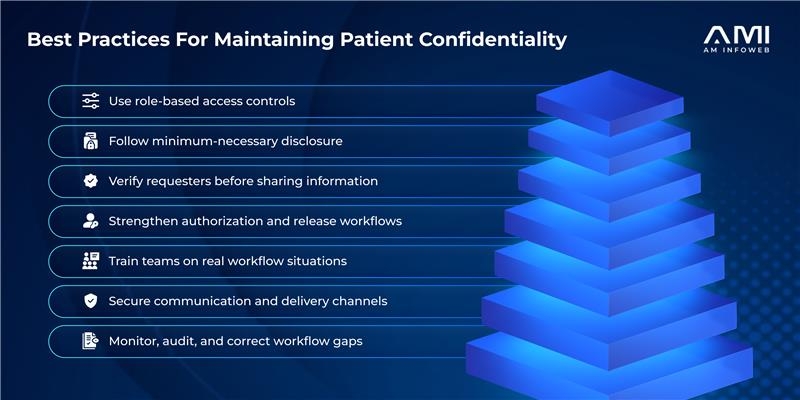
Healthcare organizations can reduce these risks through role-based access, standard request fields, authorization checklists, defined escalation triggers, QA reviews, workforce training, and regular access audits.
The goal is to make appropriate access part of the workflow rather than relying solely on individual caution.

How Release of Information Workflows Protect PHI Healthcare Data
In PHI healthcare workflows, Release of Information teams help determine whether records can be disclosed, which records fall within the approved scope, and how the disclosure should be completed.
A structured process connects requester verification, patient matching, authorization review, record retrieval, minimum-necessary review where applicable, secure delivery, and documentation.
This helps prevent medical record release from becoming an informal document-handling task. Every disclosure should follow an approved pathway and leave a traceable operational record.
Where AI Can Support Access Control and ROI Workflows
AI-assisted tools and services can help categorize requests, identify missing authorization fields, detect duplicate submissions, flag unusual request patterns, surface documentation gaps, and support QA sampling.
These tools can help teams identify cases that require attention, but AI should not independently decide whether someone may access sensitive information or whether medical records should be released.
Authorization interpretation, unclear requester authority, sensitive disclosures, and exception-based decisions still require trained human review.
Why Human Oversight Still Matters
Access and disclosure decisions frequently involve context that cannot be resolved through a simple rule.
A requester may appear legitimate but lack sufficient authority. A request may contain a valid authorization but seek information outside its scope. A legal request may require further review, or a patient may challenge an access or disclosure decision.
Human reviewers are needed to interpret policy, evaluate exceptions, communicate with requesters, manage escalations, and document final decisions.
How AMI Supports PHI-Aware Release of Information Workflows
AMI supports healthcare organizations with co-managed Release of Information workflows designed to strengthen PHI-aware request handling, authorization review, documentation quality, and operational visibility.
With trained healthcare operations teams, secure processes, requester communication support, QA checks, and reporting discipline, AMI helps leaders manage medical record release workflows while retaining oversight and control.
AMI support may include:
- PHI-aware records handling
- Release request intake and authorization review support
- Requester verification and medical record processing
- Role-based workflow discipline and requester communication
- QA checks, escalation support, and audit documentation
- Turnaround time, backlog visibility, and co-managed oversight
Need Stronger Control Over Patient Information Access? AMI supports co-managed Release of Information workflows built around PHI-aware handling, requester verification, authorization review, QA, documentation, and operational visibility.
Get in TouchFinal Thoughts
For teams asking what is the standard for accessing patient information, the practical answer is need-to-know access supported by role-based controls, approved purposes, appropriate disclosure review, and clear documentation. Applied consistently, this approach protects patient privacy without preventing legitimate care, payment, operations, patient access, or medical record release.
Frequently Asked Questions
About the Author

Written by
Urza Dey
Urza Dey is a content and copywriter with over five years of experience across marketing, B2B SaaS, HealthTech, EdTech, and related industries. At AMI, they contribute to content strategy, blog development, and marketing communication focused on healthcare operations, business process management, and AI-enabled service delivery.