

Release of Information Process: From Authorization to Secure Record Delivery
TL;DR — Release of Information Is an End-to-End Workflow
The release of information process begins with request intake and ends only after secure delivery, documentation, and closure.
Patient authorization should be reviewed for completeness, validity, requested scope, expiration terms, and delivery instructions.
Requester verification and accurate patient matching help prevent wrong-recipient and wrong-record disclosure.
PHI records should be prepared through controlled workflows with approved access, QA, escalation, and secure delivery.
Quality assurance should confirm authorization, requester details, patient identity, record scope, delivery method, and documentation before release.
Release of information support can improve capacity, consistency, backlog visibility, requester communication, and turnaround discipline.
Human oversight remains essential for unclear authorizations, sensitive information, unusual requesters, and exception-based decisions.
Medical records are not ready to be released simply because a request has arrived. Every request must move through a controlled workflow involving authorization review, requester verification, patient matching, record preparation, quality checks, documentation, and secure delivery. When healthcare organizations lack sufficient workflow capacity, incomplete forms, unclear requester details, incorrect date ranges, and fragmented records can quickly turn into backlogs, repeated follow-ups, and disclosure risk.
A reliable process connects every stage so that information moves accurately and securely from the initial request to documented closure. It also gives healthcare leaders visibility into where requests are delayed, why exceptions occur, and whether quality standards are being applied consistently.
What Is the Release of Information Process?
The release of information process is the controlled workflow used to review, prepare, document, and deliver medical records or protected health information to an authorized requester.
The workflow usually begins when a patient, provider, payer, attorney, copy service, auditor, or another approved party submits a request. It continues through authorization review, requester verification, patient identification, record retrieval, disclosure review, quality assurance, secure delivery, and closure.
Each step depends on the accuracy of the one before it. An incorrect patient identifier at intake can affect record matching later. A vague authorization can delay retrieval. An incomplete audit trail can create problems even when the correct records were delivered. For this reason, ROI should be managed as one connected process rather than a series of isolated administrative tasks.
What Operational Assistance Does the ROI Process Require?
Operational assistance in ROI helps healthcare organizations manage the steps involved in medical record disclosure workflows.
Support may include request intake, authorization review assistance, requester communication, record processing, patient matching, QA, backlog tracking, escalation coordination, delivery workflow support, and reporting. The purpose is not to transfer governance to an outside team. It is to add trained capacity and process consistency while the healthcare organization retains control over policies, exceptions, and oversight.
A strong support model should make the workflow easier to measure and manage. Leaders should be able to see how many requests are open, where they are delayed, which issues create rework, and whether releases are being completed accurately.
Why ROI Medical Records Workflows Need Structure
ROI medical records workflows involve patient access, provider communication, payer documentation, legal requests, audits, and other disclosure-sensitive activities. Each request may have different authorization requirements, record scopes, requester categories, and delivery instructions.
Without a structured process, teams may apply different standards to similar requests. One processor may escalate an unclear authorization while another proceeds. Requester updates may depend on who owns the case. Documentation may be complete in one system but missing in another.
Structure creates repeatability. It gives teams defined intake fields, review criteria, escalation triggers, QA requirements, and closure standards. It also helps prevent over-release, duplicate work, wrong-recipient errors, and untraceable decisions.
How the Release of Information Process Works Step by Step
The release of information workflow is best understood as a connected sequence rather than a series of isolated administrative tasks. Each step builds on the accuracy of the one before it, which means an intake error, incomplete authorization, mismatched patient record, or unclear requester detail can create delays later in the process. The following nine steps show how healthcare teams move a request from initial receipt through authorization review, PHI handling, quality assurance, secure delivery, and documented closure.
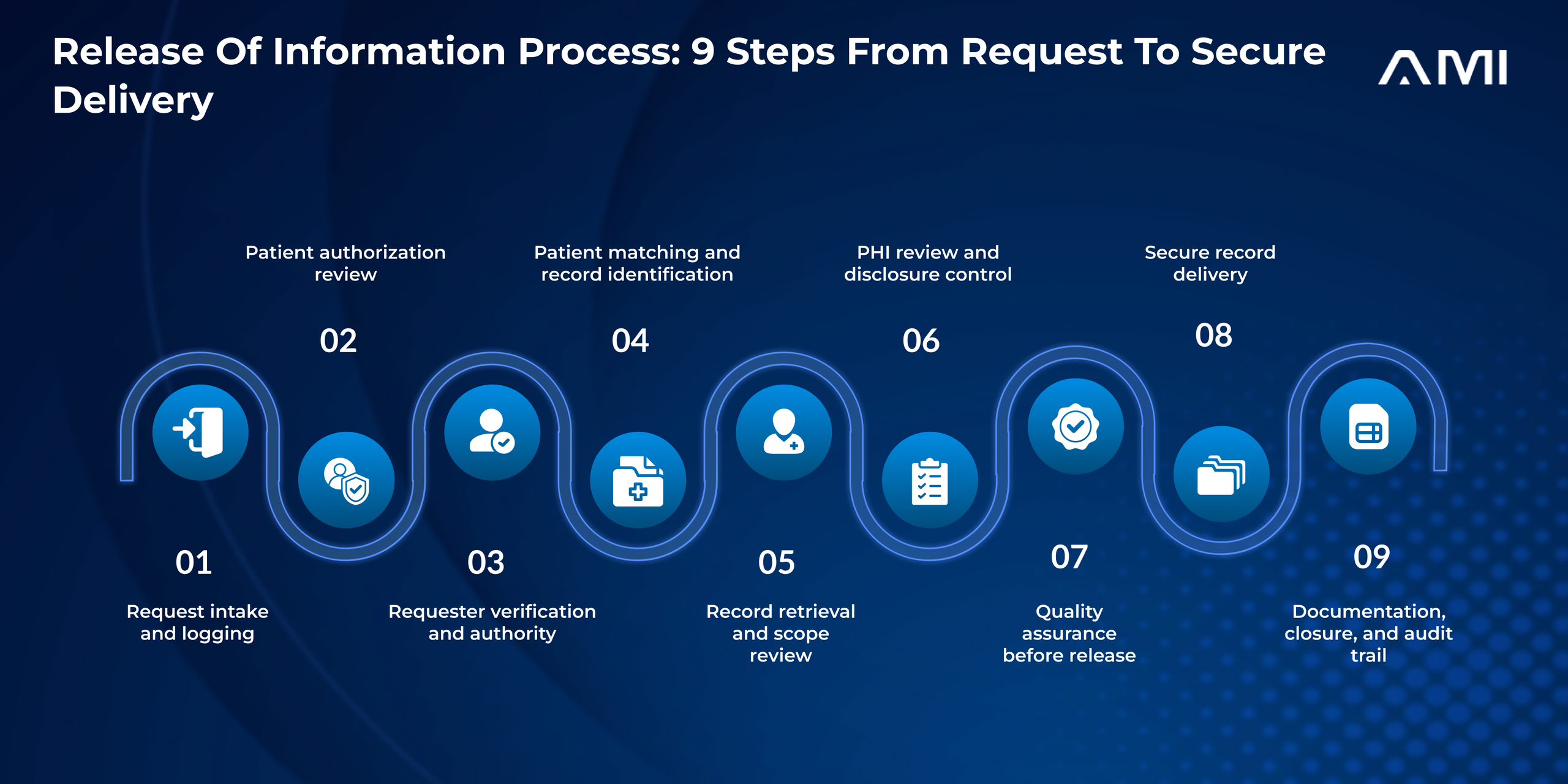
Step 1: Request intake and initial logging
The process starts when a request enters through an approved channel, such as a portal, fax, mail, secure email workflow, provider route, payer route, legal channel, or internal queue.
The intake team should capture the requester’s name and category, patient name, date of birth, medical record number when available, requested record type, date range, delivery method, authorization status, supporting documents, and received date.
Standardized intake prevents important information from being scattered across emails, notes, or disconnected systems. It also gives downstream teams a consistent starting point and makes it easier to identify incomplete requests before they enter the processing queue.
Step 2: Patient authorization review
Patient authorization is one of the most important stages in the workflow. The form should be complete, signed, dated, current, specific, and aligned with the records being requested.
A practical authorization review should confirm:
- Patient name and identifying details
- Requester or recipient information
- Requested record type and date range
- Purpose of disclosure where required
- Signature and date signed
- Expiration date or expiration event
- Delivery method or address
- Limitations, special instructions, or escalation notes
Incomplete or unclear forms should not move forward simply because a requester is waiting. The team should identify what is missing, communicate the correction required, document the hold reason, and maintain visibility until the issue is resolved.
Step 3: Requester verification and authority check
The team must verify who is requesting the information and whether that person or organization has the appropriate authority to receive it.
Patients, authorized representatives, providers, payers, attorneys, insurers, copy services, auditors, and government requesters may follow different review pathways. Requester category affects the documentation required, the permitted record scope, the delivery method, and whether escalation is necessary.
Verification should not rely only on familiarity, urgency, or a recognizable organization name. Teams need a repeatable method for confirming requester identity, relationship, authority, and contact information before the request proceeds.
Step 4: Patient matching and record identification
Records should not be retrieved until the correct patient has been identified.
Matching may involve the patient’s full name, date of birth, medical record number, account number, facility, provider, location, or date of service. When identifiers conflict, the request should be held for clarification rather than forced through the workflow.
Duplicate patient records, similar names, incomplete identifiers, unusual date ranges, and legal-sensitive requests may require a second-level review. Accurate matching protects the patient and prevents time-consuming corrections after records have already been prepared.
Step 5: Record retrieval and scope review
Once the patient is matched, the team retrieves the requested information and compares it with the approved scope.
The record type, treatment dates, facility, provider, and date range should align with the authorization or other approved basis for disclosure. A request for records from one encounter should not automatically result in the release of an entire medical history.
This is an important area where operational support can reduce over-release risk. Trained processors keep fulfillment tied to the approved request rather than treating retrieval as a broad document collection exercise.

Step 6: PHI records review and disclosure control
PHI records require controlled handling during retrieval, review, preparation, copying, packaging, and delivery.
Teams should confirm that the prepared file contains the correct patient information, approved record type, and authorized date range. Sensitive or exception-based records may require additional review, redaction where applicable, or escalation under organizational policy.
Role-based access, controlled work queues, secure systems, QA checks, and defined escalation triggers help make PHI handling workflow-based rather than person-dependent. The objective is to ensure that only the approved information moves forward.
Step 7: Quality assurance before release
Quality assurance should take place before records are delivered, particularly for legal, high-risk, sensitive, or exception-based requests.
The QA review should confirm:
- Authorization reviewed and valid
- Requester verified
- Correct patient matched
- Record type and date range confirmed
- PHI disclosure checked
- Delivery method approved
- Documentation complete
- Escalations resolved
- Release ready for closure
QA should evaluate the accuracy of the release, not simply whether the task was completed. A case can meet its turnaround target and still contain a serious authorization, scope, or delivery defect.
Step 8: Secure record delivery
Approved records should be delivered only through authorized and secure channels.
Depending on the workflow, delivery may occur through a secure portal, encrypted electronic transmission, controlled mail process, approved fax route, provider channel, payer route, or another authorized method. The appropriate channel may vary based on the requester, record type, organizational process, and disclosure basis.
Secure delivery must also be traceable. The team should document the recipient, destination, delivery method, release date, record scope, and completion status so the organization can respond to questions or investigate an issue later.
Step 9: Documentation, closure, and audit trail
The process does not end when the records are sent.
The case should be closed only after the organization documents what was released, who received it, when it was delivered, which authorization or disclosure basis was used, whether QA was completed, and whether any exception or escalation occurred.
A complete audit trail helps answer requester follow-ups, support quality reviews, investigate potential errors, and demonstrate how release decisions were made. It also gives leaders visibility into recurring delay reasons, rework, and process gaps.
Where Added Workflow Capacity Improves the ROI Process
Additional workflow capacity can improve nearly every stage of ROI, from intake and authorization review to record retrieval, QA, requester communication, delivery coordination, and closure.
The value is strongest when support adds both capacity and control. Trained teams can manage routine processing, follow up on missing information, maintain standardized documentation, and surface issues before they become aged backlog.
Healthcare leaders should still retain visibility into request volume, exceptions, QA results, turnaround performance, PHI handling, and escalation decisions. A co-managed model strengthens execution without turning the workflow into a black box.
Common Process Gaps That Create ROI Delays
Release delays often begin with incomplete authorization forms, vague record scope, incorrect requester details, missing patient identifiers, fragmented records, or unclear ownership.
Other gaps appear later in the process. Teams may prepare records without confirming the complete date range, hold requests without sending updates, apply QA inconsistently, or close cases without adequate documentation.
Leaders should categorize delay reasons instead of treating every open request as the same problem. Useful categories include authorization issues, requester clarification, patient match problems, unavailable records, QA holds, delivery issues, duplicate requests, or escalations pending. This reveals where process changes will have the greatest impact.
How Leaders Should Measure Release of Information Performance
Healthcare leaders need operational reporting that explains what is happening inside the queue.
Useful measures include request volume, turnaround time, backlog age, requester type, incomplete authorization rate, rejection reasons, patient-match issues, QA findings, escalation patterns, delivery status, and closure rate.
The objective is not to produce more dashboards. It is to identify where requests stop moving and why. For example, a growing backlog may be caused by staffing capacity, but it may also be driven by poor intake quality, slow requester follow-up, fragmented record sources, or unclear escalation rules.
Where AI Fits Into the Release of Information Process
AI-assisted tools can support selected administrative and analytical parts of the process. They may help categorize incoming requests, identify missing fields, detect duplicate submissions, surface aging cases, highlight documentation gaps, support QA sampling, and summarize workflow trends.
These capabilities can improve prioritization and visibility, but AI should not independently approve PHI disclosure or serve as the final decision-maker when interpreting unclear authorizations.
Sensitive records, unusual requester authority, legal-specific demands, conflicting patient information, and exception-based cases still require trained human review.
Why Human Oversight Still Matters in ROI Medical Records Workflows
Human judgment remains necessary because medical record requests are not always complete, consistent, or easy to interpret.
A form may be signed but vague. The requester may appear legitimate but lack clear authority for the requested scope. Patient details may not match across systems, or the request may involve sensitive information requiring additional review.
Trained reviewers are needed to clarify requests, interpret authorization details, manage exceptions, communicate with requesters, apply escalation rules, and complete final quality checks. Technology can improve efficiency, but operational accountability remains human-led.
Need More Control Across the Release Workflow? AMI provides co-managed release of information support designed around authorization review, PHI-aware processing, requester communication, QA, secure delivery, documentation, and turnaround visibility.
Get in TouchWhen Healthcare Organizations Need Additional ROI Capacity
AMI provides co-managed operational support for healthcare organizations that need more consistency, capacity, and visibility across medical record release workflows.
With trained healthcare operations teams, authorization review workflow support, PHI-aware handling, requester communication, QA controls, secure process discipline, and reporting visibility, AMI helps leaders strengthen execution without giving up oversight.
AMI support may include:
- Release of Information request intake and processing
- Authorization review workflow support
- ROI medical records processing capacity
- PHI-aware record handling
- Patient, provider, payer, legal, and copy-service requester support
- Requester communication and follow-up
- Patient matching and record-scope support
- QA checks for accuracy and completeness
- Secure delivery workflow coordination
- Escalation support
- Audit trail and documentation support
- Turnaround time and backlog visibility
- Co-managed operations with client oversight
Final Thoughts
A reliable ROI process connects patient authorization, requester verification, record matching, PHI handling, QA, secure delivery, and audit-ready closure into one controlled workflow. Healthcare organizations that need greater capacity and consistency can use additional operational capacity to improve execution, turnaround visibility, and documentation without giving up operational control.
Frequently Asked Questions
About the Author

Written by
Urza Dey
Urza Dey is a content and copywriter with over five years of experience across marketing, B2B SaaS, HealthTech, EdTech, and related industries. At AMI, they contribute to content strategy, blog development, and marketing communication focused on healthcare operations, business process management, and AI-enabled service delivery.