

PHI Records Explained: Who Can Access Medical Records and When?
TL;DR — PHI Access Requires Authority, Verification, and Documentation
PHI records include identifiable healthcare information connected to care, diagnosis, treatment, billing, claims, insurance, benefits, or payment.
Access to medical records depends on who is requesting them, why they are needed, what authority supports the request, and how the disclosure is documented.
Patients, authorized representatives, providers, payers, attorneys, auditors, and other approved parties may follow different verification and release pathways.
The medical record should be released only with a valid authorization or another approved basis for disclosure.
A strong Release of Information workflow verifies identity, confirms record scope, prepares the correct information, uses secure delivery, and maintains an audit trail.
AI can support categorization, missing-field detection, status tracking, and QA, but trained people should review unclear, sensitive, or exception-based requests.
AMI supports co-managed Release of Information workflows with authorization review support, PHI-aware handling, QA, documentation, and operational visibility.
PHI records contain sensitive information about a patient’s identity, care, diagnosis, treatment, insurance, claims, and payment history. They may be requested by patients, providers, payers, attorneys, auditors, insurers, copy services, and other third parties, but they cannot be shared casually. Access depends on the requester’s authority, the purpose of the request, applicable disclosure rules, organizational policy, and whether the information can be delivered through a documented and secure process.
When healthcare organizations lack a consistent workflow, a single medical record request can lead to repeated follow-ups, incomplete documentation, privacy concerns, and improper disclosure risk. Strong Release of Information processes help teams verify requesters, review authorization, match the correct patient and records, manage exceptions, and document every release decision.
What Are PHI Records?
What are PHI records? In practical healthcare operations terms, they are records containing health information that identifies, or could reasonably identify, an individual and relates to care, diagnosis, treatment, billing, benefits, insurance, claims, payment, or healthcare operations.
PHI may appear in medical charts, laboratory reports, imaging results, discharge summaries, treatment plans, billing records, claims documents, authorization forms, patient portal messages, call notes, and electronic health records. It is not limited to a complete medical chart. A smaller document, message, or transaction can also contain protected information when patient identity is connected to healthcare details.
The operational challenge is therefore broader than securing a file. Healthcare organizations must control who can access information, how requests are reviewed, which records are included, how the information is transmitted, and how the disclosure is documented.
What Information Can Be Considered PHI?
Information may be considered PHI when it combines identifiable patient details with healthcare-related information. This can include a patient’s name, date of birth, address, medical record number, diagnosis, treatment history, test results, provider notes, appointment details, insurance information, billing activity, claim status, or payment information.
Context matters. A patient name by itself may not reveal a healthcare condition, but a name attached to a clinical note, claim, appointment, or treatment record may become sensitive healthcare information.
This is why PHI protection cannot depend only on recognizing formal medical documents. Teams also need to consider emails, spreadsheets, system notes, scanned forms, recorded interactions, and other operational records that may connect a person to healthcare information.
Why PHI Records Need Controlled Access
Medical records connect a person’s identity with private details about their health and healthcare experience. Controlled access helps protect patient privacy, preserve trust, reduce improper disclosure risk, and maintain accountability across the organization.
Operational discipline is essential because disclosure mistakes are not limited to sending information to an obviously unauthorized person. Errors can also include selecting the wrong patient, releasing records outside the approved date range, including more information than requested, using an insecure channel, or failing to document what was released.
A strong access model therefore combines user permissions with verification, authorization review, record matching, secure delivery, escalation rules, QA, and traceable documentation.
Who Can Access Medical Records?
Who can access medical records depends on who is requesting the information, why it is needed, what authority supports access, and which organizational process applies.
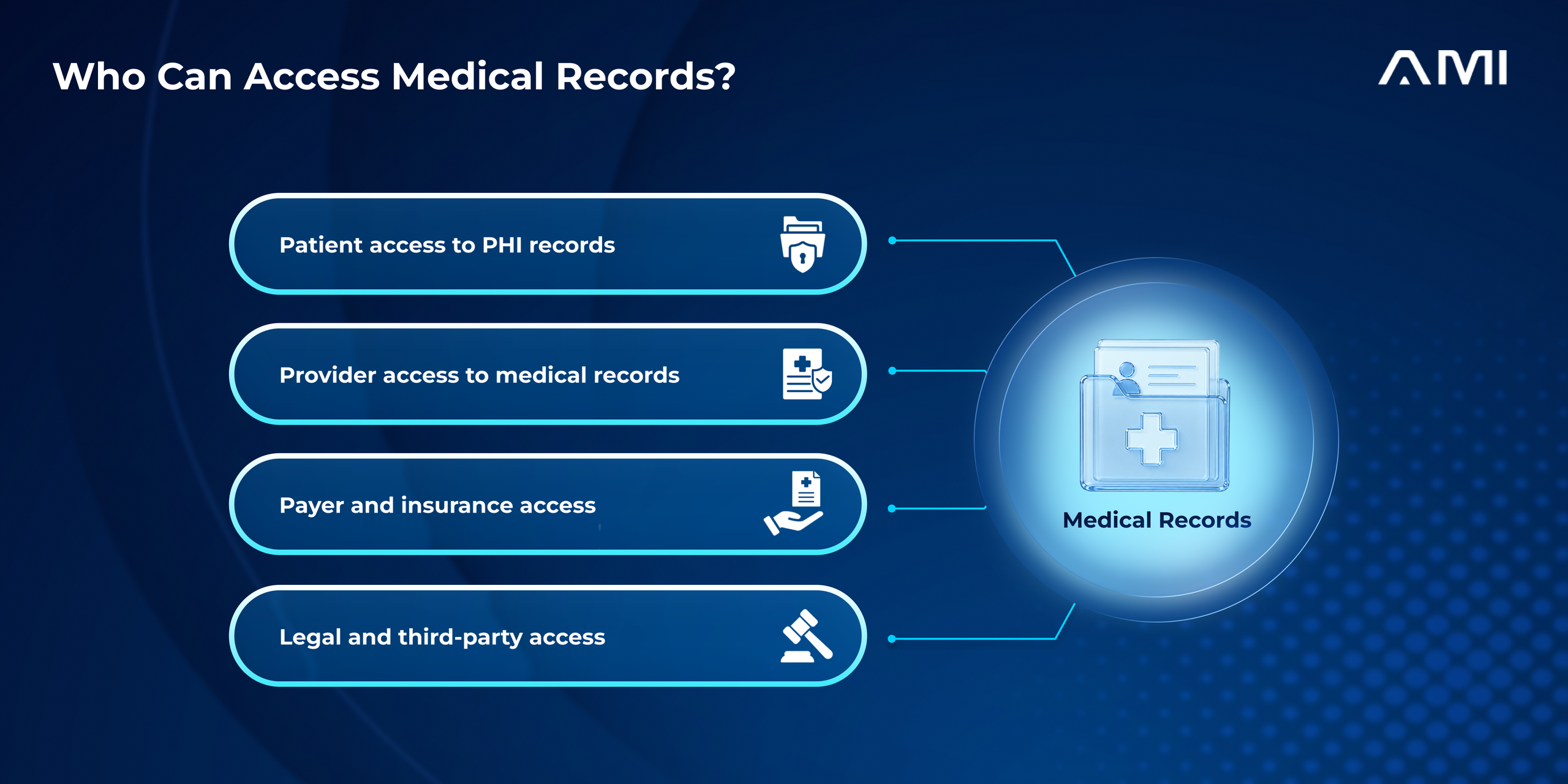
Patients and authorized representatives may request access through a patient-access process. Providers may need information for treatment or care coordination. Payers and insurers may request documentation for claims, benefits, payment, or review activities. Attorneys, auditors, government agencies, disability reviewers, workers’ compensation teams, and other third parties may also submit requests under specific circumstances.
These requester categories should not be treated as interchangeable. Each may require different identity checks, authorization documents, record scopes, delivery methods, and escalation pathways.
Patient access to PHI records
Patients generally have a pathway to request their own information, but the request still requires an organized process. The healthcare organization should verify identity, document what the patient requested, confirm the appropriate records and date range, and use an approved fulfillment method.
A patient request may appear straightforward, but unclear dates, broad record scope, duplicate requests, or mismatched identifiers can still create delays. A defined process helps the organization fulfill access while keeping a clear record of the request and response.
Provider access to medical records
Providers may need records for treatment, referrals, follow-up, care coordination, or continuity of care. Even when the purpose is healthcare-related, teams should confirm the requester, patient match, requested scope, and appropriate delivery pathway.
This is especially important when the request comes from an unfamiliar office, a third-party platform, or a provider not clearly connected to the patient’s current care. Verification protects both the patient and the organization from wrong-recipient disclosure.
Payer and insurance access
Payers and insurers may request documentation for claim review, payment, prior authorization, medical necessity, benefits administration, audits, or related activities.
The processing team should confirm the request basis, requester identity, patient information, requested documentation, date range, and delivery instructions. Broad or unclear payer requests may require clarification before records are prepared.
Legal and third-party access
Attorneys, copy services, disability reviewers, workers’ compensation teams, auditors, and other third parties may request medical information. These requests often require careful review because the requester may not have a direct treatment relationship with the patient.
Teams should verify the requester, examine the authorization or other supporting basis, confirm the record scope, and escalate unclear or sensitive requests. Pressure from a requester should never replace the required review process.
When Can PHI Records Be Released?
When can medical records be released? In general operational terms, records may be disclosed when there is valid authorization, a properly verified patient access request, a permitted healthcare purpose, a legal requirement, or another approved basis under applicable rules and organizational policy.
The correct pathway depends on the circumstances. A patient request, provider request, payer review, legal demand, and third-party authorization may all require different checks.
Healthcare teams should avoid applying one release rule to every requester. The safer approach is to use defined request categories, verification standards, authorization requirements, and escalation pathways so staff know when a routine workflow applies and when additional review is necessary.
The Medical Record Should Be Released Only With a Valid Basis
A practical operating principle is that the medical record should be released only with a valid authorization or another approved basis for disclosure.
Teams should not release information because a requester is persistent, claims urgency, provides incomplete documentation, or appears familiar with the patient. Verbal pressure does not replace identity verification, authorization review, record-scope confirmation, or internal disclosure requirements.
When details are missing or inconsistent, the request should be clarified, corrected, held, rejected, or escalated according to the organization’s policy. This protects the patient while giving staff a defensible process for making and documenting release decisions.
What Is a Release of Information?
Release of information refers to the authorization that permits records to be disclosed, the workflow used to process a request, or the operational function responsible for managing medical record releases.
The process generally begins with request intake and continues through verification, authorization review, patient and record matching, PHI preparation, secure delivery, documentation, and closure.
Release of Information is therefore not simply the final act of transmitting a file. It is the controlled decision-making and processing framework that determines whether information can be released, what may be included, who may receive it, and how the disclosure will be recorded.
What Should Be Checked Before Releasing PHI Records?
Before medical information is released, healthcare teams should confirm that the request is complete, the requester is properly identified, the patient is matched correctly, and the proposed disclosure aligns with the approved scope.
A practical review should include:
- Patient name and approved identifiers
- Requester name, organization, and relationship to the patient
- Valid authorization or another permitted disclosure basis
- Requested record type and date range
- Purpose of release where required
- Signature, date signed, and expiration date or event
- Delivery address or approved secure delivery method
- Sensitive or exception-based record considerations
- Escalation requirements
- Final documentation and audit trail
A checklist improves consistency, but it should not replace judgment. Requests involving unclear authority, conflicting details, sensitive records, or unusual circumstances may still need compliance, legal, or leadership review.

Common PHI Records Release Mistakes Healthcare Teams Should Avoid
Common errors include releasing records to the wrong requester, processing an incomplete authorization, selecting the wrong patient, including records outside the requested date range, sending more information than requested, or using an unapproved delivery channel.
Documentation gaps can be equally damaging. If the organization cannot show who requested the records, what authority was reviewed, what information was released, and how it was delivered, the workflow lacks accountability even when the correct records reached the requester.
The practical fix is to standardize intake fields, authorization checks, identity verification, secure delivery rules, escalation triggers, and QA for higher-risk disclosures. Teams should also avoid treating every request type the same, since a patient-access request may require a different workflow from a legal, payer, or third-party request.
Why Documentation Matters in PHI Disclosure Workflows
Documentation protects both the patient and the healthcare organization. It creates a traceable record of how a disclosure decision was made and how the request was completed.
The request history should show who submitted it, when it was received, which patient was identified, what authority or authorization was reviewed, what records were requested, what was released, when the release occurred, and which delivery method was used.
It should also explain why a request was delayed, rejected, corrected, or escalated. This helps teams answer follow-up questions, investigate errors, review quality, manage audits, and identify recurring workflow problems.
How Release of Information Services Help Protect PHI Records
Structured release of information services help healthcare organizations manage sensitive requests through defined intake, authorization review, requester verification, record processing, secure delivery, QA, communication, and reporting workflows.
A trained support team can identify incomplete requests earlier, apply consistent review standards, maintain request documentation, communicate missing requirements, and help leadership track backlog, turnaround, exceptions, and quality findings.
The strongest model is co-managed. The service partner supports execution and workflow discipline while the healthcare organization retains control over disclosure policies, exception rules, governance, and oversight.
Where AI Can Support PHI Records Workflows
AI-assisted tools can help categorize incoming requests, identify missing fields, flag potentially incomplete forms, detect duplicate requests, track status, support document indexing, sample cases for QA, and surface workflow trends.
These capabilities may reduce manual sorting and help teams find incomplete, aging, or high-risk requests more quickly. They can also improve reporting by showing where delays, defects, and repeat issues are occurring.
However, AI should not independently approve sensitive disclosure decisions. Unclear authorization, unusual requester authority, legal-sensitive demands, restricted information, and exception-based cases still require trained human review.
Why Human Oversight Still Matters When Releasing Medical Records
Medical record requests often involve ambiguity. A form may be signed but unclear. The requester may be legitimate but ask for a broader record scope than the documentation supports. Patient details may not match exactly, or the request may involve information requiring additional review.
Trained teams are needed to interpret unclear requests, communicate with requesters, manage exceptions, apply escalation rules, and complete final quality checks.
Technology can improve speed and visibility, but operational judgment remains necessary when the decision affects sensitive patient information.
Need Better Control Over PHI Release Workflows? AMI provides co-managed Release of Information services built around secure handling, authorization review, requester verification, QA, documentation discipline, and operational visibility.
Get in TouchHow AMI Supports PHI-Aware Release of Information Services
AMI supports healthcare organizations with co-managed Release of Information services designed to improve secure handling, documentation discipline, authorization review, quality, and workflow visibility.
With trained healthcare operations teams, PHI-aware processes, requester communication support, QA controls, and reporting discipline, AMI helps healthcare leaders manage medical record release workflows without losing operational oversight.
AMI support may include:
- PHI-aware records handling
- ROI request intake and processing support
- Authorization review workflow support
- Medical record request processing
- Patient, provider, payer, legal, and third-party requester support
- Requester communication and follow-up
- Secure workflow support
- QA checks for accuracy and completeness
- Escalation workflow support
- Audit trail and documentation support
- Turnaround time and backlog visibility
- Co-managed operations with client oversight
Related workflows can also connect to Medical Record Retrieval, Litigation Support, Healthcare Contact Center Operations, and Revenue Cycle Management.
Final Thoughts
Medical records should never move through informal or poorly documented processes. Strong access controls, requester verification, authorization review, accurate record matching, secure delivery, escalation, and QA help healthcare organizations protect PHI records while fulfilling legitimate requests in a timely and accountable manner.
Frequently Asked Questions
About the Author

Written by
Urza Dey
Urza Dey is a content and copywriter with over five years of experience across marketing, B2B SaaS, HealthTech, EdTech, and related industries. At AMI, they contribute to content strategy, blog development, and marketing communication focused on healthcare operations, business process management, and AI-enabled service delivery.