
9 Benefits of Outsourcing Release of Information Services
TL;DR — Outsourcing ROI Should Improve Control, Not Just Capacity
The strongest benefits of outsourcing release of information services include reduced backlog, better turnaround discipline, stronger authorization review, more consistent PHI handling, and clearer workflow visibility.
ROI medical records workflows are difficult to manage internally because each request may involve verification, record matching, secure delivery, documentation, and exception handling.
Outsourced support should strengthen requester communication, QA, audit trails, and reporting rather than operating as a black box.
PHI records should be managed through role-based access, secure transmission, documented release decisions, and defined escalation rules.
A co-managed model helps healthcare organizations add capacity while retaining control over policies, quality, exceptions, and performance.
The benefits of outsourcing release of information services extend far beyond reducing administrative workload. Release of Information sits at the intersection of patient access, health information management, legal requests, payer communication, authorization review, secure disclosure, and operational turnaround. When internal teams are managing rising request volume, incomplete forms, repeated follow-ups, and sensitive PHI records, even a small workflow gap can create delays, rework, and visibility problems.
Outsourcing or co-managing this function can help, but only when the support model adds structure rather than simply moving tasks outside the organization. The right partner should improve authorization discipline, documentation quality, requester communication, QA, turnaround control, and reporting while allowing the healthcare organization to retain oversight.
What Are Release of Information Services?
Release of information services are the operational processes used to receive, validate, process, document, and securely release medical records or protected health information to authorized requesters.
These requesters may include patients, providers, payers, attorneys, auditors, insurance companies, copy services, disability reviewers, government agencies, and other approved third parties. Each request may follow a different path depending on the requester, the information being sought, the authorization provided, and the organization’s disclosure policies.
The work is therefore more complex than copying records. It requires disciplined intake, patient and requester verification, authorization review, record retrieval, PHI-aware preparation, secure delivery, documentation, and closure.
Why ROI Medical Records Workflows Are Difficult to Manage Internally
ROI medical records workflows often look straightforward from the outside, but they involve several interdependent steps. A request cannot move safely from intake to release unless the patient is matched correctly, the requester is verified, the authorization is complete, the record scope is clear, and the delivery method is approved.
Internal teams can struggle when request volume rises across multiple locations, departments, or requester categories. The problem is not always staffing alone. Delays may also come from inconsistent intake channels, unclear ownership, incomplete forms, fragmented systems, weak escalation rules, or poor status visibility.
Because one defect early in the process can affect every stage that follows, healthcare leaders need a workflow that can absorb volume without sacrificing accuracy or control.
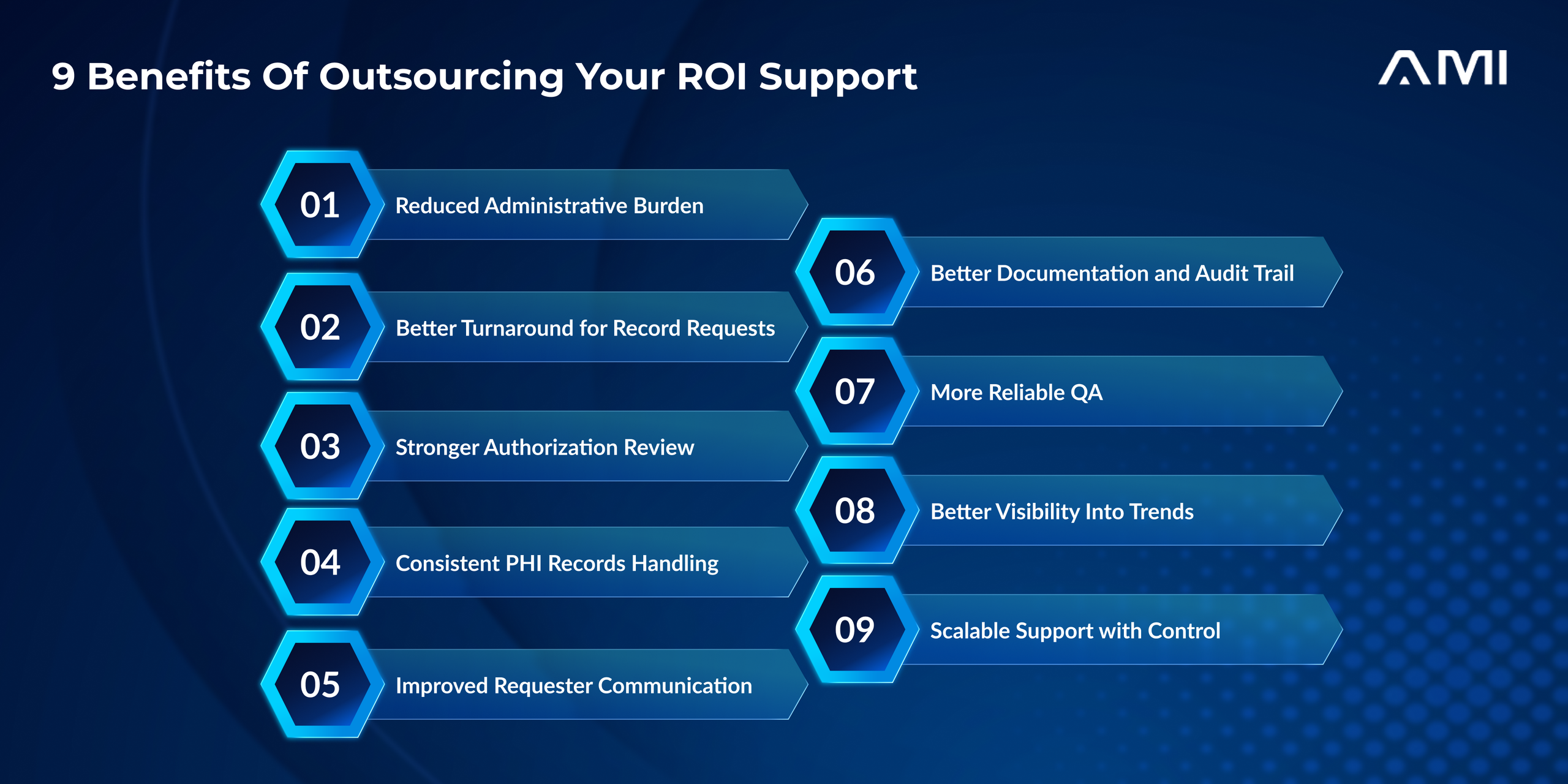
9 Benefits of Outsourcing Your ROI Support
The benefits of outsourcing release of information services become most visible when external support improves the way work is controlled, not just where the work is performed. A strong ROI partner can help healthcare organizations reduce administrative strain, strengthen authorization review, improve PHI records handling, create more consistent requester communication, and provide better visibility into turnaround, backlog, QA, and exceptions. The following benefits show how a co-managed model can improve both capacity and operational discipline without removing client oversight.
1. Reduced Administrative Burden on Internal Teams
ROI work consumes time across request intake, authorization review, record matching, requester follow-up, retrieval, delivery, documentation, and closure. These tasks often pull HIM, compliance, patient support, legal operations, and provider teams away from higher-value responsibilities.
Outsourcing selected parts of the workflow can reduce that repetitive strain. A support partner can manage routine intake, incomplete-request follow-up, request logging, status communication, and document processing while internal teams focus on exceptions, policy decisions, sensitive disclosures, and governance.
Before outsourcing, leaders should identify where internal time is being lost. In many organizations, the biggest drains are incomplete authorization follow-ups, status inquiries, record matching, request tracking, and manual closure documentation.
2. Better Turnaround Discipline for Medical Record Requests
Delayed medical record releases create frustration for patients, providers, payers, attorneys, and internal stakeholders. They can also increase call volume because requesters repeatedly seek updates.
A structured support model can help manage queues, segment request types, identify aging cases, and escalate blocked requests earlier. Turnaround discipline improves when ownership is clear, and teams can see why a request is delayed rather than simply knowing that it remains open.
Healthcare leaders should track turnaround time by requester type, request age, record type, incomplete authorization reason, and release status. This makes it easier to distinguish a volume problem from an intake, documentation, or workflow problem.
3. Stronger Authorization Review Support
Medical records should be released only when the request includes valid authorization or another approved basis for disclosure. Incomplete signatures, vague record scope, missing requester details, mismatched patient information, unclear date ranges, or expired forms can delay processing and create risk.
A trained support team can apply a consistent review process before requests move forward. That review should confirm patient identity, requester details, requested records, date range, signature, date signed, expiration date or event, release purpose where required, and delivery instructions.
The value is not simply faster approval. It is earlier identification of defects, clearer communication about what is missing, and better documentation of why a request was held, corrected, escalated, or rejected.
4. More Consistent PHI Records Handling
HIPAA-compliant PHI records handling requires more than individual caution. They require a workflow that controls access, preparation, transmission, documentation, and exception handling.
Outsourcing can improve consistency when the partner uses trained healthcare operations teams, role-based access, approved systems, secure delivery channels, documented release decisions, and clear escalation rules. This reduces dependence on individual interpretation and helps standardize how sensitive requests are managed.
Healthcare leaders should look for a process that is repeatable and auditable. PHI handling should not vary based on who happens to process the request that day.
5. Improved Requester Communication
Many ROI delays become more visible when communication is inconsistent. Requesters may not know whether the request was received, whether documentation is missing, whether authorization is incomplete, or when the records are likely to be released.
A strong support model standardizes communication across patients, providers, payers, attorneys, copy services, and other requesters. Clear updates can reduce repeated follow-ups and help the requester understand what action is required.
Common communication stages include request received, missing information, authorization incomplete, request in process, release completed, and unable to process. Consistent messaging helps prevent confusion while giving internal teams a clearer record of each interaction.
6. Better Documentation and Audit Trail Discipline
Every ROI request should show what was requested, who submitted it, what authorization was reviewed, what records were released, when they were released, how they were delivered, and why the request was delayed, escalated, or rejected.
Outsourced support can strengthen documentation when the partner follows defined closure standards and captures required information consistently. This may include the received date, requester category, patient identifiers, authorization status, record scope, missing information reason, delivery method, release date, escalation notes, and completion status.
A strong audit trail supports quality review, requester follow-up, issue investigation, leadership reporting, and organizational accountability.

7. More Reliable QA for High-Risk ROI Workflows
Quality assurance should evaluate more than whether a task was marked complete.
In release of information services, QA should review authorization validity, patient matching, requester details, record scope, PHI disclosure accuracy, delivery method, documentation quality, and escalation handling. A request can be completed on time and still contain a serious quality defect.
The most effective QA model combines routine sampling with targeted audits. Higher-risk reviews may focus on legal requests, repeated requester issues, incomplete authorizations, sensitive disclosures, late-stage escalations, or requests involving unusual record scope.
8. Better Visibility Into Backlog, Bottlenecks, and Trends
Healthcare leaders should not lose visibility after outsourcing. They should know how many requests are open, how old they are, which request types are delayed, why authorizations are rejected, and where rework is occurring.
Useful reporting should segment backlog by age, requester category, request type, missing-documentation reason, QA issue, escalation reason, and completion rate. This helps leadership move from reactive follow-up to proactive workflow control.
Visibility also makes outsourcing measurable. Without reporting, it is difficult to know whether the support model is improving turnaround, reducing defects, or simply moving the backlog elsewhere.
9. Scalable Support Without Losing Operational Control
One of the most important benefits of outsourcing release of information services is the ability to add capacity during volume spikes, staffing gaps, legal request surges, payer activity, copy-service demand, or backlog projects.
However, adding capacity should not mean transferring control. The strongest model is co-managed. The partner supports execution, reporting, QA, and workflow improvement while the healthcare organization retains authority over policies, exceptions, escalation rules, disclosure standards, and governance.
This distinction matters. Outsourcing capacity can strengthen the operation. Outsourcing visibility and control can weaken it.
What Healthcare Leaders Should Not Outsource Blindly
ROI workflows should not be handed to a vendor without clear expectations around authorization review, PHI handling, requester communication, QA, reporting, turnaround time, escalation, and audit documentation.
Healthcare leaders should evaluate:
- Healthcare workflow experience, authorization review support, PHI records handling controls, secure delivery practices, and medical record processing knowledge
- Requester communication processes, QA scorecards, audit checks, turnaround tracking, backlog reporting, and escalation rules
- Audit trail discipline, security practices, transparent reporting, and a co-managed oversight model
A black-box vendor may reduce visible workload in the short term while creating new risks around quality, documentation, and accountability. The right partner should make the workflow easier to understand, not harder to see.
When Outsourcing Release of Information Services Makes Sense
Outsourcing or co-managed support becomes relevant when the organization is facing persistent backlogs, rising request volume, delayed turnaround, incomplete authorizations, overwhelmed HIM teams, inconsistent documentation, poor requester updates, weak QA visibility, or limited leadership reporting.
It may also make sense during temporary surges, system transitions, staffing gaps, or backlog-reduction initiatives. The key is to define what the support partner will own, what remains with the client, how exceptions will be escalated, and which performance measures will be reviewed.
Organizations should enter the relationship with clear operating expectations. Outsourcing is most effective when tied to measurable workflow outcomes rather than to a general goal of reducing workload.
Need More Capacity Without Losing ROI Oversight? AMI provides co-managed release of information services designed to improve authorization discipline, PHI handling, QA, turnaround visibility, and operational reporting.
Get in TouchHow AMI Supports Release of Information Services
AMI supports healthcare organizations through a co-managed operating model built around accuracy, turnaround discipline, PHI-aware handling, QA, requester communication, and workflow visibility.
With trained healthcare operations teams, secure processes, authorization review support, and reporting discipline, AMI helps healthcare leaders strengthen ROI workflows without giving up oversight.
AMI support may include:
- ROI request intake and processing support
- Authorization review workflow support
- PHI-aware medical record handling
- Medical record request processing
- Patient, provider, payer, legal, and copy-service requester support
- Requester communication and follow-up
- QA checks for accuracy and completeness
- Turnaround time and backlog visibility
- Escalation workflow support
- Audit trail and documentation support
- Co-managed operations with client oversight
AMI can also support connected workflows through Medical Record Retrieval, Litigation Support, Healthcare Contact Center Operations, and Revenue Cycle Management.
Frequently Asked Questions
About the Author

Written by
Urza Dey
Urza Dey is a content and copywriter with over five years of experience across marketing, B2B SaaS, HealthTech, EdTech, and related industries. At AMI, they contribute to content strategy, blog development, and marketing communication focused on healthcare operations, business process management, and AI-enabled service delivery.