

How Long Is a Release of Information Authorization Good For?
TL;DR — Authorization Validity Depends on the Form
A release of information authorization is generally valid until the expiration date or expiration event listed on the form.
Healthcare organizations should not assume that every authorization lasts for a fixed period, such as 90 days or one year.
A valid form may no longer support disclosure if it has been revoked, does not match the requested records, or conflicts with organizational requirements.
Incomplete authorization forms can delay medical record requests and increase requester follow-ups.
A HIPAA authorization should clearly identify the patient, recipient, requested information, expiration terms, and other required details.
AI can help flag missing fields or expired dates, but trained people should make final disclosure and escalation decisions.
AMI supports co-managed Release of Information workflows with authorization review support, PHI-aware processing, QA, documentation, and reporting.
If you are asking how long is a release of information good for, the answer is usually found on the authorization itself. Most authorizations remain valid until the expiration date or expiration event stated on the form, unless they are revoked earlier or limited by applicable requirements, organizational policy, or the scope of the request.
Healthcare teams should never assume that all authorization forms remain valid for the same length of time. Before releasing medical records, staff should review the date signed, expiration language, requester details, patient identifiers, requested record scope, delivery instructions, and revocation status. When information is expired, incomplete, vague, or inconsistent, the request may need to be corrected, paused, rejected, or escalated.
How Long Is a Release of Information Good For?
A release authorization is generally valid until the specific expiration date or expiration event written on the form, unless it is revoked earlier or otherwise limited.
For example, a form may state that it expires on a particular calendar date, a certain number of days after signing, or when a defined event occurs. Healthcare teams should review the wording of the actual authorization rather than relying on a general timeframe.
The form must also continue to match the request being processed. An authorization may still be within its stated timeframe but may not cover a different recipient, additional record type, broader date range, or unrelated purpose.
The safest operational approach is to verify validity, scope, completeness, and revocation status each time the authorization is used.
Why There Is No Single Expiration Period for Every Authorization Form
There is no universal period that applies to every medical record authorization because the validity of the form may depend on several factors.
The wording of the authorization matters first. Some forms include a fixed expiration date, while others identify an expiration event. The requester, purpose of disclosure, requested information, and applicable organizational policy may also affect whether the form can support the release.
The type of records involved may require additional review. A broad request for an entire medical history may not be processed in the same way as a narrowly defined request for one encounter or date range.
This is why healthcare teams should not apply a standard duration to every form. The form itself, the request scope, and the applicable workflow should guide the review.
What Is a HIPAA Authorization?
A HIPAA authorization is written permission that allows a healthcare organization to use or disclose protected health information for a specified purpose or to a specified person or organization when authorization is required.
Operationally, the authorization tells the processing team who the patient is, who may receive the information, what records may be released, and when the permission expires.
It should provide enough detail for the healthcare organization to determine whether the requested disclosure is supported. A signature alone is not enough when other essential information is missing, vague, expired, or inconsistent.
A HIPAA authorization should therefore be treated as part of a larger review process rather than as a simple approval checkbox.
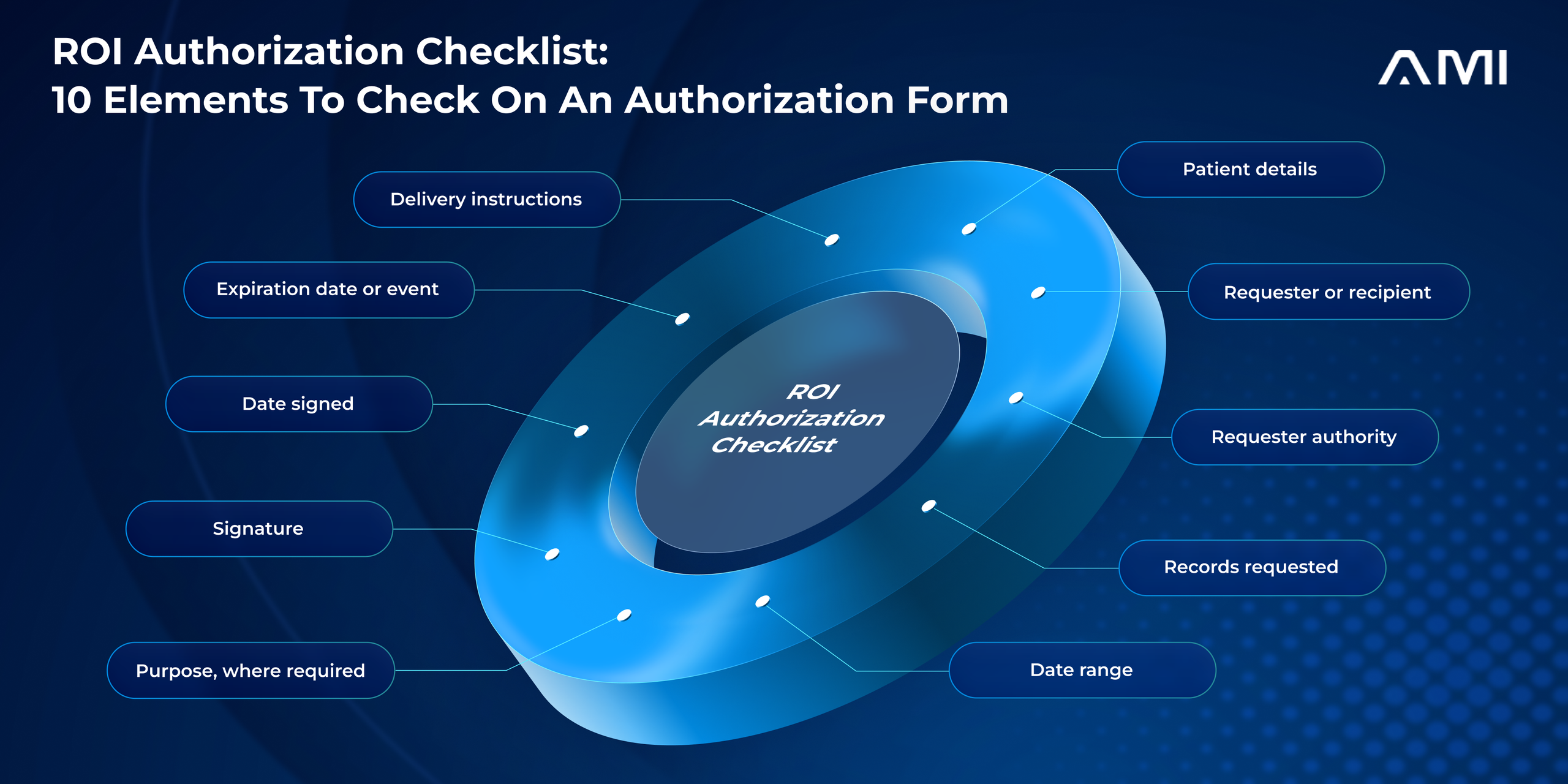
What Should Release of Information Authorization Forms Include?
Before processing a medical record request, healthcare teams should review the form for completeness, clarity, and alignment with the requested disclosure.
A practical review checklist should include:
- Patient name and identifying information
- Requester or recipient name
- Requester relationship or authority
- Records or information requested
- Requested date range
- Purpose of disclosure where required
- Patient or authorized individual’s signature
- Date signed
- Expiration date or expiration event
- Delivery method or destination
- Revocation language
- Special instructions or disclosure limitations
- Internal review or escalation notes
A checklist supports consistency, but it does not replace judgment. Forms involving unclear authority, sensitive information, unusual expiration language, or legal-sensitive requests may still require escalation.
What Is an Expiration Date on an Authorization Form?
An expiration date is the specific date after which the authorization should no longer be used to support a medical record release.
For example, a form may state that it is valid until December 31, 2026. Another may state that it expires 90 days after the date signed. These are examples of how expiration language may be written, not universal validity periods.
The processing team should compare the expiration date with the date on which the request is being reviewed. It should also confirm that the form was signed properly and that the requested disclosure remains within the authorized scope.
A form should not be treated as valid solely because it contains an expiration date. All other required elements must still be complete and consistent.
What Is an Expiration Event on an Authorization Form?
Some authorizations expire when a defined event occurs rather than on a fixed calendar date.
An expiration event may be connected to the completion of a claim review, the end of a treatment episode, the closure of a legal matter, or the completion of a specific records request.
Event-based expiration can be more difficult to verify because the processing team may need to determine whether the event has already occurred. If the language is vague or the event status cannot be confirmed, the request may need clarification or escalation.
Healthcare organizations should document how the expiration event was interpreted and why the form was accepted, paused, or rejected.
Can a Release of Information Authorization Be Revoked?
A patient or other authorized individual may generally revoke an authorization, subject to applicable requirements and actions already taken in reliance on that authorization.
Once the organization receives a revocation, the team should document when it was received, identify which requests or disclosures it affects, and follow the appropriate internal process.
A revocation does not always reverse actions already completed. However, it may prevent future disclosures that would otherwise have relied on the authorization.
Unclear revocation requests should be escalated rather than interpreted informally. The record should show how the revocation was reviewed and what action followed.
What Happens if the Authorization Form Is Expired?
If an authorization is expired, healthcare teams should generally not release records based on that form alone.
The request may need a new authorization, a corrected form, clarification from the requester, or internal escalation. The team should communicate what is required rather than allowing the request to remain in an unclear status.
The reason for the pause or rejection should also be documented. This creates a clear record for future follow-up and helps leaders understand how many requests are delayed because of expired forms.
Processing an expired form simply because the requester is waiting or the request appears urgent can create unnecessary disclosure risk.
What Happens if the Authorization Form Is Incomplete?
Incomplete authorization forms are a common source of delay in medical record workflows.
A form may be incomplete because it lacks a signature, signing date, patient identifier, recipient information, requested record scope, date range, expiration language, or usable delivery instructions. In other cases, the information may be present but contradictory or too vague to support processing.
Healthcare organizations should use a standard incomplete-authorization communication template that clearly states what is missing and how the requester can correct it. This reduces repeat calls, duplicate submissions, inconsistent explanations, and unnecessary escalation.
The request should remain traceable while the missing information is being resolved.
Can Medical Records Be Released With an Old Authorization Form?
An old authorization may still be usable only when it remains valid, has not expired, has not been revoked, matches the current requester and recipient, covers the requested records, and meets applicable requirements and organizational policy.
The age of the document alone does not answer the question. A recently signed form may still be unusable if it is incomplete or does not cover the requested disclosure. An older form may remain valid if the stated expiration event has not occurred and all other requirements are met.
Teams should therefore evaluate the language and scope of the form rather than applying a blanket yes-or-no rule based on its age.

The Medical Record Should Be Released Only After Authorization Review
Receiving a request does not mean the records are ready to be released.
The processing team should verify the patient, identify the requester, review the authorization, confirm the requested records and date range, check the expiration terms, and ensure the delivery method is appropriate.
This review protects against wrong-patient selection, over-disclosure, outdated authorization, unclear recipient details, and incomplete documentation.
When a request falls outside the standard workflow, the team should follow a defined escalation path. Pressure from a requester, internal stakeholder, or deadline should not replace the required review process.
Common Authorization Review Mistakes Healthcare Teams Should Avoid
Common mistakes include accepting expired forms, overlooking a missing signature or signing date, failing to verify revocation status, ignoring vague record scope, or releasing information to a recipient not clearly covered by the authorization.
Teams may also miss mismatched patient details, incomplete date ranges, unclear expiration events, insecure delivery instructions, or missing documentation of the final decision.
A practical safeguard is to use a first-pass review checklist followed by a second-level escalation path for unclear, high-risk, legal-sensitive, or PHI-heavy requests.
Consistency matters because authorization review should not depend entirely on the experience or judgment of one individual processor.
Why Release of Information Workflows Need Documentation
Every release of information request should create a clear record of what was received, how the authorization was reviewed, and what action was taken.
Documentation should show who requested the records, which patient was identified, whether the authorization was complete, what information was approved, when the records were released, and how they were delivered.
The audit trail should also explain why a request was delayed, corrected, rejected, or escalated. This helps teams answer requester questions, review errors, monitor turnaround, support QA, and maintain leadership visibility.
Without documentation, even a correctly completed release may be difficult to defend or investigate later.
How Release of Information Services Help With Authorization Review
Structured Release of Information services can help healthcare organizations manage request intake, authorization review, missing-field follow-up, requester communication, medical record processing, secure delivery, QA, and reporting.
A trained support team can identify defects early, apply consistent review criteria, document decisions, and communicate corrective steps to requesters.
This can reduce avoidable delays while improving visibility into why requests are being held or rejected.
The strongest model is co-managed. The service partner supports execution and workflow discipline while the healthcare organization retains responsibility for policies, escalation standards, governance, and oversight.
Where AI Can Support Authorization Form Review
AI-assisted tools can help identify missing fields, flag potentially expired dates, classify request types, detect duplicate submissions, track request status, and surface recurring authorization defects.
These capabilities can reduce manual sorting and help teams identify incomplete or aging requests earlier. AI may also support QA sampling and reporting by highlighting forms that require additional attention.
However, AI should not serve as the final decision-maker for approving a disclosure. Ambiguous language, unusual expiration events, sensitive records, revoked authorizations, and legal-sensitive scenarios still require trained human review.
Why Human Oversight Still Matters for HIPAA Authorization Workflows
Authorization forms are not always complete, consistent, or easy to interpret.
A form may include an expiration event that is difficult to verify. The requester may seek records outside the approved scope. Patient information may not match exactly, or the authorization may have been revoked after submission.
Human reviewers are needed to interpret ambiguity, contact requesters, manage exceptions, apply escalation rules, and complete final quality checks.
Technology can improve speed and visibility, but operational judgment remains essential when the decision affects protected health information.
Need Better Control Over Authorization Review? AMI supports healthcare organizations with co-managed Release of Information services designed around authorization completeness, PHI-aware processing, requester communication, QA, documentation, and turnaround visibility.
Get in TouchHow AMI Supports Release of Information Services
AMI supports healthcare organizations with co-managed Release of Information services designed to improve authorization review discipline, PHI-aware handling, turnaround visibility, and documentation quality.
With trained healthcare operations teams, secure workflows, requester communication support, QA checks, and reporting discipline, AMI helps leaders manage medical record release requests without losing operational oversight.
AMI support may include:
- Authorization form review workflow support
- Release of Information request intake and processing
- HIPAA authorization completeness support
- PHI-aware records handling
- Medical record request processing
- Requester communication and follow-up
- Missing-information resolution workflows
- QA checks for accuracy and completeness
- Escalation workflow support
- Audit trail and documentation support
- Turnaround time and backlog visibility
- Co-managed operations with client oversight
Related workflows can also connect to Medical Record Retrieval, Litigation Support, Healthcare Contact Center Operations, and Revenue Cycle Management.
Final Thoughts
For healthcare teams asking how long is a release of information good for, the safest answer is to review the actual authorization rather than assume a universal timeframe. Expiration terms, scope, completeness, revocation status, requester details, and organizational requirements should all be confirmed before medical records are released.
Frequently Asked Questions
About the Author

Written by
Urza Dey
Urza Dey is a content and copywriter with over five years of experience across marketing, B2B SaaS, HealthTech, EdTech, and related industries. At AMI, they contribute to content strategy, blog development, and marketing communication focused on healthcare operations, business process management, and AI-enabled service delivery.