
AI in Revenue Cycle Management: Reshaping RCM Operations in 2026
TL;DR — Why AI Is Reshaping RCM
AI in revenue cycle management is becoming a major 2026 operating trend as providers look for better ways to manage denials, staffing pressure, data complexity, and administrative volume.
RCM automation handles predictable, rules-based activity, while AI adds interpretation, prioritization, pattern detection, and decision support.
Leading use cases span patient access, claims, denial prevention, coding support, AR prioritization, patient financial workflows, QA, and analytics.
AI performs best when accurate data and well-designed workflows already exist.
Human oversight remains essential for complex accounts, coding interpretation, payer disputes, sensitive patient interactions, and exceptions.
Sustainable revenue cycle optimization comes from orchestrating technology and skilled teams rather than automating isolated tasks.
Artificial intelligence has moved from an experimental technology to one of the biggest operating trends shaping healthcare finance. In late 2025, 63% of healthcare providers surveyed by Experian Health said they had introduced AI somewhere in their revenue cycle, although only 15% had fully integrated it into standard RCM operations. That gap shows where the industry stands in 2026: adoption is accelerating, but organizations are still determining where AI creates measurable value and where experienced professionals need to stay closely involved.
The opportunity behind AI in revenue cycle management is not replacing revenue cycle teams. It is changing how their work gets organized. Automation can move repetitive transactions, AI can interpret information and surface patterns, and trained professionals can focus on exceptions, payer disputes, coding complexity, patient conversations, and decisions requiring judgment. The American Hospital Association describes this broader shift as “intelligent RCM,” where technology creates value when it is combined with stronger processes, data governance, and engaged teams.
Why AI Is One of the Biggest RCM Trends in 2026
The growing interest in AI for RCM is being driven by business pressures as much as technological progress. Revenue cycle teams are managing changing payer rules, rising denial activity, staffing constraints, increasing administrative complexity, and large volumes of data across patient access, claims, billing, and collections.
Recent industry data reflects that pressure. Experian Health found that more than four in ten providers report denial rates of at least 10%, while claim-data errors, inaccurate registration information, and authorization issues remain major denial triggers. At the same time, providers are increasingly exploring AI to improve front-end accuracy and identify claim problems before submission.
This helps explain why trends in revenue cycle management are moving away from simple task automation toward intelligent workflow support. The business case is no longer only “Can this task be automated?” It is increasingly “Can technology help the team decide what needs attention next?”
AI and Automation Play Different RCM Roles
Although AI and automation are often discussed together, they solve different operational problems. Traditional automation is strongest when a process follows predictable rules. AI becomes valuable when the workflow involves large amounts of information, recurring patterns, prioritization, or unstructured data.
| Automation | AI |
|---|---|
| Executes predefined tasks | Interprets information and patterns |
| Moves data between workflows | Helps prioritize work |
| Handles repetitive transactions | Identifies exceptions and risks |
| Applies established rules | Supports analysis and decision-making |
| Creates consistency at scale | Adds context to operational activity |
The benefits of intelligent automation appear when these capabilities work together. An example of intelligent automation in RCM could be automatically retrieving claim status while AI analyzes the account history and identifies which cases need immediate human intervention.
That distinction matters because successful automated RCM should not be measured by how many people can be removed from a workflow. It should be measured by how much unnecessary work can be removed from the people managing it.
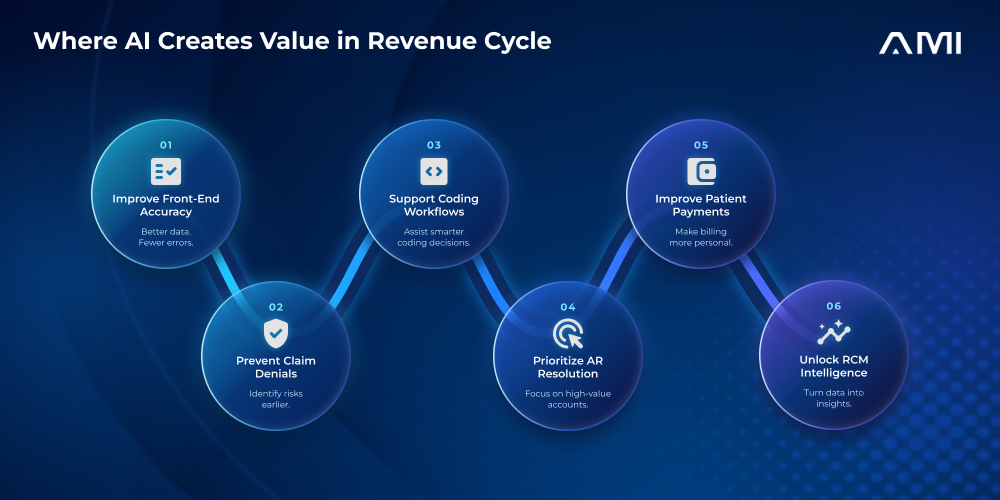
Where AI Creates Value Across the Revenue Cycle
The strongest healthcare RCM automation process does not begin with a single AI tool. It looks across the revenue cycle and identifies where repetitive work, poor data, manual prioritization, or limited visibility is slowing financial performance.
The opportunities extend from the first patient interaction through final account resolution.
1. Strengthen front-end data accuracy
Revenue cycle problems frequently begin before a claim exists. Incorrect demographics, inactive insurance, missing eligibility information, or incomplete authorization data can move downstream into denials and payment delays.
AI-assisted patient access workflows can help validate information, identify inconsistencies, and surface records requiring review before inaccurate data enters billing. Experian Health's 2026 research continues to identify front-end data problems as important drivers of preventable denials.
This makes front-end accuracy one of the strongest opportunities for revenue cycle improvement because preventing an error is usually more efficient than correcting it after adjudication.
2. Prevent avoidable claim denials
AI can analyze historical claims and payment patterns to identify accounts that may contain missing information, unusual combinations, authorization problems, or other denial risks.
The objective is not to predict every payer decision. It is to give claims teams another layer of visibility before submission. Experian Health reported that 69% of healthcare providers already using AI said it had reduced denials and/or increased resubmission success, although only 14% were using AI specifically for denial reduction in its 2025 survey.
That gap between perceived value and actual deployment makes denial prevention one of the most important areas to watch as RCM automation matures.
Exploring where technology can strengthen more than one healthcare workflow? Explore AM InfoWeb’s healthcare services, spanning revenue cycle, payer support, release of information, litigation support, and AI-powered contact center operations.
3. Support coding and documentation workflows
Coding increasingly combines clinical expertise with technology-assisted review. AI can extract information from documentation, prioritize charts, identify potential coding opportunities, and flag records that need additional attention.
The value is greatest when technology supports qualified coders rather than bypassing them. Complex encounters, unclear documentation, specialty-specific rules, and coding exceptions still require professionals who understand the clinical and reimbursement context.
For RCM leaders, the opportunity is shorter administrative cycles and better visibility without sacrificing coding governance.
4. Prioritize denials and accounts receivable
AR teams often manage thousands of accounts with different balances, ages, payer histories, denial reasons, deadlines, and recovery potential. Treating every account equally can consume substantial effort without necessarily improving collections.
AI for RCM can help prioritize accounts, as a better accounts receivable management strategy, by identifying patterns across these variables and surfacing work that may require earlier intervention.
Instead of asking teams to work every queue sequentially, AI-assisted prioritization can help answer a more useful question: Which account needs human attention now, and why?
That shifts AR from high-volume activity toward more targeted resolution.
5. Improve patient financial workflows
Patient collections also create opportunities for intelligent automation. Routine reminders, balance notifications, interaction summaries, payment links, and inquiry routing can be automated, while AI can help teams understand prior activity and identify the appropriate next action.
Sensitive financial conversations still require care. Disputed balances, insurance confusion, financial hardship, and unusual payment situations benefit from trained representatives who can understand context rather than simply execute another automated contact.
The strongest patient financial workflows therefore use technology to make communication easier without making it less human.
6. Turn RCM data into operational intelligence
One of the most valuable uses of AI in revenue cycle management may be helping leaders understand what is creating the workload.
AI-assisted analytics can surface relationships between denial patterns, payer behavior, queue aging, repeat contacts, claim errors, staffing pressure, and workflow exceptions. Instead of relying only on retrospective reports, teams can identify where operational friction is developing and investigate the cause earlier.
Operator Question: Is the revenue cycle team dealing with more work, or is the workflow repeatedly creating unnecessary work?
From RCM Automation to Intelligent Orchestration
The evolution of RCM technology is moving through several stages. Early automation focused primarily on completing repetitive transactions faster. AI adds interpretation and prioritization, creating the possibility of a more orchestrated operating model.
A simplified progression looks like this:
Manual RCM → Workflow Automation → AI-Assisted RCM → AI-Human Orchestration
In an orchestrated model, technology handles suitable high-volume activity while trained professionals focus on exceptions, quality, escalation, and judgment. This is also why enterprise intelligent automation requires more than purchasing technology. Processes, ownership, data quality, and governance have to evolve alongside it.
AHA's 2026 analysis makes a similar point: intelligent RCM depends on sequencing technology adoption around standardized workflows, data governance, and engaged teams rather than simply layering new tools onto inefficient processes.

Why does revenue still leak after the claim is submitted?
Because small breakdowns across eligibility, coding, billing, denials, and follow-up can quietly delay cash flow. AM InfoWeb helps healthcare teams strengthen RCM operations with process discipline, trained teams, and AI-assisted execution.
Why Human Oversight Becomes More Important
As AI moves deeper into the revenue cycle, organizations need clearer boundaries around what technology can execute and what requires human judgment.
Revenue cycle professionals remain particularly important for complex denials, payer disputes, coding interpretation, high-value accounts, patient financial exceptions, escalations, and situations where inaccurate output could carry financial or compliance consequences.
Experian Health's latest AI research reflects this caution. While provider confidence in AI is growing, data privacy, security, and accuracy remain major concerns, and providers continue to express greater comfort using AI for lower-risk analysis and automation than for critical decision-making.
The future of RCM is therefore not a contest between AI and people. It is an operating model where people have better information, better prioritization, and less repetitive administrative work.
Measuring Revenue Cycle Improvement From AI
AI adoption should eventually translate into measurable operational performance. Counting automated transactions or AI interactions does not show whether the revenue cycle itself is improving.
Leaders should look at outcomes such as denial trends, first-pass performance, turnaround time, AR aging, rework, exception volume, QA findings, patient contacts, and cost per resolved transaction.
The right metrics will vary by workflow, but the principle is consistent: revenue cycle optimization should connect technology adoption to financial and operational outcomes rather than automation volume alone.
Looking to combine AI-assisted execution with experienced RCM teams? Explore AM InfoWeb’s Revenue Cycle Management services for co-managed support across patient access, billing, coding, denials, AR, QA, and reporting.
How AM InfoWeb Supports AI-Assisted Revenue Cycle Operations
AM InfoWeb combines healthcare revenue cycle expertise with a co-managed orchestration model that brings trained RCM professionals, AI-assisted workflows, QA, documentation, analytics, and client-controlled governance together. Supported by SOC 2 Type II, ISO 27001, and HIPAA-aligned practices, the model is designed to improve operational capacity without removing human oversight from exceptions and judgment-intensive work.
AM InfoWeb's RCM support can extend across:
- Eligibility and patient-access workflows
- Medical coding and billing support
- Claims and denial management
- AR follow-up and account prioritization
- Patient billing and collection workflows
- QA and structured escalation
- Revenue cycle analytics and reporting
The objective is not simply to create a more automated RCM environment. It is to coordinate technology and trained teams so routine activity moves efficiently, exceptions remain visible, and revenue cycle leaders retain control over performance and governance.
Trying to scale RCM without choosing between automation and human expertise? AM InfoWeb’s co-managed orchestration combines AI-assisted execution, trained revenue cycle teams, QA, and operational visibility within one controlled model.
Get in TouchFinal Thoughts
AI in revenue cycle management is becoming one of the defining RCM trends because it changes more than individual tasks. It changes how revenue cycle work can be prioritized, analyzed, routed, and resolved.
The organizations most likely to benefit will be those that combine AI and automation with strong workflows, accurate data, measurable outcomes, and experienced teams. The future of RCM is not hands-free automation. It is intelligent orchestration between technology and people.
Frequently Asked Questions
About the Author

Written by
Urza Dey
Urza Dey is a content and copywriter with over five years of experience across marketing, B2B SaaS, HealthTech, EdTech, and related industries. At AMI, they contribute to content strategy, blog development, and marketing communication focused on healthcare operations, business process management, and AI-enabled service delivery.