

Front End Revenue Cycle Management: How to Reduce Errors and Denials
TL;DR — Why Front-End RCM Matters
Front-end revenue cycle management begins before care is delivered.
Accurate registration helps prevent demographic and insurance-related claim errors.
Eligibility and benefit verification establish whether coverage is active and what the patient may owe.
Prior authorization should be confirmed before applicable services whenever possible.
Price transparency and financial communication help patients understand expected responsibility.
Technology can reduce repetitive work, but exceptions still require trained staff.
Strong front-end controls improve the performance of end-to-end revenue cycle management.
A healthcare claim can fail long before it reaches the billing team. An incorrect insurance record, missing authorization, incomplete demographic field, or unclear patient responsibility can create denials and rework weeks after the original patient encounter. This is why front end revenue cycle management plays such an important role in overall revenue cycle performance.
The front end connects scheduling, registration, insurance verification, benefits, prior authorization, estimates, and patient communication. When these activities are accurate, downstream teams receive cleaner information. When they are not, the resulting errors can travel into claims, denials, accounts receivable, and patient collections.
What Is Front End Revenue Cycle Management?
For organizations asking what is front end revenue cycle, it refers to the activities that occur before or around the beginning of the patient encounter and establish the administrative and financial information required for reimbursement.
Typical front-end functions include:
- Appointment scheduling
- Patient registration
- Demographic validation
- Insurance and eligibility verification
- Benefits verification
- Prior authorization
- Financial estimates
- Patient financial communication
These activities establish much of the information later used by coding, billing, claims, denial management, and AR teams.
Where Front-End RCM Fits in the Revenue Cycle
The healthcare revenue cycle is often viewed through several revenue cycle management levels. The front end establishes patient and coverage information, the mid-cycle converts clinical activity into billable information, and the back end focuses on claims, payment, denials, and collections.
| Revenue Cycle Stage | Typical Activities |
|---|---|
| Front end | Scheduling, registration, eligibility, authorization, estimates |
| Mid-cycle | Documentation, coding, charge capture |
| Back end | Billing, claims, denials, AR, collections |
The stages should not operate independently. Effective end-to-end RCM depends on information moving accurately between them.
A registration error at the front end can therefore become a claim problem at the back end. Likewise, trends identified during denial or AR follow-up should feed back to front-end teams so the same errors can be prevented.
Need support beyond one revenue cycle workflow? Explore AM InfoWeb’s broader healthcare services, spanning revenue cycle, payer support, release of information, litigation support, and AI-powered contact center operations.
Current Front-End Revenue Cycle Challenges
Front-end teams now manage growing administrative expectations around eligibility, authorization, patient financial information, and digital workflows. Prior authorization remains particularly burdensome: in the AMA's 2025 physician survey, 74% of physicians said prior authorization denials had increased over the previous five years.
Regulatory expectations are also evolving. CMS requirements beginning in 2026 require impacted payers to provide specific reasons for denied prior authorization decisions, while broader interoperability and API requirements continue toward 2027.
For provider organizations, these changes increase the importance of accurate front-end information.
| Front-End Challenge | Downstream Impact |
|---|---|
| Inaccurate demographics | Rejections and manual corrections |
| Eligibility errors | Coverage-related denials |
| Missing authorization | Delayed or denied reimbursement |
| Unclear estimates | Patient billing confusion |
| Fragmented systems | Duplicate data entry and rework |
| Weak documentation | More downstream investigation |
Front-End Reality: The cost of an error often increases the farther it travels through the revenue cycle.
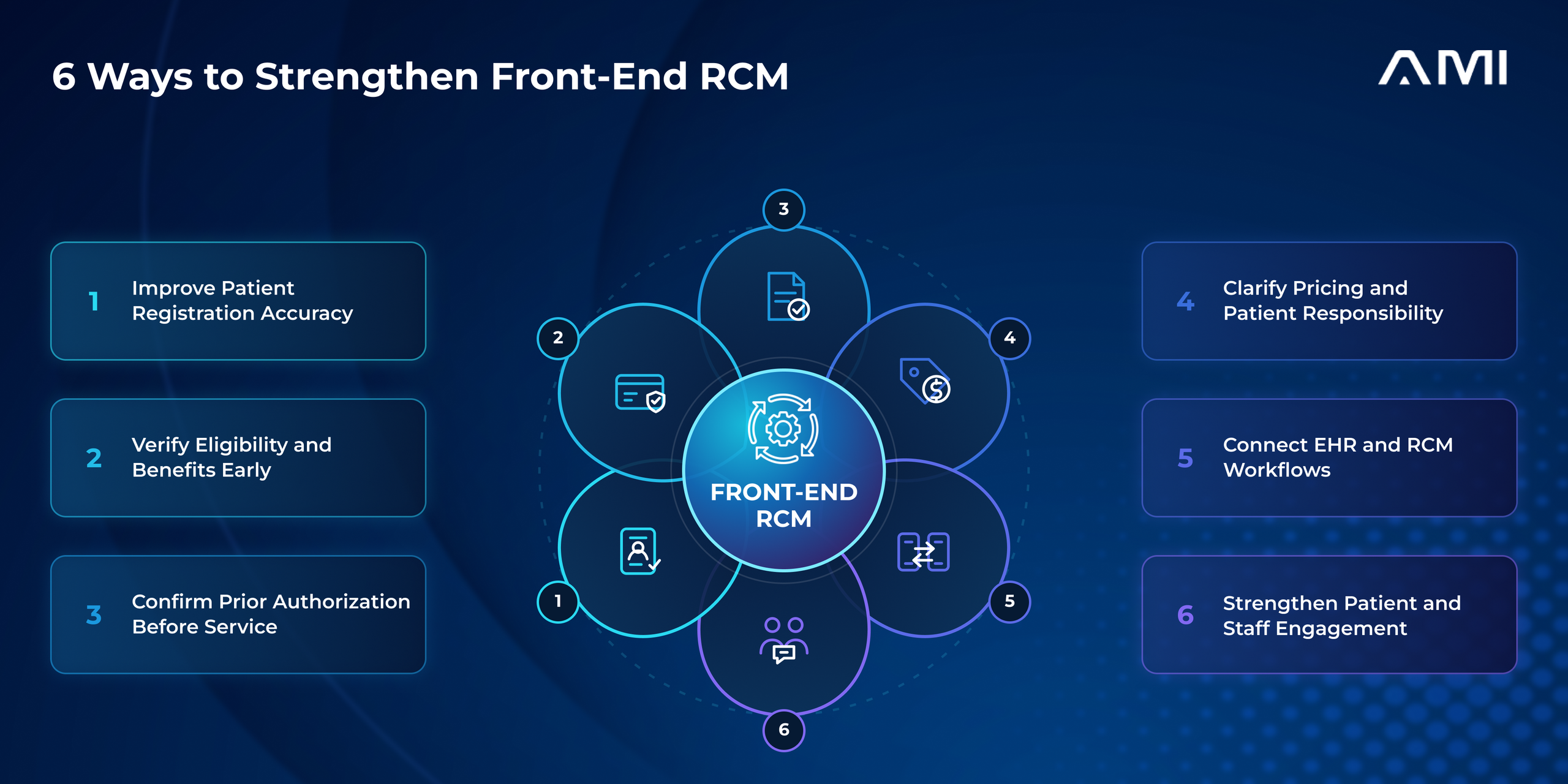
6 Strategies to Improve Front-End Revenue Cycle Management
Improving the front-end revenue cycle requires more than asking registration teams to be more careful. Providers need consistent workflows, better data, clear ownership, technology support, and feedback from downstream teams.
1. Improve Patient Registration Accuracy
Patient registration creates the demographic foundation used throughout the revenue cycle. Names, dates of birth, addresses, insurance identifiers, contact details, and guarantor information should be validated before incorrect information reaches billing.
Digital registration and patient self-service can reduce repetitive data entry, but information should still be validated before it becomes the system of record.
2. Strengthen Eligibility and Benefits Verification
Insurance coverage should be checked as close to the encounter as practical because eligibility, benefits, deductibles, and plan details can change.
Strong eligibility and benefits verification workflows should establish:
- Whether coverage is active
- Which plan is primary
- Applicable benefits
- Patient responsibility
- Referral or authorization requirements
- Exceptions requiring follow-up
This makes verification a revenue-protection activity rather than an administrative checkbox.
3. Confirm Prior Authorization Earlier
Authorization failures can create significant downstream work even when care itself was appropriate.
Front-end teams should determine whether authorization is required, confirm submission status, identify missing documentation, and establish clear ownership of unresolved requests.
The process is becoming increasingly important as CMS pushes impacted payer workflows toward faster prior authorization decisions and greater electronic exchange.
Preventive Principle: Authorization problems are easier to manage before service than after they become claim denials.
4. Make Pricing and Patient Responsibility Clear
Financial communication should begin before the statement reaches the patient.
CMS hospital price-transparency requirements continue to evolve, with updated 2026 requirements effective January 1 and enforcement beginning April 1, 2026.
Providers should combine regulatory transparency requirements with practical patient communication around estimated responsibility, available payment options, and what may change after payer adjudication.
Clear financial conversations can reduce confusion later in the cycle.
5. Connect EHR and Revenue Cycle Management Workflows
The relationship between EHR and revenue cycle management systems matters because front-end information often moves through multiple clinical, scheduling, billing, and payer systems.
Technology can support:
- Automated eligibility checks
- Demographic validation
- Authorization tracking
- Registration workflows
- Estimate generation
- Exception routing
- Work-queue prioritization
Automation should surface incomplete information rather than allow questionable data to flow downstream unchecked.
6. Strengthen Patient Engagement and Staff Accountability
Patients can help validate information, but they should not carry the entire responsibility for getting the record right.
Digital forms, portals, self-service check-in, reminders, and pre-service communication can make it easier for patients to confirm demographic, insurance, and financial information.
Staff also need clear procedures for resolving exceptions rather than simply documenting them. Training should therefore cover not only registration steps but also how front-end errors affect claims, denials, and collections.
Seeing front-end errors repeatedly become denials or aging AR? Explore AM InfoWeb’s Revenue Cycle Management services for co-managed support across eligibility, billing, denial, follow-up, and related RCM workflows.
How Front-End Errors Create Downstream Denials
Effective front-end revenue cycle management becomes easier to understand when teams trace denials backward.
Consider this sequence:
Incorrect insurance information → failed eligibility → claim submitted to wrong plan → denial → billing correction → payer follow-up → delayed payment
The denial is visible at the back end, but the root cause occurred much earlier.
This is why providers should connect denial analysis with front-end process improvement. When the same denial reason repeatedly points back to registration, eligibility, authorization, or benefit verification, the fix belongs upstream.

Want to stop front-end errors before they become denials?
AM InfoWeb helps healthcare teams connect registration, eligibility, authorization, patient communication, QA, and workflow visibility so preventable errors are resolved earlier.
What Revenue Cycle Analysis Should Track
A useful revenue cycle analysis should show whether front-end improvements are actually reducing downstream friction.
| Metric | What It Helps Reveal |
|---|---|
| Registration error rate | Demographic accuracy |
| Eligibility failure rate | Coverage-verification gaps |
| Authorization-related denials | Front-end authorization performance |
| First-pass claim rate | Overall upstream data quality |
| Front-end denial trends | Repeat process failures |
| Patient estimate accuracy | Financial communication quality |
| Rework volume | Administrative burden created downstream |
These metrics become more valuable when segmented by payer, location, service line, and error type.
How AM InfoWeb Supports Front-End Revenue Cycle Operations
AM InfoWeb combines healthcare revenue cycle expertise with a co-managed orchestration model that connects trained RCM professionals, AI-assisted workflows, QA, documentation, reporting, and client-controlled governance. Supported by SOC 2 Type II, ISO 27001, and HIPAA-aligned practices, AM InfoWeb helps healthcare organizations strengthen front-end execution while maintaining visibility into exceptions, escalations, and downstream performance.
Front-end and related RCM support can include:
- Patient registration and demographic validation
- Eligibility and benefits verification
- Authorization-related administrative support
- Billing and claim-status workflows
- Denial and AR follow-up
- QA and structured escalation
- Revenue cycle reporting and workflow visibility
Seeing front-end errors create avoidable downstream work? AM InfoWeb’s co-managed revenue cycle operations connect front-end accuracy, trained teams, QA, and workflow visibility to help reduce preventable revenue-cycle friction.
Get in TouchFinal Thoughts
Effective front-end revenue cycle management prevents small administrative errors from becoming expensive downstream problems. Accurate registration, eligibility, authorization, financial communication, connected technology, and patient engagement create a stronger foundation for the rest of the revenue cycle.
The objective is not simply faster front-end processing. It is cleaner information and clearer ownership from the first patient interaction through final reimbursement.
Frequently Asked Questions
About the Author

Written by
Urza Dey
Urza Dey is a content and copywriter with over five years of experience across marketing, B2B SaaS, HealthTech, EdTech, and related industries. At AMI, they contribute to content strategy, blog development, and marketing communication focused on healthcare operations, business process management, and AI-enabled service delivery.