
Revenue Leakage in Healthcare: Causes and Prevention Strategies
TL;DR — Where Healthcare Revenue Leakage Happens
Revenue leakage in healthcare can begin before, during, or after claim submission.
Eligibility, authorization, coding, documentation, and demographic errors can create avoidable denials.
Billing leakage may occur through missed charges, incorrect coding, underpayments, or incomplete follow-up.
Denials become more expensive when root causes are not corrected.
Aging medical AR can signal problems elsewhere in the revenue cycle.
Patient financial communication affects how much valid patient responsibility is ultimately collected.
Strong healthcare revenue protection depends on monitoring leakage by cause, payer, workflow, and account age.
Healthcare providers can deliver the right care, document the encounter, and submit a claim yet still fail to collect the full amount they are entitled to receive. Revenue leakage in healthcare occurs when earned revenue is delayed, reduced, written off, or never collected due to breakdowns anywhere in the revenue cycle.
Those breakdowns matter in an increasingly expensive operating environment. U.S. healthcare spending reached $5.3 trillion in 2024, including approximately $1.63 trillion in hospital expenditures. At the same time, hospitals spent nearly $18 billion in 2025 working to overturn claim denials alone. Effective healthcare revenue leakage prevention therefore requires more than improving medical billing. Providers need to identify where revenue is escaping and address the underlying workflow causing the loss.
What Is Revenue Leakage in Healthcare?
Revenue leakage in healthcare is the difference between the revenue a provider should reasonably collect for services delivered and the amount ultimately realized.
The loss is not always a dramatic write-off. Revenue can leak gradually through missed charges, undercoding, authorization failures, eligibility errors, avoidable denials, underpayments, aging receivables, ineffective appeals, or patient balances that are never properly resolved.
This is why revenue leakage should be viewed as a revenue-cycle problem rather than only a billing problem. The causes can originate anywhere from patient access through final account resolution.
Current Trends and Challenges Affecting Healthcare Revenue
Providers are operating in an environment where administrative requirements and payer friction can make collection increasingly difficult. The American Medical Association reported in 2026 that 74% of surveyed physicians said prior authorization denials had increased over the previous five years.
These pressures create several opportunities for healthcare revenue lost due to inefficiency:
| Current Pressure | Potential Revenue Impact |
|---|---|
| Higher denial activity | Delayed or uncollected reimbursement |
| Prior authorization complexity | Preventable claim denials |
| Staffing constraints | Missed follow-up and aging AR |
| Fragmented workflows | Duplicate work and unresolved accounts |
| Patient affordability pressure | Higher outstanding patient balances |
| More automation | Risk of scaling inaccurate processes |
The important point is that revenue loss is usually cumulative. A small eligibility error may become a denied claim, then an appeal, then an aging receivable, and eventually a write-off.
Revenue Leakage Pattern: Upstream error → claim friction → follow-up → aging → reduced recovery.
Common Revenue Leakage Points in Healthcare
Identifying the common revenue leakage points in healthcare helps revenue cycle leaders move from broad financial concerns to specific operational causes. Leakage is rarely tied to a single failure. It often builds across multiple touchpoints where incomplete information, missed follow-up, process gaps, or delayed action reduce the organization’s ability to capture revenue accurately and on time.
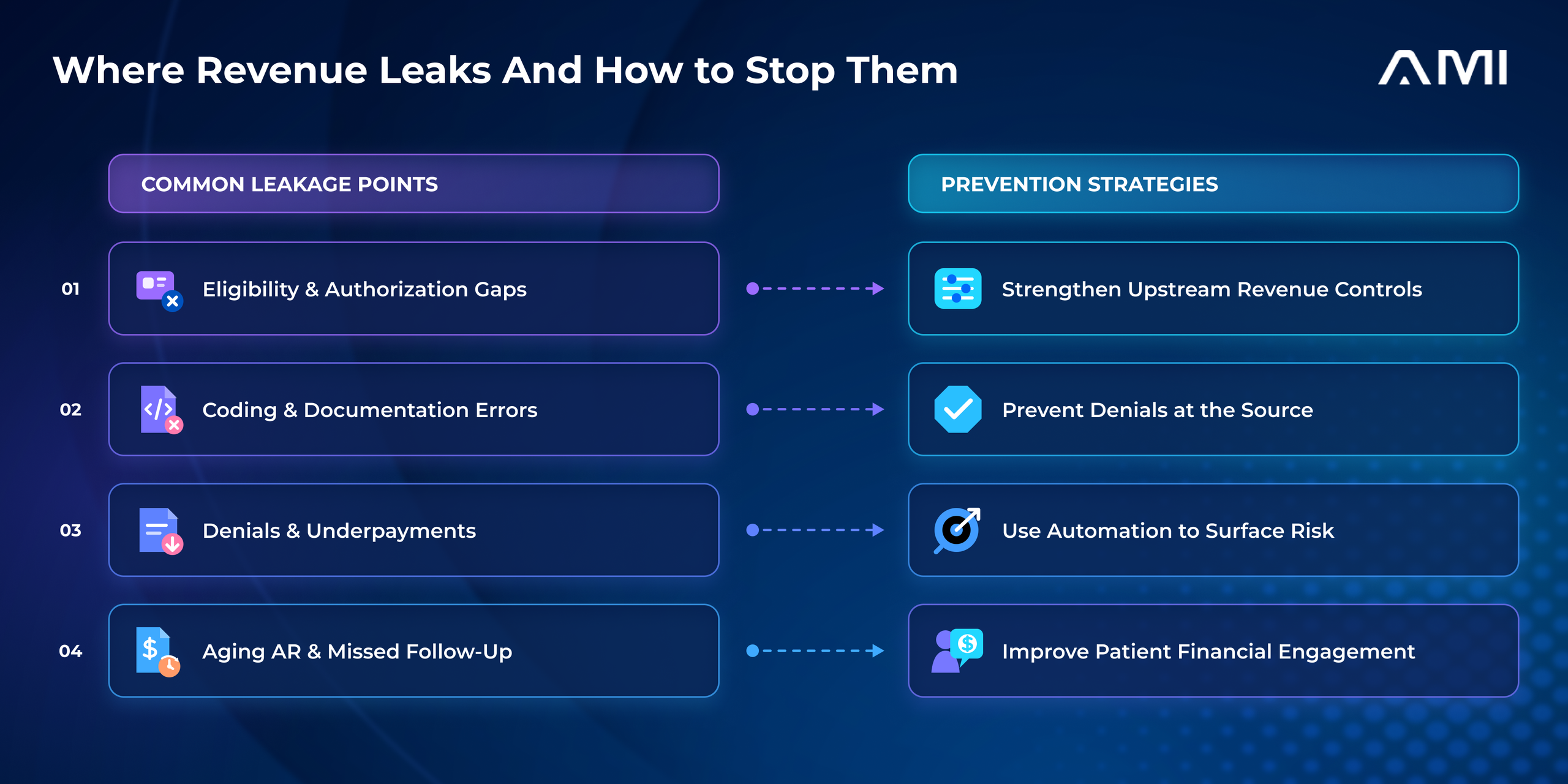
Looking at these issues by workflow stage makes it easier to identify where revenue is being lost, which teams are affected, and where stronger controls or process improvements may have the greatest impact. Leakage typically occurs across four areas:
1. Eligibility, Authorization, and Front-End Errors
Incorrect insurance information, inactive coverage, missing authorization, incomplete demographics, and benefit misunderstandings can all create problems before the claim is submitted.
These upstream issues often become expensive downstream because billing and AR teams must investigate and correct problems that could have been prevented earlier.
2. Coding, Documentation, and Billing Leakage
Billing leakage can occur when services are missed, documentation does not support the billed service, codes are incorrect, charges fail to move into billing, or claims are submitted with incomplete information.
Accurate coding and clinical documentation therefore support both compliance and reimbursement.
Regular audits can help identify recurring patterns such as missing charges, undercoding, documentation gaps, or claim edits that repeatedly prevent clean submission.
Trying to identify where revenue is getting stuck across the healthcare operation? Explore AM InfoWeb’s broader healthcare services, spanning revenue cycle, payer support, ROI, litigation support, and AI-powered contact center operations.
3. Denials and Underpayments
A denied claim is not automatically lost revenue, but it can become revenue leakage when the denial is not corrected, appealed, or prevented from recurring.
AHA estimates that hospitals spent nearly $18 billion in 2025 overturning claim denials, illustrating the administrative resources required even when payment is eventually recovered.
Strong denial workflows should track:
- Root cause
- Payer
- Denial reason
- Financial value
- Appeal deadline
- Recovery status
The same principle applies to underpayments. If expected reimbursement is not compared against actual payment, smaller discrepancies can accumulate without attracting attention.
4. Aging Medical AR and Inconsistent Follow-Up
Medical AR becomes a significant source of hospital revenue leakage when outstanding accounts continue aging without a defined resolution path.
An account should not remain in a queue simply because a previous follow-up occurred. Each touch should establish what is preventing payment, what action is required, who owns that action, and when the account should be reviewed again.
Persistent AR over 90 or 120 days can indicate more than collection weakness. It may expose problems in authorization, denials, payer communication, documentation, or work-queue prioritization.
Healthcare Revenue Leakage Prevention Strategies
Effective healthcare revenue leakage prevention focuses on correcting the causes of financial loss rather than simply increasing collection activity. That means looking beyond outstanding balances to the workflow issues creating them in the first place, such as incomplete patient information, missed eligibility checks, authorization gaps, coding or billing errors, delayed follow-up, and weak denial prevention.
The strongest prevention strategies address these issues earlier in the revenue cycle, improve accountability across teams, and use better visibility to identify recurring leakage before it turns into aged AR or lost revenue.
1. Strengthen Revenue Cycle Controls Upstream
Eligibility, authorization, charge capture, coding, and documentation should be treated as revenue-protection controls. Errors discovered before claim submission are generally easier to correct than those discovered after a denial or during AR follow-up.
2. Prioritize Denial Prevention and Root-Cause Analysis
Denial teams should identify why claims fail repeatedly as a better denial prevention tactic and feed that information back to the responsible upstream workflow. If the same denial continues appearing for the same payer, service line, location, or reason, resolving each account individually will not stop future leakage.
3. Use Automation to Surface Risk, Not Hide It
Automation can support eligibility checks, claim edits, work routing, account prioritization, documentation, and pattern detection. However, automating an inaccurate process simply allows errors to move faster. Human oversight remains important for complex denials, high-value balances, payer disputes, coding questions, and unusual reimbursement scenarios.
4. Strengthen Patient Financial Engagement
Patient responsibility is another point at which valid revenue can be difficult to collect. Clear estimates, understandable bills, financial counseling, payment options, and timely communication can reduce confusion and help patients understand what they owe and why.
Seeing persistent leakage across billing, denials, or aging receivables? Explore AM InfoWeb’s Revenue Cycle Management services for co-managed support across high-volume revenue cycle workflows.
Monitor the Right Healthcare Leakage Metrics
Providers need visibility into both financial outcomes and the operational causes behind them. Useful healthcare leakage metrics include:
| Metric | What It Can Reveal |
|---|---|
| Denial rate | Preventable claim friction |
| First-pass acceptance | Upstream billing quality |
| Days in AR | Collection speed |
| AR over 90/120 days | Aging revenue risk |
| Net collection rate | Revenue realization |
| Underpayment value | Contract or payer leakage |
| Write-off trends | Revenue no longer recovered |
Metrics become more actionable when segmented by payer, location, service line, denial type, and account age.
When Should Providers Consider Additional Revenue Cycle Support?
Persistent leakage may indicate that internal workflows no longer have enough capacity or visibility to resolve outstanding issues consistently.
Warning signs include growing AR, repeat denials, missed follow-up dates, inconsistent documentation, unresolved underpayments, staffing shortages, limited QA, and increasing work queues.
External support should not remove provider control. It should expand execution capacity while preserving policies, escalation rules, write-off authority, appeal decisions, and revenue-cycle governance.
How AM InfoWeb Supports Healthcare Revenue Protection
AM InfoWeb combines healthcare revenue cycle expertise with a co-managed orchestration model designed to strengthen billing accuracy, follow-up, denial resolution, QA, backlog management, and financial visibility. AM InfoWeb brings trained RCM professionals, AI-assisted workflows, structured reporting, and client-controlled governance together within an operating environment supported by SOC 2 Type II, ISO 27001, and HIPAA-aligned practices. AM InfoWeb’s Revenue Cycle Management practice also includes experienced healthcare professionals supporting provider operations.
Revenue cycle support can include:
- Eligibility and benefits support
- Coding and billing workflows
- Denial and appeal management
- Payer and AR follow-up
- Aging and backlog management
- QA and structured escalation
- Revenue cycle reporting and performance visibility
The objective is not simply to collect more accounts. It is to create a more controlled path from patient access through final reimbursement and reduce opportunities for revenue leakage in healthcare along the way.
Seeing revenue leak through denials, underpayments, or aging AR? AM InfoWeb’s co-managed revenue cycle operations strengthen billing, follow-up, QA, and visibility to help protect earned revenue.
Final Thoughts
Preventing revenue leakage in healthcare requires more than stronger collections. Providers need visibility into where revenue begins to break down across eligibility, authorization, coding, billing, denials, underpayments, and AR.
Effective healthcare revenue protection comes from identifying those breakdowns early, correcting recurring causes, and making sure every outstanding balance has a clear path toward resolution.
Frequently Asked Questions
About the Author

Written by
Urza Dey
Urza Dey is a content and copywriter with over five years of experience across marketing, B2B SaaS, HealthTech, EdTech, and related industries. At AMI, they contribute to content strategy, blog development, and marketing communication focused on healthcare operations, business process management, and AI-enabled service delivery.