
How Healthcare Staff Shortages Are Reshaping RCM Operations
TL;DR — What Staff Shortages Mean for RCM
A healthcare staff shortage can create slower follow-up, larger work queues, and more pressure across claims, denials, AR, patient access, and authorization.
Hiring alone may not solve the problem when administrative workload continues to grow.
RCM automation can move predictable, high-volume activities out of manual queues.
AI in healthcare RCM can help prioritize work, summarize activity, identify patterns, and surface exceptions.
Human expertise remains essential for complex denials, payer disputes, coding questions, patient conversations, and escalations.
Co-managed operations can provide additional capacity around technology without removing client governance.
Sustainable healthcare revenue cycle improvement depends on aligning workforce, workflows, technology, and accountability.
A healthcare staff shortage does more than create open positions. In revenue cycle operations, limited capacity can affect how quickly eligibility issues are resolved, authorizations are followed up, claims exceptions are worked, denials are appealed, and aging accounts receive attention. As queues grow, experienced staff can also spend more time keeping routine work moving and less time resolving the complex issues that require their expertise.
That pressure is one reason workforce design, automation, and managed capacity are becoming increasingly connected. Guidehouse and HFMA's 2026 revenue cycle research found that workforce shortages remain among the challenges affecting health systems, while 69% of surveyed leaders identified revenue cycle technology as their highest-priority investment and 69% were outsourcing at least part of their revenue cycle.
The opportunity is not to automate people out of RCM. It is to reduce repetitive workload, help teams prioritize more intelligently, and add flexible operational capacity where internal resources cannot absorb the volume.
What Is the Impact of Staff Shortage in Healthcare RCM?
The impact of staff shortage in healthcare becomes especially visible in revenue cycle functions because many activities are time-sensitive and interconnected.
A delay in one area can generate additional work elsewhere. An unresolved eligibility issue can become a claim problem. A missed authorization follow-up can create a denial. A growing denial queue can eventually increase AR. Patient billing teams may then receive more questions about balances created by unresolved payer issues.
HFMA describes revenue cycle workforce design in 2026 as increasingly inseparable from automation and operational strategy, particularly as providers face growing payer complexity and limited talent availability.
Typical signs that staffing capacity is falling behind include:
- Growing work queues
- Missed or delayed follow-up
- Higher unresolved inventory
- Increased reliance on overtime
- Limited QA coverage
- Experienced staff spending too much time on routine work
- More downstream rework from unresolved upstream issues
The challenge is therefore not simply filling vacancies. It is determining which work actually requires scarce human capacity.
Why Hiring Alone May Not Solve the RCM Staffing Problem
Recruitment remains important, but adding people to a process that depends heavily on manual activity can provide only temporary relief.
Revenue cycle workloads continue to be influenced by payer documentation requirements, denials, prior authorization, patient financial responsibility, and fragmented technology. Guidehouse's 2026 survey found that 88% of revenue cycle leaders ranked payer-related issues among their top concerns, including denials, authorization delays, documentation requests, and reimbursement pressure.
This creates a capacity problem with two sides:
The volume of work increases, while experienced staff remains limited.
A stronger response is to redesign how work is distributed:
Predictable activity → automation
Information-heavy prioritization → AI assistance
Exceptions and judgment → experienced professionals
Additional volume → co-managed capacity
That approach treats technology as a workforce multiplier rather than a substitute for domain expertise.
How Automation Helps RCM Teams Absorb More Work
RCM automation becomes useful during a staffing shortage when it removes repetitive activity from manual queues.
The goal is not to automate the entire RCM cycle in medical billing. It is to identify the portions of a workflow where staff are spending time retrieving information, updating systems, moving work, checking statuses, or performing other repeatable actions.
For example, automation can support an eligibility check, routine claim-status activity, work routing, reminders, or authorization tracking. These tasks still matter, but they do not always require the same expertise as resolving a disputed denial or interpreting an unusual payer response.
Capacity Principle: Automate the repeatable work so experienced people have more time for the work that is not repeatable.
Facing capacity pressure across multiple healthcare workflows? Explore AM InfoWeb’s broader healthcare services, spanning revenue cycle, payer support, release of information, litigation support, and AI-powered contact center operations.
Where Staffing Pressure Is Most Visible
Not every revenue cycle function experiences a staff shortage in the same way. The largest operational impact usually appears where high volume meets frequent exceptions.
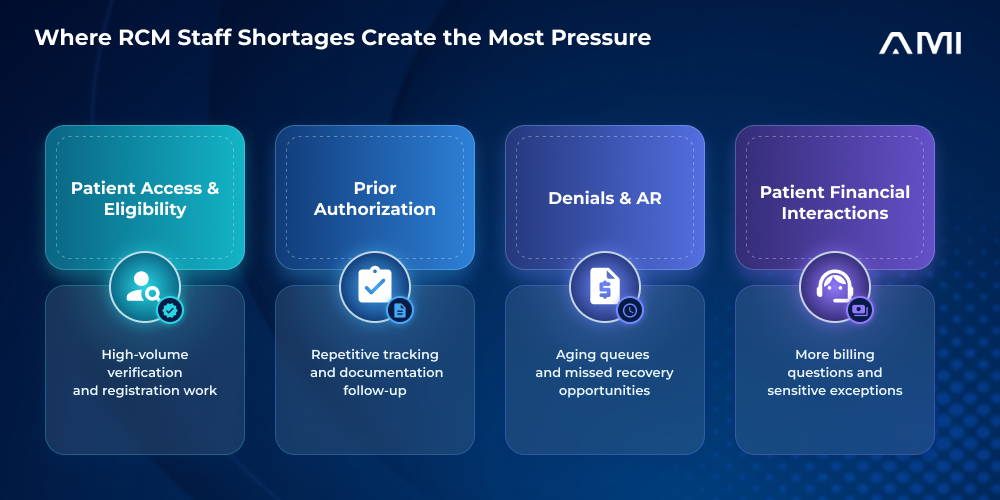
Patient access and eligibility
Front-end teams manage registration, coverage information, eligibility, benefits, and authorization requirements. When capacity is constrained, incomplete work can move downstream before anyone has time to resolve it.
Automation can help verify patient eligibility, retrieve routine coverage information, and flag records that require attention. Human teams can then concentrate on discrepancies, coordination-of-benefits questions, and unusual coverage situations.
Prior authorization administration
Authorization can consume substantial administrative capacity through documentation collection, payer portals, status checks, and follow-up. Automated prior authorization workflows can reduce manual coordination around intake, tracking, and routine status activity. Clinical decisions and complex exceptions remain with appropriate reviewers.
Denials and AR
A staffing shortage becomes difficult to hide when denials in healthcare begin aging faster than teams can resolve them.
Rather than asking a smaller team to work every account in order, automation and AI can help surface claims based on factors such as age, value, appeal deadlines, denial patterns, and previous activity. This allows experienced staff to spend more time on recovery strategy and less time sorting the queue.
Patient financial interactions
Routine reminders and balance notifications can be automated, but patient financial conversations are not always routine. Financial hardship, disputed balances, insurance confusion, and payment-plan exceptions still benefit from trained representatives who can understand context and communicate clearly.
The objective is to automate administrative repetition without automating empathy out of the process.

Why does revenue still leak after the claim is submitted?
Because small breakdowns across eligibility, coding, billing, denials, and follow-up can quietly delay cash flow. AM InfoWeb helps healthcare teams strengthen RCM operations with process discipline, trained teams, and AI-assisted execution.
How AI Helps Smaller RCM Teams Prioritize Better
AI in RCM adds another layer beyond traditional workflow automation.
Automation generally executes predefined actions. AI in healthcare RCM can help interpret information, identify patterns, summarize account history, and determine which work may deserve attention first.
Useful AI applications in RCM can include:
- Work-queue prioritization
- Denial pattern identification
- Account summarization
- Missing-information detection
- QA support
- Operational trend analysis
Oliver Wyman's 2026 RCM research found that approximately 20% to 40% of surveyed organizations already reported broad or enterprise-wide use of AI-enabled tools across parts of the revenue cycle. Experian Health separately reported that nearly two-thirds of surveyed providers were using AI somewhere in their RCM processes, while organizations remained cautious about using it for critical decisions without human oversight.
That distinction is important. AI can help teams reach the right problem faster. It does not need to make every decision itself to create meaningful workforce value.
Human Expertise Becomes More Valuable, Not Less
A common misconception is that automation solves workforce shortages by reducing the need for people. In revenue cycle operations, that oversimplifies the problem.
Some activities become more valuable when skilled professionals have more time to perform them:
- Complex denial resolution
- Appeals management
- Coding validation
- Payer escalation
- Contract-related exceptions
- Patient financial communication
- Quality review
HFMA's 2026 workforce guidance describes a layered model in which AI handles suitable high-volume processes while skilled teams retain responsibility for complexity, escalation, and patient-facing nuance.
Technology therefore changes where human expertise is spent.
The goal is not fewer people making decisions. It is fewer experienced people spending their day on work that never needed a decision in the first place.
When Automation Alone Is Not Enough
Automation can expand capacity, but a technology investment cannot solve every consequence of a healthcare staff shortage.
Organizations may still face specialist gaps, seasonal volume, persistent backlogs, limited QA capacity, or complex payer work that requires additional people. Technology can also fail to deliver the expected improvement when existing workflows are inconsistent or fragmented.
Guidehouse's 2026 research shows how frequently providers are combining approaches: 69% reported outsourcing at least part of the revenue cycle, including 67% using outside support for AR follow-up and collections, 50% for coding, and 39% for denial management.
The emerging workforce model is therefore less about choosing between automation and external support and more about deciding where each belongs.
Co-Managed Operations Can Fill the Remaining Capacity Gap
A co-managed model can add operational capacity around RCM technologies without requiring providers to give up governance.
The healthcare organization retains policies, escalation authority, performance standards, and visibility, while an integrated external team helps manage high-volume or specialized work. Automation supports repeatable activity, AI assists with prioritization and analysis, and trained professionals handle exceptions.
This creates a more resilient model during sustained staffing pressure because capacity can be distributed according to the type of work rather than relying entirely on internal hiring.
Need additional RCM capacity without giving up operational control? Explore AM InfoWeb’s Revenue Cycle Management services for co-managed support across patient access, coding, billing, denials, AR, QA, and reporting.
How AM InfoWeb Helps RCM Teams Expand Capacity
AM InfoWeb combines healthcare revenue cycle expertise with a co-managed orchestration model that brings trained RCM professionals, AI-assisted workflows, QA, reporting, and client-controlled governance together. Supported by SOC 2 Type II, ISO 27001, and HIPAA-aligned practices, the model is designed to add execution capacity while keeping exceptions, escalations, and operational performance visible to the client.
AM InfoWeb can support:
- Eligibility and patient-access operations
- Authorization-related administrative workflows
- Coding and billing support
- Claims and denial management
- AR follow-up and prioritization
- Patient financial workflows
- QA, escalation, and performance reporting
The objective is not to solve a staffing shortage by replacing the workforce. It is to create an operating model where repetitive work consumes less capacity, specialized work reaches the right people, and providers can scale without making every increase in volume another recruiting problem.
Is limited staffing turning routine RCM work into growing backlogs? AM InfoWeb’s co-managed orchestration combines trained revenue cycle teams, AI-assisted execution, QA, and operational visibility to add capacity while preserving human oversight.
Get in TouchFinal Thoughts
The impact of staff shortage in healthcare cannot be solved through recruitment alone when the underlying workload remains highly manual. Revenue cycle leaders increasingly need to rethink how work is distributed between technology, internal teams, and additional operational capacity.
Automation and AI can absorb repetitive volume and improve prioritization, while experienced professionals remain central to complex decisions and patient-facing work. Combined with a flexible workforce model, that balance can support more sustainable healthcare revenue cycle improvement even when talent remains difficult to find.
Frequently Asked Questions
About the Author

Written by
Urza Dey
Urza Dey is a content and copywriter with over five years of experience across marketing, B2B SaaS, HealthTech, EdTech, and related industries. At AMI, they contribute to content strategy, blog development, and marketing communication focused on healthcare operations, business process management, and AI-enabled service delivery.