


Accounts Receivable Management Strategy for Healthcare in 2026
TL;DR — Building a Stronger Healthcare AR Strategy
Effective accounts receivable management strategies 2026 focus on resolution, not simply account touches.
AR teams should segment receivables by age, payer, balance, denial reason, and likelihood of recovery.
Strong denial management addresses root causes before denied claims become aging AR.
AR automation can prioritize queues, surface patterns, and reduce repetitive administrative work.
Clear patient financial communication supports medical accounts receivable collection.
Days in AR, aging distribution, denial trends, collection rate, and unresolved inventory should be reviewed together.
Persistent backlogs or staffing constraints may indicate a need for specialized AR follow up services.
Healthcare organizations can deliver care, submit clean claims, and still experience cash-flow pressure when receivables are not followed through to resolution. An effective accounts receivable management strategy connects billing, payer follow-up, denial resolution, aging analysis, patient balances, and collection activity rather than treating each as a separate task.
The pressure is growing. U.S. healthcare spending reached $5.3 trillion in 2024, while hospitals continue to report substantial administrative costs associated with insurer denials and prior authorization. The American Hospital Association reported that hospitals spent nearly $18 billion in 2025 working to overturn claims denials alone. For revenue cycle teams, the challenge is therefore not simply collecting outstanding balances. It is identifying why revenue becomes stuck and resolving the problem before accounts continue to age.
What Is Accounts Receivable Management in Healthcare?
Healthcare AR includes money owed to a provider after services have been delivered and charges have entered the revenue cycle. Balances may be outstanding from commercial insurers, government programs, secondary payers, or patients.
A strong accounts receivable management strategy follows those balances from initial billing through payment, correction, appeal, collection, or appropriate resolution. Effective accounts receivable medical billing therefore depends on much more than sending a claim and waiting for reimbursement.
The accounts receivable cycle can involve claim-status checks, documentation requests, payer corrections, denial appeals, underpayment review, secondary billing, patient communication, and reconciliation. The longer unresolved balances remain in the cycle, the more difficult recovery can become.
6 Accounts Receivable Management Strategies for 2026
The most effective accounts receivable management best practices concentrate resources on the accounts most likely to affect cash flow while identifying recurring upstream problems.
Rather than treating every open balance the same way, healthcare organizations should combine account prioritization, denial prevention, technology, patient communication, and performance monitoring.
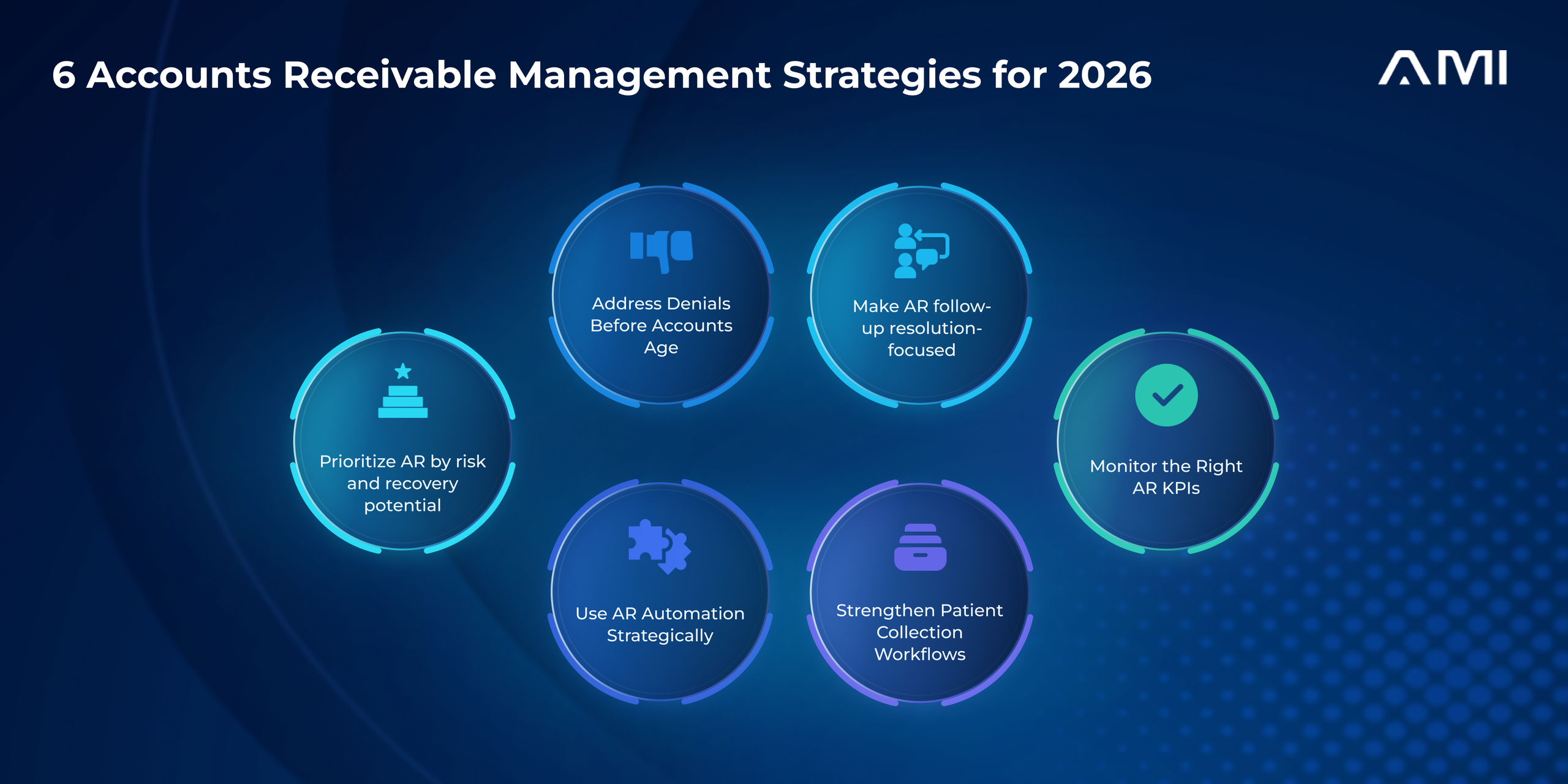
1. Prioritize AR by risk and recovery potential
An accounts receivable aging report is more useful when it drives action rather than simply showing balances in 0–30, 31–60, 61–90, and older categories.
Teams can segment work using:
- Account age and balance
- Payer and claim status
- Denial or rejection reason
- Filing and appeal deadlines
- Previous follow-up activity
- Probability and value of recovery
This approach strengthens accounts receivable risk management because teams can concentrate first on high-value or time-sensitive accounts instead of working queues sequentially.
2. Make AR follow-up resolution-focused
Effective AR follow-up should answer more than whether a claim is pending.
Every interaction should establish the current status, reason for nonpayment, required action, owner, supporting documentation, and next follow-up date. Without this discipline, teams can repeatedly touch the same account without moving it closer to payment.
A useful operating principle is simple: an AR touch should change the status of the account or clarify the next action.
Seeing more touches without faster AR resolution? AM InfoWeb’s co-managed revenue cycle operations combine structured follow-up, documentation, QA, and workflow visibility to help teams move aging accounts toward resolution.
3. Address Denials Before Accounts Age
Denials are closely connected to receivables because an unresolved denial eventually becomes aging AR. Strong denial management in medical billing therefore begins before the follow-up team receives the account.
The AMA continues to report significant administrative burden associated with prior authorization and payer denials, while the AHA has documented increasing provider resources spent contesting denied claims.
Find the root cause of medical billing denials
Recurring medical billing denials should be classified by cause rather than managed as isolated accounts. Eligibility, authorization, medical coding, documentation, demographic, timely-filing, and payer-processing issues can each require a different corrective action.
Tracking medical denial codes alongside root causes helps revenue cycle leaders see whether an issue originates upstream or within follow-up operations. A common denial in medical billing that repeatedly appears across the same payer, procedure, or location can signal a process problem that should be corrected before additional claims are submitted.
Appeal with documentation and deadlines in view
Appeals should be prioritized according to filing limits, balance value, denial reason, and documentation requirements. Clear case notes are equally important so that subsequent team members can understand what has already occurred without repeating work.
The goal of denial management should ultimately be twofold: recover appropriate revenue today and reduce preventable denials tomorrow.
4. Use AR Automation Strategically
Technology can help teams manage large receivable inventories more intelligently. AR automation can support account prioritization, status retrieval, work routing, documentation, pattern detection, and reporting.
A well-designed automated AR workflow can identify accounts requiring immediate attention while routing exceptions to trained staff. It should not remove human judgment from complex appeals, payer disputes, underpayments, or unusual account situations.
| Automation Can Support | Human Teams Should Control |
|---|---|
| Queue prioritization | Complex payer disputes |
| Routine status retrieval | Appeal decisions |
| Work routing | High-value exceptions |
| Pattern detection | Contract interpretation |
| Documentation support | Escalations and judgment |
The strongest accounts receivable solutions therefore combine automation with defined workflows, QA, and accountable human oversight.
5. Strengthen Patient Collection Workflows
Not all outstanding AR sits with insurers. Higher patient responsibility makes clear billing and payment communication increasingly important to medical accounts receivable collection.
Statements should clearly communicate the balance, reason for responsibility, payment options, and next step. Payment plans and digital payment methods can also reduce unnecessary friction where appropriate.
Better patient collections should not begin only after an account becomes overdue. Accurate eligibility, estimates, insurance processing, and financial communication earlier in the revenue cycle can reduce confusion later.
6. Monitor the Right AR KPIs
Days in AR remains an important indicator, but one metric cannot explain why receivables are aging. A stronger accounts receivable management strategy uses several measures together.
| KPI | What It Helps Reveal |
|---|---|
| Days in AR | Overall collection speed |
| AR over 90/120 days | Aging inventory risk |
| Net collection rate | Revenue actually collected |
| Denial rate | Preventable reimbursement friction |
| Appeal success | Effectiveness of denial recovery |
| AR touches per resolution | Follow-up efficiency |
| Unresolved inventory | Backlog and capacity pressure |
Trends should also be segmented by payer, service line, location, denial category, and account age. That makes it easier to distinguish a broad performance problem from a specific workflow bottleneck.
When Should Healthcare Organizations Consider AR Support?
Internal teams may need additional support when managing receivables becomes difficult without allowing backlogs, aging balances, or repeat follow-ups to increase.
Common indicators include persistent AR over 90 days, growing work queues, missed follow-up dates, staffing shortages, inconsistent documentation, high denial volumes, limited QA visibility, or teams spending too much time on routine payer contacts.
At that point, organizations may evaluate AR follow up services or decide to outsource accounts receivable services for selected workflows. External support should strengthen capacity and consistency without removing provider control over policies, escalation rules, write-offs, appeals, and revenue cycle governance.
Need additional AR capacity without giving up operational control? AM InfoWeb’s co-managed RCM operations bring trained teams, AI-assisted workflows, QA, reporting, and client oversight together across high-volume receivables work.
How AM InfoWeb Supports Healthcare Accounts Receivable Operations
AM InfoWeb supports healthcare organizations with deep revenue cycle expertise and a co-managed orchestration model designed to strengthen follow-up, documentation, denial resolution, QA, backlog management, and visibility across aging receivables. AM InfoWeb combines trained RCM professionals with AI-assisted workflows, structured reporting, and client-controlled governance so repetitive activities can move faster while experienced teams retain oversight of exceptions, escalations, and judgment-intensive accounts. Supported by SOC 2 Type II, ISO 27001, and HIPAA-aligned practices, this model helps providers expand AR capacity without giving up operational control. The objective is not simply to increase accounts receivable collection activity, but to create a clearer, more controlled path from outstanding balance to documented resolution.
AM InfoWeb’s AR management support can include:
- Payer AR follow-up and claim-status activity
- Account prioritization and aging AR management
- Denial resolution and appeal workflows
- Underpayment and exception follow-up
- Backlog and work-queue management
- Documentation, QA, and structured escalations
- AR aging, recovery, and performance reporting
Final Thoughts
A strong accounts receivable management strategy connects follow-up, denial prevention, automation, patient communication, aging analysis, and performance visibility. The goal is not to generate more AR activity, but to move outstanding balances toward the right resolution faster.
For healthcare organizations facing rising aging balances or persistent follow-up backlogs, improving the underlying workflow can be just as important as adding collection capacity.
Frequently Asked Questions
About the Author

Written by
Urza Dey
Urza Dey is a content and copywriter with over five years of experience across marketing, B2B SaaS, HealthTech, EdTech, and related industries. At AMI, they contribute to content strategy, blog development, and marketing communication focused on healthcare operations, business process management, and AI-enabled service delivery.