

Claims Denial Management: From Root Cause to Revenue Recovery
TL;DR — Building a Stronger Denial Management Strategy
Effective claims denial management combines revenue recovery with root-cause prevention.
Denials should be categorized by reason, payer, financial value, and recovery potential.
Strong denial management in RCM connects appeals activity with registration, authorization, coding, and billing improvements.
Front-end errors remain a major source of preventable denials. Experian Health found that missing documentation, coding issues, and eligibility errors rank among the leading preventable causes.
Automation can help prioritize denied accounts, identify patterns, and reduce repetitive administrative work.
Human oversight remains important for complex appeals, payer disputes, coding interpretation, and high-value exceptions.
Persistent denial backlogs or inconsistent follow-up may indicate a need for an external denial management service.
Denied claims are not just a reimbursement problem. They create rework across billing, coding, prior authorization, patient access, appeals, and accounts receivable while delaying cash that healthcare organizations have already earned. In 2025, hospitals spent nearly $18 billion overturning claims denials and about $43 billion trying to collect payments insurers owed for care already delivered, according to the American Hospital Association.
Effective claims denial management therefore needs to do more than work rejected accounts one by one. It should help teams understand why denials occur, prioritize recoverable revenue, manage appeals efficiently, and feed recurring issues back into upstream workflows. The strongest approach connects recovery with prevention, so the same errors don’t keep entering the revenue cycle.
What Is Claims Denial Management?
Claims denial management is the structured process of identifying, analyzing, correcting, appealing, and resolving denied healthcare claims while reducing the likelihood that the same problems recur.
In practice, denial management in medical billing connects several activities: denial identification, root-cause analysis, correction or appeal, documentation, payer follow-up, recovery tracking, and feedback to the workflow where the denial originated.
That last step matters. A denial caused by an eligibility error needs a different long-term fix than one caused by coding, missing authorization, documentation, or payer processing. Effective denial management in healthcare therefore treats denied claims as operational signals, not just accounts waiting for appeal.
The Current Denial Landscape in U.S. Healthcare
Claim denials continue to create significant pressure across provider organizations. Experian Health's 2026 research found that 25% of providers saw denial rates increase over the previous 12 months, while 42% saw little meaningful change. More than four in ten providers also reported that at least 10% of claims were being denied.
The administrative burden goes beyond the denied amount itself. Hospitals must spend time identifying the reason, correcting the claim, collecting additional documentation, submitting appeals, and following up with payers. AHA also reported that 70% of denied claims in one analysis were ultimately paid, but only after multiple costly reviews.
This is why denial management in US healthcare increasingly needs to balance two questions:
- Can this denial be recovered?
- What should change so the next claim does not fail for the same reason?
Where Denials Typically Begin
A denial may appear at the back end, but the underlying cause often begins earlier in the revenue cycle. Experian Health's 2026 denial research identifies incomplete documentation, coding mistakes, eligibility issues, authorization problems, and inaccurate front-end information among the most preventable denial triggers.
Common denial sources include:
- Eligibility and coverage errors
- Missing or incomplete prior authorization
- Coding and documentation problems
- Demographic or registration errors
- Duplicate or incomplete claims
- Timely-filing issues
- Payer-specific processing rules
This makes denial management a cross-functional discipline. Billing teams cannot sustainably solve a recurring registration or coding problem through appeals alone.
Trying to reduce revenue-cycle friction beyond denied claims? Explore AM InfoWeb’s broader healthcare services, spanning revenue cycle management, payer support, release of information, litigation support, and AI-powered contact center operations.
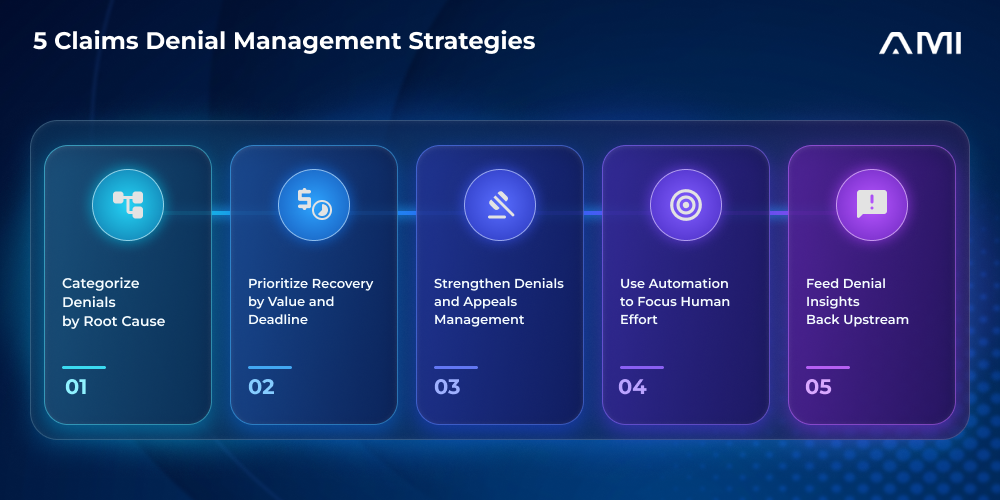
5 Strategies for Effective Claims Denial Management
Effective claims denial management should make denied inventory easier to understand, prioritize, resolve, and prevent. The objective is not simply to increase appeal volume. It is to put resources against the accounts and root causes that matter most.
1. Categorize denials by root cause
The first step is understanding why claims are failing. Broad denial counts do not tell teams whether the issue sits in registration, authorization, documentation, coding, billing, or payer processing.
Denials should be grouped by reason, payer, service line, location, and financial impact. When the same issue appears repeatedly, the pattern can point to a process weakness that should be corrected upstream.
This is where denial management solutions become more valuable than simple account follow-up: they connect individual denied claims to recurring operational causes.
2. Prioritize recovery by value and deadline
Not every denial should receive the same level of attention. Teams may be managing thousands of accounts with different balances, appeal deadlines, payer rules, documentation requirements, and recovery probabilities.
Prioritization should consider factors such as financial value, filing limits, denial reason, previous activity, and likelihood of recovery. This helps teams focus first on claims where timely intervention can make the greatest financial difference.
A high-value denial approaching an appeal deadline should not sit behind a lower-value account simply because it entered the queue later.
3. Strengthen denials and appeals management
Strong denials and appeals management requires more than submitting an appeal letter. Teams need complete supporting documentation, clear case notes, payer-specific requirements, and visibility into what has already occurred.
Appeals should also be tracked through final resolution so organizations can understand which denial types are being overturned and where recovery efforts are consuming disproportionate time.
Recent OIG findings in Medicare Advantage show why appeal visibility matters: in one 2024 review of skilled nursing facility prior authorization denials, only 18% were appealed, yet 95% of those appealed denials were overturned.
The lesson is not that every denial should automatically be appealed. It is that organizations need enough data to identify which denials merit escalation and which recurring patterns require broader intervention.
4. Use automation to focus human effort
Denial management automation can help teams manage large inventories by organizing denied claims, identifying patterns, prioritizing work, summarizing account history, and routing cases based on defined criteria.
A well-designed automated denial management workflow can reduce repetitive administrative work while keeping experienced staff focused on complex appeals, payer disputes, coding questions, and high-value exceptions.
AI can also support prioritization. Experian Health describes AI-enabled denial workflows that use historical patterns to identify high-value resubmissions and highlight claims most likely to benefit from intervention.
Automation Principle: Use technology to reduce sorting and searching, not to remove accountable human judgment from complex denial decisions.
5. Feed denial insights back upstream
The most valuable denial analysis changes future claims.
If authorization-related denials are rising, teams should examine the authorization workflow. If coding issues recur, the feedback belongs with coding and documentation teams. If registration errors are driving denials, patient-access processes need attention.
Experian Health's 2026 research found that 50% of healthcare organizations see front-end accuracy as a key opportunity to reduce denials, reinforcing the importance of connecting denial data back to upstream operations.
This creates a continuous improvement loop:
Denial identified → root cause classified → claim resolved → upstream workflow corrected → future denial risk reduced

Why does revenue still leak after the claim is submitted?
Because small breakdowns across eligibility, coding, billing, denials, and follow-up can quietly delay cash flow. AM InfoWeb helps healthcare teams strengthen RCM operations with process discipline, trained teams, and AI-assisted execution.
How AI Supports Denial Management Without Replacing Human Oversight
AI is becoming more relevant to denial management in RCM because denied claims generate large volumes of structured and unstructured information. Technology can help identify patterns that are difficult to see when teams are working accounts individually.
AI-assisted workflows may support denial classification, account prioritization, document summarization, missing-information detection, appeal preparation, and trend analysis. AR denial management automation can also help connect denied claims with aging and recovery data so teams can prioritize work more intelligently.
Human review remains essential where decisions involve coding interpretation, payer contracts, clinical documentation, high-value disputes, or complex appeals. That distinction is especially important as policymakers scrutinize the use of AI in coverage and denial decisions. In July 2026, the AMA backed proposed legislation requiring physician oversight of certain AI-assisted Medicare Advantage prior authorization denials.
For providers, the strongest model is AI-assisted execution with clear human accountability.
What to Measure in Denial Management
Denial rate alone does not show whether the process is improving. Leaders also need visibility into recovery, aging, causes, and the administrative effort required to resolve denied claims.
Useful measures include:
- Initial denial rate
- Denial dollars by payer and reason
- Appeal volume and success
- Average days to resolution
- Preventable-denial percentage
- Denied AR aging
- Recovery rate
- Repeat denial causes
These measures help distinguish between a team that is processing more denial work and one that is actually reducing financial leakage and recurring rework.
When Should Providers Consider Denial Management Support?
Internal teams may need additional support when denied inventory grows faster than available capacity or when recovery efforts become inconsistent across payers, service lines, or locations.
Common warning signs include persistent denial backlogs, missed appeal deadlines, inconsistent documentation, limited root-cause reporting, high-value claims aging without resolution, or staff spending too much time on routine payer follow-up.
At that point, organizations may evaluate a denial management service or decide to outsource denial management services for selected workflows. A denial management service in USA healthcare operations should provide more than additional account touches; it should strengthen prioritization, documentation, QA, reporting, and escalation while the provider retains authority over policies, write-offs, and complex decisions.
Need additional denial recovery capacity without giving up revenue-cycle control? Explore AM InfoWeb’s Revenue Cycle Management services for co-managed support across denials, appeals, AR, billing, QA, and reporting.
How AM InfoWeb Supports Claims Denial Management
AM InfoWeb combines healthcare revenue cycle expertise with a co-managed orchestration model designed to strengthen denial analysis, follow-up, appeals, QA, backlog management, and operational visibility. AM InfoWeb brings trained RCM professionals, AI-assisted workflows, structured reporting, and client-controlled governance together so routine activity can move efficiently while experienced teams retain oversight of complex exceptions and judgment-intensive claims.
Supported by SOC 2 Type II, ISO 27001, and HIPAA-aligned practices, AM InfoWeb’s denial management support can include:
- Denial identification and root-cause categorization
- Appeal preparation and follow-up
- Payer status and exception management
- Denied AR prioritization
- Backlog and work-queue management
- QA, documentation, and structured escalation
- Denial trend, recovery, and performance reporting
The objective is not simply to increase the number of appeals submitted. It is to create a more controlled path from denial identification to revenue recovery while feeding recurring insights back into the broader revenue cycle.
Are the same denials returning month after month? AM InfoWeb’s co-managed RCM operations combine denial recovery, root-cause analysis, AI-assisted workflows, QA, and trained teams to reduce repeat work and strengthen revenue recovery.
Get in TouchFinal Thoughts
Strong claims denial management turns denied claims into more than recovery work. It gives healthcare organizations visibility into where the revenue cycle is breaking and which operational changes can prevent the same problems from recurring.
The goal is not simply to appeal more denials. It is to recover appropriate revenue faster, reduce unnecessary rework, and use denial intelligence to strengthen the broader revenue cycle.
Frequently Asked Questions
About the Author

Written by
Urza Dey
Urza Dey is a content and copywriter with over five years of experience across marketing, B2B SaaS, HealthTech, EdTech, and related industries. At AMI, they contribute to content strategy, blog development, and marketing communication focused on healthcare operations, business process management, and AI-enabled service delivery.