
Hospital Compliance: Prevent Operational Gaps Across Teams and Vendors
TL;DR: Hospital Compliance
Hospital compliance is an enterprise operating responsibility shared across departments.
Cross-functional handoffs can hide authorization, access, documentation, and vendor gaps.
High-risk workflows need coordinated controls and reliable evidence.
Access governance should cover provisioning, transfers, privileged use, and termination.
Monitoring should combine metrics, audits, sampling, reports, and incident trends.
Corrective actions require accountable owners, deadlines, validation, and recurrence checks.
Hospitals coordinate clinical care, patient access, billing, technology, records, contractors, and outside vendors. That complexity makes compliance an operational responsibility shared across the enterprise, not a task owned by one department.
Hospital compliance programs are strongest when policies connect to clear workflows, evidence, monitoring, and escalation. Leaders need visibility into how controls perform at the points where information and responsibility change hands.
Need support for controlled healthcare operations? Explore AMI’s healthcare services.
What Does Hospital Compliance Include?
Hospital compliance can encompass patient privacy, information security, billing integrity, documentation, quality, workplace conduct, exclusion screening, vendor oversight, emergency preparedness, and other federal and state obligations.
Requirements vary by facility and activity. An effective program identifies applicable obligations, translates them into role-specific procedures, and documents how leaders monitor performance.
Why Are Hospitals Vulnerable to Cross-Department Compliance Gaps?
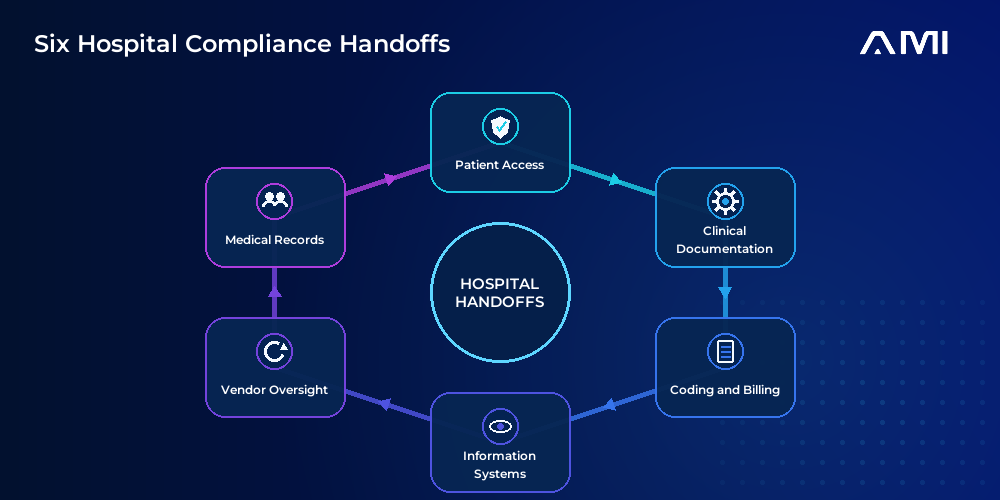
One patient journey can involve registration, clinicians, laboratories, coding, billing, records, call centers, and external partners. If each team manages only its own step, critical assumptions may go untested at handoffs.
Common gaps include incomplete authorization, excessive access, missing documentation, inconsistent escalation, unverified vendors, and unresolved exceptions. Local workarounds can hide risk from enterprise reporting.
Which Operational Areas Require Coordinated Controls?
Hospitals should map controls around high-volume and high-risk workflows.
| Operational area | Example risk | Coordinated control |
|---|---|---|
| Patient access | Incorrect or excessive disclosure | Identity and authorization checks |
| Clinical documentation | Incomplete support for services | Completion and escalation rules |
| Coding and billing | Unsupported or inaccurate claims | Validation and quality review |
| Information systems | Inappropriate access | Role-based access governance |
| Vendors | Uncontrolled data handling | Risk-tiered oversight |
| Records | Missing or delayed fulfillment | Request tracking and QA |
How Can Hospitals Improve Documentation Compliance?
Procedures should identify what must be recorded, by whom, by when, and in which system. Required fields and standardized reasons reduce ambiguity, while exception queues help leaders follow up before gaps affect care, billing, or disclosure.
Documentation quality should be sampled for completeness and consistency. Findings need feedback loops to the teams that control the source process.
How Should Hospitals Control Workforce Access?
Access should reflect job responsibilities and change promptly when roles change. Hospitals need reliable provisioning, transfer, privileged-access, emergency-access, and termination processes.
Periodic reviews should investigate unusual privileges and shared or dormant accounts. The broader healthcare data security solutions framework can help connect these controls to monitoring and resilience.
What Does Effective Hospital Vendor Oversight Require?
Hospitals should identify which vendors receive data, connect to systems, enter facilities, or influence regulated workflows. Oversight should address due diligence, agreements, access, subcontractors, incidents, continuity, monitoring, and termination.
Review depth should reflect risk. Evidence should show that identified issues were accepted, mitigated, transferred, or escalated by an authorized owner.
Need reliable execution across complex healthcare handoffs? Explore AM Infoweb.
How Should Hospitals Monitor Compliance Performance?
Monitoring combines routine metrics, targeted audits, quality sampling, employee reports, incident trends, and corrective-action tracking. Leaders should prioritize signals that reveal whether controls operate, not simply whether policies exist.
Useful segmentation includes department, workflow, location, vendor, issue type, severity, and recurrence. A healthcare data security risk assessment can support risk-based testing priorities.
How Can Hospitals Manage Compliance Incidents?
Teams need defined intake, triage, preservation, investigation, escalation, remediation, and closure procedures. Records should distinguish observed facts, analysis, decisions, communications, and follow-up actions.
After closure, leaders should examine whether the event reflects an isolated error or a repeatable workflow weakness. Corrective actions require owners, deadlines, validation, and recurrence monitoring.
The hospital response model should align with broader healthcare cybersecurity compliance controls. Leaders can also apply lessons from payer compliance solutions when translating policy obligations into traceable operational evidence.
Which Hospital Compliance Metrics Matter?
Track documentation defects, access-review exceptions, vendor assessments overdue, incident response time, corrective-action aging, repeat findings, disclosure accuracy, training completion, claim-quality findings, and open high-risk issues.
The OIG General Compliance Program Guidance provides an authoritative reference for healthcare compliance programs. Hospitals should apply requirements with qualified legal and compliance guidance.

Why do healthcare security gaps persist despite strong policies?
Because patient data moves across teams, systems, and vendors where access, disclosure, and documentation controls can fail. AMI brings PHI-aware workflows, trained teams, QA, and operational visibility together to strengthen security across every handoff.
How AM Infoweb Supports Hospital Compliance Operations
AM Infoweb has two decades of experience in the U.S. healthcare industry and uses a co-managed model where AI agents and skilled human agents work together to eliminate process bottlenecks and execute secure healthcare workflows.
AMI can support:
- Secure patient and administrative workflows
- Documentation and authorization checks
- Exception queue management
- Vendor and stakeholder coordination
- Quality assurance and sampling
- Evidence organization and retrieval
- Escalation tracking and operational reporting
Hospital leaders retain responsibility for clinical decisions, legal interpretation, investigations, risk acceptance, and final compliance determinations.
How Can Hospitals Prevent Compliance Gaps?
Hospitals can reduce operational compliance gaps by mapping responsibilities across departments, embedding evidence into workflows, governing access and vendors, monitoring meaningful exceptions, and validating corrective actions. Coordination is the control that keeps individual safeguards connected.
Need more accountable hospital compliance operations? AMI combines secure workflows, skilled teams, quality assurance, evidence controls, and reporting across complex healthcare handoffs.
Get in TouchFrequently Asked Questions
About the Author

Written by
Urza Dey
Urza Dey is a content and copywriter with over five years of experience across marketing, B2B SaaS, HealthTech, EdTech, and related industries. At AMI, they contribute to content strategy, blog development, and marketing communication focused on healthcare operations, business process management, and AI-enabled service delivery.