
Payer Compliance Solutions: From Policy to Operational Evidence
TL;DR — Payer Compliance Requires Proof of Execution
Policies define what should happen; operational evidence proves what actually happened.
Payer compliance solutions combine controls, documentation, QA, vendor safeguards, monitoring, and reporting.
Claims compliance requires transaction-level evidence, not only aggregate performance reports.
Healthcare data security must cover access, transmission, retention, vendors, audit logs, and incident response.
Third-party HIPAA compliance affects payers whenever vendors or business associates handle PHI.
Audit readiness is strongest when evidence is created during daily work rather than assembled before an audit.
AI can surface documentation gaps and recurring exceptions, but human governance remains responsible for compliance decisions.
AM InfoWeb supports co-orchestrated payer operations with secure workflows, QA, documentation, escalation controls, and leadership visibility.
A payer compliance program may look complete on paper while still breaking down during daily execution. Policies may state that claims are reviewed, access to PHI is restricted, vendor activity is monitored, and exceptions are escalated. But when auditors or leaders ask what happened in a specific case, the organization needs evidence: who performed the work, which control was followed, what exception occurred, and how it was resolved.
Effective payer compliance solutions connect written expectations with repeatable workflows, case-level documentation, QA, monitoring, and reporting. They help payer organizations prove that approved controls are being followed across claims, enrollment, provider data, member support, vendor operations, and PHI-sensitive processes.
Why Payer Compliance Must Move Beyond Written Policies
Payer organizations operate across claims, enrollment, eligibility, provider data, prior authorization, appeals, grievances, member support, provider inquiries, payment workflows, and third-party operations. Each function may have approved procedures, yet compliance risk appears when those procedures are applied inconsistently or cannot be demonstrated later.
A policy may require an escalation when a claims exception meets a specific threshold. If the case record does not show when the exception was identified, who reviewed it, or why the final action was taken, the policy has not produced reliable evidence.
The same problem appears when provider data is updated without validation, member information is discussed without sufficient verification, or vendor work is reported only through high-level summaries. Compliance becomes operational only when the rule is embedded into the workflow and leaves a reviewable trail.
What Are Payer Compliance Solutions?
Payer compliance solutions are the systems, processes, controls, reporting practices, vendor safeguards, QA programs, and operating workflows used to support regulatory, contractual, claims, data-security, and audit requirements.
They may include role-based permissions, case documentation standards, claims review controls, exception logs, access monitoring, vendor oversight, quality scorecards, escalation rules, corrective-action tracking, and compliance reporting.
The objective is not to create more paperwork. It is to make required controls visible in the way payer work is performed. Leaders should be able to trace a claim, member inquiry, provider update, or vendor-supported case from intake through review, escalation, resolution, and closure.
Policy vs. Operational Evidence
Payer leaders need to distinguish between the rule, the mechanism that applies it, and the proof that the mechanism worked.
| Compliance layer | What it shows | Payer example |
|---|---|---|
| Policy | What should happen | Claims exceptions must receive additional review |
| Operational control | How the requirement enters the workflow | The system routes identified exceptions into a review queue |
| Operational evidence | What happened in a specific case | Reviewer, action, timestamp, exception reason, QA result, and resolution are documented |
Policy provides direction, but operational evidence supports accountability. It also helps leaders determine whether an isolated error occurred or whether a control is failing repeatedly across a workflow.
Where Compliance Risk Appears in Payer Operations
Compliance risk can emerge wherever member, provider, claims, payment, or health information is handled.
Claims may move forward without the required review. Provider-data changes may be accepted without validation. Member information may be disclosed before identity checks are completed. Case notes may omit the reason for a decision or fail to identify the next owner.
Manual workarounds create additional exposure when employees move information outside approved systems. Vendor-supported workflows may also create visibility gaps if the payer cannot review access, QA, escalations, or case-level documentation.
The common issue is not always the absence of a policy. It is the inability to show that the policy operated consistently under real workload conditions.
Claims Compliance Requires Transaction-Level Evidence
Claims compliance means claims are processed, reviewed, documented, corrected, and escalated according to applicable requirements, contracts, payer policies, and workflow rules.
Aggregate reports may show total claim volume or turnaround, but they do not explain whether the correct control was applied to an individual transaction. Case-level evidence should show the claim or case reference, processing status, review action, control applied, documentation received, exception reason, escalation owner, resolution date, QA result, and any correction or rework.
This evidence allows compliance and operations teams to trace decisions and identify patterns. For example, repeated rework for one exception type may reveal unclear guidance, weak training, a system configuration problem, or inconsistent documentation.
Healthcare Data Security as a Payer Requirement
Payer workflows involve member demographics, eligibility data, claims, benefits, provider information, payment details, and PHI. Protecting that information requires controls across access, transmission, storage, retention, disclosure, and incident response.
The HIPAA Security Rule establishes standards for protecting ePHI and requires appropriate administrative, physical, and technical safeguards to preserve its confidentiality, integrity, and availability.
For payer operations, this means access should align with job responsibility, sensitive files should move through approved channels, activity should be traceable, and vendors should not receive broader access than their work requires.
Security evidence may include access approvals, account reviews, transmission records, audit logs, disclosure documentation, incident records, and proof that outdated permissions were removed.
Healthcare Data Security Standards Payers Should Understand
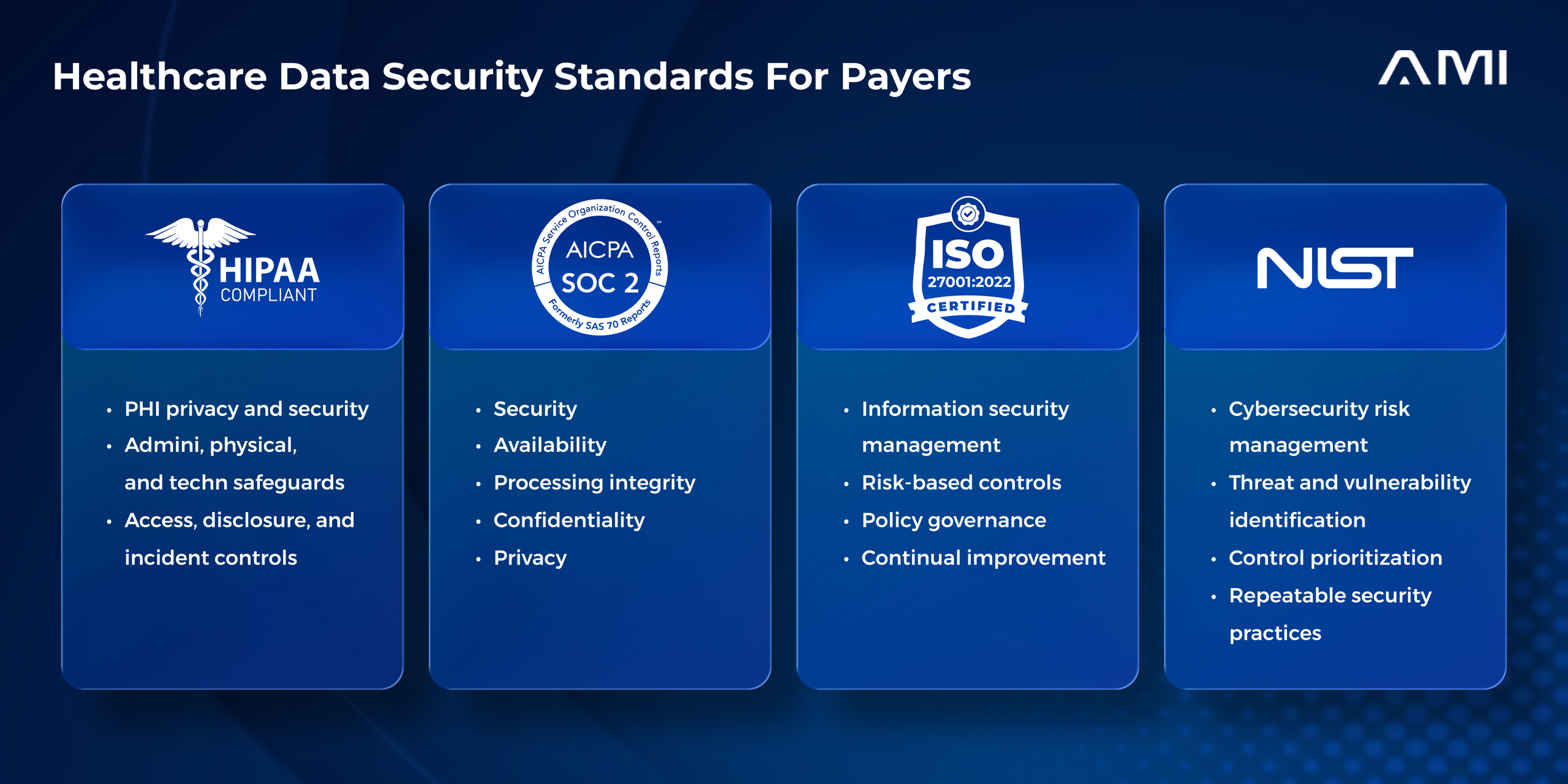
Relevant healthcare data security standards play different roles in the compliance environment.
HIPAA establishes privacy and security requirements for protected health information. SOC 2 examinations evaluate controls at service organizations relevant to security, availability, processing integrity, confidentiality, or privacy. ISO/IEC 27001 defines requirements for establishing, maintaining, and continually improving an information security management system.
NIST frameworks can also help organizations manage cybersecurity and privacy risk through structured, repeatable processes.
These standards and reports can support assessment, but they do not automatically prove that every payer workflow is controlled. Leaders still need evidence tied to the systems, teams, vendors, and processes within scope.
Data Security Risk Assessment for Payer Workflows
A data security risk assessment examines where member and provider information lives, who can access it, how it moves, which vendors handle it, and where safeguards may be insufficient.
The review should cover claims and enrollment systems, provider-data platforms, contact center tools, file transfers, reporting exports, shared drives, vendor queues, user permissions, audit logs, and data-retention practices.
HHS guidance states that HIPAA risk analysis should assess potential risks and vulnerabilities affecting the confidentiality, integrity, and availability of ePHI. It should be documented, and the resulting risks should feed corrective action and risk-management work.
A useful assessment follows actual data movement. It should test whether an approved control remains effective when information moves from a payer platform to a vendor, into a manual review queue, and back into the payer’s reporting environment.
Third-Party HIPAA Compliance and Vendor Risk
Payers often depend on contact centers, claims vendors, analytics providers, records teams, cloud platforms, and administrative partners. If these organizations create, receive, maintain, or transmit PHI on behalf of a covered entity or another business associate, they may qualify as business associates.
HHS explains that business associates perform certain functions or services involving PHI and may include subcontractors handling PHI for other business associates. Appropriate written agreements and safeguards are part of that relationship.
Strong third-party HIPAA compliance oversight should examine the vendor’s permitted uses of PHI, role-based access, workforce training, confidentiality policies, incident response, subcontractor controls, audit log availability, retention and disposal practices, security reports, and compliance reporting cadence.
A BAA or certification supports due diligence, but leaders should also ask the vendor to demonstrate a real workflow from intake through processing, QA, escalation, and closure.
Operational Controls That Strengthen Audit Readiness
Audit readiness should be created during normal operations rather than reconstructed shortly before a review.
Useful operational controls include role-based access, mandatory case-note fields, defined SOPs, QA scorecards, escalation triggers, exception logs, turnaround tracking, approved communication templates, vendor reviews, corrective action plans, and audit trail checks.
Each control should answer four questions:
- What requirement does it support?
- Where is it applied in the workflow?
- What evidence does it create?
- Who reviews whether it is working?
When those answers are unclear, the control may exist in policy but remain difficult to defend operationally.
Compliance Monitoring: From Reactive to Proactive
Compliance monitoring helps payer organizations identify patterns before they become audit findings, member complaints, provider disputes, or security incidents.
Monitoring may combine QA error rates, claims exceptions, rework reasons, escalation volume, documentation completeness, SLA misses, vendor issue trends, access-review findings, PHI-handling exceptions, and corrective-action closure.
The goal is not to collect every possible metric. It is to identify repeated control failures and determine whether the root cause is training, system design, workload, policy ambiguity, vendor performance, or weak ownership.
A single incomplete case note may be an isolated error. A recurring documentation defect across one queue is evidence of a larger operating problem.
How Payer Leaders Should Report Compliance Evidence
Executives need a concise view of risk, ownership, and progress rather than raw case data.
A monthly compliance operating review can show high-risk workflows, open control gaps, claims-exception trends, vendor status, overdue corrective actions, audit-readiness concerns, access-review results, and recurring PHI-handling issues.
The report should distinguish volume from risk. A workflow with fewer cases may still require leadership attention when the potential impact of an error is high.
It should also identify what changed since the prior review. Evidence is more useful when leaders can see whether the control environment is improving, remaining stable, or deteriorating.
Common Mistakes That Weaken Payer Compliance
One of the most common mistakes is treating compliance as a policy-management exercise owned only by legal or compliance teams.
Other weaknesses include inconsistent case documentation, unclear process ownership, limited QA feedback, weak vendor oversight, outdated user access, poor root-cause analysis, and incomplete claims-exception tracking.
Audit preparation also becomes harder when teams attempt to assemble evidence retrospectively. If employees must search emails, personal notes, and disconnected spreadsheets to explain a case, the workflow is not producing reliable evidence.
A practical test is to compare one policy against five recently completed cases. When the organization cannot show how the policy was applied, the issue lies in control design or execution, not merely document retention.
Where AI Can Support Payer Compliance Operations
AI-assisted workflows can help identify missing case fields, flag unusual claims patterns, categorize vendor issues, summarize QA findings, and surface recurring exception themes across high volumes of work.
They can also support monitoring by prioritizing cases that may require human review and helping leaders compare trends across teams, workflows, or vendors.
AI should not replace compliance governance, investigation, or final audit judgment. Its role is to improve visibility and direct attention. Trained reviewers remain responsible for interpreting exceptions, validating evidence, determining corrective action, and making compliance decisions.

Why do healthcare security gaps persist despite strong policies?
Because patient data moves across teams, systems, and vendors where access, disclosure, and documentation controls can fail. AM InfoWeb brings PHI-aware workflows, trained teams, QA, and operational visibility together to strengthen security across every handoff.
How AM InfoWeb Supports Payer Compliance Operations
AM InfoWeb supports payer organizations with co-managed operations designed to turn compliance expectations into measurable workflow execution.
Across claims support, provider data, member and provider inquiries, payer back-office operations, and PHI-sensitive workflows, AM InfoWeb combines trained healthcare teams, secure processes, QA, escalation support, documentation discipline, and reporting visibility.
AM InfoWeb support may include:
- Payer operations and claims-status support
- Claims compliance workflow execution
- Provider-data and member-support operations
- PHI-aware handling and role-based discipline
- SOC 2 Type II and ISO 27001:2022 certified delivery environment
- QA checks for accuracy and completeness
- Exception and escalation tracking
- Audit-trail and case documentation support
- Compliance monitoring and operational reporting
- Corrective-action visibility
- Co-managed execution with client oversight
Need clearer proof that payer controls work in practice? AM InfoWeb’s co-orchestrated payer operations connect secure workflows, QA, documentation, monitoring, and oversight across every process.
Get in TouchFinal Thoughts
Written policies are necessary, but they do not prove that payer workflows are operating as intended. Strong payer compliance solutions turn expectations into transaction-level controls, traceable evidence, continuous monitoring, vendor accountability, and leadership visibility across claims, member, provider, data-security, and back-office operations.
Frequently Asked Questions
About the Author

Written by
Urza Dey
Urza Dey is a content and copywriter with over five years of experience across marketing, B2B SaaS, HealthTech, EdTech, and related industries. At AMI, they contribute to content strategy, blog development, and marketing communication focused on healthcare operations, business process management, and AI-enabled service delivery.