
Healthcare Data Security Risk Assessment: Identify Gaps Early
TL;DR — Risk Assessment Should Lead to Action
A data security risk assessment maps where sensitive information is stored, accessed, transmitted, processed, and disclosed.
A HIPAA risk analysis focuses specifically on potential risks and vulnerabilities affecting the confidentiality, integrity, and availability of ePHI.
Effective assessments examine systems, workforce access, vendors, encryption, audit trails, incident response, and operational workflows.
Risks should be prioritized by likelihood, patient impact, compliance exposure, operational disruption, and urgency.
Vendor risk management should assess what PHI third parties access, why they need it, and how they protect, retain, and delete it.
Findings should produce assigned owners, remediation deadlines, supporting evidence, and follow-up reviews.
AM InfoWeb supports security-aware, co-orchestrated healthcare operations with PHI controls, QA, documentation, and leadership visibility.
A data security risk assessment helps healthcare organizations identify weaknesses before they develop into patient privacy incidents, compliance exposure, or operational disruption. Most security problems do not appear without warning. They often begin as excessive permissions, outdated accounts, weak vendor controls, unsecured file sharing, incomplete audit logs, missing encryption, or patient data moving through poorly documented workflows.
Finding these gaps requires looking beyond networks and applications. Healthcare leaders must understand where PHI and ePHI live, who can access them, how information moves between teams and vendors, which safeguards are working, and where daily execution differs from written policy.
What Is a Data Security Risk Assessment in Healthcare?
A data security risk assessment is a structured review of where sensitive healthcare information is stored, accessed, transmitted, processed, disclosed, and protected.
In healthcare, its scope may include electronic medical records, billing systems, claims platforms, contact center applications, shared drives, reporting tools, medical record workflows, payer files, secure portals, vendor environments, and manual processes involving PHI.
The assessment identifies threats and vulnerabilities, evaluates existing safeguards, estimates the potential impact of control failures, and determines which gaps require remediation.
Under the HIPAA Security Rule, regulated entities must conduct an accurate and thorough assessment of potential risks and vulnerabilities affecting the confidentiality, integrity, and availability of ePHI.
Why Risk Assessments Matter Before a Security Breach
The purpose of an assessment is not simply to satisfy a compliance requirement. It is to identify weak controls while leaders still have time to correct them.
An unreviewed user account may allow a former employee to retain access. A vendor may transmit records securely but retain downloaded copies longer than necessary. A contact center may have strong system controls but inconsistent caller verification. A records team may use approved tools while failing to document disclosures clearly.
Any of these gaps could contribute to a security breach in healthcare or make an incident harder to investigate and contain. Risk assessments help leaders prioritize remediation, improve vendor oversight, reduce avoidable PHI exposure, and strengthen operational resilience.
HIPAA Risk Analysis vs. General Security Assessment
A HIPAA risk analysis focuses on potential risks and vulnerabilities to ePHI under the HIPAA Security Rule. It examines whether safeguards appropriately protect the confidentiality, integrity, and availability of electronic health information.
A broader security assessment may also examine enterprise applications, networks, workforce behavior, physical access, third-party systems, business continuity, operational processes, and information that falls outside the HIPAA-defined ePHI scope.
The two exercises can support one another, but they are not automatically interchangeable. The ONC and HHS Office for Civil Rights provide a Security Risk Assessment Tool intended to guide smaller and medium-sized providers through a HIPAA Security Rule assessment, including threats, vulnerabilities, assets, and vendor management.
How to Conduct a Healthcare Data Security Risk Assessment
A useful assessment follows patient data across the organization rather than reviewing each system in isolation. The following steps help leaders connect technology, workforce activity, vendors, and operational execution.
Step 1: Map where healthcare data lives and moves
Start by documenting the full lifecycle of patient information. This includes where data enters the organization, which systems process it, who uses it, where it is exported, and how it is retained or deleted.
The map should cover:
- Types of PHI and ePHI collected, the systems and locations where they are stored, and the teams that access them
- Data movement through EMRs, claims tools, contact centers, billing platforms, reporting systems, portals, email, file transfers, and manual workflows
- Vendors and business associates that receive, maintain, transmit, or process healthcare information
- Data exports, backups, archives, retention periods, disposal methods, and points where information leaves controlled systems
An accurate asset and data inventory is an important starting point because organizations cannot assess risks to information they have not identified. HHS guidance similarly emphasizes understanding where ePHI exists across the environment.
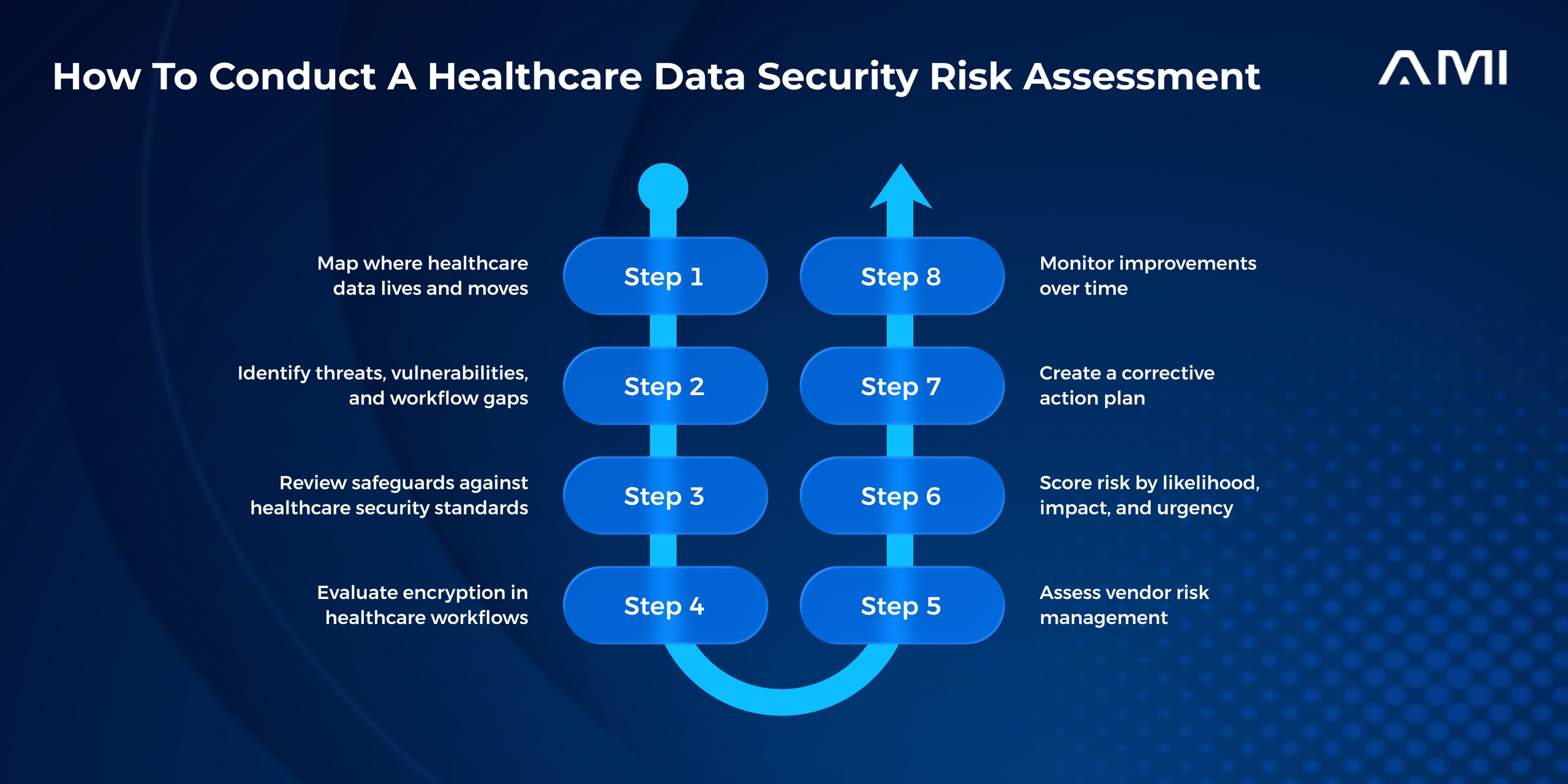
Step 2: Identify threats, vulnerabilities, and workflow gaps
Next, examine what could go wrong and which weaknesses could allow it to happen.
Threats may include phishing, malware, credential theft, insider misuse, device loss, system outages, or vendor compromise. Vulnerabilities may include weak authentication, outdated software, excessive permissions, shared accounts, poor logging, insecure file transfers, or inadequate backups.
Operational gaps matter equally. Staff may release records without complete authorization, discuss information with an unverified caller, download files unnecessarily, or leave exceptions undocumented.
The assessment should distinguish the threat from the vulnerability. A malicious login attempt is a threat. Weak authentication or an active former-employee account is the vulnerability that may allow it to succeed.
Step 3: Review safeguards against healthcare security standards
Existing controls should be compared with applicable healthcare data security standards, internal policies, vendor agreements, and recognized security frameworks.
The HIPAA Security Rule addresses administrative, physical, and technical safeguards for ePHI. NIST’s Cybersecurity Framework provides high-level outcomes organizations can use to understand, assess, prioritize, and communicate cybersecurity risk. ISO/IEC 27001 establishes requirements for an information security management system focused on governance, risk management, and continual improvement.
Review whether controls are merely documented or actually operating. A policy requiring access reviews is not effective if permissions have not been reviewed for two years.
Step 4: Evaluate encryption in healthcare workflows
Encryption in healthcare can protect data while it is stored or transmitted through systems, backups, portals, integrations, email, and vendor workflows.
The assessment should determine which data is encrypted, where encryption begins and ends, how keys are managed, and whether unencrypted copies are created through exports, downloads, or manual processing.
Encryption is important, but it does not prevent every exposure. An authorized user can still send encrypted information to the wrong recipient. Compromised credentials may provide access to decrypted data. Encryption must therefore work with authentication, access restrictions, secure delivery rules, monitoring, and workforce training.
Step 5: Assess vendor risk management
Patient information frequently moves through contact centers, cloud providers, RCM partners, records teams, analytics tools, IT vendors, and other business associates.
Effective vendor risk management should examine the vendor’s actual role and data access rather than relying only on questionnaires or certifications.
Healthcare leaders should ask:
- What PHI or ePHI does the vendor access, and why is that access required?
- Is an appropriate agreement in place, and are permitted uses clearly defined?
- Who can access the data, and are permissions role-based and regularly reviewed?
- How is information stored, transmitted, retained, returned, and deleted?
- Are subcontractors involved, and how are their controls evaluated?
- How are training, audit activity, incidents, corrective actions, and compliance reporting documented?
A useful test is to follow one real vendor-supported workflow from intake through processing, quality review, delivery, and closure. This often reveals gaps that policy documents do not show.
Step 6: Score risk by likelihood, impact, and urgency
Not every finding requires the same response.
A risk involving broad administrator access to a large ePHI environment may deserve more immediate action than an isolated documentation inconsistency. Leaders should consider likelihood, data sensitivity, number of affected records, patient impact, compliance exposure, operational disruption, vendor dependency, and remediation complexity.
A simple classification can help:
- High-risk findings could expose PHI, interrupt critical services, or create significant compliance consequences.
- Medium-risk findings involve meaningful weaknesses that require planned remediation.
- Low-risk findings have limited immediate impact but should remain documented and corrected over time.
The scoring method should be defined consistently so leadership can compare risks across systems and workflows.
Step 7: Create a corrective action plan
An assessment that ends with findings but no remediation plan has limited value.
Each issue should include a clear description, affected system or workflow, risk rating, recommended control, responsible owner, target date, status, required evidence, and follow-up review date.
Corrective actions may include removing access, changing system configurations, introducing encryption, revising a vendor agreement, improving caller verification, updating training, strengthening audit review, or redesigning a PHI-handling workflow.
Evidence matters. A risk should not be marked complete merely because a policy was updated. Leaders should confirm that the corrective control has been implemented and operates as intended.
Step 8: Monitor improvements over time
Risk changes as the organization changes.
New systems, vendors, integrations, locations, services, exports, workforce models, and patient communication channels can introduce new exposure. A prior assessment may no longer reflect the current operating environment.
Ongoing healthcare data security best practices should therefore include access reviews, vendor reassessments, audit monitoring, QA, incident exercises, workforce training, corrective-action tracking, and targeted assessments after significant changes.
NIST frames cybersecurity risk management as an ongoing process of understanding, prioritizing, communicating, and adjusting risk activities rather than a one-time exercise.

Why do healthcare security gaps persist despite strong policies?
Because patient data moves across teams, systems, and vendors where access, disclosure, and documentation controls can fail. AM InfoWeb brings PHI-aware workflows, trained teams, QA, and operational visibility together to strengthen security across every handoff.
Common Gaps Healthcare Risk Assessments Uncover
Common findings include excessive permissions, active accounts for former employees, shared credentials, unsupported software, inconsistent encryption, missing audit-log reviews, unsecured transfers, and incomplete incident-response procedures.
Operational assessments may also uncover weak requester verification, undocumented disclosures, inconsistent authorization reviews, unmanaged spreadsheet exports, unclear vendor access, and poor data retention controls.
One practical method is to review the last ten real PHI-handling cases across contact center, RCM, billing, payer, medical records, and Release of Information workflows. Comparing actual execution with approved policy helps leaders see whether controls work under normal operating pressure.
Where AI Can Support Risk Assessment Workflows
AI-assisted tools can help analyze high volumes of access activity, summarize audit findings, categorize recurring exceptions, identify missing documentation, and surface unusual patterns for review.
They may also help security and operations teams prioritize workflows or vendors that generate repeated QA defects, access anomalies, or unresolved control gaps.
AI should remain a support layer. It should not replace formal risk governance, security analysis, legal or compliance oversight, human investigation, or accountable remediation decisions. Context still matters when determining whether an event is legitimate, accidental, suspicious, or harmful.
How AM InfoWeb Supports Secure Healthcare Operations
AM InfoWeb supports healthcare organizations with secure, co-managed operations designed around PHI-aware workflows, trained teams, quality controls, and operational visibility.
Across healthcare contact center operations, Release of Information, medical records, RCM, payer support, and back-office workflows, AM InfoWeb helps leaders reduce operational risk while maintaining consistency, documentation discipline, and control.
AM InfoWeb support may include:
- HIPAA-aware healthcare operations support
- SOC 2 Type II and ISO 27001:2022 certified delivery environments
- PHI-aware records and data handling
- Role-based workflow discipline
- Secure request intake and processing
- Healthcare contact center and Release of Information support
- Medical records, RCM, and payer operations support
- QA checks and escalation workflows
- Audit trails and documentation controls
- Reporting visibility and backlog tracking
- Co-managed operations with client oversight
Need stronger control over security risks across healthcare workflows? AM InfoWeb’s co-orchestrated healthcare operations embed PHI-aware controls, QA, documentation, and oversight into every process.
Get in TouchFinal Thoughts
A strong data security risk assessment gives healthcare leaders a practical view of where patient information is exposed and which weaknesses require action first. By connecting data mapping, access controls, encryption, vendor oversight, operational workflows, incident readiness, and corrective-action tracking, organizations can identify gaps before they become larger privacy, compliance, or operational problems.
Frequently Asked Questions
About the Author

Written by
Urza Dey
Urza Dey is a content and copywriter with over five years of experience across marketing, B2B SaaS, HealthTech, EdTech, and related industries. At AMI, they contribute to content strategy, blog development, and marketing communication focused on healthcare operations, business process management, and AI-enabled service delivery.