
Healthcare Cybersecurity Compliance: Protecting Healthcare Operations
TL;DR — Why Healthcare Cybersecurity Is an Operational Priority
Healthcare cybersecurity compliance now affects operational continuity, patient safety, PHI protection, vendor governance, and financial performance.
Ransomware, vulnerability exploitation, phishing, credential abuse, configuration errors, and third-party exposure remain major healthcare risks.
HIPAA requires regulated entities to protect the confidentiality, integrity, and availability of ePHI and conduct appropriate risk analysis and risk management.
Vendor risk deserves greater attention because healthcare organizations increasingly depend on external technology and operational partners.
Security assessments should evaluate how vendors actually access, process, transmit, store, and govern healthcare information.
AI and automation can improve detection, prioritization, and assessment, but they do not replace security governance or human oversight.
Cybersecurity in healthcare has moved well beyond the IT department. A ransomware event can disrupt patient access, claims, medical records, scheduling, billing, payer communication, and other workflows that healthcare organizations depend on every day. In the 2026 Verizon Data Breach Investigations Report, healthcare recorded 1,438 confirmed data-disclosure breaches, with system intrusion, miscellaneous errors, and social engineering accounting for 81% of breaches in the sector.
That is why healthcare cybersecurity compliance increasingly needs to be viewed as an operational discipline rather than a periodic compliance exercise. Hospitals, health systems, payers, business associates, and healthcare service providers operate through interconnected systems and third parties. Protecting electronic protected health information (ePHI) therefore depends not only on perimeter security, but also on access controls, workforce behavior, vendor oversight, risk analysis, system hardening, incident readiness, and clear accountability across the healthcare ecosystem.
Why Healthcare Remains a High-Value Cyber Target
Healthcare organizations combine several characteristics attackers can exploit: sensitive personal information, interconnected technology, complex third-party environments, time-sensitive services, and limited tolerance for system downtime.
The consequences extend far beyond stolen records.
A compromised healthcare environment can interfere with appointment scheduling, EHR access, claims submission, medical-record workflows, patient communications, billing, and other essential operations. That makes healthcare cybersecurity different from security in many conventional business environments: availability can be almost as important as confidentiality.
Financial exposure also remains significant. IBM reported that the average healthcare data breach cost reached $7.42 million in 2025, the highest average among industries for the 14th consecutive year.
But cost alone misses the larger issue. When systems fail, employees often have to work around the disruption manually. Queues accumulate. Information becomes harder to verify. Turnaround times increase. Patients and providers start calling for answers.
In healthcare, cyber resilience is increasingly inseparable from operational resilience.
How Cyber Risk Enters Healthcare Operations
A modern healthcare environment has far more entry points than the hospital network itself. Employees, cloud applications, clearinghouses, payment systems, medical devices, outsourced teams, software vendors, patient-facing platforms, and remote connections can all become part of the attack surface.
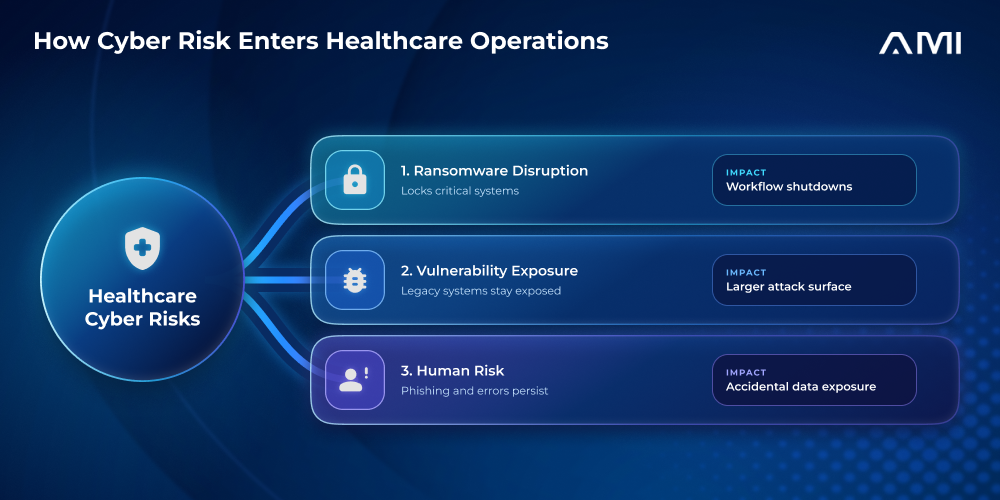
The 2026 Verizon healthcare analysis found that external actors were involved in 81% of healthcare breaches, but the human element was present in 54%. Third parties were involved in 32%. Vulnerability exploitation, phishing, and credential abuse were among the leading initial-access vectors.
That mix matters because it shows why there is no single cybersecurity control that solves the healthcare problem.
1. Ransomware can turn a security event into an operational crisis
Ransomware healthcare incidents are particularly disruptive because attackers can make systems or information unavailable precisely when healthcare organizations need them.
A hospital cyberattack can affect more than the compromised infrastructure. Dependencies between systems mean the disruption can move into eligibility checks, registration, clinical documentation, claims, medical-record access, patient support, and revenue cycle activity.
HHS enforcement activity also shows that ransomware continues to be closely linked with HIPAA Security Rule scrutiny. In July 2026, OCR announced its 21st ransomware enforcement action and again emphasized the importance of accurate and thorough risk analysis.
For healthcare leaders, the operational question is therefore not simply:
Can we prevent every attack?
It is also:
If a critical system becomes unavailable, which workflows stop next?
2. Vulnerabilities and legacy technology increase exposure
Healthcare environments often contain applications and infrastructure accumulated over many years. Some systems are difficult to patch quickly because of operational dependencies, vendor limitations, compatibility requirements, or concerns about disrupting patient-facing functions.
HHS's January 2026 cybersecurity guidance specifically highlighted system hardening, vulnerability scanning, patching, removal of unnecessary software and services, and security baselines as important ways to reduce attack surfaces around ePHI.
That makes vulnerability management less of a maintenance task and more of an ongoing risk-management process.
3. People remain part of the attack surface
Phishing, social engineering, credential misuse, and simple operational mistakes continue to contribute to healthcare breaches.
Verizon's 2026 healthcare data also highlights another persistent issue: miscellaneous errors. Misdelivery, loss, and misconfiguration continue to expose information even without a sophisticated attacker successfully penetrating the organization.
Healthcare security therefore depends on more than security awareness training. Organizations also need workflows that reduce the opportunity for accidental exposure through access controls, standardized processes, QA, appropriate permissions, and clear escalation paths.
Looking beyond cybersecurity as an isolated IT function? Explore AM InfoWeb's broader healthcare services, where controlled workflows, trained teams, QA, and operational oversight support complex healthcare processes.
Healthcare Cybersecurity Compliance Goes Beyond Checking HIPAA Boxes
The HIPAA Security Rule establishes standards for safeguarding ePHI and applies to covered entities and their business associates. HHS states that regulated entities must ensure the confidentiality, integrity, and availability of the ePHI they create, receive, maintain, or transmit.
But healthcare security compliance should not be reduced to producing documentation during an audit.
Effective cybersecurity requires organizations to understand:
- What information they hold
- Where it moves
- Who can access it
- Which systems depend on it
- Which vendors interact with it
- What vulnerabilities exist
- How the organization will respond when controls fail
Risk analysis is central to that approach. HHS continues to describe accurate and thorough assessment of risks and vulnerabilities to ePHI as a Security Rule requirement, followed by risk-management measures appropriate to those findings.
There is also an important regulatory distinction for healthcare leaders in 2026. HHS proposed substantial changes to the HIPAA Security Rule in December 2024 to strengthen cybersecurity protections, but those provisions remain part of a proposed rule, not requirements that should automatically be described as current law.
Alongside HIPAA, HHS has published voluntary Healthcare and Public Health Cybersecurity Performance Goals to help healthcare organizations prioritize high-impact security practices. These include controls such as multifactor authentication, separate user and privileged accounts, vendor cybersecurity requirements, incident planning, strong encryption, asset inventories, vulnerability management, and third-party incident reporting.
The direction is clear: cybersecurity governance is moving toward continuous risk management rather than periodic compliance validation.

Why do healthcare security gaps persist despite strong policies?
Because patient data moves across teams, systems, and vendors where access, disclosure, and documentation controls can fail. AM InfoWeb brings PHI-aware workflows, trained teams, QA, and operational visibility together to strengthen security across every handoff.
Healthcare operations rarely remain entirely inside one organization. A provider may depend on clearinghouses, EHR platforms, patient communication systems, payment vendors, cloud infrastructure, medical-record partners, RCM vendors, analytics platforms, contact-center providers, and other business associates.
Each relationship creates an operational dependency and potentially another path to sensitive information. That is why a vendor cyber risk assessment should go beyond asking whether a vendor claims to be secure. A meaningful third-party vendor security assessment should help healthcare organizations understand how the partner controls access, protects sensitive data, manages employees, detects incidents, responds to vulnerabilities, maintains continuity, and governs subcontractors.
HHS's Healthcare and Public Health Cybersecurity Performance Goals explicitly include vendor/supplier cybersecurity requirements as an essential goal and identify third-party vulnerability disclosure and incident reporting among enhanced goals.
Operator Question: Do you know which external partner could interrupt a critical healthcare workflow even if your own environment remains secure?
That question changes vendor cybersecurity assessment from a procurement exercise into operational risk management.
What Healthcare Leaders Should Evaluate in a Vendor Cybersecurity Assessment
A certification or completed questionnaire can be useful evidence, but neither tells the whole story. The stronger assessment looks at how security operates in the actual delivery environment.
For a vendor handling PHI or other sensitive healthcare information, leaders should understand areas such as access provisioning and removal, authentication, workforce controls, encryption, audit logging, incident escalation, vulnerability management, data retention, business continuity, and subcontractor governance. The assessment should also match the risk of the service.
A vendor that never touches patient information should not necessarily undergo the same review as a partner processing thousands of healthcare records every day. Similarly, a technology platform with broad system access creates a different risk profile from a narrowly scoped administrative service.
This is where vendor cybersecurity assessment becomes more useful when it is risk-based rather than questionnaire-based.
Cybersecurity for Hospitals and Healthcare Facilities Requires Layers
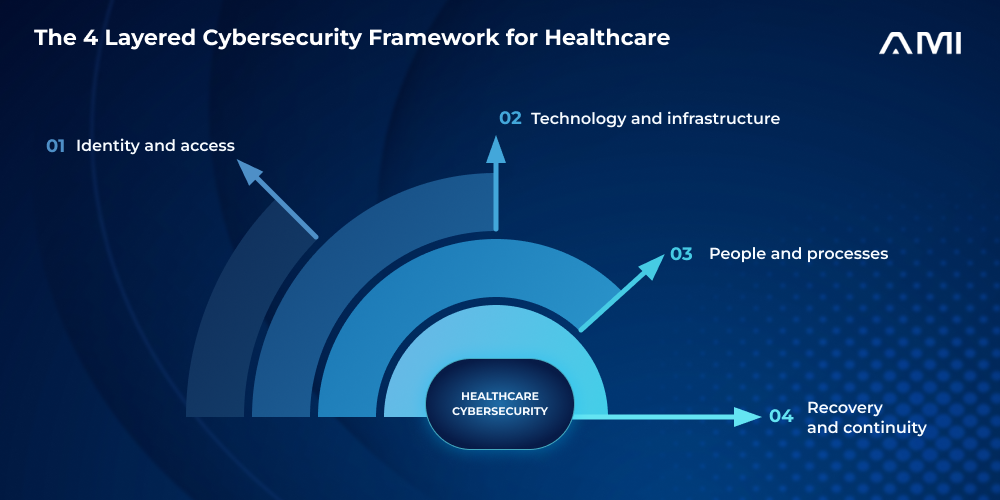
There is no single cybersecurity solution for healthcare that eliminates cyber risk. Resilience is built through multiple controls working together. A practical model includes four interconnected layers:
1. Identity and access
Organizations need to control who can reach sensitive systems and what they can do once they are inside them. MFA, role-based permissions, least-privilege access, privileged-account separation, and prompt removal of unnecessary credentials reduce the impact of compromised accounts.
2. Technology and infrastructure
System hardening, encryption, endpoint protection, network segmentation, patching, asset inventories, monitoring, and vulnerability management reduce opportunities for attackers to establish or expand access.
3. People and processes
Security-aware workflows, recurring training, clear escalation procedures, quality controls, and disciplined handling of sensitive information reduce avoidable human exposure.
4. Recovery and continuity
Incident response is only part of readiness. Healthcare organizations also need to understand how critical operations continue when a system, platform, facility, or third party becomes temporarily unavailable.
The objective is not merely to keep attackers outside. It is to reduce the operational consequences when something inevitably goes wrong.
AI Is Changing Cybersecurity and Vendor Risk Management
AI is creating opportunities on both sides of the cybersecurity equation. Threat actors are already using generative AI to support elements of targeting, initial access, and malicious tooling, according to Verizon's 2026 research.
At the same time, security teams are using AI to analyze large volumes of telemetry, identify anomalous behavior, prioritize vulnerabilities, accelerate investigations, and review vendor information. This is also influencing automated vendor risk assessment tools.
Instead of manually reviewing every questionnaire and supporting document from scratch, AI-assisted tools can help teams:
- Extract security-control information
- Identify missing documentation
- Compare responses against risk frameworks
- Flag inconsistencies
- Prioritize higher-risk vendors
- Surface changes that may require reassessment
Searching for the top AI tools for vendor security, however, should come after defining the governance model.
Automation can accelerate assessment. It cannot determine the organization's risk tolerance, verify every vendor claim, understand every healthcare workflow dependency, or accept risk on leadership's behalf. The better model is AI-assisted assessment with accountable human review.
From Cybersecurity Compliance to Operational Resilience
Healthcare organizations mature when cybersecurity moves beyond checklist completion and becomes part of operational decision-making. Here’s what the difference looks like:
Checklist Approach
| Checklist Approach | Resilience-Focused Approach |
|---|---|
| Did we complete the assessment? | What did the assessment reveal, and who owns remediation? |
| Is the vendor HIPAA-compliant? | What data does the vendor access, where are the dependencies, and what happens if the service fails? |
| Did employees complete cybersecurity training? | Have we designed workflows so one mistake is less likely to expose information? |
Compliance → Risk Visibility → Control → Detection → Resilience
Healthcare cybersecurity becomes stronger when controls are connected directly to the workflows, systems, vendors, and people they are intended to protect.
Evaluating operational partners that will handle sensitive healthcare information? Explore AM InfoWeb's services to see how controlled healthcare workflows, trained teams, QA, and operational oversight fit into a co-managed delivery model.
Measuring Healthcare Cybersecurity Beyond Audit Completion
Cybersecurity programs can become difficult to evaluate when success is reduced to completing required activities.
Leaders should also look at operational indicators such as time to remediate critical vulnerabilities, privileged-access reviews, unresolved vendor findings, patch exposure, security incidents, phishing-reporting behavior, access termination, recovery performance, third-party dependencies, and recurring audit findings. The exact measures will vary by organization. The principle does not.
Healthcare cybersecurity compliance should provide evidence that risk is being identified and controlled, not simply that compliance activity occurred.
How AM InfoWeb Supports Security-Aware Healthcare Operations
AM InfoWeb supports healthcare organizations through co-managed, security-aware operational delivery designed around disciplined access, documentation, quality controls, workforce governance, and client oversight.
Supported by SOC 2 Type II, ISO 27001, and HIPAA-aligned practices, AM InfoWeb's operating environment is designed for workflows where sensitive healthcare and business information require controlled handling.
That operational model can support areas including:
- Revenue cycle management
- Health information management
- Release of information
- Payer and TPA operations
- Medical record retrieval and litigation support
- Healthcare contact-center workflows
- QA, documentation, and structured escalation
The objective is not to position an operational partner as the organization's cybersecurity function. Healthcare organizations retain responsibility for their security architecture, policies, risk decisions, and regulatory obligations.
The role of a security-aware partner is different: to ensure the outsourced workflow itself is delivered with appropriate controls, visibility, accountability, and governance.
Need stronger control over sensitive healthcare workflows? AM InfoWeb’s co-orchestrated healthcare operations combine trained teams, PHI-aware controls, QA, documentation, and operational oversight within a security-conscious delivery model.
Need stronger control over sensitive healthcare workflows? AM InfoWeb’s co-orchestrated healthcare operations combine trained teams, PHI-aware controls, QA, documentation, and operational oversight within a security-conscious delivery model.
Get in TouchThe cyber battle facing healthcare is no longer happening only at the network perimeter. It is happening across people, systems, workflows, vendors, cloud environments, credentials, and every operational connection where sensitive information moves. That is why healthcare cybersecurity compliance needs to evolve from a regulatory obligation into an operating discipline.
Strong healthcare organizations will still need technical defenses. But they will also need visibility into third-party risk, disciplined access, resilient workflows, informed employees, measurable controls, and clear accountability when exceptions occur.
Cybersecurity cannot eliminate every threat. It can determine whether the next threat becomes a contained security incident or an organization-wide operational crisis.
Frequently Asked Questions
About the Author

Written by
Urza Dey
Urza Dey is a content and copywriter with over five years of experience across marketing, B2B SaaS, HealthTech, EdTech, and related industries. At AMI, they contribute to content strategy, blog development, and marketing communication focused on healthcare operations, business process management, and AI-enabled service delivery.