
Healthcare Data Security Solutions: A Stronger Protection Framework
TL;DR — Healthcare Data Security Requires Layered Control
Strong healthcare data security combines people, processes, technology, governance, and vendor oversight.
HIPAA requires appropriate administrative, physical, and technical safeguards for electronic protected health information.
SOC 2 and ISO 27001 provide additional ways to evaluate service-organization controls and information security management.
Role-based access and minimum-necessary practices reduce avoidable exposure.
Encryption in healthcare helps protect data at rest and in transit, but it must work alongside authentication, monitoring, and secure workflows.
A recurring data security risk assessment helps leaders identify where patient information lives, moves, and becomes vulnerable.
Security controls should extend into contact centers, medical records, billing, claims, payer support, and third-party operations.
Healthcare data security solutions must protect patient information wherever it moves, not only where it is stored. Patient data passes through electronic medical records, billing platforms, contact centers, payer communications, Release of Information workflows, reporting tools, file transfers, and vendor-supported operations. Every access point and handoff can introduce exposure when controls are unclear or inconsistently applied.
A stronger security framework connects technology with governance, trained teams, workflow discipline, vendor oversight, monitoring, and incident response. Encryption and security software matter, but they cannot compensate for excessive access, weak verification, undocumented disclosures, poor vendor controls, or employees using unapproved communication channels.
Why Healthcare Data Security Needs a Framework
Healthcare organizations often approach security through individual tools such as encryption, endpoint protection, access controls, backups, and activity monitoring. Those controls are necessary, but their effectiveness depends on how they work together.
A technically secure system can still expose information when permissions are excessive, accounts are shared, employees send files through unapproved channels, or vendors operate without clear oversight. Likewise, a strong policy has limited value when staff does not understand how it applies during a patient call, medical record release, billing inquiry, or provider follow-up.
A framework creates consistency across systems and workflows. It establishes who owns security decisions, how access is granted, which controls vendors must follow, how incidents are escalated, and what leaders can see through reporting.
What Are Healthcare Data Security Solutions?
Healthcare data security solutions are the technologies, policies, safeguards, workflows, and vendor controls used to protect patient information from unauthorized access, disclosure, alteration, loss, misuse, or disruption.
They may include identity and access management, role-based permissions, encryption, audit logs, secure communication, workforce training, risk assessments, data backup, incident response, and third-party governance.
The HIPAA Security Rule requires regulated entities to use reasonable and appropriate administrative, physical, and technical safeguards to protect the confidentiality, integrity, and availability of ePHI.
Security is therefore not one product or department. It is the operating environment surrounding patient information throughout its lifecycle.
What Makes Healthcare Data Security Different?
Healthcare information can connect a person’s identity with diagnoses, treatment, claims, billing, insurance, benefits, appointments, and private communications. A security failure may therefore affect more than confidentiality. It can disrupt care coordination, delay operations, weaken patient trust, and create compliance exposure.
Healthcare data also moves through diverse workflows. A patient may provide information through a contact center, a provider may update an EMR, a payer may request documentation, and a records team may prepare information for secure release.
This makes healthcare data security both a technical and operational responsibility. Controls must follow the information across systems, teams, communication channels, and external partners.
Healthcare Data Security Standards Leaders Should Know
Different frameworks help healthcare leaders evaluate different parts of their security environment. HIPAA establishes requirements around protected health information, while SOC 2 and ISO 27001 provide broader mechanisms for assessing controls and information security management.
HIPAA compliance
HIPAA compliance requires appropriate safeguards for protected health information, particularly ePHI. Operationally, that includes policies, workforce responsibilities, access controls, secure transmission, audit activity, incident procedures, and risk management.
The Security Rule applies to ePHI created, received, maintained, or transmitted by covered entities and their business associates.
SOC 2
SOC 2 examinations address controls at service organizations relevant to security, availability, processing integrity, confidentiality, or privacy. This can help healthcare organizations evaluate outsourcing partners, platforms, contact centers, IT vendors, and data processors whose systems support sensitive operations.
A SOC 2 report should inform vendor evaluation, but it does not remove the need to understand the specific workflow, access model, and responsibilities involved.
ISO 27001
ISO 27001 defines requirements for establishing, implementing, maintaining, and continually improving an information security management system. It emphasizes governance, risk treatment, policy discipline, and continual improvement rather than a one-time technology review.
Together, these healthcare data security standards can support stronger oversight, but no certification or framework eliminates operational risk by itself.
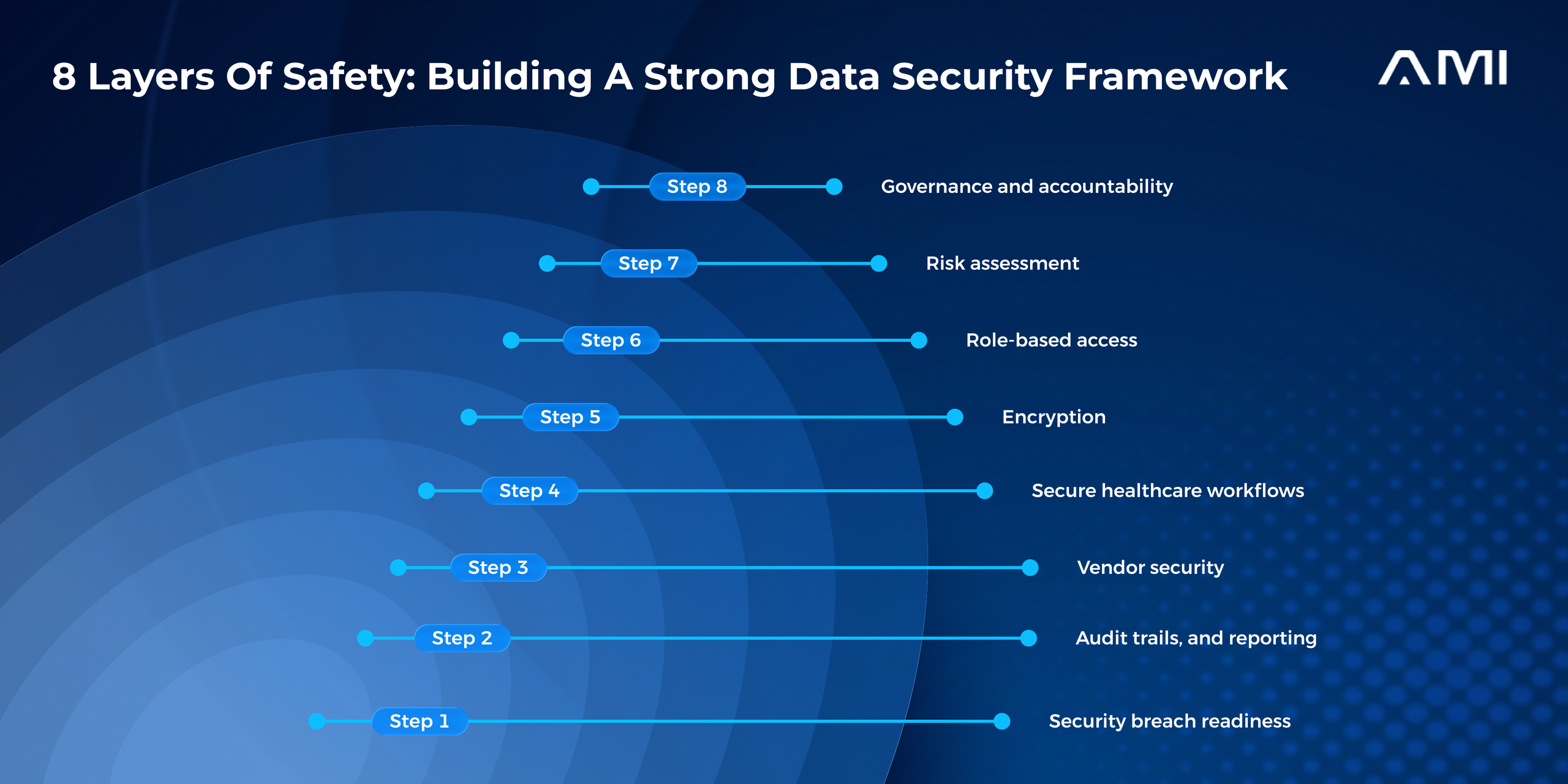
8 Layers of a Strong Healthcare Data Security Framework
A strong security framework protects patient information across every point where it is accessed, processed, transmitted, stored, or shared. Each layer addresses a different source of risk, from unclear ownership and excessive permissions to weak vendor controls, poor monitoring, and untested incident response. Together, these layers help healthcare organizations move beyond isolated safeguards and build security into daily patient-facing, clinical, administrative, and vendor-supported workflows.
Layer 1: Governance and accountability
Healthcare data security begins with clearly assigned ownership.
Leaders should know who approves access, reviews vendors, maintains policies, investigates incidents, monitors audit findings, coordinates workforce training, and reports security risks. Departments should not create separate handling practices without shared governance.
Accountability also extends to outsourced work. Contracts and policies should identify what the vendor may access, how incidents are reported, which controls apply, and who owns escalation and corrective action.
Without defined ownership, security exceptions can remain unresolved because every team assumes another function is responsible.
Layer 2: Data security risk assessment
A data security risk assessment helps an organization understand where patient information is exposed and whether existing safeguards adequately address those risks.
HHS guidance describes risk analysis as an accurate and thorough assessment of potential risks and vulnerabilities affecting the confidentiality, integrity, and availability of ePHI. It should consider both the likelihood of a threat and the potential impact if that threat exploits a vulnerability.
A practical assessment should review:
- What patient information is collected, where it is stored, and which systems process it
- Which employees, contractors, vendors, and business associates can access it
- How information is transmitted, exported, backed up, retained, and disposed of
- Where encryption, authentication, access approval, and access removal controls apply
- Which audit logs are reviewed and how unusual activity is investigated
- How incidents are detected, reported, documented, and corrected
The assessment should follow real workflows instead of reviewing systems in isolation.
Layer 3: Role-based access and minimum necessary use
Employees, contractors, and vendors should access only the information required for their assigned responsibilities.
A scheduling employee may need patient contact and appointment information. A billing specialist may need claim and payment details. A records processor may need access to specific documents covered by an approved request.
Role-based permissions reduce unnecessary exposure and make activity easier to attribute to an individual user. Access should also be reviewed when roles change, projects end, or vendor responsibilities are reduced.
The objective is not to block legitimate work. It is to align each user’s access with a defined purpose and scope.
Layer 4: Encryption in healthcare
Encryption in healthcare helps protect electronic patient information by making it unreadable without the appropriate key or authorized process.
It can support protection for stored databases, backups, portable files, system integrations, electronic messages, and information moving between healthcare organizations and vendors. However, encryption does not correct excessive permissions, compromised credentials, wrong-recipient delivery, or inappropriate exports.
It works best when combined with authentication, access restrictions, secure delivery rules, device controls, audit monitoring, and clear ownership.
Layer 5: Secure healthcare workflows
Security controls must be visible in the way daily work is performed.
Contact center teams need caller verification before discussing patient or claim details. Records teams need authorization and requester review before disclosure. Billing and payer support teams need controlled access and approved communication channels. Reporting teams need rules around data exports, storage, and distribution.
Operational controls should cover approved intake routes, role-based work queues, secure file transfer, PHI-aware documentation, authorization review where required, QA before disclosure, escalation for unclear requests, device restrictions, and audit-ready closure notes.
These controls reduce the likelihood that a technically secure system will be undermined by an inconsistent process.
Layer 6: Vendor and business associate security
Healthcare organizations should understand how every vendor handles patient information.
The review should examine what data the partner receives, why it needs access, where the information is processed, whether subcontractors are involved, how employees are trained, and how access is approved and removed.
For cloud and technology partners that maintain ePHI, HIPAA obligations remain relevant even when the provider cannot view encrypted data. HHS notes that cloud service providers maintaining ePHI are generally business associates and must safeguard the information according to their role.
A vendor should be able to demonstrate controls through evidence, documentation, workflow walkthroughs, and reporting rather than relying only on broad compliance claims.
Layer 7: Monitoring, audit trails, and reporting
Healthcare data security best practices require ongoing visibility.
Leaders should monitor access patterns, failed logins, unusual activity, file transfers, disclosure records, QA findings, vendor performance, and recurring exceptions. Audit logs are valuable only when someone reviews them and acts on meaningful findings.
Reporting should connect technical events with operational context. A file export, for example, may be legitimate, accidental, or unauthorized depending on the user, purpose, destination, and workflow.
Regular reporting helps security, compliance, and operations teams identify trends before isolated exceptions become recurring control failures.

Why do healthcare security gaps persist despite strong policies?
Because patient data moves across teams, systems, and vendors where access, disclosure, and documentation controls can fail. AM InfoWeb brings PHI-aware workflows, trained teams, QA, and operational visibility together to strengthen security across every handoff.
Layer 8: Incident and security breach readiness
A security breach in healthcare requires a coordinated response across security, privacy, compliance, operations, legal, communications, and vendor teams.
Organizations should establish responsibilities before an incident occurs. The response process should address detection, containment, investigation, evidence preservation, internal escalation, vendor coordination, notification assessment, corrective action, and documentation.
After the immediate issue is addressed, leaders should determine which control failed. The corrective response may require access changes, workflow redesign, updated training, stronger monitoring, or revised vendor requirements.
Incident readiness cannot be improvised effectively while sensitive information is already exposed.
Healthcare Data Security Best Practices
A strong framework should translate security expectations into repeatable actions.
Healthcare leaders should:
- Maintain HIPAA-aligned policies, role-based access, minimum-necessary practices, workforce training, and secure communication requirements
- Apply encryption where appropriate, review logs, conduct recurring risk assessments, test incident procedures, and maintain backup and recovery controls
- Validate vendor safeguards, monitor QA and compliance trends, document disclosure workflows, and review data retention and disposal practices
These practices should be tested against actual patient-facing and back-office workflows rather than assessed only through annual policy reviews.
Where AI Can Support Security Workflows
AI-assisted services and tools can help detect unusual activity, flag missing documentation, categorize requests, identify repeat exceptions, support QA sampling, and surface operational trends across large volumes of activity.
This can help security and operations teams prioritize cases that require investigation. AI may also improve visibility across contact center interactions, access events, release workflows, or vendor-supported queues.
However, AI should not replace security governance, human investigation, authorization decisions, or incident ownership. Its role is to help teams identify patterns and exceptions faster while accountable people determine the appropriate response.
How AM InfoWeb Supports Secure Healthcare Operations
AM InfoWeb supports healthcare organizations with secure, co-managed operations designed around PHI-aware workflows, trained teams, quality controls, and operational visibility.
Across contact center operations, Release of Information, medical records, RCM, payer support, and back-office workflows, AM InfoWeb helps leaders protect patient information while maintaining consistency and control.
AM InfoWeb support may include:
- HIPAA-aware healthcare operations
- SOC 2 Type II and ISO 27001:2022 certified delivery environments
- PHI-aware record and data handling
- Role-based workflow discipline
- Secure request intake and processing
- Healthcare contact center and Release of Information support
- Medical records, RCM, and payer operations support
- QA, escalation, and audit documentation
- Leadership reporting and backlog visibility
- Co-managed operations with client oversight
AM InfoWeb supports secure, co-managed healthcare workflows built around PHI-aware processing, trained teams, quality controls, documentation discipline, and leadership visibility.
Get in TouchFinal Thoughts
Protecting patient information requires more than deploying isolated security products or completing an annual compliance exercise. Strong healthcare data security solutions connect governance, access control, encryption, risk assessment, monitoring, vendor oversight, incident response, and workflow discipline so protection follows patient data across every system, team, and operational handoff.
Frequently Asked Questions
About the Author

Written by
Urza Dey
Urza Dey is a content and copywriter with over five years of experience across marketing, B2B SaaS, HealthTech, EdTech, and related industries. At AMI, they contribute to content strategy, blog development, and marketing communication focused on healthcare operations, business process management, and AI-enabled service delivery.