
Healthcare IT Compliance: Controls That Protect Connected Clinical Operations
TL;DR: Healthcare IT Compliance
Healthcare IT compliance connects regulatory expectations to daily technology operations.
Connected clinical systems increase risk across access, integrations, configurations, and vendors.
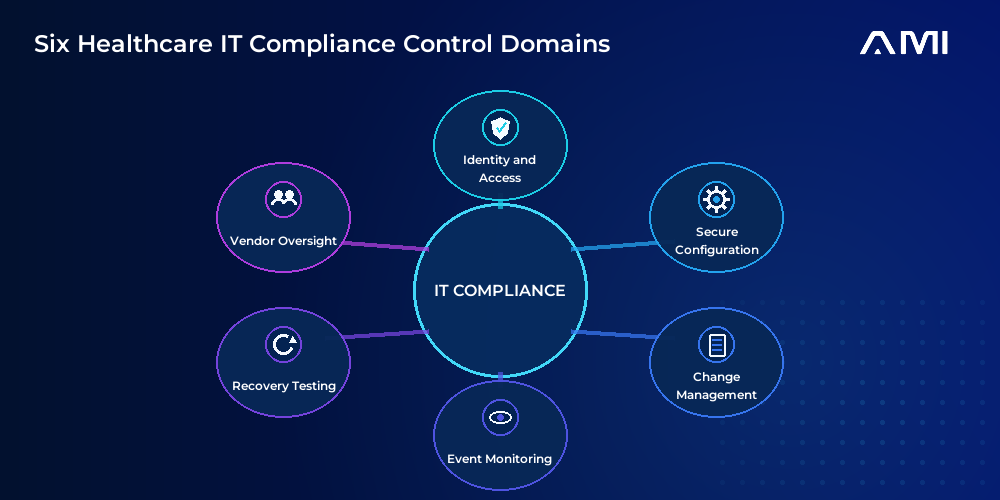
A practical baseline governs identity, change, monitoring, resilience, and third parties.
Operating evidence should be complete, attributable, dated, and retrievable.
Meaningful metrics identify overdue controls, exceptions, and unresolved remediation.
AI can assist monitoring and classification while accountable humans validate decisions.
Healthcare technology connects clinical teams, administrative workflows, vendors, cloud platforms, and patient information. Each connection can improve access and efficiency, but it also introduces responsibilities for privacy, security, availability, and evidence.
Healthcare IT compliance turns regulatory expectations and internal policies into repeatable controls. Leaders need to know who can access systems, how configurations change, whether integrations are monitored, and what evidence proves that safeguards operate consistently.
This guide explains how healthcare organizations can build practical IT compliance controls without separating governance from daily operations.
Need structured support across secure healthcare workflows? Explore AMI’s healthcare services.
What Does Healthcare IT Compliance Cover?
Healthcare IT compliance covers the administrative, physical, and technical practices used to protect regulated information and maintain dependable systems. Its scope can include identity management, access reviews, encryption, logging, vulnerability management, backups, incident response, change control, vendor oversight, and documentation.
The exact control set depends on the organization, technology environment, contracts, and applicable requirements. A useful program translates each obligation into an owner, operating procedure, evidence source, review frequency, and escalation path.
Why Do Connected Clinical Systems Increase Compliance Risk?
Electronic health records, portals, billing platforms, contact centers, interfaces, and vendor tools exchange data across organizational boundaries. Weak identity practices, excessive privileges, unmonitored interfaces, or undocumented configuration changes can create exposure without causing an obvious failure.
Risk also increases when operational and technical teams maintain separate records. A security policy may look complete while access exceptions, shared accounts, delayed terminations, or unsupported applications remain unresolved.
Which Controls Form a Practical IT Compliance Baseline?
Organizations should establish a baseline that can be applied consistently and tested with evidence.
| Control area | Operational question | Typical evidence |
|---|---|---|
| Identity and access | Does each user have appropriate access? | Access reviews and termination records |
| Configuration | Are secure settings approved and monitored? | Baselines and exception logs |
| Change management | Are production changes authorized and tested? | Tickets, approvals, and test results |
| Monitoring | Are meaningful events reviewed? | Logs, alerts, and investigation records |
| Resilience | Can critical systems and data be restored? | Backup and recovery tests |
| Vendors | Are third-party responsibilities controlled? | Assessments, agreements, and reviews |
How Should Access Controls Be Governed?
Access should be tied to an identifiable person, approved role, legitimate purpose, and defined review cycle. Provisioning, transfers, temporary access, privileged access, and termination need documented workflows with accountable owners.
Periodic reviews should focus on meaningful risk rather than checkbox completion. Teams should investigate inactive accounts, conflicting roles, unusual privileges, emergency access, and accounts that remain active after employment or contract changes. These controls complement a broader healthcare data security framework.
How Does Change Management Protect Compliance?
Configuration and software changes can affect authentication, data flows, retention, logging, and availability. A controlled process records the request, risk, testing, approval, deployment, rollback plan, and post-change validation.
Urgent changes still need retrospective review. Repeated emergency work can signal weak planning, aging infrastructure, or unclear ownership that deserves corrective action.
What Evidence Demonstrates That Controls Actually Operate?
Auditors and leaders need evidence created through normal work. Access certifications, change tickets, monitoring records, incident documentation, vendor reviews, and recovery tests should be complete, dated, attributable, and retrievable.
Evidence quality improves when teams define retention, naming, ownership, and review expectations. A healthcare data security risk assessment can identify where controls or evidence remain incomplete.
Need a co-managed partner for secure operational execution? Learn how AM Infoweb supports healthcare organizations.
How Should Healthcare Organizations Govern Technology Vendors?
Vendor governance begins before access is granted and continues throughout the relationship. Teams should document data use, connectivity, access, subcontractors, incident duties, recovery expectations, and termination procedures.
Reviews should be proportional to risk. A vendor with privileged access or extensive protected health information requires deeper oversight than a low-risk supplier. Contract language does not replace verification of operational controls.
Which Metrics Reveal IT Compliance Weaknesses?
Useful measures include overdue access reviews, termination completion time, privileged-account exceptions, unapproved changes, critical vulnerabilities past deadline, logging gaps, failed recovery tests, overdue vendor reviews, and unresolved audit findings.
Metrics need context, ownership, and thresholds. A declining ticket count is not automatically positive if teams are failing to record exceptions.
How Can Teams Prepare for Incidents and Audits?
Prepared organizations know where evidence resides and who can coordinate technical, legal, compliance, and operational action. Tabletop exercises should test escalation, containment, documentation, communication, and recovery assumptions.
Teams can use lessons from healthcare cybersecurity compliance to connect technical response with operational continuity. The discussion of SOC 2 certification for healthcare data also helps leaders evaluate whether documented controls generate dependable evidence over time.
The HHS Security Rule guidance provides authoritative information about safeguards for electronic protected health information. Organizations should interpret requirements with qualified legal and compliance professionals.

Why do healthcare security gaps persist despite strong policies?
Because patient data moves across teams, systems, and vendors where access, disclosure, and documentation controls can fail. AMI brings PHI-aware workflows, trained teams, QA, and operational visibility together to strengthen security across every handoff.
How AM Infoweb Supports Healthcare IT Compliance Operations
AM Infoweb has two decades of experience in the U.S. healthcare industry and uses a co-managed model where AI agents and skilled human agents work together to eliminate process bottlenecks and execute secure healthcare workflows.
AMI can support:
- Access and documentation workflow execution
- Evidence collection and indexing
- Vendor-review coordination and follow-up
- Exception queue monitoring
- Quality assurance and escalation tracking
- Operational reporting and audit support
- Secure contact center and back-office workflows
Healthcare organizations retain responsibility for legal interpretation, risk acceptance, technical control design, and final compliance decisions.
How Can Leaders Strengthen Healthcare IT Compliance?
Strong healthcare IT compliance connects governance to operating evidence. Clear ownership, controlled access, disciplined changes, monitored integrations, tested recovery, and risk-based vendor oversight help protect connected clinical operations without relying on policy alone.
Need more reliable healthcare IT compliance execution? AMI combines controlled workflows, skilled teams, quality assurance, and operational reporting to strengthen evidence and accountability.
Get in TouchFrequently Asked Questions
About the Author

Written by
Urza Dey
Urza Dey is a content and copywriter with over five years of experience across marketing, B2B SaaS, HealthTech, EdTech, and related industries. At AMI, they contribute to content strategy, blog development, and marketing communication focused on healthcare operations, business process management, and AI-enabled service delivery.