
SOC 2 Certification: Safeguarding Healthcare Data
TL;DR — What SOC 2 Means for Healthcare Operations
SOC 2 certification commonly refers to an independent SOC 2 examination and resulting report.
SOC 2 uses AICPA Trust Services Criteria covering security, availability, processing integrity, confidentiality, and privacy.
Type II evaluates whether relevant controls operated effectively over a defined period.
SOC 2 and HIPAA serve different purposes and should not be treated as interchangeable.
Strong healthcare data security requires controls to operate within everyday workflows, not only exist in policies.
Healthcare organizations should evaluate access, monitoring, workforce practices, incident response, and third-party controls when reviewing service providers.
AMI has completed SOC 2 Type II examinations with zero findings for four consecutive years.
Organizations handling sensitive healthcare, insurance, and legal information are expected to demonstrate that security controls work consistently, not simply document that controls exist. This is why SOC 2 certification has become an important search term for organizations evaluating service providers that process or manage sensitive customer information.
Technically, SOC 2 is not a certification issued by the AICPA. It is an independent examination performed by a licensed CPA firm that results in a SOC 2 report. A Type II examination evaluates controls over a defined period, making it particularly useful for organizations that need evidence of ongoing control effectiveness.
For AMI, completing SOC 2 Type II examinations with zero findings for four consecutive years reflects a broader commitment to operational security across healthcare, payer, release-of-information, litigation-support, and contact-center workflows.
What Is SOC Compliance?
People searching what is SOC compliance are generally asking how organizations demonstrate controls over systems, financial processes, or customer information.
SOC stands for System and Organization Controls. The AICPA maintains several SOC reporting frameworks, each designed for a different purpose. SOC 2 focuses on controls relevant to the security, availability, processing integrity, confidentiality, or privacy of information and systems.
In practical terms, SOC compliance is about demonstrating that defined controls are designed appropriately and, for a Type II examination, operate effectively over time.
SOC 1 vs SOC 2: What Is the Difference?
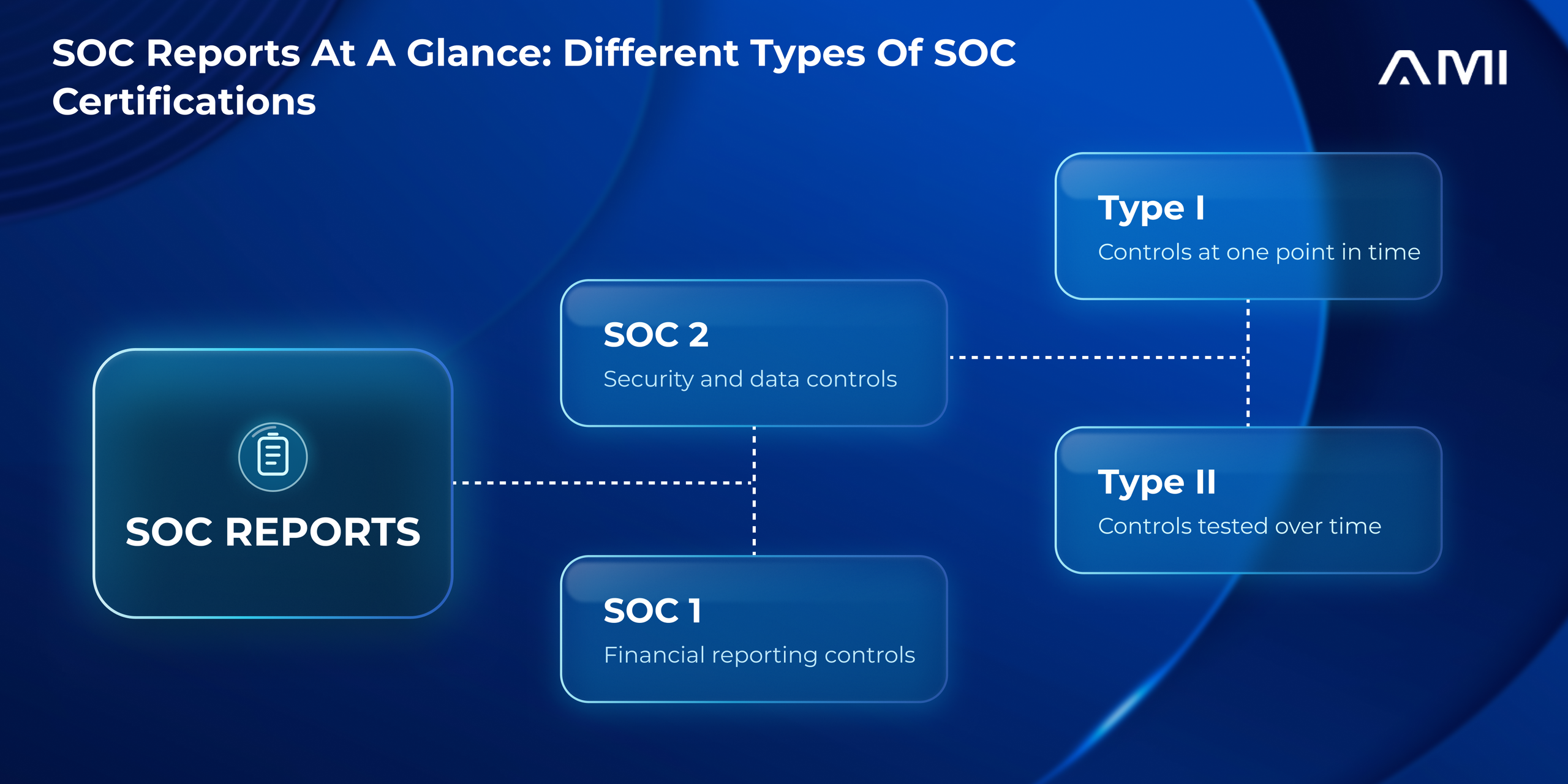
Understanding SOC 1 vs SOC 2 is important because the reports evaluate different types of controls.
| SOC Report | Primary Focus | Common Use |
|---|---|---|
| SOC 1 | Controls relevant to financial reporting | Service organizations affecting clients' financial statements |
| SOC 2 | Security, availability, processing integrity, confidentiality, and privacy controls | Technology and service organizations handling customer systems or information |
For healthcare operations involving PHI, member data, claims information, medical records, or other sensitive information, SOC 2 is particularly relevant because its criteria focus directly on information and system controls.
SOC 2 Explained: Type I vs Type II
For SOC 2 explained simply, the distinction comes down largely to when and how controls are evaluated.
A Type I report evaluates the design of controls at a specified point in time. A SOC 2 Type II report goes further by examining the operating effectiveness of applicable controls throughout a defined review period.
Why Type II Matters: A security control documented on paper is different from evidence showing that the control operated consistently over time.
This makes SOC 2 Type II certification, as it is commonly searched, especially relevant during vendor-risk and security reviews where organizations want evidence of sustained control performance.
What Are SOC 2 Compliance Requirements?
There is no single universal checklist of SOC 2 compliance requirements that every organization implements identically. A SOC 2 examination is evaluated against applicable AICPA Trust Services Criteria and the organization's system description and controls.
The Trust Services Criteria cover five categories:
- Security
- Availability
- Processing integrity
- Confidentiality
- Privacy
Security is foundational, while the other categories may be included depending on the organization and examination scope.
Operationally, organizations may establish controls around access management, risk assessment, system monitoring, incident management, change controls, data handling, workforce practices, and other areas relevant to the defined system.
Need stronger evidence that security controls extend into daily healthcare operations? AMI combines controlled workflows, trained teams, documentation discipline, QA, and operational oversight when handling sensitive information.
Why SOC 2 Matters for Healthcare Data Security
Healthcare organizations operate in an environment where sensitive information passes through providers, payers, business associates, technology systems, contact centers, and administrative teams.
The HIPAA Security Rule requires regulated organizations to protect electronic PHI through appropriate administrative, physical, and technical safeguards designed to preserve confidentiality, integrity, and availability.
SOC 2’s data security risk assessment does not replace HIPAA compliance. Instead, a SOC 2 Type II report can provide additional assurance about whether defined organizational and technology controls operated effectively during the examination period.
This relationship makes SOC 2 Type II compliance healthcare data security principles particularly relevant when healthcare organizations evaluate vendors that will create, receive, maintain, access, or transmit sensitive information.
What Data Security Issues in Healthcare Should Leaders Evaluate?
Modern data security issues in healthcare extend beyond external hacking attempts. Risks can emerge through workforce behavior, third-party access, inappropriate permissions, system vulnerabilities, misconfigured technology, poor documentation, and inconsistent handling of sensitive information.
Recent cybersecurity evidence reinforces the scale of the threat. Verizon's 2026 Data Breach Investigations Report found ransomware involved in 48% of breaches across its dataset, while its healthcare analysis continues to identify ransomware-driven system intrusions and human error as important threats.
For healthcare organizations evaluating service providers, useful questions include:
- Who can access sensitive information?
- How is access granted, reviewed, and removed?
- How are incidents identified and escalated?
- Do operational teams consistently follow security controls?
- How are third parties governed?
- Can control effectiveness be independently evidenced?
These questions turn healthcare data security solutions from a policy discussion into an operational one.
Healthcare Data Security Best Practices in Daily Operations
Effective healthcare data security best practices should be embedded into routine work rather than treated as an annual compliance exercise.
For organizations handling PHI or other sensitive healthcare information, this can include controlled system access, secure work environments, workforce training, defined escalation paths, auditability, risk assessments, monitoring, and documented incident-response procedures.
HHS continues to emphasize safeguards such as system hardening and security baselines as organizations work to protect ePHI against evolving threats.
Operational Principle: Security is strongest when the approved process and the everyday process are the same.
That is also why recurring independent examinations can matter. They help organizations demonstrate that controls are not simply documented but are being followed over the review period.
Need stronger proof behind payer compliance claims? See how payer compliance solutions can turn policies, controls, and workflow activity into operational evidence.

Why do healthcare security gaps persist despite strong policies?
Because patient data moves across teams, systems, and vendors where access, disclosure, and documentation controls can fail. AMI brings PHI-aware workflows, trained teams, QA, and operational visibility together to strengthen security across every handoff.
AMI's Four-Year SOC 2 Type II Track Record
AMI has completed SOC 2 Type II examinations with zero findings for four consecutive years, providing clients with independent evidence around the controls supporting its operating environment.
The achievement matters because AMI teams work across processes where information security and operational execution are closely connected, including healthcare payer support, RCM, Release of Information, medical record retrieval, litigation support, and contact-center operations.
AMI's approach includes:
- Controlled work environments
- Access restrictions
- Workforce security practices
- Monitoring
- Documentation
- Compliance QAs
- Defined operational governance.
Looking for operational support where security cannot be separated from execution? AMI's security-aware operational delivery combines trained teams, controlled workflows, QA, documentation, and governance around sensitive healthcare and business information.
Get in TouchFinal Thoughts
SOC 2 certification is valuable not because of a badge, but because organizations need evidence that security controls operate consistently over time. For healthcare operations, that assurance becomes especially important when vendors handle PHI, claims information, medical records, or other sensitive data.
AMI's four consecutive SOC 2 Type II examinations with zero findings reinforce a security model in which controls, workforce practices, documentation, and operational execution work together.
Frequently Asked Questions
About the Author

Written by
Urza Dey
Urza Dey is a content and copywriter with over five years of experience across marketing, B2B SaaS, HealthTech, EdTech, and related industries. At AMI, they contribute to content strategy, blog development, and marketing communication focused on healthcare operations, business process management, and AI-enabled service delivery.