
Healthcare Compliance Management: Build Evidence Across Every Operational Handoff
TL;DR: Healthcare Compliance Management
Healthcare compliance management translates formal requirements into repeatable operating controls.
Operational handoffs create risk when responsibilities and evidence are unclear.
Effective programs combine prevention, detection, reporting, investigation, and correction.
Evidence quality improves when documentation is embedded into normal work.
Corrective action requires root cause, ownership, validation, and recurrence monitoring.
Segmented metrics reveal concentrated workflow, system, team, and vendor risk.
Healthcare compliance is tested during everyday work: a patient request is routed, a claim is reviewed, a vendor receives access, or a team documents an exception. Policies establish expectations, but operational handoffs determine whether those expectations are followed and provable.
Healthcare compliance management gives leaders a structured way to assign responsibilities, monitor controls, investigate issues, and preserve evidence. The goal is not more paperwork. It is reliable execution across people, systems, and vendors.
Need accountable support across healthcare operations? Explore AMI’s healthcare services.
What Is Healthcare Compliance Management?
Healthcare compliance management coordinates policies, procedures, training, monitoring, reporting, investigations, corrective actions, and evidence. It connects formal requirements with the workflows where risk appears.
A functioning program clarifies what must happen, who owns it, how completion is documented, which exceptions require escalation, and how leaders verify effectiveness.
Why Do Compliance Programs Break at Operational Handoffs?
Handoffs create ambiguity. One team may assume another verified authorization, restricted access, documented outreach, or closed an exception. Data may move into a new system without the corresponding context or control record.
Failures become more likely when teams use inconsistent procedures, disconnected trackers, or informal approvals. The result can be missing evidence even when employees believe the work was completed correctly.
What Components Create an Effective Compliance System?
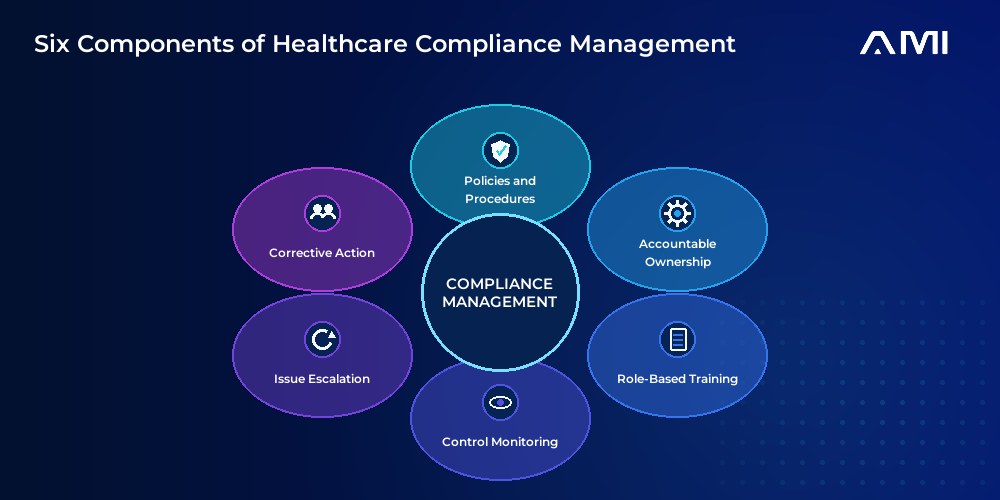
An effective system combines preventive, detective, and corrective controls.
| Component | Purpose | Evidence example |
|---|---|---|
| Policies and procedures | Define expected conduct | Approved policy versions |
| Ownership | Assign accountability | Control-owner register |
| Training | Build role-specific capability | Completion and assessment records |
| Monitoring | Detect exceptions | Review logs and dashboards |
| Reporting | Enable safe escalation | Hotline and case records |
| Corrective action | Resolve causes | Action plans and validation |
How Should Organizations Map Requirements to Workflows?
Begin with the workflow, not the regulation in isolation. Document the trigger, information received, decisions, approvals, handoffs, systems, expected evidence, and failure points. Then map each relevant obligation to a practical control.
This approach helps reveal control gaps hidden between departments. It also makes procedures easier for frontline teams to follow because responsibilities are attached to actual work.
How Can Compliance Evidence Become More Reliable?
Evidence should be created as part of execution. Required fields, timestamps, named owners, standardized reason codes, and quality checks reduce dependence on memory and manual reconstruction.
Records need consistent retention and retrieval practices. The existing discussion of payer compliance solutions shows why policy must translate into operational proof.
What Makes Issue Escalation Effective?
Employees need clear channels, nonretaliation protections, triage standards, confidentiality controls, and response expectations. Cases should be categorized by risk, routed to qualified owners, and tracked through resolution.
Escalation data can reveal systemic problems. Repeated access exceptions, documentation gaps, or missed deadlines may require workflow redesign rather than individual reminders.
Need stronger visibility across controlled healthcare workflows? Explore AM Infoweb.
How Should Corrective Actions Be Managed?
A corrective action should identify the root cause, accountable owner, required change, deadline, validation method, and closure evidence. Closing an item because training was assigned is insufficient if the underlying process still permits the same failure.
Leaders should test whether remediation works in practice. Quality sampling, trend monitoring, and follow-up reviews can confirm that the risk has actually declined.
Which Metrics Make Compliance Management Actionable?
Track overdue controls, repeat findings, time to triage, time to close, corrective-action aging, training completion, access exceptions, documentation accuracy, vendor-review status, and recurrence after remediation.
Segment results by workflow and root cause. Aggregate scores can hide concentrated risk in a particular team, system, or handoff.
How Does Compliance Management Support Data Security?
Compliance and security converge around access, data handling, documentation, incident response, and vendor accountability. The healthcare cybersecurity compliance program should share evidence and escalation paths with broader compliance operations.
A healthcare data security risk assessment can guide monitoring priorities, while SOC 2 certification controls provide additional context for testing evidence across service relationships.
The HHS Office of Inspector General compliance guidance describes foundational compliance considerations. Organizations should adapt guidance to their risks with qualified counsel and compliance leadership.

Why do healthcare security gaps persist despite strong policies?
Because patient data moves across teams, systems, and vendors where access, disclosure, and documentation controls can fail. AMI brings PHI-aware workflows, trained teams, QA, and operational visibility together to strengthen security across every handoff.
How AM Infoweb Supports Healthcare Compliance Management
AM Infoweb has two decades of experience in the U.S. healthcare industry and uses a co-managed model where AI agents and skilled human agents work together to eliminate process bottlenecks and execute secure healthcare workflows.
AMI can support:
- Controlled workflow execution and documentation
- Evidence collection and indexing
- Exception identification and routing
- Quality assurance and case sampling
- Corrective-action tracking
- Vendor and stakeholder follow-up
- Operational dashboards and trend reporting
Healthcare organizations retain responsibility for legal advice, regulatory interpretation, investigations, risk acceptance, and final compliance decisions.
How Can Compliance Become Part of Daily Operations?
Healthcare compliance management becomes effective when policies, owners, evidence, monitoring, and corrective actions are embedded in the work itself. This creates clearer accountability and helps organizations identify operational risk before it becomes a repeated failure.
Need stronger healthcare compliance management? AMI combines controlled execution, evidence workflows, skilled teams, quality assurance, and reporting across complex operational handoffs.
Get in TouchFrequently Asked Questions
About the Author

Written by
Urza Dey
Urza Dey is a content and copywriter with over five years of experience across marketing, B2B SaaS, HealthTech, EdTech, and related industries. At AMI, they contribute to content strategy, blog development, and marketing communication focused on healthcare operations, business process management, and AI-enabled service delivery.