
AI in Healthcare Compliance: Balancing Automation, Oversight, and Accountability
TL;DR: AI in Healthcare Compliance
AI compliance covers both compliant AI use and AI-assisted compliance operations.
Risks include data misuse, inaccurate output, bias, drift, weak logs, and unclear accountability.
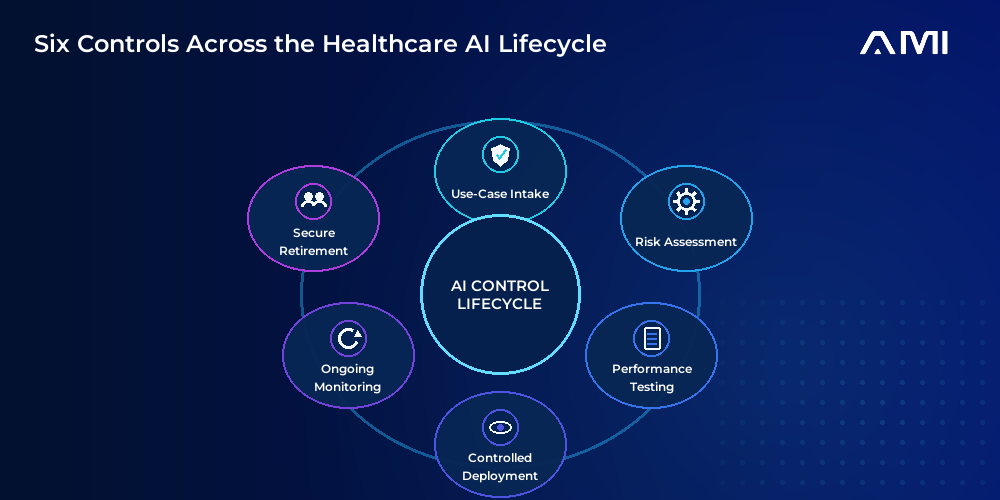
Controls should follow AI systems from intake and assessment through secure retirement.
Meaningful human oversight requires expertise, context, authority, and time to challenge outputs.
Auditability depends on approved use, versions, inputs, outputs, reviews, and changes.
Continuous monitoring should track errors, overrides, complaints, incidents, and remediation.
Healthcare organizations are using artificial intelligence to classify documents, route work, summarize information, detect anomalies, and support operational decisions. These capabilities can improve consistency and speed, but they also create questions about data use, accuracy, explainability, oversight, and accountability.
AI in healthcare compliance requires more than approving a tool. Organizations need controls across selection, design, data handling, testing, deployment, monitoring, human review, incident response, and retirement.
Need structured support for secure healthcare workflows? Explore AMI’s healthcare services.
What Does AI in Healthcare Compliance Mean?
AI in healthcare compliance refers both to using AI within compliance workflows and governing AI used elsewhere in healthcare operations. The first can support monitoring and evidence review. The second helps ensure AI-enabled processes follow privacy, security, contractual, ethical, and organizational requirements.
Governance should match the use case and risk. A model that categorizes internal documents requires different oversight from a system influencing patient access, coverage, communication, or clinical activity.
Which AI Risks Require Healthcare Oversight?
Relevant risks include unauthorized data use, inaccurate output, bias, weak explainability, automation overreliance, insecure integrations, model drift, vendor dependency, incomplete logs, and unclear accountability.
Risk can also arise when employees use unapproved public tools. Governance therefore needs an inventory of authorized use cases, clear restrictions, accessible alternatives, and practical reporting channels.
What Controls Should Govern the AI Lifecycle?
Controls should follow the system from proposal through retirement.
| Lifecycle stage | Core question | Required evidence |
|---|---|---|
| Intake | Is the use case authorized and necessary? | Business case and owner |
| Risk assessment | What could affect people, data, or operations? | Documented assessment |
| Testing | Is performance acceptable for the use? | Test results and limitations |
| Deployment | Are access and integrations controlled? | Approvals and configurations |
| Monitoring | Is performance changing? | Metrics and review records |
| Retirement | Are access and data handled correctly? | Closure and disposition records |
How Should Healthcare Organizations Control AI Data?
Teams should document what data enters the system, why it is needed, where it travels, how long it remains, who can access it, and whether it is used to train or improve models. Minimum-necessary and contractual considerations should be evaluated before deployment.
Integrations and vendor practices deserve particular attention. The organization should understand logging, encryption, isolation, subcontractors, incident duties, deletion, and data-return procedures. These controls should align with the healthcare cybersecurity compliance program.
What Does Meaningful Human Oversight Look Like?
Human oversight is meaningful only when reviewers have the time, information, authority, and expertise to challenge an output. Teams need defined review triggers, confidence thresholds, escalation paths, and prohibited uses.
Reviewers should know the system’s limitations and avoid treating fluent output as verified fact. High-impact decisions require stronger validation and traceable approval.
How Can Teams Test Accuracy, Bias, and Reliability?
Testing should use representative scenarios, edge cases, failure conditions, and relevant subgroups. Measures must reflect the operational consequence of mistakes, not only average model performance.
After deployment, teams should monitor drift, overrides, exceptions, complaints, and downstream outcomes. Material changes to models, prompts, data, integrations, or intended use may require renewed testing.
Need accountable human support around AI-enabled operations? Explore AM Infoweb.
What Evidence Makes AI Decisions Auditable?
Evidence may include the approved use case, system version, input source, output, human review, override, decision rationale, monitoring result, incident record, and change history. Required evidence depends on the workflow and risk.
Documentation should allow leaders to reconstruct what happened without exposing information unnecessarily. The SOC 2 certification and healthcare data discussion provides useful context for control evidence and trust.
How Should Organizations Manage AI Vendors?
Due diligence should address model purpose, training and customer-data practices, security controls, performance claims, limitations, auditability, subcontractors, incidents, change notification, continuity, and exit provisions.
Organizations remain accountable for how a vendor tool is configured and used. Contract terms should be paired with implementation testing and ongoing monitoring.
The organization’s healthcare data security risk assessment should include AI-specific data flows and failure modes. A broader healthcare data security framework can then connect those findings to access, infrastructure, people, and recovery controls.
Which Metrics Support Responsible AI Governance?
Track approved and unapproved use cases, validation status, exception rates, human overrides, error severity, drift indicators, access violations, vendor findings, incident response, complaints, and overdue remediation.
The NIST AI Risk Management Framework offers a voluntary U.S. framework for managing AI risks. Healthcare organizations should align governance with applicable law and qualified guidance.

Why do healthcare security gaps persist despite strong policies?
Because patient data moves across teams, systems, and vendors where access, disclosure, and documentation controls can fail. AMI brings PHI-aware workflows, trained teams, QA, and operational visibility together to strengthen security across every handoff.
How AM Infoweb Supports Compliant AI-Enabled Healthcare Workflows
AM Infoweb has two decades of experience in the U.S. healthcare industry and uses a co-managed model where AI agents and skilled human agents work together to eliminate process bottlenecks and execute secure healthcare workflows.
AMI can support:
- Controlled intake and classification workflows
- Human validation and exception handling
- Evidence capture and documentation
- Quality assurance and output sampling
- Access-aware operational execution
- Escalation and remediation tracking
- Performance and governance reporting
Healthcare organizations retain responsibility for legal interpretation, model approval, risk acceptance, clinical judgment, and final high-impact decisions.
How Can Healthcare Organizations Use AI Responsibly?
Responsible AI requires approved purposes, controlled data, rigorous testing, meaningful human oversight, auditable evidence, vendor governance, and continuous monitoring. These safeguards help organizations gain operational value without allowing automation to obscure accountability.
Need accountable support around AI-enabled healthcare workflows? AMI combines AI agents, skilled human validation, quality assurance, evidence capture, and operational reporting.
Get in TouchFrequently Asked Questions
About the Author

Written by
Urza Dey
Urza Dey is a content and copywriter with over five years of experience across marketing, B2B SaaS, HealthTech, EdTech, and related industries. At AMI, they contribute to content strategy, blog development, and marketing communication focused on healthcare operations, business process management, and AI-enabled service delivery.