
Revenue Cycle Management Challenges: 10 Problems Leaders Must Solve
TL;DR: Revenue Cycle Management Challenges
Revenue cycle problems are connected across patient access, documentation, coding, claims, payment, and collections.
Registration, eligibility, and authorization defects create preventable downstream rework.
Documentation, coding, and charge-capture controls protect both revenue integrity and compliance.
Claim rejections and denials require upstream prevention as well as disciplined recovery.
Technology improves repeatable work only when workflows, exception paths, ownership, and monitoring are defined.
Balanced metrics and cross-functional feedback loops help leaders solve root causes instead of moving work downstream.
Revenue cycle management healthcare challenges rarely begin in one department. A registration error can disrupt eligibility, authorization, coding, claim submission, payment, and patient collections. When teams manage each defect only after it reaches the back end, cost and delay accumulate across the entire revenue cycle.
Healthcare leaders therefore need more than a list of billing problems. They need a connected view of how patient access, clinical documentation, payer rules, technology, workforce capacity, denials, and payment behavior influence one another.
This guide examines 10 revenue cycle management challenges and explains how healthcare organizations can address them without optimizing one metric at the expense of accuracy, compliance, patient experience, or long-term revenue performance.
Need structured support across complex healthcare workflows? Explore AM InfoWeb's healthcare services.
Why Are Healthcare Revenue Cycles Becoming Harder to Manage?
Revenue cycles now span more systems, payer rules, access channels, clinical workflows, and third-party connections. Each handoff can introduce incomplete data, delayed decisions, duplicate work, or weak ownership. Even organizations with strong teams can struggle when information arrives late or workflows are not designed around exceptions.
The American Hospital Association reports that payer denials, prior authorization, administrative burden, and delayed payments continue to consume hospital resources. Its Costs of Caring analysis connects these pressures to financial strain, workforce burden, and reduced capacity for patient care.
The objective is not to eliminate all exceptions. Healthcare is too complex for that. The objective is to prevent avoidable defects, identify high-risk exceptions earlier, and give every unresolved item an owner, deadline, and escalation path.
Which 10 Revenue Cycle Management Challenges Matter Most?
The following problems affect different parts of the revenue cycle, but they should be evaluated as one operating system. Improving an isolated metric will not create lasting results if defects simply move downstream.
1. Inaccurate Patient Registration
Incorrect names, demographic details, insurance information, guarantor data, or coordination-of-benefits status can cause eligibility failures, claim rejections, denials, and patient billing problems.
Standardized registration fields, real-time validation, duplicate-record controls, and focused quality checks help prevent these errors. Teams should track defects by source, location, registrar, and downstream impact. Related guidance on front-end revenue cycle management explains how early controls reduce later rework.
2. Eligibility and Benefits Uncertainty
Eligibility is not a single yes-or-no check. Coverage dates, network status, benefits, deductibles, copayments, coinsurance, exclusions, and authorization requirements can all affect payment and patient responsibility.
Organizations need verification workflows that reflect the service and date of care. Unclear or conflicting responses should enter a documented exception process rather than being ignored or left for billing staff to resolve later.
3. Prior Authorization Delays
Prior authorization workflows can involve changing payer requirements, incomplete clinical documentation, manual portals, status follow-up, peer review, and appeal activity. Delays can disrupt scheduling, care delivery, and cash flow.
CMS now requires impacted payers to make certain medical prior authorization decisions within defined timeframes and provide specific denial reasons. Its Interoperability and Prior Authorization Final Rule also advances API-based information exchange and transparency.
Provider workflows still require accurate intake, documentation readiness, submission tracking, follow-up, and escalation. Automation can reduce repetitive work, but teams must retain oversight for clinical and payer-specific exceptions.
4. Incomplete Clinical Documentation
Coding and billing depend on documentation that supports the services provided. Missing specificity, signatures, procedure details, medical necessity, discharge status, or time-based information can delay coding and create denials.
Documentation improvement should focus on recurring workflow defects, not generic reminders. Clinical, coding, compliance, and revenue integrity teams should agree on requirements and provide feedback close to the point of care.
5. Coding Complexity and Capacity
Coding teams must interpret clinical documentation while applying current code sets, payer rules, edits, and compliance requirements. Volume shifts, specialty complexity, incomplete documentation, and workforce shortages can create backlogs or inconsistent decisions.
Quality assurance should combine accuracy audits, targeted education, denial feedback, and productivity monitoring. Productivity must not encourage unsupported coding or reduced review of complex accounts.
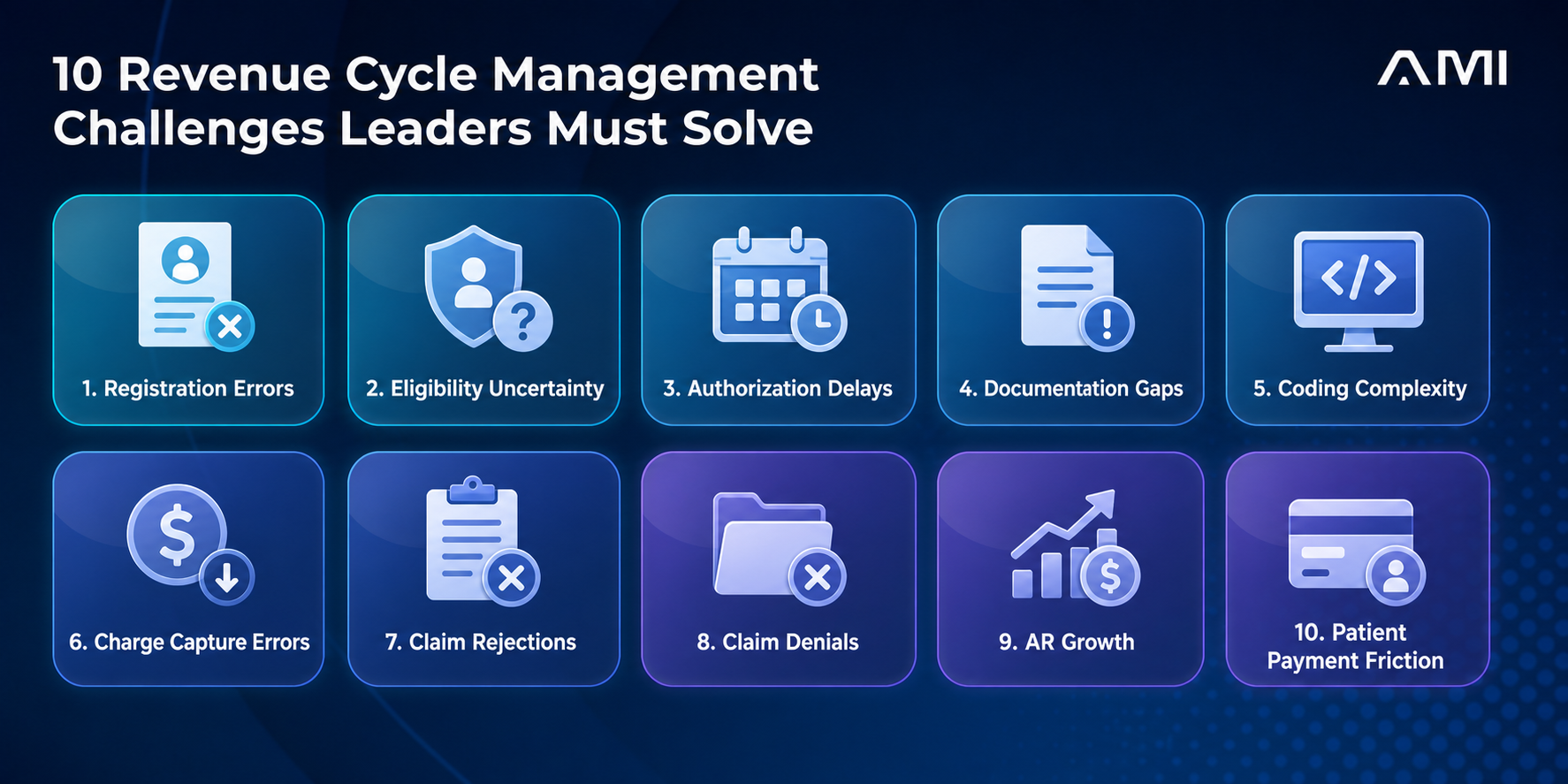
6. Missed or Incorrect Charge Capture
Charges can be lost or delayed when clinical documentation, departmental systems, interfaces, charge-master rules, and reconciliation processes do not align. Duplicate or unsupported charges create different but equally serious risks.
Daily encounter reconciliation, exception queues, controlled charge-master changes, and cross-functional governance improve revenue integrity. See how healthcare charge capture supports revenue integrity.
7. Claim Rejections and First-Pass Errors
Claims may fail before payer adjudication because of missing data, invalid identifiers, formatting errors, coding edits, coverage issues, or clearinghouse rules. Rejections delay the billing clock and create avoidable touchpoints.
Leaders should monitor rejection reason, source, correction time, recurrence, and responsible workflow. A strong clean claim rate depends on preventing errors upstream, not only correcting rejected claims quickly.
8. Claim Denials and Appeal Burden
Denials can arise from authorization, eligibility, coding, medical necessity, timely filing, documentation, bundling, and payer-policy differences. Treating every denial as an isolated appeal hides the process that created it.
Denial management should connect root cause, financial value, preventability, appeal outcome, payer behavior, and corrective action. AHA reporting notes that many denied claims are eventually paid only after costly review, showing why recovery and prevention must operate together. Its overview of claims and denial automation describes the continuing administrative burden.
9. Slow Payments and Accounts Receivable Growth
Unresolved rejections, denials, underpayments, missing remittances, credit balances, and weak follow-up can increase days in accounts receivable. High-level aging totals may conceal specific payer, service-line, or workflow problems.
Segment receivables by payer, age, balance, denial status, claim status, and action required. Work should be prioritized by collectability, value, filing deadlines, and root cause rather than processed only from oldest to newest.
10. Patient Payment Friction
Patients often receive estimates, explanations of benefits, statements, payment requests, and collection communications from different systems. Confusing responsibility, unexpected balances, and limited payment options can reduce trust and delay payment.
Clear estimates, plain-language communication, financial assistance screening, flexible payment options, and coordinated support can improve the experience. Patient collections should be measured alongside complaint, access, and resolution metrics, not only dollars collected.
How Can Leaders Connect Front-End and Back-End Performance?
Front-end and back-end teams need shared defect categories and feedback loops. If a denial begins with registration or authorization, the originating team should see the outcome. If a coding issue stems from documentation, clinical leaders need evidence about the recurring gap.
A connected scorecard can map upstream defects to downstream results:
| Upstream Workflow | Leading Measure | Downstream Outcome |
|---|---|---|
| Registration | Demographic and insurance accuracy | Rejections and eligibility denials |
| Eligibility | Verification completion and exception rate | Coverage denials and patient balances |
| Authorization | Approval status before service | Authorization denials and care delays |
| Documentation | Query and completion rate | Coding lag and medical-necessity denials |
| Charge capture | Reconciliation completion | Late charges and revenue leakage |
| Claim preparation | First-pass acceptance | Billing delay and rework |
The scorecard should show where work originates, where it is detected, and who owns corrective action.
How Should Healthcare Organizations Manage Payer Variation?
Payer requirements can differ across eligibility, authorization, coding, attachments, medical necessity, filing limits, appeals, and payment policies. Staff may rely on memory or informal notes when rules are not centralized.
Create a governed payer-rule repository with ownership, effective dates, source documentation, workflow impact, and review schedules. Route policy changes to the teams and systems affected. Monitor payer-specific denials, underpayments, response times, and appeal outcomes.
Payer meetings become more productive when teams bring segmented evidence rather than broad complaints. Patterns by plan, service, code, location, and denial reason can support focused escalation and contract discussions.
How Can Technology Reduce Revenue Cycle Bottlenecks?
Technology can validate registration data, automate eligibility checks, route authorization tasks, detect missing documentation, identify claim edits, prioritize receivables, and surface denial patterns. The highest-value opportunities usually involve repetitive, rules-based work with clear exception paths.
Automation needs governance. Rules should have an owner, testing evidence, change control, failure monitoring, and fallback procedures. A weak automated rule can create errors at scale or silently move work into another queue.
AI can help classify work, summarize notes, predict risk, and recommend next actions. Skilled human teams remain necessary for ambiguous payer responses, clinical interpretation, appeals, patient conversations, and compliance-sensitive decisions.
Need disciplined execution across billing, claims, denials, and follow-up? Explore AM InfoWeb's Revenue Cycle Management services.

Why does revenue still leak after the claim is submitted?
Because small breakdowns across eligibility, coding, billing, denials, and follow-up can quietly delay cash flow. AM InfoWeb helps healthcare teams strengthen RCM operations with process discipline, trained teams, and AI-assisted execution.
How Can Leaders Address Revenue Cycle Staffing Pressure?
Staffing problems are not solved by productivity targets alone. Vacancies, turnover, training time, specialized knowledge, and uneven work distribution can reduce quality and slow exception resolution.
Leaders should separate capacity problems from process problems. Additional staff will not fix duplicate entry, unclear ownership, broken interfaces, or poorly designed work queues. Standard operating procedures, knowledge controls, cross-training, and workload segmentation can improve resilience.
Co-managed support can add capacity while the healthcare organization retains governance and escalation authority. Performance expectations should include accuracy, turnaround, quality, compliance, and root-cause improvement.
Which Metrics Reveal Revenue Cycle Management Problems?
No single KPI can describe revenue cycle health. Use a balanced set of leading and lagging measures:
- Registration and insurance accuracy
- Eligibility and authorization completion
- Coding and documentation lag
- Charge lag and reconciliation completion
- Clean claim and rejection rates
- Initial denial and preventable denial rates
- Appeal overturn and recovery rates
- Days in accounts receivable
- Underpayment and credit-balance resolution
- Patient estimate and collection performance
- Work-queue aging and exception turnaround
Define every metric, including numerator, denominator, exclusions, data source, owner, and reporting period. Segment results so organization-wide averages do not hide payer, facility, specialty, or workflow problems.
What Revenue Cycle Improvement Mistakes Should Leaders Avoid?
Common mistakes include:
- Optimizing one department without measuring downstream impact
- Treating all denials as back-end billing problems
- Adding automation before standardizing the workflow
- Using generic benchmarks without validating local definitions
- Allowing payer rules to live in spreadsheets and staff memory
- Measuring productivity without accuracy and quality safeguards
- Correcting accounts without fixing recurring root causes
- Ignoring patient experience during financial conversations
- Buying technology without assigning operational ownership
- Expanding staff without removing preventable work
Sustainable improvement requires a portfolio of controls rather than a single project. Leaders should prioritize changes by financial impact, patient risk, compliance exposure, recurrence, and implementation effort.
How AM InfoWeb Supports Revenue Cycle Improvement
AM InfoWeb supports healthcare organizations with co-managed revenue cycle workflows built around trained execution, quality controls, escalation discipline, and operational visibility.
With two decades of experience in the U.S. healthcare industry, AM InfoWeb uses a co-managed model that brings AI agents and skilled human agents together to eliminate process bottlenecks and execute secure healthcare workflows.
AM InfoWeb can support:
- Patient registration and eligibility workflows
- Prior authorization follow-up
- Medical coding and documentation support
- Charge and claim review
- Rejection correction and claim submission
- Denial analysis and appeal support
- Accounts receivable follow-up
- Patient financial communication
- Quality assurance and performance reporting
The co-managed model helps healthcare leaders increase capacity while retaining control over policies, escalations, compliance, and performance priorities. For a deeper look at recovery controls, review claims denial management strategies.
What Should Healthcare Revenue Cycle Leaders Do Next?
Start with a cross-functional map of the revenue cycle. Identify where information enters, where it is validated, which exceptions require human judgment, and where unresolved work becomes a rejection, denial, delayed payment, or patient complaint.
Choose a small number of high-impact defects and connect each one to an owner, baseline, corrective action, and balancing measure. Verify that improvement in one area does not create risk or hidden work elsewhere.
Revenue cycle management challenges become more manageable when leaders connect upstream prevention with downstream resolution. Clear ownership, disciplined workflows, reliable data, governed automation, and skilled execution create the foundation for stronger revenue performance.
Need stronger control across the healthcare revenue cycle? AM InfoWeb combines trained RCM teams, AI-assisted workflows, quality assurance, and operational reporting to reduce bottlenecks and improve accountable execution.
Get in TouchFrequently Asked Questions
About the Author

Written by
Urza Dey
Urza Dey is a content and copywriter with over five years of experience across marketing, B2B SaaS, HealthTech, EdTech, and related industries. At AMI, they contribute to content strategy, blog development, and marketing communication focused on healthcare operations, business process management, and AI-enabled service delivery.