

Clean Claim Rate: How Healthcare Teams Improve First-Pass Accuracy
TL;DR: Improving Clean Claim Rate
Clean claim rate measures the share of eligible claims that pass defined first-submission edits without preventable correction.
Organizations should distinguish clearinghouse acceptance, payer acceptance, and first-pass resolution when defining the metric.
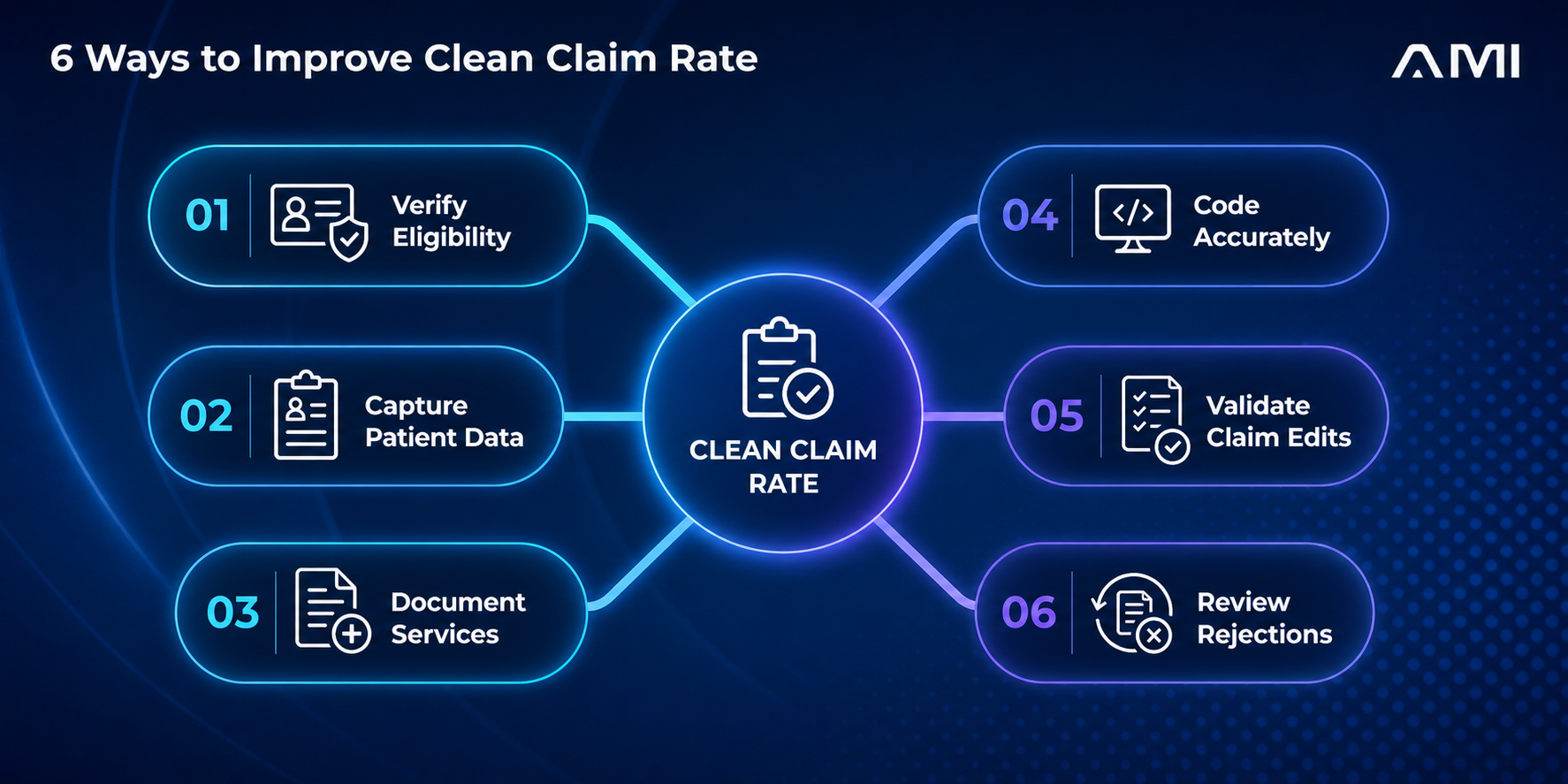
Registration, eligibility, authorization, documentation, coding, charge capture, and payer rules all affect clean claim performance.
Claim edits should combine standard transaction validation with current payer-specific requirements.
Rejection data should be routed to the upstream team capable of preventing each recurring defect.
Clean claim rate should be reviewed with rejection, denial, submission-lag, accounts-receivable, and collection metrics.
A strong clean claim rate shows that a healthcare organization is submitting claims with the information needed to move through payer edits without preventable rejection, manual correction, or additional development. It connects front-end accuracy, clinical documentation, coding, charge capture, billing, and payer-specific validation within one measurable outcome.
When the rate falls, the impact extends beyond the billing office. Staff spend more time correcting claims, payment slows, denial risk rises, and leaders lose confidence in revenue forecasts. Improving clean claims therefore requires more than a final billing review. It requires disciplined workflows across the revenue cycle.
This guide explains how to calculate clean claim rate, what lowers it, and how healthcare teams can improve first-pass claim accuracy without shifting errors downstream.
Need stronger healthcare operations across the revenue cycle? Explore AM InfoWeb's healthcare services.
What Is Clean Claim Rate in Healthcare?
Clean claim rate is the percentage of claims that pass initial payer or clearinghouse edits and can proceed without preventable correction or resubmission. It is often used as an operational measure of claim submission quality.
CMS defines a clean Medicare claim as one that does not require external investigation or development on a prepayment basis. CMS also explains that electronic claims pass through multiple levels of front-end and policy edits. A batch or individual claim may be rejected when required standards are not met. The CMS electronic healthcare claims guidance describes how those edits occur.
Organizations should document their internal definition because clean claim rate, first-pass acceptance rate, and first-pass resolution rate are sometimes used interchangeably even though they may measure different events.
How Is Clean Claim Rate Calculated?
The basic clean claim rate formula is:
Clean claims accepted on first submission ÷ total claims submitted × 100
If 9,500 of 10,000 claims pass the defined first-submission edits, the clean claim rate is 95%.
The denominator should exclude test files, duplicates created by system defects, and other transactions that do not represent genuine claim submissions. Leaders should also decide whether the numerator measures clearinghouse acceptance, payer acceptance, or successful adjudication without manual intervention.
A reliable dashboard defines the submission point, response transaction, measurement period, payer scope, and treatment of corrected or replacement claims. Without those rules, different teams may report different clean claim rates from the same claim population.
What Causes a Low Clean Claim Rate?
A low clean claim rate rarely comes from one isolated billing error. It usually reflects defects that entered earlier and were not detected before submission.
Eligibility and registration errors
Incorrect member IDs, inactive coverage, mismatched demographics, missing coordination-of-benefits information, and inaccurate payer selection can stop a claim before adjudication.
Incomplete clinical documentation
Missing signatures, unclear service details, unsupported diagnoses, and incomplete medical necessity documentation can delay coding or trigger payer requests and denials. CMS notes that common claim errors can include missing signatures and insufficient documentation in its Targeted Probe and Educate guidance.
Coding and charge-capture defects
Invalid or outdated codes, modifier errors, diagnosis-procedure mismatches, missed charges, and incorrect units can cause claim edits or reduce payment accuracy.
Payer-specific rule failures
Each payer may apply different filing, authorization, attachment, coding, and data requirements. A claim that passes a generic scrubber can still fail a payer edit.
Weak correction feedback
When rejection and denial reasons remain within the billing team, registration, clinical, coding, and authorization teams cannot correct the upstream workflow that produced the defect.
How Can Front-End RCM Improve Clean Claim Rate?
Clean claim performance begins before the patient receives care. Registration teams need accurate demographics, coverage information, subscriber relationships, and contact details. Eligibility and benefits verification should confirm active coverage, plan rules, patient responsibility, and relevant service limitations.
Prior authorization requirements should be identified before service whenever possible. Staff also need a process for documenting authorization numbers, approved services, date ranges, and payer communications in fields that billing teams can locate.
Standardized validation can prevent common mismatches before they reach the claim. This includes name and date-of-birth checks, member ID formatting, payer-plan mapping, coordination-of-benefits review, and required-field controls. See Front End Revenue Cycle Management: How to Reduce Errors and Denials for a broader workflow framework.
How Do Documentation and Coding Improve First-Pass Accuracy?
Documentation must support the services, diagnoses, medical necessity, and code selection represented on the claim. Clear templates and timely clinician completion can reduce coding queries and prevent claims from entering billing with missing information.
Coding teams need current guidance, specialty knowledge, payer awareness, and focused quality review. Prebill audits should target high-risk services, new codes, modifier use, recurring provider issues, and patterns found in rejection or denial data.
Charge reconciliation is equally important. Teams should compare scheduled, documented, coded, and billed activity so missing or duplicate charges are identified before submission. Learn how healthcare medical coding services improve revenue cycle management.
How Should Claim Edits and Rejections Be Managed?
Claim scrubbers should combine standard transaction checks with payer-specific rules. Edit logic needs clear ownership, regular maintenance, and testing after payer updates, code changes, or system releases.
Teams should distinguish a clearinghouse rejection from a payer denial. A rejection usually means the claim did not enter adjudication, while a denial occurs after the payer evaluates the claim. Both require action, but the workflows, ownership, and reporting should remain separate.
Every rejection should be categorized by reason, payer, location, specialty, provider, and source workflow. Rapid correction restores the claim, while trend analysis prevents recurrence. For downstream root-cause methods, read Claims Denial Management: From Root Cause to Revenue Recovery.
Need disciplined claim preparation, billing, denial, and follow-up workflows? Explore AM InfoWeb's Revenue Cycle Management services.

Why does revenue still leak after the claim is submitted?
Because small breakdowns across eligibility, coding, billing, denials, and follow-up can quietly delay cash flow. AM InfoWeb helps healthcare teams strengthen RCM operations with process discipline, trained teams, and AI-assisted execution.
What Is a Good Clean Claim Rate Benchmark?
There is no single universal clean claim rate benchmark that fits every organization. Results vary with payer mix, specialty, claim type, clearinghouse logic, and the exact definition used in the calculation.
Healthcare leaders should first establish a trusted baseline and then segment results by payer, facility, specialty, provider, and rejection category. A high overall rate can hide poor performance within a specific payer or service line.
Targets should be paired with balancing measures. A team should not improve the reported clean claim rate by delaying valid claims, excluding difficult populations, or moving defects into a later denial category.
Which Metrics Should Accompany Clean Claim Rate?
Clean claim rate becomes more useful when reviewed with:
- First-pass acceptance rate
- Initial rejection rate
- Corrected-claim volume
- Claim submission lag
- Coding and billing hold volume
- Initial denial rate
- Days in accounts receivable
- Rework touches per claim
- Payer response time
- Net collection rate
Leaders should connect operational defects to financial outcomes. For example, a recurring registration error may increase rejections, delay payment, and raise accounts receivable even when the final claim is eventually paid.
Automation can help identify error patterns and route exceptions, but rules and outputs need human oversight. AI in revenue cycle management explains where technology can support controlled execution.
How Can Teams Sustain Clean Claim Improvements?
Sustained improvement depends on shared accountability. Revenue cycle leaders should assign each defect category to the team able to prevent it, not only the team correcting it.
Weekly or monthly reviews should show the leading rejection causes, financial impact, affected payers, responsible workflows, corrective actions, and whether the error recurred. Training should use real defects and measurable follow-up rather than generic reminders.
System changes also require monitoring. New payer edits, software releases, code updates, acquisitions, staffing changes, and new service lines can create fresh claim defects. A controlled change process helps teams test workflows before errors reach production volumes.
How Does AM InfoWeb Support Clean Claim Performance?
AM InfoWeb supports healthcare organizations with co-managed revenue cycle operations designed around process accuracy, trained execution, quality control, and operational visibility.
AM InfoWeb can support:
- Eligibility and benefits verification
- Prior authorization workflow support
- Patient-data validation
- Medical coding and charge review
- Claim preparation and submission
- Rejection correction and trend reporting
- Denial management and follow-up
- Quality assurance and escalation
- Performance dashboards and operational reviews
The objective is not only to correct rejected claims. It is to help healthcare teams identify where defects enter the workflow and build controls that improve first-pass accuracy over time.
What Should Healthcare Leaders Do Next?
Clean claim rate should be managed as a cross-functional revenue cycle measure. Registration, authorization, clinical documentation, coding, billing, IT, and payer-management teams all influence the outcome.
Start by defining the metric clearly, validating the data, and identifying the most expensive recurring defects. Then assign preventive actions to the correct workflow owners and monitor whether each change improves first-pass results.
A higher clean claim rate can reduce rework and support faster payment, but the lasting value comes from building a revenue cycle that produces accurate claims consistently.
Need stronger control over claim accuracy and preventable rework? AM InfoWeb combines trained RCM teams, structured workflows, QA, and AI-assisted execution to help improve first-pass claim performance.
Get in TouchFrequently Asked Questions
About the Author

Written by
Urza Dey
Urza Dey is a content and copywriter with over five years of experience across marketing, B2B SaaS, HealthTech, EdTech, and related industries. At AMI, they contribute to content strategy, blog development, and marketing communication focused on healthcare operations, business process management, and AI-enabled service delivery.