

Healthcare Charge Capture: Improving Revenue Integrity Performance
TL;DR: Healthcare Charge Capture
Charge capture connects documented care to accurate, timely, and supported billing.
Missed, late, duplicate, or unsupported charges can create revenue loss, rework, denials, and compliance exposure.
Point-of-care documentation and daily encounter reconciliation prevent many charge defects.
Charge description master changes require cross-functional governance, testing, and post-launch validation.
Balanced metrics should track charge lag, late charges, exceptions, corrections, denials, and reconciliation completion.
Technology can detect exceptions, but automated rules still require ownership and human oversight.
Healthcare charge capture connects the care delivered to the financial transaction submitted for payment. When the process works, documented procedures, medications, supplies, and services move into the billing workflow accurately and on time. When it breaks, providers can lose revenue, delay claims, create compliance exposure, and force staff to reconstruct encounters after the fact.
Charge capture is not only a billing responsibility. Clinical documentation, department workflows, EHR configuration, coding, charge description master governance, reconciliation, and quality assurance all shape the final result. Sustainable improvement therefore requires shared controls across clinical, operational, and revenue cycle teams.
This guide explains what healthcare charge capture means, where errors enter the process, which controls reduce missed or incorrect charges, and how leaders can measure revenue integrity without encouraging inappropriate billing.
Need stronger operational support across healthcare workflows? Explore AM InfoWeb's healthcare services.
What Is Healthcare Charge Capture?
Healthcare charge capture is the process of recording billable services, procedures, medications, supplies, and other resources associated with a patient encounter. The captured information moves through coding, charge validation, claim preparation, and billing.
The objective is a complete, accurate, timely, and compliant representation of the care actually provided. Charge capture should never create a charge that is unsupported by the medical record. It should ensure that supported services are not lost between clinical delivery and claim submission.
The American Hospital Association identifies charge capture as a middle-revenue-cycle function alongside clinical documentation integrity, coding, compliance, and denial prevention. Its revenue cycle automation overview shows why these connected functions need coordinated controls.
Why Does Charge Capture Matter for Revenue Integrity?
Missed charges reduce earned revenue and distort service-line performance. Late charges can delay claim submission, trigger corrected claims, or create additional work after an account has already moved downstream. Duplicate, incorrect, or unsupported charges can produce overpayments, denials, refunds, and compliance risk.
Accurate healthcare charge capture also improves the quality of operational data. Leaders rely on charge information to understand utilization, supply consumption, service demand, reimbursement, and margin. If charge data is incomplete, financial and operational decisions are built on an unreliable picture.
Charge integrity differs from simply maximizing charges. It focuses on whether each charge is supported, coded correctly, routed to the right account, and submitted according to applicable payer and billing requirements.
Where Do Charge Capture Errors Enter Healthcare Workflows?
Charge capture errors often originate before the billing team sees the account. The most common failure points include:
Incomplete clinical documentation
Missing procedure details, start and stop times, medication administration records, signatures, units, or medical necessity information can prevent a valid charge from being created or supported.
Manual charge entry
Paper forms, spreadsheets, delayed batch entry, and duplicate handoffs increase the risk of omissions, transposition errors, and late charges.
EHR and interface configuration
Order-to-charge rules, preference lists, interfaces, department mappings, and automated charging logic may fail after workflow, system, or service changes.
Charge description master defects
Outdated codes, incorrect revenue codes, inactive items, inaccurate units, and inconsistent departmental mappings can send valid services into incorrect billing paths.
Weak encounter reconciliation
If scheduled, documented, coded, dispensed, administered, and billed activity is not compared, missing and duplicate charges can remain invisible.
How Can Documentation Improve Charge Capture Accuracy?
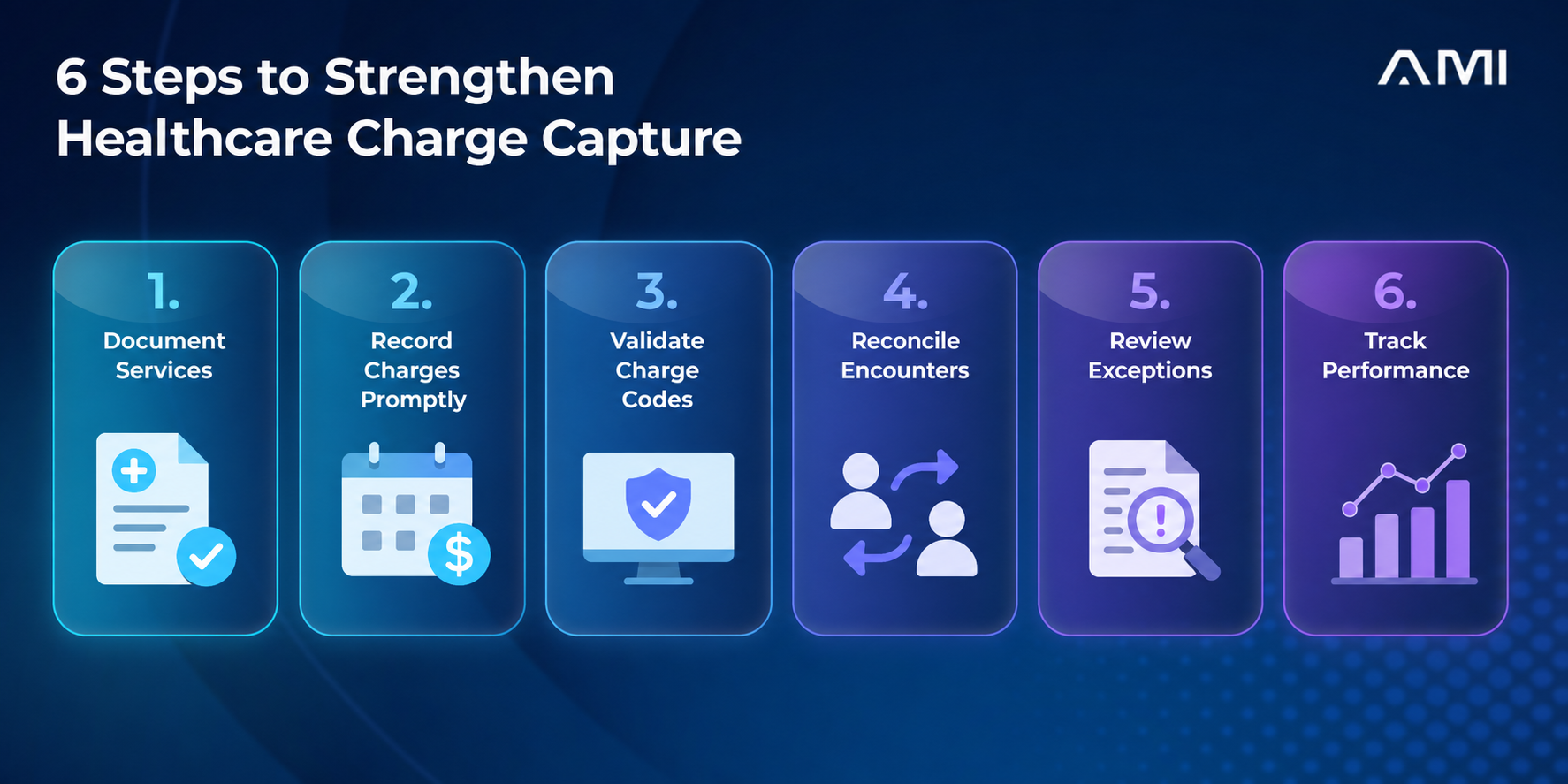
Documentation should record the service at the point of care in fields that support coding and charging. Templates can make required elements visible, but they must reflect the actual workflow and avoid encouraging copied or unsupported information.
Departments should define which documentation events create charges, which require manual review, and which exceptions enter a work queue. High-risk areas often include infusions, injections, implants, supplies, medications, bedside procedures, therapy units, and observation services.
Training works best when it uses real defects. Clinicians and departmental staff need to see how missing details affect coding, billing, and payment. A focused feedback loop is more effective than generic reminders. For related guidance, see how medical coding services support revenue cycle performance.
How Should Providers Reconcile Charges Before Billing?
Charge reconciliation compares evidence that a service occurred with evidence that it was charged. The comparison may include appointment schedules, procedure logs, clinical notes, orders, medication administration records, supply systems, device logs, coding output, and posted charges.
Daily reconciliation helps departments resolve missing information while the encounter is still recent. High-value drugs, implants, procedures, and supplies may require same-day exception review. Lower-risk services can be monitored through automated variance reports and periodic audits.
Each exception needs an owner, due date, escalation path, and documented resolution. Reconciliation should also detect duplicates and unsupported charges, not only missed revenue. This balanced approach protects both revenue and compliance.
Which Metrics Reveal Charge Capture Performance?
No single metric describes charge capture quality. Leaders should review a balanced set of operational and financial measures, including:
- Charge lag by department and service line
- Late-charge volume and value
- Missing-charge exceptions
- Duplicate or deleted charges
- Manual charge-entry rate
- Reconciliation completion rate
- Charge correction volume
- Unbilled accounts caused by charge holds
- Denials linked to charging or documentation
- Net revenue variance after audits
Trends should be segmented by facility, department, provider, service, payer, and charge source. Averages can hide concentrated problems. The same discipline used in front-end revenue cycle management can help teams connect upstream defects to downstream claim outcomes.
| Metric | What It Helps Reveal |
|---|---|
| Charge lag | Delays between service delivery and charge posting |
| Late-charge value | Revenue entered after normal billing cutoffs |
| Reconciliation completion | Whether departments complete expected daily controls |
| Missing-charge exceptions | Services or resources that may not have reached billing |
| Charge correction volume | Recurring documentation, coding, or system defects |
| Charging-related denials | Downstream payment impact from charge or documentation errors |
Need disciplined charge, coding, billing, and follow-up workflows? Explore AM InfoWeb's Revenue Cycle Management services.

Why does revenue still leak after the claim is submitted?
Because small breakdowns across eligibility, coding, billing, denials, and follow-up can quietly delay cash flow. AM InfoWeb helps healthcare teams strengthen RCM operations with process discipline, trained teams, and AI-assisted execution.
How Can Technology Strengthen Charge Capture Controls?
Technology can connect orders, documentation, coding, inventory, and billing events so exceptions are identified sooner. Automated rules can flag an administered medication without a corresponding charge, a completed procedure without documentation, or a charge posted without expected supporting activity.
Analytics can prioritize high-value and high-risk exceptions. Work queues can route issues to the department able to resolve them. Dashboards can show recurring defects by location, workflow, or system source.
Automation still requires governance. Rules need testing, ownership, change control, and periodic validation. A faulty automated rule can scale errors faster than a manual process. Human review remains necessary for ambiguous documentation, unusual clinical circumstances, and compliance-sensitive decisions.
How Should Charge Description Master Governance Work?
Charge description master governance should bring revenue integrity, coding, compliance, finance, clinical operations, pharmacy, supply chain, and IT together. The team should review new services, annual code changes, payer requirements, pricing decisions, units, revenue codes, and department mappings through a controlled process.
Every requested change should document the business reason, supporting code or policy, affected workflows, testing evidence, approval, implementation date, and post-launch validation. New service lines should not go live until documentation, coding, charging, billing, and reconciliation paths have been tested.
Periodic audits should compare the charge master with actual clinical workflows. An accurate table cannot protect revenue if departments use a different process in practice.
How Can Teams Prevent Recurring Charge Capture Errors?
Recurring defects need root-cause analysis. Correcting one account restores a charge, but changing the workflow prevents the next hundred errors. Teams should classify defects by source, quantify financial and operational impact, assign corrective actions, and confirm whether the issue returns.
Common corrective actions include template changes, interface fixes, preference-list updates, staff training, clearer ownership, automated exception logic, and revised reconciliation procedures. Leaders should monitor both completion and effectiveness.
Charge capture should also be connected to denial and payment data. A pattern of missing units, invalid codes, or late charges may appear first in a work queue and later as delayed payment or revenue leakage.
How Does AM InfoWeb Support Charge Capture Performance?
AM InfoWeb supports healthcare organizations with co-managed revenue cycle workflows built around trained execution, quality controls, and operational visibility.
With two decades of experience in the U.S. healthcare industry, AM InfoWeb uses a co-managed model that brings AI agents and skilled human agents together to eliminate process bottlenecks and execute secure healthcare workflows.
AM InfoWeb can support:
- Documentation follow-up
- Charge and coding review
- Encounter reconciliation work queues
- Claim preparation and submission support
- Rejection correction and denial analysis
- Quality assurance and escalation
- Charge-capture performance reporting
These workflows help identify where charge defects enter the process and maintain the disciplined follow-through needed to resolve exceptions.
The objective is not aggressive charging. It is accurate, timely, supported billing that protects revenue integrity and reduces avoidable rework.
What Should Healthcare Leaders Do Next?
Start by mapping how services become charges in each high-risk department. Identify manual handoffs, automated rules, exception queues, reconciliation controls, and accountable owners. Then validate the process using real encounters.
Prioritize defects by financial value, frequency, compliance exposure, and operational effort. Improvements should address the workflow that creates the error, not only the account where the error appears.
Consistent healthcare charge capture depends on clear documentation, reliable systems, disciplined reconciliation, and shared accountability across clinical and revenue cycle teams.
Need stronger control over charge accuracy and revenue integrity? AM InfoWeb combines trained RCM teams, structured workflows, QA, and operational reporting to help healthcare organizations reduce missed charges and prevent avoidable rework.
Get in TouchFrequently Asked Questions
About the Author

Written by
Urza Dey
Urza Dey is a content and copywriter with over five years of experience across marketing, B2B SaaS, HealthTech, EdTech, and related industries. At AMI, they contribute to content strategy, blog development, and marketing communication focused on healthcare operations, business process management, and AI-enabled service delivery.