


Patient Collections in Healthcare: Best Practices That Improve Payment
TL;DR — Building Better Patient Collection Workflows
Patient collections in healthcare should begin before the final statement is issued.
Cost clarity and accurate estimates can reduce confusion about patient responsibility.
Clear statements help patients understand what they owe and why.
Flexible payment options can help providers collect valid balances without relying only on repeated collection contacts.
Automated patient collections can support reminders, payment links, routing, and routine communication.
Collection teams should track payment behavior, aging balances, contact effectiveness, and unresolved billing issues together.
Persistent patient-balance backlogs may signal a need for third-party patient collections or broader medical billing support.
Collecting patient balances has become a larger part of healthcare revenue cycle management as deductibles, coinsurance, copays, and other out-of-pocket responsibilities continue to affect patients. In 2025, the average deductible among covered workers with a general annual deductible reached $1,886, while 34% of covered workers were enrolled in plans with deductibles of at least $2,000 for single coverage.
For providers, that makes patient collections in healthcare more than a back-end collections activity. Payment performance increasingly depends on what happens before the bill is sent: estimating responsibility, explaining charges, offering accessible payment methods, resolving insurance questions, and communicating with patients in a way that maintains trust. The strongest collection strategy makes payment easier without turning the financial interaction into an adversarial one.
What Are Patient Collections in Healthcare?
For organizations asking what does patient collections do, the function focuses on collecting the portion of healthcare charges that a patient is responsible for after insurance benefits, contractual adjustments, and other payment rules are applied.
The patient collections process can begin before care and continue after payer adjudication. It may include estimates, point-of-service collections, statements, payment reminders, financial counseling, payment plans, balance inquiries, follow-up, and final account resolution.
This is why patient collections in medical billing cannot be separated from eligibility, benefits, claims processing, and patient communication. If the underlying bill or insurance information is unclear, collection activity may simply generate more questions rather than payment.
Why Patient Collections Are Becoming More Difficult
Patients are carrying meaningful financial responsibility while also reporting difficulty affording healthcare. KFF reported in April 2026 that just under half of U.S. adults say healthcare costs are difficult to afford, and roughly three in ten say they or someone in their household had difficulty paying for healthcare during the previous year.
Confusion can compound the affordability problem. KFF's research on healthcare debt found that some adults delayed payment because they expected insurance to pay or were unsure whether a bill was accurate.
That creates three distinct challenges for providers:
| Patient Collection Challenge | Operational Impact |
|---|---|
| Unclear responsibility | More billing questions and delayed payment |
| High out-of-pocket costs | Greater need for payment flexibility |
| Insurance uncertainty | Patients may wait for payer resolution |
| Fragmented communication | Repeated calls and inconsistent answers |
| Limited payment options | Additional friction at the point of payment |
| Aging balances | More follow-up and lower recovery potential |
These challenges often begin before a patient receives a bill. Upstream revenue cycle processes such as documentation, charge capture, and medical coding directly influence claim accuracy, reimbursement, and the amount that eventually reaches the patient responsibility stage.
Collection Principle: Not every unpaid balance is a collection problem. Some are clarity, affordability, or workflow problems first.
Patient Billing and Collections Best Practices
The strongest patient billing and collections best practices reduce friction throughout the financial journey rather than waiting until an account becomes overdue.
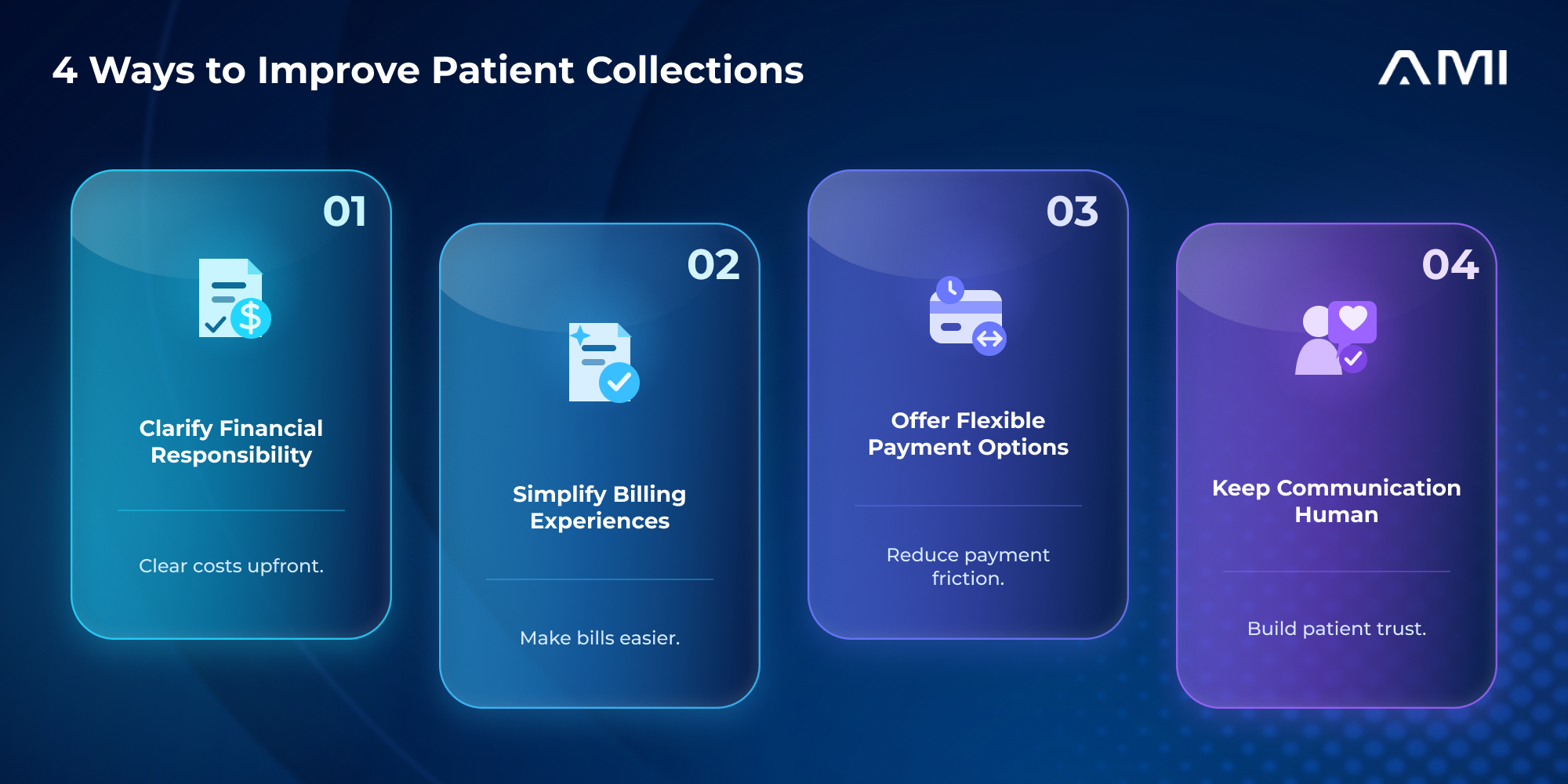
For providers looking to improve patient collections, four areas deserve particular attention.
1. Clarify Financial Responsibility Earlier
Patients should receive useful financial information before care whenever practical.
Eligibility and benefit verification, expected coverage, deductible status, and estimated patient responsibility can provide a clearer starting point for the financial conversation. This begins with optimized front-end revenue cycle processes that capture accurate patient information, verify coverage details, and establish clearer expectations around financial responsibility before services are delivered.
CMS requires hospitals to make standard charge information publicly available and provide a consumer-friendly display of at least 300 shoppable services, or offer a qualifying online price estimator. Updated 2026 Hospital Price Transparency requirements are already in effect.
An estimate is not necessarily the final bill, but explaining what is known, what may change, and what the patient may owe reduces surprises later.
2. Make Bills Easier to Understand
A patient should be able to answer basic questions from the bill itself:
- What service am I being charged for?
- What did insurance pay or adjust?
- What amount is my responsibility?
- When is payment expected?
- Who should I contact if something appears incorrect?
- What payment options are available?
This is where customer-facing health care billing becomes an experience issue as much as a revenue-cycle issue. A technically correct statement can still create payment friction if patients cannot understand it.
Need support across more than patient billing? Explore AM InfoWeb’s broader healthcare services, spanning revenue cycle management, payer support, release of information, litigation support, and AI-powered contact center operations.
3. Offer Practical Payment Options
Understanding how to effectively collect patient balances requires recognizing that willingness to pay and ability to pay are not always the same thing.
Payment options may include online portals, mobile payment links, scheduled payments, approved installment plans, and financial-assistance pathways where applicable. The 2025 InstaMed Consumer Healthcare Payments Survey specifically tracks growing consumer expectations around payment choice, payment plans, cost clarity, and digital payment experiences.
Providers should establish clear rules for which options are available, how arrangements are documented, and when unresolved balances require escalation.
4. Keep Collection Communication Patient-Centered
Collection conversations should remain clear, respectful, and consistent regardless of whether they occur through phone, text, email, or another approved channel.
Representatives should be able to see previous activity, understand the balance, identify unresolved insurance issues, document the conversation, and explain the next step.
Trust does not mean avoiding payment conversations. It means making those conversations accurate and actionable.
Where Automation Fits in Patient Collections
Automated patient collections can reduce repetitive administrative work without making the financial experience impersonal.
Automation can support:
| Automation Can Help With | Human Support Remains Important For |
|---|---|
| Payment reminders | Financial hardship conversations |
| Payment links | Disputed balances |
| Routine balance notifications | Complex insurance questions |
| Contact scheduling | Payment-plan exceptions |
| Work-queue prioritization | Sensitive escalations |
| Interaction summaries | Judgment-intensive resolution |
The same principle applies to AI healthcare billing and emerging AI medical billing services. Technology can organize information, automate routine outreach, and route work, but patients still need access to trained representatives when the issue cannot be solved through self-service.
The objective should be fewer unnecessary contacts and faster resolution, not automation for its own sake.

Why does revenue still leak after the claim is submitted?
Because small breakdowns across eligibility, coding, billing, denials, and follow-up can quietly delay cash flow. AM InfoWeb helps healthcare teams strengthen RCM operations with process discipline, trained teams, and AI-assisted execution.
Trends in Patient Collections
Several trends in patient collections are reshaping how providers approach patient responsibility in 2026.
Digital payments and self-service continue to influence patient expectations, while cost transparency is becoming more structured. CMS's 2026 price-transparency changes require hospitals to provide additional standardized pricing information in machine-readable files, with enforcement of the new requirements beginning April 1, 2026.
At the same time, affordability remains a constraint. KFF's latest review found that 64% of adults are at least somewhat worried about affording healthcare costs.
For providers, the direction is clear:
- More financial communication before care
- Greater use of digital and self-service payments
- More flexible payment arrangements
- Increasing automation of routine outreach
- Better integration between billing and contact-center data
- Greater emphasis on resolving patient questions before balances age
Measure More Than Total Collections
Collection dollars matter, but they do not explain why performance is changing.
A stronger view of patient collections in healthcare should combine financial and operational measures.
| Metric | What It Helps Reveal |
|---|---|
| Point-of-service collection rate | Pre-service effectiveness |
| Patient AR aging | Unresolved balance risk |
| Payment-plan adherence | Sustainability of arrangements |
| Contact-to-payment rate | Outreach effectiveness |
| Digital payment adoption | Self-service utilization |
| Repeat billing inquiries | Billing clarity problems |
| Resolution rate | Whether contacts actually solve issues |
These metrics can help distinguish an affordability problem from a billing, communication, or workflow problem.
When Should Providers Consider Third-Party Collection Support?
Internal teams may struggle when patient balances increase faster than available billing and contact-center capacity.
Warning signs include aging patient AR, high call volumes, inconsistent follow-up, limited payment-plan administration, repetitive billing questions, staffing shortages, or weak visibility into collection outcomes.
At that point, providers may consider third-party patient collections, a specialized medical billing service, or broader hospital medical billing services depending on the scope of the problem.
The right billing provider should not simply add collection contacts. External support should strengthen billing communication, documentation, QA, workflow visibility, and escalation while the healthcare organization retains control over financial-assistance policies, collection rules, exceptions, and governance.
Need additional support across patient billing and collections? Explore AM InfoWeb’s Revenue Cycle Management services for co-managed support across billing, patient balances, payer follow-up, denials, AR, QA, and reporting.
How AM InfoWeb Supports Patient Billing and Collections
AM InfoWeb combines healthcare revenue cycle expertise with a co-managed orchestration model designed to bring trained RCM professionals, AI-assisted workflows, QA, documentation, reporting, and client governance together. Supported by SOC 2 Type II, ISO 27001, and HIPAA-aligned practices, AM InfoWeb helps healthcare organizations strengthen billing/collections workflows while maintaining control over policies, escalations, and sensitive patient interactions.
Patient billing and collection support can include:
- Patient balance and billing inquiries
- Payment reminder and follow-up workflows
- Patient AR and aging-account management
- Payment-plan administration support
- Insurance-related balance resolution
- Documentation, QA, and structured escalations
- Collection performance and workflow reporting
The objective is not simply to generate more payment contacts. It is to create a clearer path from patient responsibility to explanation, payment, appropriate escalation, or documented resolution.
Need to improve patient collections without making the experience feel transactional? AM InfoWeb combines trained healthcare teams, AI-assisted workflows, QA, and co-managed oversight to support clearer, more consistent patient financial interactions.
Get in TouchFinal Thoughts
Successful patient collections in healthcare depend on more than how frequently providers ask for payment. Clear bills, early financial communication, practical payment options, responsive support, and well-designed automation all influence whether a patient can understand and resolve a balance.
Trust matters because collection performance and patient experience are not separate goals. The strongest patient collections process makes valid financial responsibility easier to understand, easier to act on, and easier to resolve.
Frequently Asked Questions
About the Author

Written by
Urza Dey
Urza Dey is a content and copywriter with over five years of experience across marketing, B2B SaaS, HealthTech, EdTech, and related industries. At AMI, they contribute to content strategy, blog development, and marketing communication focused on healthcare operations, business process management, and AI-enabled service delivery.