

How Healthcare Medical Coding Services Improve Revenue Cycle Management
TL;DR — What Strong Medical Coding Services Should Deliver
Healthcare medical coding services should connect coding accuracy with documentation, billing, claims, and reimbursement.
The 2026 CPT code set contains 418 changes, including 288 new codes, 84 deletions, and 46 revisions.
ICD-10-CM and ICD-10-PCS files also continue to receive scheduled updates, making current code-set knowledge essential.
Qualified coders and structured QA remain important even as AI-assisted coding expands.
Coding problems can create denials, rework, underpayments, compliance exposure, and downstream AR.
Buyers should evaluate coder qualifications, specialty experience, QA, security, technology, scalability, and reporting.
Medical coding outsourcing services should expand capacity without removing provider governance.
Medical coding sits between clinical documentation and reimbursement. Every diagnosis, procedure, treatment, and service documented during care must be translated into the appropriate coding structure before a clean claim can move through the revenue cycle. When coding is inaccurate, incomplete, or delayed, the impact can extend into denials, rework, audits, payment delays, and aging accounts receivable.
Professional healthcare medical coding services help providers manage this process with trained coders, standardized workflows, QA, current code-set knowledge, and scalable capacity. For healthcare organizations evaluating external coding support, the question is no longer simply whether a vendor can assign codes. It is whether the operating model can maintain accuracy, compliance, turnaround, and revenue-cycle visibility as coding requirements continue to change.
Where Medical Coding Fits in the Revenue Cycle
The RCM cycle in medical coding connects clinical care with financial reimbursement. Documentation created during the patient encounter must be translated into standardized diagnosis and procedure codes before billing teams can prepare and submit claims.
A simplified RCM process looks like this:
Patient access → clinical documentation → medical coding → charge capture → claim submission → payer adjudication → payment or denial → AR follow-up
Coding therefore influences several downstream RCM steps. An incorrect diagnosis code can affect medical necessity. Missing procedure details can affect reimbursement. Incomplete documentation can delay coding altogether.
For organizations asking what is RCM in medical billing, coding is one of the central control points connecting documented care with a billable and defensible claim.
Why Medical Coding Accuracy Matters in 2026
Medical coding is not static. Coding teams must continuously adapt to changes in CPT, ICD-10-CM, ICD-10-PCS, HCPCS, payer rules, specialty requirements, and documentation practices.
The AMA's CPT 2026 code set introduced 418 total changes: 288 new codes, 84 deletions, and 46 revisions. Updates cover areas including remote patient monitoring, AI-assisted medical services, hearing devices, and lower-extremity revascularization.
CMS also maintains scheduled ICD-10-CM and ICD-10-PCS updates. New FY 2027 files become effective October 1, 2026, reinforcing the need for coding teams and systems to remain current rather than treating annual updates as a one-time training exercise.
For U.S. medical coding operations, these changes create an ongoing requirement for:
- Current coding knowledge
- Updated coding systems and reference materials
- Documentation review
- Specialty-specific expertise
- QA and auditing
- Clear escalation processes
Outdated knowledge can turn otherwise accurate clinical documentation into an avoidable revenue-cycle problem.
Where Coding Problems Affect Revenue Cycle Performance
The financial impact of coding rarely appears only inside the coding department. Problems can move downstream into billing, claims, denials, compliance review, and AR.
Understanding those connections helps organizations evaluate the value of healthcare medical coding services beyond coder productivity alone.
1. Coding errors can increase denials and rework
Incorrect, unsupported, incomplete, or mismatched codes can prevent a claim from moving cleanly through adjudication. Accurate medical coding actively contributes to denial prevention by reducing avoidable coding-related errors before claims are submitted.
Billing teams may otherwise need to investigate the issue, obtain additional documentation, correct the claim, and resubmit it. Even when reimbursement is eventually recovered, the organization incurs additional administrative work and a longer payment cycle.
Revenue Cycle Principle: Coding quality should be measured by downstream claim performance, not simply by the number of charts coded.
2. Documentation gaps can delay the medical coding process
The medical coding process depends on the quality of the underlying clinical record.
If documentation does not adequately support the diagnosis or service, a coder may need clarification rather than making assumptions. This makes provider documentation, coding, and billing closely interconnected.
A strong workflow should give coders a defined process for identifying incomplete information and escalating queries without creating unnecessary delays.

Why does revenue still leak after the claim is submitted?
Because small breakdowns across eligibility, coding, billing, denials, and follow-up can quietly delay cash flow. AM InfoWeb helps healthcare teams strengthen RCM operations with process discipline, trained teams, and AI-assisted execution.
3. Coding also affects audit and compliance risk
Coding errors can result in both undercoding and overcoding. Under-coding may leave legitimate revenue unbilled, while unsupported coding can create repayment, audit, and compliance concerns.
This is why accuracy should take priority over simply maximizing reimbursement.
Need support across more than medical coding? Explore AM InfoWeb’s broader healthcare services, spanning revenue cycle management, payer support, release of information, litigation support, and AI-powered contact center operations.
What Does a Healthcare Coder Do?
For organizations evaluating external coding support, understanding what does a healthcare coder do is important because medical coding requires more than software proficiency.
A coder reviews clinical documentation, identifies reportable diagnoses and procedures, applies appropriate coding guidelines, and ensures the coded information accurately reflects the documented encounter.
Depending on the setting, a health information coder may work across physician services, inpatient or outpatient hospital care, surgery, emergency care, radiology, or other specialties.
Important requirements for medical coding support typically include:
- Knowledge of ICD-10-CM and applicable ICD-10-PCS
- CPT and HCPCS familiarity
- Medical terminology and anatomy
- Coding guideline knowledge
- Documentation interpretation
- Payer and specialty awareness
- QA and compliance discipline
Specialty experience matters because the complexity of coding can vary substantially between clinical environments.
How AI Is Changing Medical Coding
AI-assisted and autonomous coding technologies are becoming more prominent across healthcare revenue cycle operations.
AI can analyze clinical documentation, identify potentially relevant diagnoses or procedures, recommend codes, prioritize charts, detect patterns, and support coder QA. The 2026 CPT code set itself reflects growing use of augmented intelligence in clinical medicine, with new codes covering several AI-assisted services.
However, automation does not remove the need for coding governance.
| AI Can Support | Human Expertise Remains Important For |
|---|---|
| Documentation analysis | Ambiguous clinical context |
| Code suggestions | Complex coding decisions |
| Work prioritization | Specialty-specific exceptions |
| Pattern detection | Provider queries |
| QA flagging | Final review and escalation |
The strongest model combines automation with trained coders instead of assuming every chart should move through the same autonomous pathway.
What to Look for in a Medical Coding Vendor
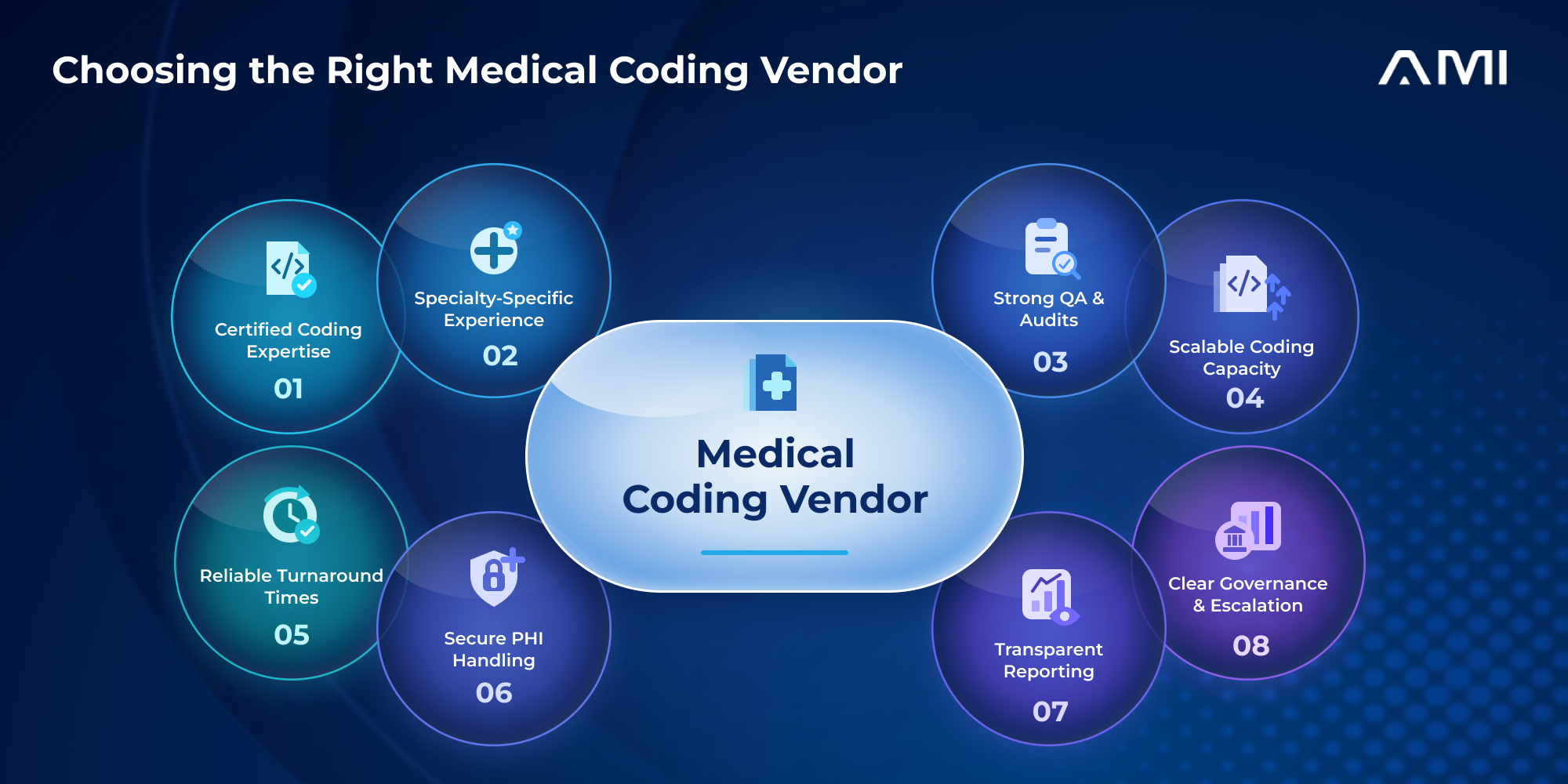
Choosing a medical coding vendor should be based on more than rate per chart.
Providers evaluating medical coding vendors should determine whether the partner can consistently support accuracy and turnaround while adapting to specialty, volume, and documentation differences.
A strong evaluation should cover:
| Area | What Buyers Should Evaluate |
|---|---|
| Coding expertise | Credentials, specialties, and U.S. coding knowledge |
| QA | Audit methodology and accuracy monitoring |
| Scalability | Ability to absorb changing volumes |
| Turnaround | Defined productivity and TAT expectations |
| Technology | Coding platforms, automation, and workflow integration |
| Security | PHI controls and secure operating environment |
| Reporting | Productivity, accuracy, exceptions, and trends |
| Governance | Escalation and client oversight |
The best medical coding services are not necessarily those promising the highest automation rate or lowest unit price. Buyers should look for the operating model that best balances accuracy, capacity, security, transparency, and control.
When Medical Coding Outsourcing Services Make Sense
Internal coding teams may become difficult to scale when providers face recruitment challenges, specialty-specific requirements, seasonal volume, growing backlogs, inconsistent turnaround, or limited QA capacity.
Medical coding outsourcing services can provide additional capacity for selected specialties or workflows without requiring the organization to transfer control over coding policies or revenue-cycle governance.
External support may be worth evaluating when:
- Coding backlogs persist
- Turnaround begins affecting billing
- Specialty expertise is difficult to maintain
- QA results vary across teams
- Internal teams cannot absorb volume spikes
- Leadership lacks visibility into productivity and errors
For RCM for hospitals and larger provider organizations, the objective should be flexible capacity with defined accountability rather than simply replacing an internal coding function.
Need coding capacity that stays connected to the rest of the revenue cycle? Explore AM InfoWeb’s Revenue Cycle Management services for co-managed support across coding, billing, denials, AR, QA, and related workflows.
How AM InfoWeb Supports Healthcare Medical Coding Services
AM InfoWeb combines healthcare revenue cycle expertise with a co-managed orchestration model that integrates trained coding professionals, AI-assisted workflows, structured QA, documentation, reporting, and client governance. Supported by SOC 2 Type II, ISO 27001, and HIPAA-aligned practices, AM InfoWeb helps providers expand medical coding capacity while maintaining visibility into quality, exceptions, and downstream revenue-cycle performance.
AM InfoWeb’s healthcare medical coding services can support:
- ICD-10, CPT, and HCPCS coding
- Inpatient and outpatient coding workflows
- Specialty medical coding support
- Coding QA and audit workflows
- Coding-related documentation review
- Backlog and overflow coding support
- Productivity, quality, and exception reporting
Coding also remains connected to AM InfoWeb’s broader revenue cycle capabilities, allowing issues identified during billing, denials, or AR follow-up to feed back into upstream coding and documentation workflows.
Need stronger coding accuracy without creating another disconnected vendor workflow? AM InfoWeb’s co-managed RCM model combines trained coding teams, AI-assisted execution, QA, reporting, and client oversight across the revenue cycle.
Get in TouchFinal Thoughts
The value of healthcare medical coding services extends beyond assigning the correct code. Coding accuracy affects claim quality, turnaround, compliance, denials, payment, and the performance of the broader revenue cycle.
For healthcare organizations evaluating coding support, the strongest partner is one that combines qualified coders, current code-set knowledge, disciplined QA, secure operations, technology-assisted execution, and visibility into how coding decisions affect downstream RCM.
Frequently Asked Questions
About the Author

Written by
Urza Dey
Urza Dey is a content and copywriter with over five years of experience across marketing, B2B SaaS, HealthTech, EdTech, and related industries. At AMI, they contribute to content strategy, blog development, and marketing communication focused on healthcare operations, business process management, and AI-enabled service delivery.