


Medical Billing Outsourcing: Control, Cost, and Revenue Performance
TL;DR — Medical Billing Outsourcing as a Revenue Strategy
Evaluate outsourcing as a revenue-performance decision, not only a staffing or cost-reduction measure.
Track denial rate, days in accounts receivable, clean-claim rate, and net collection ratio before and after transition.
Co-managed RCM models can preserve visibility through dashboards, SLAs, reporting, and clearly defined escalation paths.
Vendor selection should prioritize specialty expertise, EHR integration, compliance controls, pricing alignment, and transition planning.
AI is most useful when paired with experienced human oversight for complex denials, payer nuances, and compliance decisions.
Healthcare providers across the United States are caught between rising administrative costs and reimbursement rates that have remained stubbornly flat, and the financial pressure is reaching a breaking point.
The numbers tell a stark story. Medical practices adopting outsourcing services saw a 16.9% decrease in billing-related costs and an average revenue increase of 11.6%, according to Fortune Business Insights. And yet, many practices still rely on in-house billing operations built for a simpler era, one where payer rules were predictable and staffing was manageable.
Labor market pressure has made that approach increasingly difficult to sustain. Skilled billing specialists are in short supply, and turnover in administrative roles is costly. Recruiting, onboarding, and retaining a qualified team pulls leadership attention away from patient care while adding layers of overhead that compound year over year.
The definition of outsourcing itself is evolving. What once meant handing off a function and hoping for the best now looks more like an integrated, co-managed model, where a specialized medical billing company operates as an extension of your practice rather than a detached vendor. This shift in how billing operations are structured reflects a broader maturation in how healthcare organizations think about revenue cycle management.
The real question is not whether outsourcing costs you control; it's about the potential hidden costs of your current model. It is whether your current model is quietly costing you both.
Need support beyond one billing workflow? Explore AM InfoWeb’s broader healthcare services, spanning revenue cycle management, payer support, release of information, litigation support, and AI-powered contact center operations.
Is Outsourcing Medical Billing a Good Idea for Your Practice?
Deciding whether to outsource medical billing services is less about preference and more about recognizing when your current setup is quietly draining revenue.
The break-even calculation often surprises practice administrators. In-house billing looks cost-effective on the surface, but the true expense runs deeper than salary lines. Software licensing, ongoing coder training, employee benefits, and the productivity gaps created by staff turnover all compound into a figure that frequently exceeds what a specialized billing partner would charge. When those hidden costs are mapped against actual collections, many practices discover their internal team is operating at a net loss relative to what an optimized external arrangement would produce.
AR days and denial rates
are the two clearest early-warning signals that an RCM operation is struggling. When average days in accounts receivable climb above 40 and denial rates push past 10%, the billing function has effectively become a drag on the practice's liquidity. These are not minor inefficiencies, they represent real cash that is either delayed or permanently forfeited. Understanding where that revenue leakage originates is the first step toward deciding whether internal corrections are realistic or whether a structural change is warranted.
The decision to outsource is often triggered when internal AR workdown stalls or when cash acceleration becomes necessary to maintain liquidity, a pattern that signals the problem has moved beyond what incremental fixes can address. At that stage, the question is no longer whether outsourcing makes sense, but how quickly the transition can deliver measurable results. The following section examines this, the financial return practices can realistically expect and the mechanisms that drive it.
The ROI of Specialized Medical Billing Services
When practices choose to outsource billing services, the financial return is not abstract, it shows up in cleaner claims, faster cash flow, and a revenue cycle that bends without breaking under volume pressure.
Clean claim submission
is where the ROI story begins. Specialized billing teams operate with coding expertise and payer-rule knowledge that generalist in-house staff rarely match. The practical result is a measurable drop in claim rejections and rework cycles. Data from 2023 indicates that shifting to third-party billing significantly reduces financial burden while boosting top-line collections, a pattern driven largely by first-pass claim acceptance rates that internal teams struggle to sustain consistently.
Denial management
is the second lever. Dedicated billing partners do not treat denials as administrative noise; they treat them as recoverable revenue. Aggressive AR follow-up, payer-specific appeal workflows, and root-cause analysis on denial trends all feed into a cycle of continuous improvement. Understanding how billing automation supports these workflows clarifies why specialized teams recover dollars that would otherwise age out and disappear. Conversely, in-house teams managing denials alongside scheduling, documentation, and patient intake tend to prioritize volume over recovery, and revenue slips through.
Scalability
is where the argument becomes particularly compelling for growing or seasonally variable practices. Hiring lags are real: recruiting, onboarding, and training a billing specialist takes months, and patient volume does not wait. Outsourced partners absorb fluctuations, a sudden surge in claims after a new provider joins, or a dip during slower months, without the fixed overhead of additional full-time staff. This flexibility alone often justifies the investment. And the financial upside does not stop at cost avoidance; it extends directly into cash acceleration, which becomes the foundation for the next critical conversation around visibility and control.
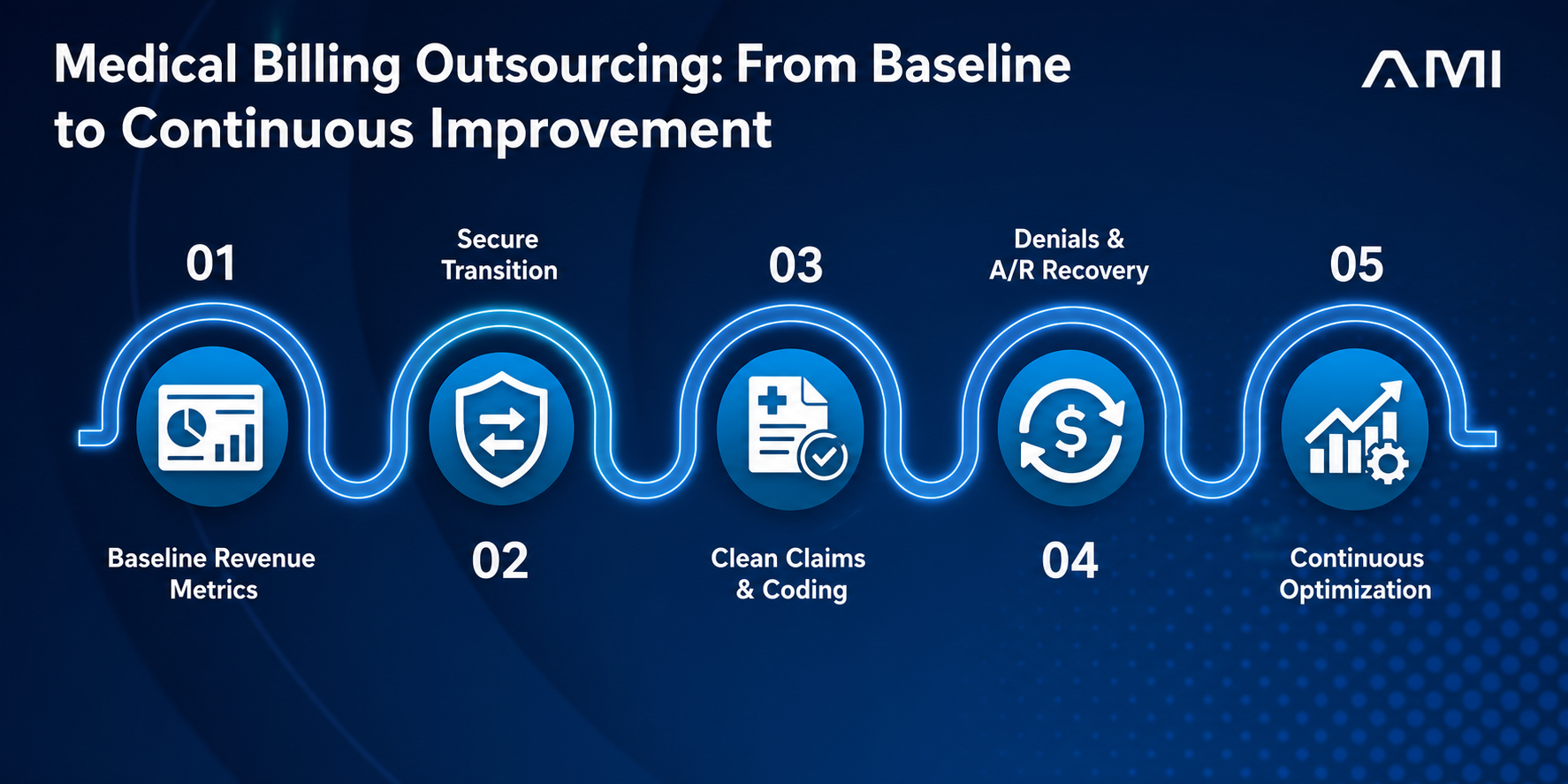
Addressing the 'Control' Myth: Transparency in Modern RCM
The belief that revenue cycle management outsourcing means losing visibility into your own financial data is one of the most persistent, and most outdated, fears in healthcare administration.
The reality has shifted dramatically. Where practices once relied on monthly paper reports that arrived too late to course-correct, modern RCM platforms deliver real-time dashboards showing claim status, denial rates, collections by payer, and outstanding balances, all accessible on demand. You are not handing over the keys; you are gaining a clearer windshield.
The co-managed model
represents the most significant evolution in this space. Rather than a full handoff, co-management keeps clinical and administrative staff actively involved while the outsourced partner handles execution. Your team sets the priorities, reviews the data, and approves escalation decisions. The vendor handles the labor-intensive processing. This tends to work better for practices that want accountability without the overhead of running a full in-house billing department.
What makes the data richer today is the role of AI. Modern RCM providers use orchestrated operations that combine AI speed with human expertise to surface granular insights, denial pattern analysis, payer-specific lag trends, and coding anomalies, that a human-only team would take weeks to compile manually. You can review billing performance metrics that once required a dedicated analyst.
That shift from passive reporting to active, shared visibility is exactly what makes the next question worth examining: as AI takes on more of the operational workload, what role does human expertise still play, and why does it remain irreplaceable?
Will AI Replace Medical Billers? The Human-Machine Balance
AI is reshaping RCM cost reduction across the industry, but the practices seeing the strongest results are not replacing human billers, they are pairing them with intelligent automation.
The more precise question is not whether AI will replace billers, but what role each should play. In practice, AI handles the high-volume, rule-based work exceptionally well. Eligibility verification, claim scrubbing, prior authorization status checks, and remittance posting are all tasks where automation delivers speed and consistency that no manual process can match at scale. For a busy practice processing hundreds of claims daily, that kind of throughput is transformative.
But complex denials tell a different story. When a payer disputes medical necessity, requests clinical documentation, or applies a contract-specific reimbursement rule, the resolution requires judgment, negotiation experience, and a deep understanding of payer behavior. These are not algorithmic problems. They are human ones. And the cost of mishandling them, through delayed appeals or abandoned claims, is real and measurable.
"The most effective RCM models today use AI for scale and human teams for litigation support and complex workflows, functioning not as separate layers but as one orchestrated system."
This orchestration philosophy is what separates modern outsourced billing from older models. AI agents surface anomalies, flag outliers, and route cases intelligently. Human experts then apply focused attention where it genuinely matters. The result is a system that is faster, more accurate, and more adaptive than either could be alone. As you evaluate outsourcing partners, understanding how they integrate these two forces is just as important as their pricing structure, and that evaluation becomes even more critical when compliance and data security enter the conversation.
Compliance and Security in the Outsourcing Transition
Medical billing compliance is not a checkbox exercise, it is an ongoing operational discipline that many in-house teams, stretched thin by clinical demands, struggle to maintain consistently.
The transition to an outsourced billing partner raises a fair and important question: what happens to sensitive patient financial data when it leaves your walls? The answer, for reputable vendors, is that it becomes subject to a more rigorous security infrastructure than most practices can build internally. Vetting a vendor begins with two non-negotiable credentials: HIPAA compliance documentation and SOC 2 certification. HIPAA establishes the baseline for how protected health information must be handled, while SOC 2 audits independently verify that a vendor's data security controls, covering availability, confidentiality, and processing integrity, meet established standards. A vendor that cannot produce both should not advance past the initial evaluation stage.
Data encryption and access controls
are where the operational detail matters most. Reputable billing companies enforce role-based access, meaning staff only reach the data their function requires. Transmission of claims data occurs over encrypted channels, and audit trails log every interaction with patient records. These are not features unique to enterprise vendors; they are baseline expectations for any credentialed partner.
The internal risk dimension is one that practices often overlook. Professional billing companies often provide higher levels of compliance security than small, resource-strapped in-house departments, partly because external oversight creates accountability structures that familiarity and proximity can erode inside a practice. Internal billing fraud, though rarely discussed, is a documented risk in healthcare finance, and distributed professional oversight reduces that exposure meaningfully.
Knowing what to look for in a vendor's compliance posture is one piece of the puzzle. The next is knowing how to evaluate the right partner for your specific specialty and practice size.
Need help improving billing, denials, and AR performance? Explore AM InfoWeb’s Revenue Cycle Management services for co-managed support across coding, billing, follow-up, QA, and reporting.

Why does revenue still leak after the claim is submitted?
Because small breakdowns across eligibility, coding, billing, denials, and follow-up can quietly delay cash flow. AM InfoWeb helps healthcare teams strengthen RCM operations with process discipline, trained teams, and AI-assisted execution.
Selecting the Right Medical Billing Company
Choosing a medical billing partner is one of the highest-leverage decisions a practice can make, and getting it wrong costs far more than the vendor fee.
With compliance frameworks now firmly in place (as covered in the previous section), the focus shifts to finding a partner that can actually execute. Not all billing companies are built the same, and the criteria that matter most tend to be the ones practices overlook during the sales process.
Specialty-specific expertise
is the first filter worth applying. Coding accuracy is not a universal skill, a billing company experienced in orthopedics may lack the nuance required for behavioral health or oncology, where modifier use, prior authorization requirements, and payer-specific rules differ significantly. Top-tier US billing companies are evaluated based on their ability to integrate with existing EHR systems and their track record in specific medical specialties, which means you should ask prospective partners for denial rate benchmarks within your exact specialty, not just general performance metrics.
Fee structures
deserve equally careful scrutiny. The two most common models, percentage of collections and flat monthly fees, carry different risk profiles. Percentage-based arrangements align vendor incentives with your revenue, which tends to work better for practices with variable volume. Flat fees offer predictability but can create misaligned incentives when claim complexity rises. Neither is universally superior; the right choice depends on your payer mix, claim volume, and growth trajectory.
Transition planning
is where many vendor relationships quietly fail before they begin. The "implementation dip", a temporary drop in collections during the handoff period, is a real and documented risk. Practices that avoid it typically negotiate a parallel-run window, establish clear data migration checkpoints, and set a minimum response-time SLA before a single claim moves to the new system. And those details belong in the contract, not in a verbal commitment during the sales call.
With the right selection framework in place, the broader strategic picture becomes clearer, and that is exactly what the final takeaways will address.
How AM InfoWeb Supports Medical Billing Outsourcing
AM InfoWeb supports healthcare providers through a co-managed revenue cycle model that combines trained RCM professionals, AI-assisted workflows, structured QA, documentation, reporting, and client-controlled governance.
Medical billing outsourcing support can include:
- Medical coding and claim-preparation support
- Claim submission, payment posting, and status workflows
- Denial management and accounts-receivable follow-up
- QA, documentation, escalation, and performance reporting
The objective is to expand execution capacity and improve revenue visibility while the healthcare organization retains control over policies, priorities, exceptions, and payer relationships.
The Bottom Line: Key Takeaways for Healthcare Leaders
Medical billing outsourcing, when executed strategically, is not a cost-cutting compromise, it is a revenue acceleration decision that reshapes how a practice competes.
The distinction matters. Practices that approach outsourcing purely as a way to reduce overhead often capture only a fraction of the available benefit. Those that treat it as a structural upgrade to their revenue operations tend to see results that compound over time. Research supports this directly: successful outsourcing transitions deliver a 16.9% cost reduction and an 11.6% revenue increase, a combination that no internal headcount adjustment alone can reliably produce.
What separates high-performing outsourcing arrangements from disappointing ones tends to come down to model design. Orchestrated approaches, those that layer AI-driven automation over human clinical and compliance expertise, consistently outperform either element in isolation. Automation accelerates claims velocity and catches errors before submission. Human oversight handles payer-specific nuances, appeals, and the judgment calls that no algorithm resolves cleanly. Together, they deliver the transparency and ROI that healthcare leaders increasingly demand from their billing operations.
The four principles that define a successful outsourcing outcome are straightforward:
- Strategic framing: Treat outsourcing as a revenue play, not a budget line item.
- Model selection: Prioritize orchestrated AI-plus-human partnerships over pure automation or pure labor arbitrage.
- Partner alignment: Choose a billing company that operates as an extension of your clinical and administrative team, not a transactional vendor.
- Transition discipline: Mitigate handoff risk through clear data-sharing agreements, defined compliance protocols, and documented escalation paths established before go-live.
These principles do not require a large practice or an enterprise-level budget to implement. They do require intentionality and a willingness to evaluate current revenue cycle performance honestly before selecting a path forward. That audit, and a clear plan for acting on its findings, is where the next step begins.
Ready to strengthen medical billing performance without losing operational control? AM InfoWeb combines trained RCM teams, AI-assisted workflows, QA, and co-managed oversight to improve billing accuracy, follow-up, and revenue visibility.
Get in TouchFrequently Asked Questions
About the Author

Written by
Urza Dey
Urza Dey is a content and copywriter with over five years of experience across marketing, B2B SaaS, HealthTech, EdTech, and related industries. At AMI, they contribute to content strategy, blog development, and marketing communication focused on healthcare operations, business process management, and AI-enabled service delivery.