
Medical Necessity Denials: How Providers Prevent and Resolve Them
TL;DR: Medical Necessity Denials
A medical necessity denial requires review of the payer reason, service, policy criteria, and supporting record.
Prevention combines current coverage criteria, authorization checks, and clinician documentation.
Appeals should answer the actual denial rationale with relevant source documents.
AI can organize packets while human reviewers validate clinical and payer-specific exceptions.
A medical necessity denial can occur even when a service was delivered and the claim contains the right codes. The payer may question whether the service met its coverage criteria, whether the clinical record supports it, or whether the supporting information arrived on time. For revenue cycle teams, the challenge is to connect payer policy, clinical documentation, authorization, billing, and appeals without treating every denied claim as an isolated event.
Need help strengthening those handoffs? Explore AM InfoWeb's services for structured healthcare operations support.
What Is a Medical Necessity Denial?
A medical necessity denial is a payer decision that the submitted service does not meet applicable coverage or clinical-necessity requirements, or that the documentation provided does not establish that it does. The exact reason depends on the plan, benefit, policy, service, and denial notice. A coding defect, missing prior authorization, and medical-necessity determination should not be grouped into one root-cause category just because all three result in unpaid claims.
The CMS medical-review overview explains that Medicare reviews may request records to test coverage, coding, billing, and medical-necessity requirements. Commercial plan rules can differ, so teams should use the relevant payer policy rather than assume a Medicare rule applies everywhere.
Why Do Medical Necessity Denials Happen?
Medical necessity denials often begin before submission. A patient-access team may miss a plan restriction, an authorization may describe a different service, or a clinical note may not explain the indication and decision-making clearly. Sometimes the documentation exists but is not attached or delivered through the payer's requested channel.
| Failure point | Question to answer | Operational check |
|---|---|---|
| Coverage criteria | Does the plan cover this service for this condition? | Confirm the current payer policy and benefit details. |
| Clinical record | Does the note support the indication, findings, and plan? | Review the relevant encounter and supporting results. |
| Authorization | Does approval match the billed service and date? | Reconcile approval details before claim release. |
| Additional records | Did the payer receive the requested documents? | Track requests, delivery, acknowledgments, and deadlines. |
This is why a broad claims denial management program still needs a separate medical-necessity workstream.
How Can Providers Prevent Medical Necessity Denials?
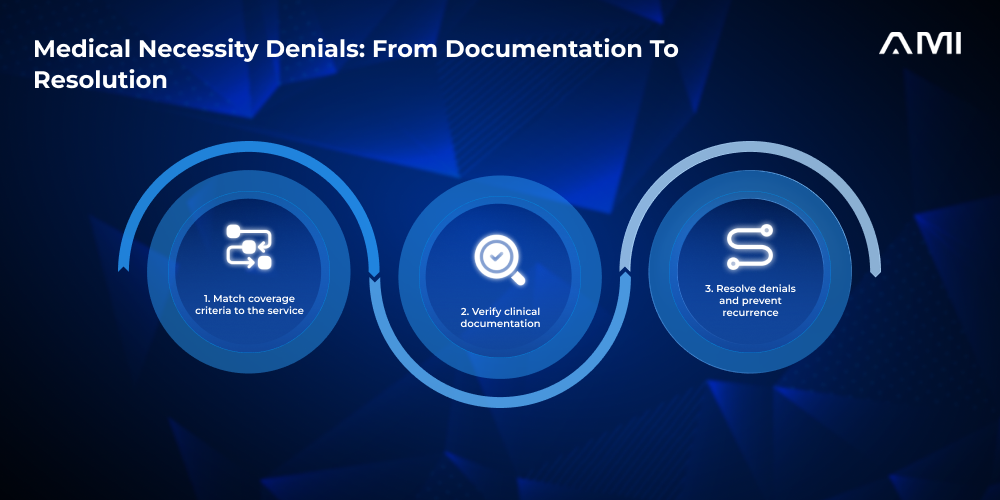
Prevention starts with a service-level checklist. Match the planned or delivered service to the current payer criteria, identify any authorization requirement, and make the documentation expectation visible to clinicians before the account reaches billing. The review should be proportionate to risk, not a blanket manual hold on every claim.
For high-risk services, confirm that the record explains the patient's condition, relevant findings, prior treatment when required, and why the selected service was appropriate. The CMS E/M compliance guidance stresses that documentation must support the codes reported on the claim. A claim scrubbing workflow can catch claim-format errors, but clinical necessity requires a different review of policy and supporting evidence.
How Should Teams Work a Medical Necessity Denial?
Read the actual denial notice first. Identify the policy or criterion cited, the service and dates affected, the records reviewed, and the available correction, reconsideration, or appeal path. Do not automatically resubmit an unchanged claim. Assign an owner to gather the relevant clinical record and payer evidence, then document the decision and deadline.
An appeal should answer the payer's stated reason directly. It may require the clinical note, test results, prior-therapy history, authorization details, or an explanation from the treating clinician. CMS notes that Medicare redetermination submissions should include documentation supporting the disagreement; other payers have their own instructions and timelines.
For operational support across denial follow-up and appeals, see revenue cycle management services.
Need tighter control before submission? AM InfoWeb helps teams define policy checks, document handoffs, and accountable exception review across the revenue cycle.
Get in TouchWhich Documents Make a Medical Necessity Appeal Stronger?
The useful packet is specific to the denied service. It should make the indication, decision, and payer criterion easy to trace, not bury the reviewer in unrelated records. A short cover explanation can map each clinical fact to the policy issue while preserving the original note and source documents.
- Denial notice, claim details, and the cited policy or reason code.
- Relevant encounter notes, findings, and diagnostic results.
- Prior treatment or conservative-care history when the criterion requires it.
- Authorization and referral records when applicable.
- Submission proof, payer correspondence, and a deadline log.
The same source-level discipline used in a medical billing audit checklist helps teams distinguish missing evidence from a genuinely unsupported service.
What Metrics Reveal Repeat Medical Necessity Problems?
Track medical-necessity denials separately from eligibility, coding, and authorization denials. Measure the rate by payer, service line, and policy; the percentage resolved; time to resolution; appeal overturn rate; and the share of cases requiring late record retrieval. Review repeated reasons with clinical, utilization, and revenue cycle owners.
A rising denial rate paired with a stable clean claim rate suggests the claim may be technically complete while its clinical support or coverage alignment is not. That distinction prevents teams from solving the wrong problem.
Where Should AI Assist and Humans Decide?
AI agents can help classify denial reasons, surface payer-policy references, organize document requests, and flag missing packet elements. Skilled human agents should validate the record, interpret exceptions, coordinate with clinicians, and approve any response that makes a clinical or coverage assertion. Automation should accelerate review without turning a suggested match into a final medical judgment.

How AM InfoWeb Supports Medical Necessity Denial Workflows
AM InfoWeb has two decades of experience in the U.S. healthcare industry. Its co-managed model brings AI agents and skilled human agents together to eliminate process bottlenecks and execute secure healthcare workflows. For medical necessity denials, support can include:
- Policy-aware work queues and documented account ownership.
- Clinical-record request tracking and packet organization.
- Human validation of payer-specific exceptions and appeal materials.
- Denial trend reporting that feeds prevention work upstream.
Conclusion
A medical necessity denial is best addressed as a connected coverage, documentation, and follow-up problem. When teams separate it from generic claim errors, they can prevent avoidable cases, make appeals easier to review, and use repeat-denial patterns to improve upstream workflows.
Frequently Asked Questions
About the Author

Written by
Urza Dey
Urza Dey is a content and copywriter with over five years of experience across marketing, B2B SaaS, HealthTech, EdTech, and related industries. At AMI, they contribute to content strategy, blog development, and marketing communication focused on healthcare operations, business process management, and AI-enabled service delivery.