

Medical Billing Audit Checklist: Find Revenue and Compliance Gaps
TL;DR: Medical Billing Audit Checklist
A medical billing audit tests documentation, coding, claims, payments, denials, and related controls.
Define the audit objective before selecting a representative, risk-based claim sample.
Trace findings to their workflow source instead of treating errors as isolated defects.
Review both overpayments and missed-revenue risks to protect compliance and revenue integrity.
Assign corrective actions, owners, deadlines, and validation steps for every material finding.
Repeat targeted audits to confirm that process changes produce sustained improvement.
A medical billing audit checklist helps healthcare organizations test whether documentation, coding, claim submission, payment posting, and follow-up processes produce accurate and supportable results. It can reveal missed revenue, recurring rework, payer-specific defects, and compliance exposure before those problems become larger financial or operational risks.
An effective audit is not limited to finding individual claim errors. It connects each finding to the workflow that created it, identifies whether the problem is isolated or systemic, and assigns corrective action to an accountable owner.
This guide provides a practical medical billing audit checklist, explains how to select claims and evaluate findings, and shows how leaders can convert audit results into measurable improvement.
Need structured support across healthcare operations? Explore AM InfoWeb's healthcare services.
What Is a Medical Billing Audit?
A medical billing audit is a structured review of claims, supporting records, coding, billing rules, payment activity, and related workflows. The audit tests whether services were documented, coded, billed, and followed up accurately under applicable payer requirements and organizational policies.
Audits may be prospective, concurrent, or retrospective. A prospective audit reviews claims before submission. A concurrent audit examines work while it is active. A retrospective audit reviews completed claims and payments to identify patterns, recovery opportunities, and control failures.
The HHS Office of Inspector General identifies internal monitoring and auditing as a core component of an effective healthcare compliance program. Its compliance guidance for physicians also emphasizes accurate claims, corrective action, training, communication, and documented standards.
What Should a Medical Billing Audit Accomplish?
The audit objective should be defined before claims are selected. Common objectives include testing coding accuracy, validating documentation, identifying underpayments, evaluating denial root causes, reviewing modifier use, confirming medical necessity support, or measuring billing-process performance.
A useful audit should answer four questions:
- Was the claim accurate and supported?
- Did the payer process the claim according to applicable terms?
- Which workflow created any error or missed opportunity?
- What corrective action will prevent recurrence?
Audits should balance revenue and compliance. Looking only for underbilling can miss unsupported charges, duplicate claims, overpayments, and other risks. Looking only for overbilling can overlook missed revenue and payer payment errors.
How Should Healthcare Organizations Select an Audit Sample?
Sample design should reflect the audit objective and risk profile. Random samples can estimate general performance, while targeted samples can investigate high-risk codes, modifiers, providers, payers, denial reasons, service lines, or unusual payment patterns.
Teams may combine both methods. A random sample provides a baseline, and targeted samples explore known or suspected risks. Sample size should consider claim volume, variability, financial exposure, available resources, and the level of assurance required.
Document the selection method, date range, exclusions, population, and rationale. Without that information, leaders may overgeneralize findings from a narrow or biased sample.
Which Items Belong on a Medical Billing Audit Checklist?
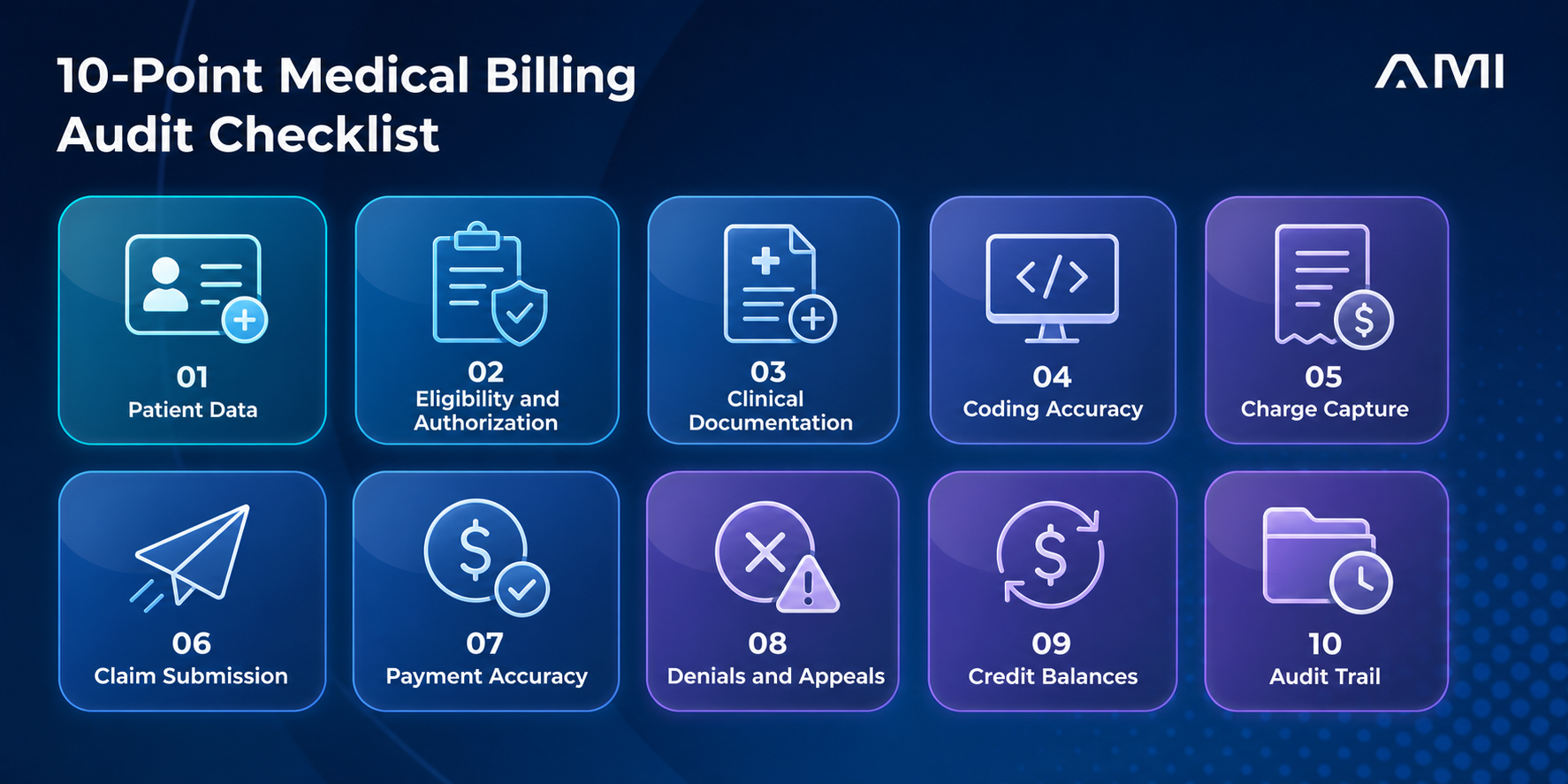
The checklist should follow the claim from patient intake through final account resolution.
1. Patient and Insurance Information
Confirm the patient's identity, demographics, coverage, member identifiers, payer order, and coordination-of-benefits information. Registration defects can create rejections, eligibility denials, incorrect patient balances, and duplicate records.
2. Eligibility and Authorization
Verify coverage for the date of service, benefit requirements, network status, referrals, and required prior authorization. Confirm that approval details match the service, provider, location, units, and dates billed.
3. Clinical Documentation
Determine whether the record supports the service, diagnosis, medical necessity, units, time, supplies, signatures, and other required elements. CMS advises that documentation should support the CPT, HCPCS, and ICD-10-CM codes reported on the claim. See its Evaluation and Management compliance guidance.
4. Coding Accuracy
Review diagnosis and procedure codes, sequencing, modifiers, units, place of service, bundling, edits, and specialty-specific requirements. Confirm that coding reflects documented services without unsupported assumptions.
5. Charge Capture
Reconcile clinical and operational evidence with posted charges. Look for missing, late, duplicate, incorrect, or unsupported charges. The audit should connect defects to documentation, interfaces, departmental workflows, or charge-master configuration. Related guidance explains how healthcare charge capture supports revenue integrity.
6. Claim Preparation and Submission
Validate provider identifiers, patient data, dates, codes, units, amounts, claim type, attachments, and payer-specific formatting. Review clearinghouse edits and confirm that rejected claims were corrected promptly.
7. Payment and Contract Accuracy
Compare allowed amounts, contractual adjustments, patient responsibility, bundling, and payment terms with the applicable contract or fee schedule. Flag underpayments, unexpected zero payments, and unexplained variance.
8. Denials and Appeals
Review denial reason, preventability, appeal timeliness, documentation, outcome, and root cause. Separate valid payer decisions from provider-side errors and payer-processing problems.
9. Refunds and Credit Balances
Confirm that overpayments, duplicate payments, credit balances, and refunds are identified, investigated, documented, and resolved according to applicable requirements and policies.
10. Audit Trail and Follow-Up
Verify that claim changes, notes, communications, approvals, escalations, and corrective actions are traceable. An audit finding without ownership and follow-up does not improve the process.
How Should Audit Findings Be Classified?
Use consistent categories so leaders can compare findings across samples and periods. Classifications may include documentation, coding, registration, authorization, charge capture, claim formatting, payer processing, payment posting, denial follow-up, or compliance.
Each finding should record severity, financial impact, recurrence, responsible workflow, and whether the issue produced an overpayment, underpayment, delay, denial, or no immediate financial effect.
| Finding Element | What to Record |
|---|---|
| Error category | Workflow or control that failed |
| Severity | Low, moderate, high, or critical risk |
| Financial impact | Overpayment, underpayment, delay, or potential exposure |
| Root cause | Why the defect occurred |
| Corrective owner | Team responsible for remediation |
| Validation date | When the correction will be retested |
How Can Audits Identify Revenue Leakage?
Revenue leakage may appear as missed charges, reduced units, incorrect contract adjustments, underpayments, untimely filing, unresolved denials, or balances written off without adequate review.
Auditors should trace financial findings back to their operational causes. Recovering one underpayment creates immediate value, but correcting the contract-loading or follow-up problem prevents recurrence.
Compare audit findings with broader revenue-cycle data. A small sample may reveal a pattern that should be quantified across the full claim population. Review clean claim rate improvement to connect upstream quality with first-pass claim performance.
How Should Compliance Gaps Be Escalated?
Potential overpayments, unsupported claims, repeated coding errors, documentation concerns, or suspected misconduct require appropriate compliance review. The audit team should follow established escalation, investigation, legal, and refund procedures rather than resolving sensitive findings informally.
OIG's General Compliance Program Guidance presents voluntary guidance on compliance infrastructure, risk assessment, auditing, education, reporting, and corrective action. Organizations should adapt their response to applicable laws, contracts, and professional advice.
Preserve the evidence supporting the finding, who reviewed it, decisions made, and actions completed. Do not alter records or backdate documentation to correct an audit result.
Need stronger billing, claims, and follow-up controls? Explore AM InfoWeb's Revenue Cycle Management services.

Why does revenue still leak after the claim is submitted?
Because small breakdowns across eligibility, coding, billing, denials, and follow-up can quietly delay cash flow. AM InfoWeb helps healthcare teams strengthen RCM operations with process discipline, trained teams, and AI-assisted execution.
How Should Corrective Action Plans Be Built?
Corrective actions should address the root cause rather than only the affected claim. Possible actions include workflow redesign, training, template changes, payer-rule updates, interface corrections, access changes, revised quality checks, or expanded monitoring.
Every action needs an owner, deadline, success measure, and validation method. Retest the corrected process using new claims after implementation. Closure should require evidence that the defect rate improved and that the change did not create another problem.
Which Medical Billing Audit Metrics Should Leaders Track?
Useful measures include:
- Overall claim accuracy
- Documentation support rate
- Coding accuracy by provider and service line
- Missed and unsupported charge rates
- Clean claim and rejection rates
- Initial and preventable denial rates
- Underpayment and overpayment findings
- Financial impact by root cause
- Corrective-action completion
- Repeat finding rate after remediation
Report both count and financial value. A frequent low-dollar defect and a rare high-dollar defect may require different responses.
How Often Should a Medical Billing Audit Be Performed?
Audit frequency should reflect risk, claim volume, regulatory change, payer behavior, new services, staffing changes, and past findings. High-risk workflows may require continuous monitoring or monthly targeted reviews. Stable areas may be reviewed quarterly or annually.
Trigger audits after major EHR changes, code-set updates, new payer contracts, new service lines, unusual payment patterns, material denials, compliance concerns, or repeated quality failures.
The audit plan should remain flexible. Emerging risk may justify changing the sample or accelerating a review.
How AM InfoWeb Supports Medical Billing Audit Readiness
AM InfoWeb supports healthcare organizations with structured billing, coding, claims, denial, payment, and quality-assurance workflows.
With two decades of experience in the U.S. healthcare industry, AM InfoWeb uses a co-managed model that brings AI agents and skilled human agents together to eliminate process bottlenecks and execute secure healthcare workflows.
AM InfoWeb can support:
- Claim and documentation review
- Coding and charge validation
- Rejection and denial analysis
- Payment and underpayment review
- Accounts receivable follow-up
- Audit-sample preparation
- Root-cause classification
- Quality reporting and corrective-action tracking
Co-managed execution gives healthcare leaders additional capacity and visibility while they retain governance, compliance oversight, and final decision authority. For related guidance, see how claims denial management connects prevention and recovery.
What Should Healthcare Leaders Do After an Audit?
Prioritize findings by compliance risk, financial impact, recurrence, and patient effect. Resolve affected claims appropriately, but devote equal attention to the process that produced the defect.
A medical billing audit checklist creates value when it leads to verified improvement. Consistent sampling, traceable evidence, root-cause analysis, corrective ownership, and retesting turn isolated findings into stronger revenue and compliance controls.
Need a stronger medical billing audit process? AM InfoWeb combines experienced teams, structured controls, AI-assisted workflows, quality assurance, and operational reporting to uncover revenue and compliance gaps.
Get in TouchFrequently Asked Questions
About the Author

Written by
Urza Dey
Urza Dey is a content and copywriter with over five years of experience across marketing, B2B SaaS, HealthTech, EdTech, and related industries. At AMI, they contribute to content strategy, blog development, and marketing communication focused on healthcare operations, business process management, and AI-enabled service delivery.