
Claim Scrubbing: How Providers Prevent Errors Before Claim Submission
TL;DR: Claim Scrubbing
Claim scrubbing reviews assembled claims against formatting, coding, payer, and data rules before submission.
Scrubbers can catch many preventable defects but cannot replace documentation, coding, or coverage judgment.
CMS NCCI edits are important inputs alongside current payer-specific and organization-specific rules.
Exceptions need clear owners, evidence standards, escalation paths, and monitored override reasons.
Balanced metrics include clean claim rate, edit rate, overrides, rejections, denials, and correction turnaround.
Recurring scrubber edits should improve registration, authorization, coding, charge, and provider-data workflows upstream.
Claim scrubbing checks healthcare claims for errors before they reach a payer. A strong process can catch missing data, incompatible codes, invalid identifiers, coverage conflicts, modifier problems, and payer-specific formatting issues while there is still time to correct them.
Software is important, but claim scrubbing is not simply a button inside a billing system. Rules must be current, exceptions need skilled review, and recurring edits should lead to upstream fixes. Otherwise, teams may clear edits without improving the documentation, registration, coding, or charge workflows that created them.
This guide explains how claims scrubbing works, what it can and cannot detect, and how providers build a controlled pre-submission process that improves clean claim performance.
Need stronger support across complex healthcare workflows? Explore AMI’s healthcare services.
What Is Claim Scrubbing in Medical Billing?
Claim scrubbing is the automated and manual review of claim data before submission. The scrubber compares the claim against formatting requirements, code relationships, coverage rules, provider data, and configurable payer edits.
The purpose is to prevent avoidable rejections and denials without altering claims in ways unsupported by the medical record. An edit is a prompt to verify the claim, not permission to add a code, modifier, diagnosis, or service.
Scrubbing in medical billing supports claim quality, but it does not replace documentation review, coding expertise, eligibility verification, prior authorization, or payer follow-up.
Which Errors Can a Claim Scrubber Detect?
Claim scrubber software may identify:
- Missing or invalid patient demographics
- Subscriber, member, or group-number defects
- Provider identifier and taxonomy mismatches
- Invalid diagnosis or procedure codes
- Code combinations that require review
- Missing, inconsistent, or unsupported modifiers
- Units that exceed configured thresholds
- Place-of-service conflicts
- Missing authorization or referral data
- Date, charge, and claim-format inconsistencies
- Payer-specific required fields
- Duplicate claim indicators
The output depends on the rules available, their configuration, and the quality of source data. A scrubber cannot reliably detect every clinical-documentation gap or contractual issue.
How Does the Claim Scrubbing Process Work?
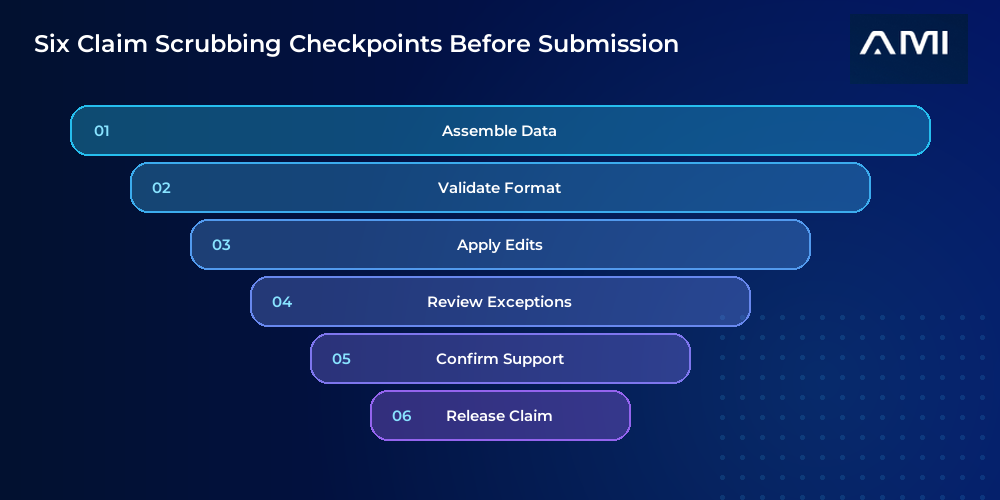
A disciplined process moves through six checkpoints:
1. Assemble claim data from registration, eligibility, documentation, coding, charge capture, and authorization systems.
2. Run standard formatting and completeness edits.
3. Apply coding, payer, plan, and organization-specific rules.
4. Route edits to the team qualified to resolve them.
5. Validate corrections against source documentation and record the action.
6. Release the claim, monitor payer response, and analyze recurring defects.
High-confidence technical corrections may be automated. Edits involving coding judgment, medical necessity, documentation, or payer interpretation require skilled review.
How Do CMS Coding Edits Inform Claim Scrubbing?
CMS developed the National Correct Coding Initiative to promote correct coding and reduce improper payments. Its Medicare NCCI guidance includes procedure-to-procedure edits and medically unlikely edits used within Medicare claim processing.
NCCI edits are important inputs, but organizations also need current payer-specific rules, claim-format validation, contract knowledge, and internal policies. CMS notes that private plans may choose to adopt Medicare methodologies, so teams should not assume that every payer applies every edit identically.
Rules and code sets change. Owners need a controlled schedule for updates, testing, release documentation, and post-deployment monitoring.
What Is the Difference Between Rejections and Denials?
A rejection usually means the claim failed an initial format, eligibility, or data validation and was not accepted for adjudication. A denial occurs after the payer processes the claim and decides not to pay all or part of it.
Claim scrubbing is especially effective against preventable front-end rejections. It can also reduce some denials by identifying code, modifier, authorization, and payer-rule issues before submission. It cannot guarantee payment because coverage, medical necessity, contract interpretation, and payer decisions remain outside the scrubber.
Teams should analyze both outcomes. Rejection trends improve submission rules, while denial management reveals issues that require broader clinical, coding, authorization, or payer action.
How Should Claim Scrubbing Exceptions Be Managed?
Each edit should have a clear definition, severity, responsible team, acceptable resolution, and escalation path. Work queues should prioritize timely filing, financial value, payer deadline, and clinical complexity.
Staff should not bypass an edit simply to improve throughput. Overrides require a reason and should be monitored by rule, user, payer, and outcome. A high override rate may reveal a faulty rule, insufficient training, or a workflow that asks the wrong team to make the decision.
Quality review should sample cleared and overridden edits. The question is whether the final claim is accurate and supported, not whether the queue reached zero.
Which Metrics Show Whether Claim Scrubbing Works?
| Metric | What It Reveals |
|---|---|
| First-pass acceptance rate | Whether payers accept claims without front-end correction |
| Clean claim rate | Whether claims pass defined quality criteria on initial submission |
| Edit rate | How frequently scrubber rules flag submitted claim data |
| First-touch resolution | Whether staff resolve an edit without repeated handling |
| Override rate | How often users bypass rules and why |
| Rejection rate | Whether technical and demographic defects persist |
| Denial rate by cause | Whether pre-submission controls reduce preventable denials |
| Correction turnaround | How quickly held claims become submission-ready |
Definitions matter. The clean claim rate should use a stable formula so teams can compare performance over time.
How Can Scrubber Data Improve Upstream Workflows?
Every recurring edit points toward a source. Demographic errors may originate in patient access. Missing authorization data may reflect handoff failures. Modifier issues may require coder education. Provider-data defects may come from enrollment or system configuration. Charge errors may point to documentation or interface problems.
Create a feedback loop that groups edits by root cause, owner, location, provider, payer, and financial impact. Correcting the upstream workflow reduces future edits and prevents staff from repeatedly repairing the same defect at the claim stage.
This connects claim scrubbing with front-end revenue cycle management, where accurate registration, coverage, authorization, and documentation establish claim quality early.
Need disciplined claim preparation, coding, and follow-up workflows? Explore AMI’s Revenue Cycle Management services.
How Should Providers Select and Govern Claim Scrubbing Software?
Evaluate coverage across claim types, specialties, payers, code sets, and organization-specific rules. Review integration, update frequency, test environments, work-queue routing, analytics, audit history, access controls, and the ability to explain why an edit fired.
Governance should include revenue cycle, coding, compliance, clinical operations, and IT. Each rule needs an owner and a measurable purpose. New or modified rules should be tested against representative claims before production use.
Technology should make the correct action easier without concealing how a decision was made. Unsupported automatic changes can create risk at scale.

How Does AM Infoweb Support Claim Scrubbing Operations?
AM Infoweb supports healthcare organizations with structured claim workflows, skilled review, quality assurance, and operational reporting.
With two decades of experience in the U.S. healthcare industry, AM Infoweb uses a co-managed model where AI agents and skilled human agents work together to eliminate process bottlenecks and execute secure healthcare workflows.
AMI can support:
- Pre-submission claim review and exception handling
- Demographic, provider, and payer-data validation
- Coding and modifier edit workflows
- Rejection correction and resubmission support
- Payer-specific rule and work-queue execution
- Quality assurance and override monitoring
- Root-cause and performance reporting
The objective is accurate, supported claims and a feedback loop that reduces recurring errors before submission.
What Should Revenue Cycle Leaders Do Next?
Inventory current claim edits, owners, override behavior, and payer outcomes. Identify rules that create noise, defects that escape to payers, and recurring issues that belong upstream. Then prioritize changes by volume, value, denial risk, and timely-filing exposure.
Effective claim scrubbing combines current rules, reliable source data, skilled judgment, controlled exceptions, and measurable feedback. That combination improves first-pass quality without treating automation as a substitute for accountable billing and coding.
Need stronger control before claim submission? AMI combines trained RCM teams, AI-assisted workflows, QA, and operational reporting to improve claim accuracy and exception resolution.
Get in TouchFrequently Asked Questions
About the Author

Written by
Urza Dey
Urza Dey is a content and copywriter with over five years of experience across marketing, B2B SaaS, HealthTech, EdTech, and related industries. At AMI, they contribute to content strategy, blog development, and marketing communication focused on healthcare operations, business process management, and AI-enabled service delivery.