
Medical Records Custodian: Responsibilities in Litigation and Record Authentication
TL;DR: Medical Records Custodian
A medical records custodian protects record integrity, access, retention, retrieval, certification, and authorized disclosure.
Authentication depends on reliable source custody and recordkeeping facts, not clinical interpretation.
Precise requests reduce delays caused by unclear scope, incorrect recipients, and distributed record systems.
Affidavits and certifications should reconcile with the patient, provider, dates, record types, and production.
Secure transfer, access controls, and audit trails protect records through every operational handoff.
Co-managed support improves tracking and quality while counsel retains legal responsibility.
A medical records custodian protects the reliability of healthcare information from creation through retention, retrieval, and authorized disclosure. In litigation, that responsibility becomes especially visible because attorneys may need to establish where records came from, how they were maintained, and whether a production accurately reflects the provider’s files.
The custodian is not usually asked to interpret treatment or offer a clinical opinion. The role is operational and evidentiary: preserve trustworthy records, locate responsive sources, validate release authority, and explain the organization’s ordinary recordkeeping practices.
This guide explains what custodians do, how their work affects authentication, and how legal teams can reduce avoidable production delays. It provides general information, not legal advice.
Need structured support across healthcare and legal workflows? Explore AM InfoWeb’s healthcare services.
What Is a Medical Records Custodian?
A medical records custodian is the person or function responsible for maintaining, protecting, and producing records held by a healthcare organization. Depending on the organization, the work may sit with health information management, privacy, compliance, legal, or release-of-information teams.
The custodian may supervise retention schedules, access permissions, amendments, request processing, certification, and secure delivery. A qualified witness may also perform authentication functions when that person understands the recordkeeping system, even if the job title is different.
What Responsibilities Does a Custodian Handle?
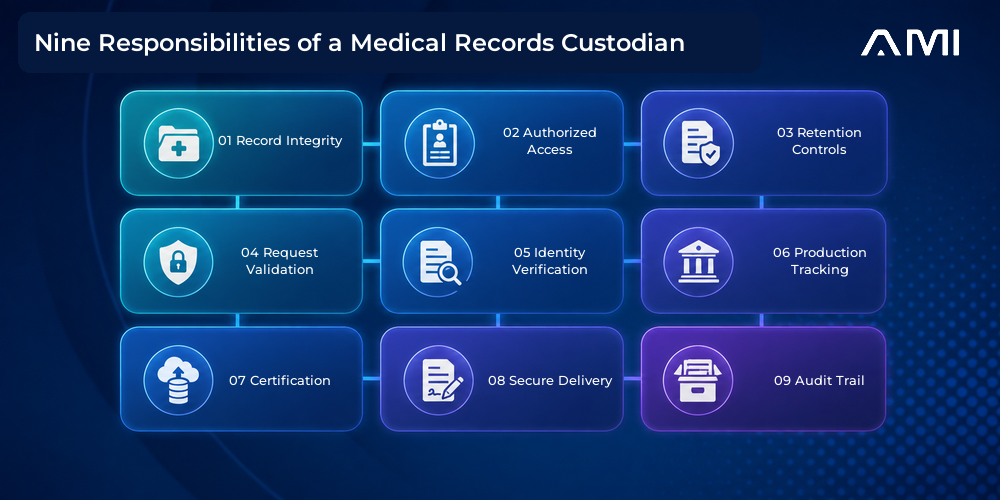
Custodian responsibilities vary by facility and jurisdiction, but litigation-related work typically includes:
- Confirming patient identity and request authority
- Locating records across clinical, billing, imaging, and legacy systems
- Applying retention, privacy, and disclosure rules
- Preserving source and production traceability
- Identifying missing, unavailable, or separately maintained material
- Certifying copies when authorized and required
- Tracking requests, fees, deadlines, and delivery
- Maintaining a defensible audit trail
These controls help prevent a technically delivered production from remaining incomplete or unusable.
How Does the Custodian Support Record Authentication?
Authentication asks whether evidence is what a party claims it is. Federal Rule of Evidence 901 states the general requirement, while Rule 902(11) addresses certified domestic records of a regularly conducted activity.
A custodian can describe how records are created, entered, stored, protected, and retrieved during regular operations. A certification or affidavit may address those facts and support a business-record foundation. It does not automatically resolve relevance, hearsay within hearsay, privilege, completeness, or admissibility.
| Control area | Custodian question | Litigation value |
|---|---|---|
| Identity | Is this the correct patient and facility? | Prevents mismatched productions |
| Scope | Are all requested dates and record types included? | Exposes gaps early |
| Source | Which system or department maintained each file? | Preserves provenance |
| Certification | Does the declaration meet the applicable requirement? | Supports authentication |
| Delivery | Was the production transferred securely and completely? | Protects chain of handling |
How Should Custodians Process Litigation Requests?
The workflow begins by validating the request, authorization, subpoena, court order, or other legal authority. The custodian then identifies the correct patient, facility, date range, departments, and record types. Ambiguous scope should be clarified before search and production begin.
Retrieval should account for documents stored outside the main electronic health record. Billing platforms, imaging archives, scanned charts, laboratory systems, and acquired practices may each hold responsive material. The production should be reconciled against the request before release.
What Makes a Custodian Affidavit Reliable?
A reliable affidavit identifies the declarant and organization, describes the records, and states facts about ordinary creation and maintenance. It may also confirm that the attached copies are true and complete, explain the applicable date range, or identify why no responsive record exists.
The required language, notarization, notice, and filing procedure depend on the forum. Counsel should determine legal sufficiency. Operational teams should ensure the affidavit and production agree on the patient, provider, scope, dates, and page count.
Which Problems Commonly Delay Custodian Responses?
Delays often result from requests sent to the wrong entity, missing authorization elements, unclear patient identifiers, broad date ranges, or records distributed across multiple systems. A facility may also have separate custodians for clinical records, billing, radiology, pharmacy, or archived material.
The workflow for a medical records subpoena is stronger when ownership, milestones, exceptions, and follow-ups are visible. Teams should escalate scope questions and missing sources instead of silently closing an incomplete request.
Need reliable custodian outreach, retrieval tracking, and production QA? Explore AM InfoWeb’s Record Retrieval and Litigation Support.

Why does record retrieval become difficult to control at scale?
Delays, follow-ups, provider coordination, and documentation gaps can slow down litigation support workflows. AM InfoWeb helps legal and healthcare teams manage record retrieval with structured processes, experienced teams, and clear operational visibility.
How Can Legal Teams Work More Effectively With Custodians?
Send precise requests that identify the patient, provider location, dates, record types, format, certification requirement, deadline, and delivery method. Maintain a provider-level request log and document every acknowledgment, fee, follow-up, objection, production, and unresolved gap.
Review the response against the requested scope. Guidance on certified medical records and complete record retrieval can help teams distinguish a delivered file from a complete, traceable production.
What Metrics Improve Custodian Workflow Visibility?
Useful measures include time to acknowledgment, time to production, first-pass completeness, request aging, exception rate, certification accuracy, rework rate, and percentage of productions reconciled before delivery. Metrics should reveal bottlenecks without encouraging rushed or incomplete disclosure.
How Should Organizations Protect Records During Production?
Access should be limited to authorized personnel, and disclosures should follow applicable privacy requirements. HHS guidance on individuals’ right of access explains federal access principles, but litigation disclosures may involve different authority and procedural requirements.
Secure transfer, access logging, minimum-necessary review where applicable, and documented quality checks help protect information through every handoff.
How AM InfoWeb Supports Medical Records Custodian Workflows
AM InfoWeb supports legal and healthcare teams with structured retrieval, provider coordination, production control, and operational reporting.
With two decades of experience in the U.S. healthcare industry, AM InfoWeb uses a co-managed model that brings AI agents and skilled human agents together to eliminate process bottlenecks and execute secure healthcare workflows.
AM InfoWeb can support:
- Request intake and authority checks
- Provider and custodian identification
- Multi-source retrieval tracking
- Follow-up and exception escalation
- Certification coordination
- Completeness and page-count review
- Secure file organization and delivery
- Status dashboards and audit trails
Legal teams retain responsibility for legal interpretation, deadlines, evidentiary decisions, and case strategy.
What Should Teams Remember About Records Custodians?
A medical records custodian connects healthcare records to the systems and practices that produced them. Clear requests, source-level tracking, aligned certifications, secure delivery, and documented quality checks help legal teams obtain evidence that is easier to review and authenticate.
Need stronger control over custodian-led retrieval? AM InfoWeb combines experienced teams, structured follow-up, certification tracking, production QA, and secure delivery for litigation support.
Get in TouchFrequently Asked Questions
About the Author

Written by
Urza Dey
Urza Dey is a content and copywriter with over five years of experience across marketing, B2B SaaS, HealthTech, EdTech, and related industries. At AMI, they contribute to content strategy, blog development, and marketing communication focused on healthcare operations, business process management, and AI-enabled service delivery.