

Attorney Request for Medical Records: Reduce Retrieval Delays
TL;DR — Medical Record Requests Need Active Management
An attorney request for medical records should be accurate, authorized, provider-specific, trackable, and actively followed through closure.
Incomplete HIPAA authorization forms, unclear date ranges, incorrect provider details, pending fees, and weak follow-up commonly delay retrieval.
An ROI request is reviewed by the provider or custodian before records are located, prepared, and released.
Request-level tracking should show submission dates, provider responses, fees, follow-ups, partial records, QA status, and attorney delivery.
Electronic medical records retrieval can improve speed and traceability, but it does not guarantee a complete or correct record set.
QA should identify wrong-patient files, missing periods, duplicate documents, partial responses, and absent billing records.
AM InfoWeb supports law firms with request preparation, authorization review, provider follow-up, electronic retrieval, QA, reporting, and case-ready organization.
An attorney request for medical records is often one of the first major bottlenecks in a legal matter. Attorneys may need records for case evaluation, damages analysis, demand preparation, expert review, discovery, settlement negotiations, or trial preparation. Yet even a legitimate request can stall when the authorization is incomplete, provider details are incorrect, the date range is vague, or no one follows up with the records custodian.
These delays are not always unavoidable provider problems. Many begin with small process gaps inside the retrieval workflow. Better request preparation, structured follow-up, request-level tracking, electronic retrieval, and completeness review can help law firms move records from submission to attorney review with fewer surprises.
Important: This article is for general educational purposes and is not legal advice. Medical record release requirements may vary based on the request, jurisdiction, court process, provider policy, record type, and case context. Law firms should follow applicable laws, court rules, client authorization requirements, and provider-specific instructions.
What Is an Attorney Request for Medical Records?
An attorney request for medical records is a formal request made by a lawyer, law firm, or legal representative to obtain records from a healthcare provider, facility, custodian, insurer, records department, or another record source for use in a legal matter.
The request may rely on a patient-signed authorization, subpoena, court order, client-directed release, or another valid basis. The correct pathway depends on the circumstances. HHS explains that a covered provider or health plan may disclose PHI in response to a court order, but only the information specifically described in that order may be disclosed. A subpoena that is not accompanied by a court order may involve additional conditions.
Submitting a request does not automatically make records available. The provider or custodian must still review the request, verify its supporting authority, identify the patient, locate the requested material, address applicable fees, and prepare the response.
Why Attorney Medical Record Requests Get Delayed
Retrieval delays often begin before the request reaches the provider. A patient name may not match the provider’s records. The facility location may be wrong. The request may seek “all records” without defining a treatment period, or the authorization may omit a required recipient, signature, date, or expiration term.
Other delays develop after submission. The request may reach the wrong department, a provider fee may remain unpaid, a portal notification may be missed, or a partial response may be mistaken for a completed request. Duplicate submissions can create further confusion when different team members contact the provider without a shared history.
These are operational problems. They require better intake, ownership, follow-up, documentation, and escalation rather than repeated unstructured calls.
How HIPAA Authorization Affects Retrieval
Many attorney requests rely on a valid HIPAA authorization signed by the patient or an authorized representative. The form should meaningfully describe the information being requested, identify who may disclose it and who may receive it, and include an expiration date or event. Depending on the circumstances, a purpose may also need to be stated.
A signed form can still be unusable when the patient identifiers conflict, the recipient is unclear, the requested records fall outside the approved scope, or the authorization has expired.
Law firms should review authorization completeness before submission. This gives the provider a request it can process and prevents avoidable correction cycles after the matter has already entered the retrieval queue.
ROI Request vs. Medical ROI
In medical records operations, ROI means Release of Information. Medical ROI is the controlled process used to review and fulfill requests for medical records or protected health information.
An ROI request is the individual request moving through that process. The provider or custodian reviews the authorization or other supporting basis, verifies the patient and requester, confirms the record scope, retrieves the documents, prepares the release, and delivers it through an approved channel.
For legal teams, understanding this distinction matters. The request does not go directly from the paralegal’s email to the medical chart. It enters a provider-side review process with its own queues, documentation requirements, fees, and exception pathways.
How to Improve Attorney Medical Record Requests
A reliable retrieval workflow connects preparation, submission, tracking, provider follow-up, electronic delivery, and final QA. Each stage should create enough information for the next team member to understand what has happened and what still needs action.
Step 1: Confirm the client, provider, and record scope
Before sending a request, verify the client’s legal name, date of birth, provider, facility location, requested dates, record categories, and billing-record needs.
A provider-ready request should include:
- Client or patient’s full legal name, date of birth, and medical record number when available
- Correct provider, facility, department, or custodian information
- Requested medical and billing record categories
- Defined date range or treatment period
- Complete HIPAA authorization or other supporting documentation where required
- Delivery details and the firm’s case or matter reference
This first review prevents the retrieval team from spending its follow-up capacity correcting information the firm could have confirmed before submission.
Step 2: Submit a complete request packet
The request packet should be legible, specific, properly signed, and easy for the custodian to process. It may include the request letter, authorization, provider-specific form, subpoena or court order where applicable, client identifiers, record scope, and delivery instructions.
Provider-type templates can improve consistency. A hospital request may require different information from a pharmacy, imaging center, behavioral health provider, physical therapy clinic, billing office, or insurer request.
Templates should guide preparation without becoming rigid. The final packet still needs to reflect the particular client, provider, records, and legal pathway.
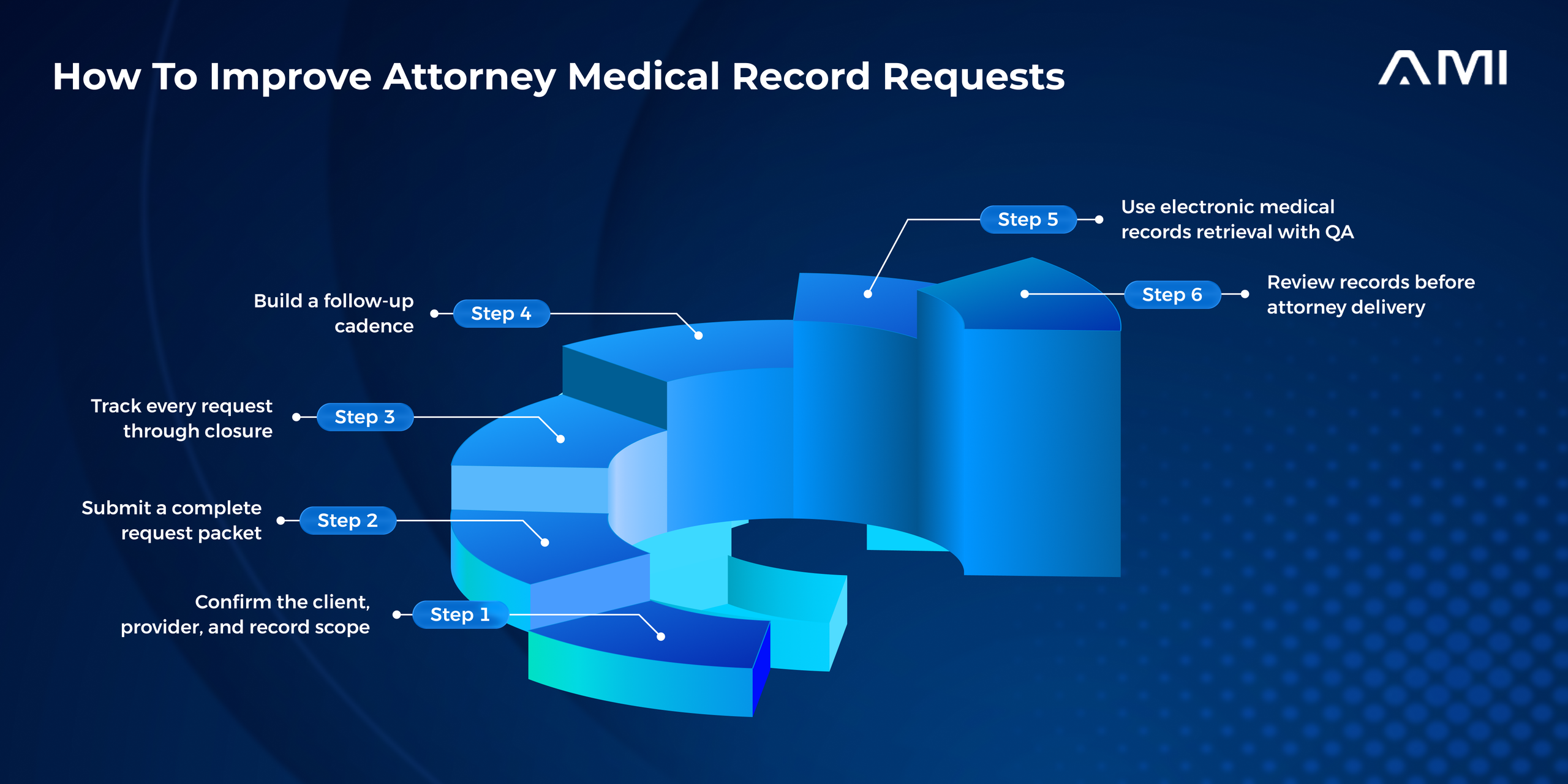
Step 3: Track every request through closure
Legal record retrieval becomes difficult when updates are scattered across inboxes, spreadsheets, provider portals, and individual paralegal notes.
Each request should have one visible history showing when it was submitted, how it was sent, who received it, what the provider said, which fee or correction is pending, when follow-up occurred, and whether records were received.
Tracking should distinguish partial records from complete fulfillment. It should also show whether the file has passed QA and reached the attorney or case team. This prevents a provider response from being treated as the end of the workflow when important records are still missing.
Step 4: Build a follow-up cadence
Active medical record retrieval for law firms requires a defined follow-up process. Without one, requests may remain in “submitted” status long after the provider has rejected the authorization, issued a fee notice, or requested clarification.
Follow-up should reflect the request’s age and current status. No-response cases, rejected authorizations, fee-pending requests, partial responses, wrong-department submissions, and provider clarification requests need different next actions.
A structured cadence also prevents excessive duplicate contact. The goal is persistent, documented coordination rather than repeated calls without a shared record of the provider’s response.
Step 5: Use electronic medical records retrieval with QA
Electronic medical records retrieval can improve transmission speed, portal visibility, and secure delivery. Records may arrive through provider platforms, encrypted links, secure file transfers, or digital retrieval channels.
However, a fast download is not necessarily a complete response. The legal team still needs to confirm that the files belong to the right client, come from the correct facility, cover the requested dates, and include the required medical or billing categories.
Electronic delivery changes how records arrive. It does not remove the need for provider coordination, document organization, or completeness review.
Step 6: Review records before attorney delivery
A request should not be closed merely because a file was received. QA should determine whether the response matches what the law firm requested.
The review should identify wrong-patient documents, missing treatment periods, partial provider responses, duplicate files, unreadable pages, absent billing records, and documents requiring organization. Medical records and billing records should be distinguished when both were requested.
The final output should make it clear what was received, what remains missing, and whether additional provider follow-up is required. Attorney-ready delivery means the case team can begin review without first reconstructing the retrieval history.
Common Risks When a Lawyer Is Requesting Medical Records
A lawyer requesting medical records may encounter risk when an incomplete authorization is submitted, the wrong provider or facility is contacted, or the date range does not match the client’s treatment history.
A firm may also forget to request billing records, overlook a provider invoice, submit the same request through multiple channels, or mark a partial response as complete. Poor communication between intake, retrieval, and case teams can leave attorneys unaware that records are still outstanding.
The most damaging gap is often the absence of escalation. Aging requests, repeated rejections, missing treatment periods, and unresponsive providers should move into a defined exception workflow rather than remaining in routine follow-up indefinitely.
How AI-First Operations Help Manage Retrieval Volume
High-volume retrieval can overwhelm legal teams when every request requires manual intake, status checks, provider follow-up prioritization, file sorting, and completeness review. AI-first operations can help absorb repetitive workflow activity while directing exceptions and higher-risk decisions to trained retrieval professionals.
AI can support volume management through:
- Classifying incoming requests and identifying missing intake fields
- Prioritizing aging, rejected, urgent, or stalled requests
- Organizing provider response histories and follow-up queues
- Indexing received files and detecting duplicate documents
- Flagging potential date-range gaps or partial responses
- Reporting provider delays, backlog patterns, and recurring request defects
This approach helps teams spend less time manually sorting queues and more time resolving provider issues, authorization defects, and incomplete responses. Human reviewers remain responsible for legal-pathway questions, unclear authority, provider coordination, wrong-patient risk, sensitive information, escalation, and final record-completeness decisions.

Why does record retrieval become difficult to control at scale?
Delays, follow-ups, provider coordination, and documentation gaps can slow down litigation support workflows. AM InfoWeb helps legal and healthcare teams manage record retrieval with structured processes, experienced teams, and clear operational visibility.
How Legal Record Retrieval Support Reduces Delays
Structured legal record retrieval support gives law firms dedicated capacity across request preparation, submission, provider outreach, fee tracking, electronic delivery, QA, and status reporting.
The value is not limited to reducing paralegal workload. A retrieval team can apply consistent follow-up, document provider responses, identify partial fulfillment, and escalate aging requests before they affect case deadlines.
Strong support also connects retrieval to downstream legal work. Organized records can move more efficiently into chronology development, medical summaries, demand preparation, expert review, discovery, and case evaluation.
Metrics Law Firms Should Track for Better Control
Retrieval reporting should help legal operations teams identify why cases are waiting, not simply count how many requests remain open.
Useful measures include average turnaround by provider type, open requests by age, provider rejection rate, authorization correction rate, fee-pending volume, partial-response rate, duplicate-request rate, missing-billing-record rate, QA defects, and attorney-ready completion.
Metrics should also separate provider-caused delays from internal workflow delays. That distinction shows whether the firm needs better intake, faster fee approval, stronger follow-up, more retrieval capacity, or escalation with particular provider types.
Outsource Retrieval: When Should Law Firms Do It?
Outsourcing may make sense when paralegals spend significant time chasing providers, request status is difficult to reconstruct, incomplete responses are common, or attorneys repeatedly wait for records before moving matters forward.
It can also help during case-volume surges, mass-tort projects, staffing gaps, or backlogs involving multiple providers and facilities.
The strongest model does not turn retrieval into a black box. The law firm should retain visibility into authorization issues, provider responses, fees, request age, partial records, QA results, and attorney delivery.
How AM InfoWeb Supports Medical Record Retrieval for Law Firms
AM InfoWeb supports law firms with medical record retrieval and litigation workflows designed to reduce delays, incomplete responses, and retrieval risk.
With trained legal support teams, structured request preparation, HIPAA authorization review support, provider follow-up, electronic medical records retrieval, QA, secure document handling, and reporting visibility, AM InfoWeb helps attorneys and paralegals move records from request to case review with greater control.
AM InfoWeb support may include:
- Attorney medical record request preparation and intake
- Medical record retrieval for law firms
- Legal record retrieval and ROI request tracking
- Authorization review workflow support
- Provider and custodian follow-up
- Electronic medical and billing record retrieval
- Fee and provider-response tracking
- Completeness checks and partial-response identification
- Duplicate and missing-record flagging
- Secure document handling
- Legal-team status reporting
- Alignment with chronology, summary, and litigation workflows
Need Better Control From Request to Case Review? AM InfoWeb supports law firms with provider-ready requests, authorization review support, active follow-up, electronic retrieval, completeness QA, secure handling, and case-level reporting.
Get in TouchFinal Thoughts
Medical record retrieval should be managed as part of case preparation, not as a standalone administrative task. A well-controlled attorney request for medical records combines accurate request preparation, appropriate authority, provider follow-up, electronic retrieval, completeness QA, status visibility, and escalation so legal teams receive records that are ready to support the matter.
Frequently Asked Questions
About the Author

Written by
Urza Dey
Urza Dey is a content and copywriter with over five years of experience across marketing, B2B SaaS, HealthTech, EdTech, and related industries. At AMI, they contribute to content strategy, blog development, and marketing communication focused on healthcare operations, business process management, and AI-enabled service delivery.