

Medical Billing Expert Witness: When Attorneys Need Independent Analysis
TL;DR: Medical Billing Expert Witness
A medical billing expert applies specialized knowledge to billing questions in a legal dispute.
Expert analysis is separate from operational retrieval, indexing, chronology, and record-preparation support.
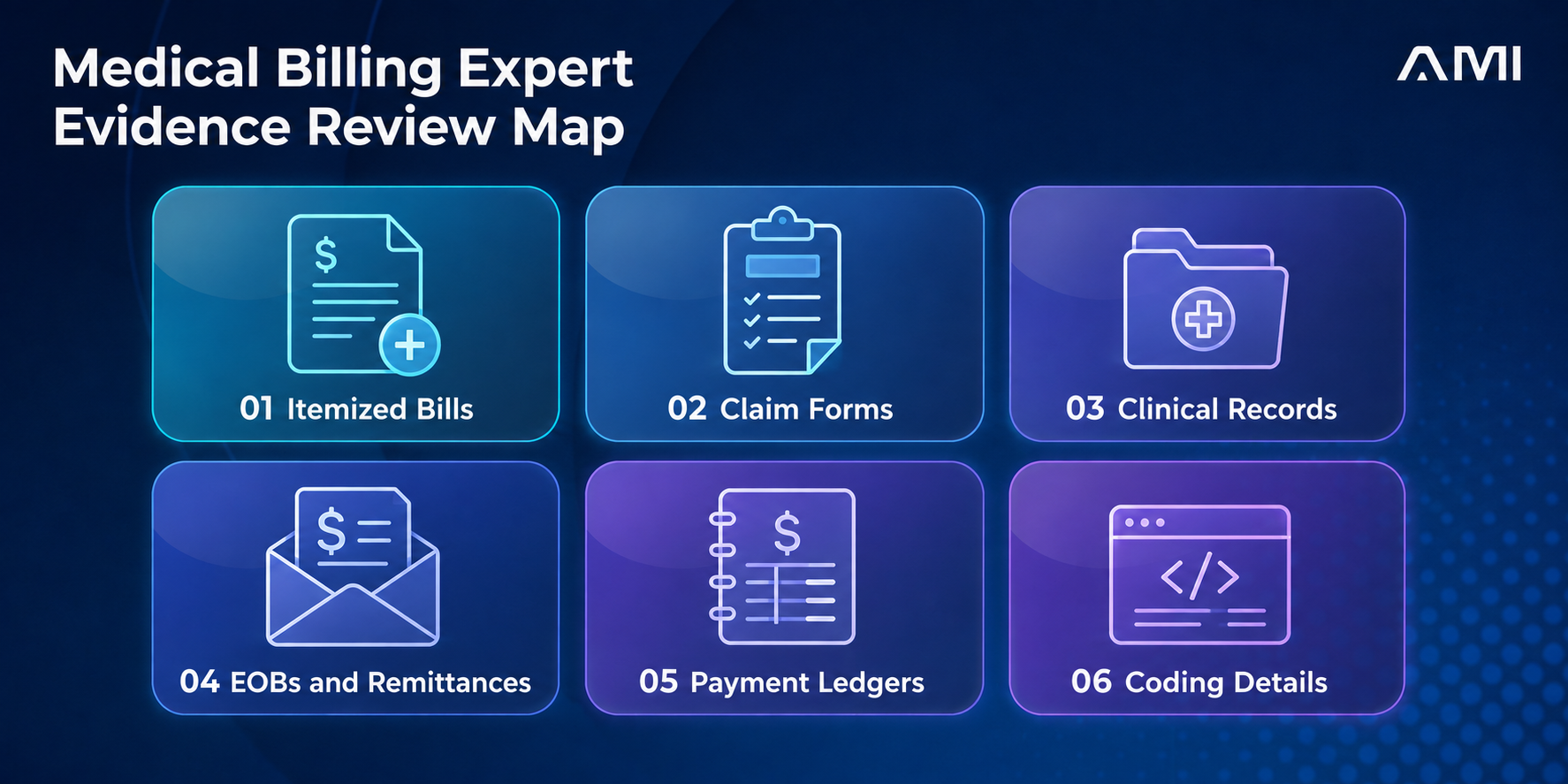
Itemized bills, claims, clinical records, remittances, ledgers, and coding details should be reconciled.
Clear scope, appropriate qualifications, complete evidence, and transparent methods support defensible analysis.
Missing or inconsistent billing evidence should be documented before substantive expert review.
Litigation-support teams can prepare traceable evidence without directing or replacing independent expert judgment.
A medical billing expert witness may help attorneys evaluate whether healthcare charges, coding, reimbursement methods, or claimed medical expenses are consistent with the records and the question presented in a case. The expert's role is different from routine medical record retrieval, billing operations, or chronology preparation.
An expert develops and supports an opinion. Litigation-support teams assemble, organize, reconcile, and quality-check the evidence that the expert and attorneys need. Confusing those roles can create scope, independence, and admissibility problems.
This guide explains when medical billing expertise may be useful, what documents support the analysis, and how legal teams can prepare cleaner evidence packages. It is general information, not legal, coding, valuation, or expert-witness advice.
Need structured support across healthcare and legal workflows? Explore AM InfoWeb's healthcare services.
What Does a Medical Billing Expert Witness Do?
A medical billing expert witness applies specialized knowledge to billing questions relevant to a legal dispute. Depending on qualifications and scope, the expert may analyze codes, charges, payment records, reimbursement methodology, customary billing practices, medical necessity documentation, or the relationship between clinical services and billed items.
The expert may prepare a report, assist counsel with discovery, evaluate an opposing analysis, or testify. The engagement should define the precise question rather than asking the expert to “review the bills” without an analytical framework.
Federal Rule of Evidence 702 addresses testimony by expert witnesses in federal proceedings, including qualification, helpfulness, sufficient facts or data, reliable principles and methods, and reliable application.
When Might Attorneys Need Independent Billing Analysis?
Medical billing expertise may be considered when a matter involves disputed charges, coding patterns, reimbursement, reasonableness questions, damages, overpayment allegations, healthcare fraud issues, workers' compensation, personal injury, or contractual payment disputes.
The need depends on the legal theory, jurisdiction, evidence, and type of opinion. A clinician may address treatment and causation but not possess the specialized knowledge needed to analyze coding or reimbursement. A billing specialist may understand operational practices but still need appropriate expert qualifications for the question presented.
Counsel should select and direct the expert. Litigation-support teams should protect evidence integrity and avoid shaping the opinion.
What Records Does a Medical Billing Expert Need?
The evidence package may include:
- Itemized bills and claim forms
- Explanations of benefits and remittance advice
- Payment, adjustment, refund, and balance histories
- Contracts or fee schedules when relevant and discoverable
- Clinical notes supporting billed services
- Orders, operative reports, diagnostic reports, and treatment plans
- Coding and modifier details
- Charge-master or departmental information when within scope
- Denial and appeal correspondence
- Prior audit reports or opposing expert materials
- A data dictionary explaining unfamiliar exports
CMS states that medical-record documentation should support Medicare coverage, coding, and billing requirements in its medical documentation guidance. Although a litigation question may use a different standard, the connection between a billed service and its supporting documentation remains operationally important.
How Should Billing Records Be Reconciled Before Review?
Reconciliation tests whether the data set is internally consistent and complete enough for analysis.
| Evidence Set | Reconciliation Check |
|---|---|
| Itemized bill | Match patient, provider, dates, codes, units, and gross charges |
| Claim form | Compare submitted codes, modifiers, diagnosis codes, and place of service |
| Clinical record | Locate documentation supporting each disputed service |
| EOB or remittance | Match allowed amount, payment, adjustment, denial, and patient responsibility |
| Ledger | Reconcile payments, write-offs, refunds, and remaining balance |
| Coding data | Confirm code set, year, units, modifiers, and edits relevant to the analysis |
| Source log | Record where each document came from and when it was received |
Unexplained totals, duplicate bills, missing remittances, or inconsistent patient identifiers should be resolved before expert analysis begins.
How Is a Billing Expert Different From a Coding Expert?
The terms overlap but are not interchangeable. A medical coding expert witness may focus on code selection, sequencing, modifiers, documentation support, bundling, or applicable coding conventions. A medical billing expert may focus more broadly on claim generation, charges, reimbursement, payment posting, balances, and billing practices.
Some experts possess both areas of knowledge. Others specialize by provider type, payer, setting, or legal issue. The engagement letter should state the expected opinion and avoid assuming that one credential covers every billing and coding question.
What Makes Expert Billing Analysis Defensible?
Defensible work starts with a clear question, complete evidence, appropriate qualifications, a repeatable method, and transparent assumptions. The expert should identify documents considered, data limitations, calculations, methodologies, and conclusions.
Legal teams should preserve versions and distinguish source evidence from attorney work product, demonstratives, and expert-created analysis. If new records arrive, the team should document what changed and whether the opinion requires reconsideration.
Independent analysis also requires role separation. Retrieval and organization support should not direct the expert toward a preferred conclusion.
Which Evidence Gaps Can Undermine the Review?
Common gaps include missing itemized bills, absent claim forms, incomplete payment histories, missing clinical support, unexplained adjustments, inconsistent dates, duplicate lines, and unidentified data fields.
A total charge alone rarely explains the services, codes, units, payments, or contractual adjustments behind it. Similarly, a clinical chart without billing records cannot show the full financial history.
Teams should issue a gap report before substantive review. The report should distinguish unavailable material from material that has not yet been requested or received.
How Should Attorneys Prepare an Expert Review Package?
Create an indexed package with consistent filenames, Bates ranges, provider separation, date coverage, record types, and a source log. Include a neutral case overview and the exact question counsel wants addressed.
Do not silently remove duplicates, alter source files, or combine entries in a way that obscures provenance. Provide a working copy for analysis while preserving the original production.
The package may include a litigation-ready medical chronology, but the chronology should point back to exact source pages.
Need structured retrieval and evidence preparation for expert review? Explore AM InfoWeb's litigation support services.

Why does record retrieval become difficult to control at scale?
Delays, follow-ups, provider coordination, and documentation gaps can slow down litigation support workflows. AM InfoWeb helps legal and healthcare teams manage record retrieval with structured processes, experienced teams, and clear operational visibility.
What Should Counsel Ask a Potential Billing Expert?
Questions should cover qualifications, relevant settings, prior testimony, conflicts, methodology, required evidence, expected deliverables, assumptions, data limitations, timing, and fees. Counsel should also ask how the expert distinguishes billed charges, allowed amounts, payments, adjustments, and outstanding balances.
The expert should explain which questions are within scope and which require another specialist. A clear scope helps prevent the report from drifting into clinical causation, legal conclusions, or unsupported valuation opinions.
How AM InfoWeb Supports Billing Evidence Preparation
AM InfoWeb supports legal teams by retrieving, organizing, reconciling, and quality-checking medical and billing records used in litigation workflows.
With two decades of experience in the U.S. healthcare industry, AM InfoWeb uses a co-managed model that brings AI agents and skilled human agents together to eliminate process bottlenecks and execute secure healthcare workflows.
AM InfoWeb can support:
- Medical and billing record retrieval
- Provider and custodian follow-up
- Itemized-bill and ledger collection
- File indexing and Bates-range control
- Duplicate and missing-record identification
- Billing-to-clinical record reconciliation
- Chronology and summary preparation
- Secure delivery, tracking, and reporting
AM InfoWeb does not replace counsel or provide an expert opinion through these operational services. The goal is to give authorized reviewers a complete, traceable evidence set. Related resources explain medical records summarization services, medical chronology services for law firms, and the operational controls in a medical billing audit checklist.
How Can Better Preparation Improve Independent Analysis?
Expert analysis is only as efficient as the evidence package permits. Clear scope, complete records, reconciled billing data, source-level traceability, and documented gaps help the expert spend more time analyzing the question and less time reconstructing the file.
Counsel retains responsibility for expert selection, legal strategy, and admissibility. Structured litigation support strengthens the factual foundation without replacing independent professional judgment.
Need cleaner billing evidence for legal review? AM InfoWeb combines experienced retrieval teams, record reconciliation, indexing, QA, and secure delivery to support organized expert-review workflows.
Get in TouchFrequently Asked Questions
About the Author

Written by
Urza Dey
Urza Dey is a content and copywriter with over five years of experience across marketing, B2B SaaS, HealthTech, EdTech, and related industries. At AMI, they contribute to content strategy, blog development, and marketing communication focused on healthcare operations, business process management, and AI-enabled service delivery.