


Medical Chronology Template: What a Litigation-Ready Timeline Should Include
TL;DR: Medical Chronology Template
A medical chronology template turns fragmented records into a traceable, date-based legal review tool.
Every entry should identify the date, provider, encounter, clinical information, treatment, and exact source location.
Neutral attribution keeps patient reports, objective findings, diagnoses, and legal conclusions distinct.
Treatment gaps, conflicting dates, missing providers, and absent reports should be flagged without unsupported assumptions.
AI can accelerate extraction and classification, but skilled human validation remains essential.
Record inventory reconciliation, citation checks, terminology review, and version control strengthen reliability.
A medical chronology template gives legal teams a consistent structure for turning fragmented medical records into a reviewable timeline. It should help an attorney understand what happened, when it happened, who documented it, and where the supporting information appears in the source record.
The template is only the framework. A litigation-ready chronology also depends on complete record collection, careful clinical interpretation, neutral writing, source-level citations, and quality review. A polished table cannot compensate for missing records, merged events, unsupported conclusions, or dates that cannot be traced back to the file.
This guide explains what a useful medical chronology template should contain, how each field supports case preparation, and which controls help legal teams produce a dependable timeline.
Inline CTA 1: Need structured operational support for record-intensive workflows? Explore AM InfoWeb's healthcare services.
What Is a Medical Chronology Template?
A medical chronology template is a standardized format for arranging relevant medical events in date order. Each entry connects an event to its provider, facility, clinical details, treatment, and source location. The finished chronology helps counsel review causation, damages, treatment progression, pre-existing conditions, gaps in care, and potential expert issues.
A chronology is different from a narrative medical summary. A chronology preserves event-level detail in a time-based structure. A narrative summary synthesizes the overall medical story. Many matters benefit from both, but the chronology usually provides the traceable working record used during discovery, deposition preparation, expert review, mediation, and trial preparation.
The American Bar Association notes that a thorough medical chronology can help identify missing or illegible records, additional treating providers, suspicious documentation, and potential expert needs. Its guidance on reviewing medical records in litigation shows why organization and clinical review must work together.
Who Uses a Medical Chronology in Litigation?
Plaintiff and defense firms use chronologies in personal injury, medical malpractice, workers' compensation, product liability, mass tort, disability, insurance, and other record-intensive matters. Nurse consultants, paralegals, claims professionals, experts, and litigation-support teams may also use the same timeline for different review purposes.
The intended reader should shape the level of detail. An attorney preparing for a deposition may need concise entries with page citations and flagged inconsistencies. A medical expert may require laboratory values, imaging findings, medication changes, and symptom progression. A claims professional may prioritize treatment duration, billed services, prior conditions, and functional limitations.
The template should therefore be configurable without changing its core traceability controls. For a related overview, see how medical records summarization services support case review.
Which Core Fields Should Every Medical Chronology Include?
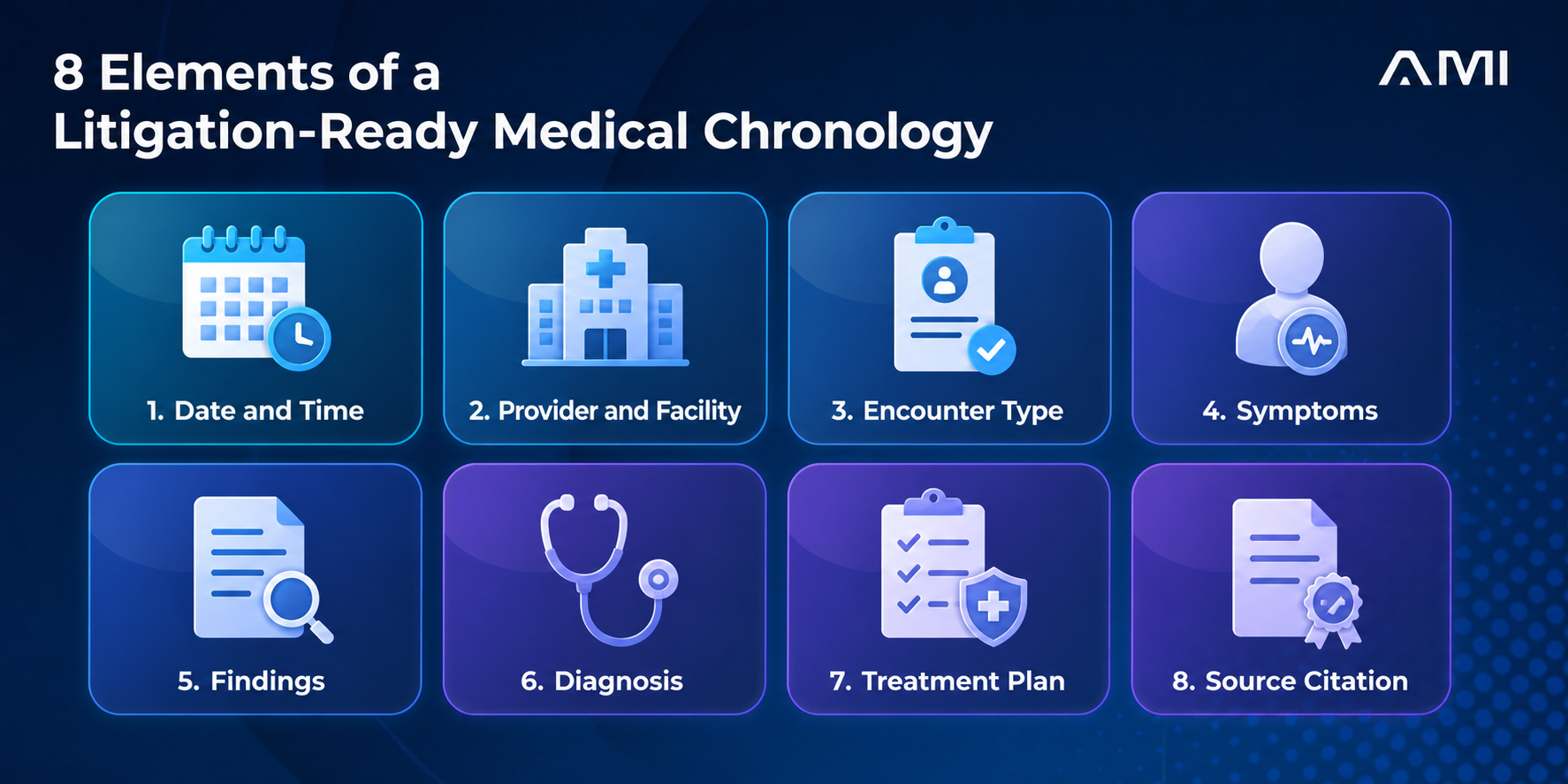
A litigation-ready medical chronology should include enough information to understand the event without losing the connection to the original record.
| Template Field | What It Should Capture | Why It Matters |
|---|---|---|
| Date and time | Service date, admission and discharge dates, or documented event time | Establishes sequence and duration |
| Provider and facility | Clinician name, specialty, organization, and location | Identifies the source and care setting |
| Encounter type | Office visit, emergency care, surgery, therapy, imaging, or other event | Adds context to the clinical information |
| Complaints and symptoms | Patient-reported concerns and relevant history | Shows presentation and symptom progression |
| Examination and findings | Objective examination, laboratory, and imaging findings | Separates reported symptoms from documented findings |
| Assessment or diagnosis | Diagnoses, differential diagnoses, and clinical impressions | Tracks how the clinical picture changed |
| Treatment and plan | Procedures, medications, referrals, restrictions, and follow-up | Shows clinical response and next steps |
| Source citation | File name, document type, Bates number, and page reference | Makes every entry verifiable |
Optional fields may include accident history, prior or subsequent injuries, work status, functional limitations, medical expenses, exhibit number, reviewer notes, or issue tags. Add fields only when they support the legal review. Too many columns can make the chronology harder to use.
How Should Dates and Events Be Organized?
Arrange events in true chronological order and use a consistent date format throughout. When an encounter spans several days, record the admission, significant inpatient events, procedures, and discharge in a way that preserves sequence without repeating the same information unnecessarily.
Do not silently convert unclear dates into precise dates. If the record says only “three weeks earlier” or contains conflicting dates, label the uncertainty and cite the source. Distinguish the date of service from the date a report was signed, transcribed, filed, or received.
Multiple records may describe the same event. Combine them only when the relationship is clear and the citations remain complete. Separate entries when reports conflict, add material information, or reflect different stages of care.
How Should Clinical Information Be Summarized Neutrally?
Chronology entries should be concise, accurate, and attribution-based. Record what the patient reported, what the clinician observed, what a diagnostic test showed, and what the provider concluded. Do not turn an allegation or clinical impression into an established fact.
Preserve clinically meaningful qualifiers such as “possible,” “reported,” “denied,” “unchanged,” or “no acute finding.” These terms can materially affect interpretation. Avoid changing medical terminology merely to make an entry sound more definitive.
Use plain language where possible, but retain technical terms when simplification could change the meaning. Define uncommon abbreviations and apply the same abbreviation rules throughout the chronology.
What Should a Litigation-Ready Source Citation Contain?
Every entry should point the reviewer back to the evidence. At minimum, record the source file or production set and the page, Bates, or exhibit reference. When available, include the document type, provider, and facility so the source remains identifiable if files are reorganized.
Source citations should be specific enough for another reviewer to locate the supporting text without repeating the research. A broad citation to a 900-page PDF is not sufficient. If an entry combines information from several pages, cite each relevant location.
Consistent citations also support chronology updates. When additional records arrive, the team can identify whether an event is genuinely new, fills a known gap, or changes an earlier interpretation.
How Can a Template Reveal Gaps and Inconsistencies?
A well-built chronology makes missing information visible. It may reveal an unexplained break between referral and treatment, a provider mentioned without corresponding records, an imaging study cited but not produced, or an admission with no discharge summary.
The chronology should flag gaps without assuming why they occurred. A treatment gap may reflect recovery, access barriers, insurance problems, unrelated events, or missing records. The timeline identifies the question; it does not supply an unsupported answer.
Inconsistencies should also be documented neutrally. Examples include different accident dates, changing symptom descriptions, conflicting medication lists, or varying accounts of prior injury. Record each source and allow counsel or an expert to evaluate significance.
How Should Prior Conditions and Later Events Be Handled?
Prior conditions can be relevant to baseline function, causation, aggravation, and damages. Later accidents, new diagnoses, or unrelated care may also affect the medical story. A useful template provides a way to tag these events without mixing them into the alleged injury sequence.
Include prior or subsequent events according to counsel's scope and the needs of the matter. Do not omit information merely because it appears unfavorable. Neutral completeness makes the chronology more dependable for legal analysis.
The ABA's guidance on AI-assisted medical-record review specifically highlights chronology construction, treatment gaps, inconsistencies, and prior or subsequent trauma as important review tasks. See its guide to medical-record analysis for personal injury matters.
How Should Medical Bills and Expenses Be Presented?
Medical expenses may be integrated into the chronology or maintained in a separate medical-expense summary. The right approach depends on the matter, jurisdiction, and review purpose. If expenses are included, distinguish billed charges from payments, adjustments, balances, liens, or claimed damages.
Do not infer that a charge proves a service occurred or that a clinical note proves a bill is complete. Reconcile bills and records when the scope requires it. Identify duplicate bills, unexplained charges, missing statements, and mismatches between service dates.
A separate expense table can keep the clinical chronology readable while still connecting each amount to the corresponding treatment event and source document.
What Quality Checks Make a Medical Chronology Dependable?
Quality review should test both content and usability. The reviewer should confirm that dates sort correctly, citations resolve, names and facilities are consistent, abbreviations are defined, duplicates are controlled, and important findings have not been lost through over-compression.
Useful quality controls include:
- Record-inventory reconciliation before drafting
- Date and provider normalization
- Duplicate-event review
- Page-level citation checks
- Clinical terminology validation
- Gap and inconsistency review
- Scope and relevance checks
- Independent proofreading before delivery
Review should be risk-based. Surgery, hospitalization, imaging, specialist opinions, medication changes, functional restrictions, and disputed events usually deserve closer validation than routine duplicate documentation.
Can AI Build a Medical Chronology Safely?
AI can help classify documents, extract dates, identify providers, normalize recurring fields, and propose timeline entries. It can also help reviewers search large record sets for diagnoses, procedures, medications, and possible gaps.
AI output still requires skilled human validation. Scanned handwriting, copied-forward notes, conflicting dates, abbreviations, multi-patient files, and clinically nuanced statements can produce errors. A generated chronology should never be treated as verified simply because it is formatted cleanly.
Secure handling is equally important. Medical records may contain protected health information and sensitive litigation material. Access, storage, transmission, retention, and review workflows should follow the applicable legal, contractual, privacy, and security requirements.
Inline CTA 2: Need structured chronology and record-review support? Explore AM InfoWeb's Litigation Support Services.

Why does record retrieval become difficult to control at scale?
Delays, follow-ups, provider coordination, and documentation gaps can slow down litigation support workflows. AM InfoWeb helps legal and healthcare teams manage record retrieval with structured processes, experienced teams, and clear operational visibility.
How Should Legal Teams Customize the Template?
Begin with the decisions the chronology must support. Define the relevant injury, treatment period, providers, specialties, issues, and output format. Then select fields that allow reviewers to answer those questions efficiently.
Common customizations include issue tags for causation, standard-of-care questions, prior conditions, treatment gaps, functional capacity, future care, or expert review. Color coding can help, but it should never replace descriptive labels or source citations.
The template should also accommodate updates. New records often arrive after an initial chronology is delivered. Version control, a record inventory, and a documented cutoff date help prevent reviewers from relying on an outdated timeline. For retrieval planning, see how complete medical record retrieval supports litigation review.
What Medical Chronology Template Mistakes Should Teams Avoid?
Common mistakes include:
- Copying long passages instead of summarizing material events
- Omitting source citations or using citations that are too broad
- Combining conflicting events into one definitive statement
- Treating allegations, symptoms, findings, and diagnoses as equivalent
- Ignoring prior conditions, later injuries, or treatment gaps
- Failing to reconcile the chronology with the record inventory
- Using unexplained abbreviations or inconsistent provider names
- Allowing automated extraction to replace clinical and legal review
The objective is not to include every sentence in the medical record. It is to preserve the facts needed for analysis while keeping each entry accurate, neutral, and traceable.
How AM InfoWeb Supports Litigation-Ready Medical Chronologies
AM InfoWeb supports legal and healthcare teams with structured medical-record review, chronology development, record retrieval, and quality-controlled litigation-support workflows.
With two decades of experience in the U.S. healthcare industry, AM InfoWeb uses a co-managed model that brings AI agents and skilled human agents together to eliminate process bottlenecks and execute secure healthcare workflows.
AM InfoWeb can support:
- Medical record inventory and organization
- Chronological timeline development
- Medical record summarization
- Provider and facility normalization
- Treatment-gap and missing-record identification
- Page-level source citations
- Medical expense summaries
- Quality assurance and escalation
The co-managed model helps teams process record volume while retaining human review for clinical context, ambiguity, and case-specific judgment. Learn more about selecting medical chronology services for law firms.
What Should a Litigation-Ready Timeline Deliver?
A litigation-ready medical chronology should let a reviewer understand the treatment sequence, locate the supporting record, identify open questions, and update the timeline as new information arrives. Its value comes from traceability and disciplined review, not visual complexity.
Start with a consistent template, define the scope, reconcile the record inventory, and validate every material entry. When those controls are in place, the chronology becomes a reliable working tool for discovery, deposition preparation, expert review, negotiation, and trial strategy.
Need a chronology that legal teams can verify and use? AM InfoWeb combines structured templates, experienced medical-record reviewers, source-level citations, and quality controls to support litigation-ready case analysis.
Get in TouchFrequently Asked Questions
About the Author

Written by
Urza Dey
Urza Dey is a content and copywriter with over five years of experience across marketing, B2B SaaS, HealthTech, EdTech, and related industries. At AMI, they contribute to content strategy, blog development, and marketing communication focused on healthcare operations, business process management, and AI-enabled service delivery.