
Affidavit of Medical Records: Requirements for Authenticating Legal Evidence
TL;DR: Affidavit of Medical Records
A medical records affidavit identifies the custodian, provider, recordkeeping practices, and covered production.
The affidavit may support authentication but does not automatically establish admissibility.
Requirements for language, execution, notice, and notarization vary by jurisdiction.
The affidavit should reconcile with the patient, provider, dates, record types, page count, and files.
Requesting the affidavit with the initial records request reduces follow-up and deadline risk.
Provider-level tracking separates records received from complete, affidavit-ready production.
An affidavit of medical records can help establish who maintains a provider’s records, how those records are created and stored, and whether the supplied copies reflect the organization’s files. Legal teams often use this foundation when preparing healthcare evidence for a claim or proceeding.
The affidavit is only one part of a defensible production. A perfectly executed statement cannot cure missing pages, an incorrect patient, an incomplete date range, or unclear source custody.
This guide explains common affidavit elements, authentication principles, review controls, and operational steps. Requirements vary by jurisdiction, so counsel should confirm the applicable law and procedure.
Need structured support across healthcare and legal workflows? Explore AM InfoWeb’s healthcare services.
What Is an Affidavit of Medical Records?
An affidavit of medical records is a sworn statement from a records custodian or another qualified person concerning the identity, creation, maintenance, and production of healthcare records. Some jurisdictions use a certification or unsworn declaration instead.
The document may support authentication and a business-record foundation. It does not prove that every statement within the chart is true, and it does not guarantee admissibility.
What Should a Medical Records Affidavit Include?
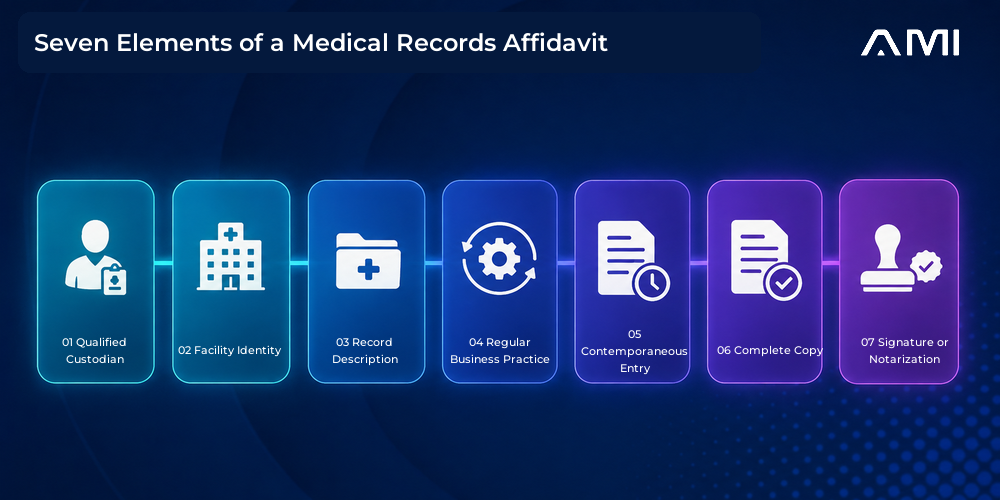
Required language differs, but a practical checklist includes:
- Declarant’s name, title, and qualification
- Provider or facility identity
- Patient or subject identification
- Description and date range of the records
- Statement about regular business practices
- Confirmation that entries were made at or near the relevant time
- Confirmation that the copies are true and complete
- Signature, date, oath, declaration, or notarization as required
- Page count or production identifier when used
- Explanation when responsive records do not exist
The affidavit should be reviewed together with the production it covers.
How Does an Affidavit Support Authentication?
Federal Rule of Evidence 803(6) describes conditions for records of a regularly conducted activity. Federal Rule of Evidence 902(11) addresses certified domestic records and includes notice and inspection requirements.
An affidavit may establish recordkeeping facts without live custodian testimony when the applicable rules permit. State statutes, local rules, case orders, and evidentiary objections can change what is required.
| Review point | What to verify | Risk if missed |
|---|---|---|
| Declarant | Custodian or qualified person | Foundation challenge |
| Facility | Correct legal entity and location | Wrong source |
| Patient | Reliable identifiers | Mismatched records |
| Scope | Dates and record types align | Incomplete evidence |
| Execution | Signature and formalities are present | Procedural defect |
| Production | Files reconcile with the affidavit | Authenticity or completeness dispute |
Who Can Sign a Medical Records Affidavit?
The signer is commonly a medical records custodian or another person qualified to explain the organization’s recordkeeping practices. The signer does not necessarily need to have treated the patient or created each entry.
The key question is whether the person can truthfully establish the facts required by the applicable rule. Counsel should confirm signer qualifications and prescribed affidavit language.
When Should Legal Teams Request the Affidavit?
Request the affidavit with the initial record request whenever possible. Asking for certification after the records arrive adds another provider contact, review cycle, and deadline risk.
The request should specify the acceptable form, required language, patient, facility, date range, record types, and whether separate affidavits are needed for separately maintained sources.
What Common Defects Make an Affidavit Unusable?
Common defects include the wrong patient or provider, missing signature, missing notarization where required, vague record descriptions, conflicting dates, inaccurate page counts, and language that does not address the necessary recordkeeping facts.
An affidavit can also be misleading when it covers only part of a multi-file production. Review the source inventory and production before treating the certification as complete. The related guide to certified medical records explains how certification and production QA work together.
Need affidavit follow-up, complete retrieval, and production controls? Explore AM InfoWeb’s Record Retrieval and Litigation Support.

Why does record retrieval become difficult to control at scale?
Delays, follow-ups, provider coordination, and documentation gaps can slow down litigation support workflows. AM InfoWeb helps legal and healthcare teams manage record retrieval with structured processes, experienced teams, and clear operational visibility.
How Should Attorneys Review the Affidavit and Production?
Compare the declarant, provider, patient, dates, record types, and page count with the delivered files. Confirm that clinical notes, billing records, imaging, laboratory results, and attachments are included when requested. Document gaps and request corrections promptly.
A medical records custodian may explain separately maintained systems or unavailable material. That explanation should remain connected to the request history.
How Do Electronic Records Affect Affidavit Review?
Electronic exports may contain system-generated information, metadata, audit history, attachments, or links that do not appear in a basic PDF. Teams should identify what was requested, what the provider can export, and whether the affidavit accurately describes the format produced.
Maintain stable filenames, page identifiers, and a documented chain of handling. Do not change source files in ways that obscure their origin.
How Can Teams Track Affidavits Across Multiple Providers?
Use a provider-level tracker with request date, service date, acknowledgment, fee, production status, affidavit status, defects, follow-up date, and owner. Separate “records received” from “records and acceptable affidavit received.”
The workflow used for a medical records subpoena can help teams manage authority, objections, deadlines, and production milestones.
How AM InfoWeb Supports Affidavit-Ready Record Retrieval
AM InfoWeb supports legal and healthcare teams with structured retrieval, certification coordination, production review, and operational visibility.
With two decades of experience in the U.S. healthcare industry, AM InfoWeb uses a co-managed model that brings AI agents and skilled human agents together to eliminate process bottlenecks and execute secure healthcare workflows.
AM InfoWeb can support:
- Request intake and authority review
- Provider and custodian identification
- Affidavit and certification tracking
- Follow-up and defect resolution
- Multi-source retrieval coordination
- Production and page-count reconciliation
- Secure file organization and delivery
- Status reporting and audit trails
Counsel retains responsibility for legal sufficiency, admissibility, notice, filing, and case strategy.
What Should Teams Remember About Medical Records Affidavits?
An affidavit supports authentication when it accurately describes the custodian, recordkeeping process, and accompanying production. Request it early, verify every material detail, reconcile it with the records, and correct defects before the evidence becomes time-sensitive.
Need more reliable affidavit-ready productions? AM InfoWeb combines experienced teams, custodian follow-up, certification tracking, QA, and secure delivery for litigation support.
Get in TouchFrequently Asked Questions
About the Author

Written by
Urza Dey
Urza Dey is a content and copywriter with over five years of experience across marketing, B2B SaaS, HealthTech, EdTech, and related industries. At AMI, they contribute to content strategy, blog development, and marketing communication focused on healthcare operations, business process management, and AI-enabled service delivery.