
Conversational IVR: How Healthcare Contact Centers Improve Patient Access
TL;DR: Conversational IVR
Conversational IVR lets callers state intent naturally instead of navigating rigid menus.
Healthcare workflows require privacy controls, identity verification, accessibility, and safe escalation.
Routine administrative tasks fit automation better than ambiguous or clinically sensitive interactions.
Human handoffs should carry verified context so patients do not repeat the interaction.
Quality measurement must include containment, resolution, transfer accuracy, errors, and patient effort.
Governance should monitor recognition gaps, urgent-intent detection, integrations, and workflow outcomes.
Conversational IVR allows callers to explain what they need in natural language instead of navigating a rigid sequence of keypad menus. In healthcare contact centers, that capability can improve routing, support routine self-service, reduce repeated information, and connect patients with qualified human agents when judgment is required.
The technology does not improve access automatically. Success depends on accurate intent recognition, secure identity workflows, reliable integrations, clinical and operational boundaries, accessible design, and clear escalation paths.
This guide explains how conversational IVR works, which healthcare interactions fit automation, and how leaders can measure access without sacrificing privacy, accuracy, or human support.
Need stronger operational support across healthcare workflows? Explore AM InfoWeb’s healthcare services.
What Is Conversational IVR?
Conversational interactive voice response uses speech recognition, natural-language understanding, and automated workflows to interpret a caller’s request. Instead of hearing “press one for scheduling,” a patient might say, “I need to move my appointment,” and the system can identify the intent, collect required details, and either complete the task or route the caller.
Traditional IVR is menu-led. Conversational IVR is intent-led. Both can route calls, but conversational systems can accept a wider range of phrases and preserve context across steps.
The system should clearly disclose when automation is being used and make human assistance easy to reach. Healthcare callers may be anxious, have accessibility needs, speak differently than the training data, or present an urgent issue that cannot remain in self-service.
How Does Conversational IVR Work in Healthcare?
A healthcare conversational IVR workflow generally follows these stages:
1. Receive the call and provide required notices.
2. Capture the caller’s spoken request.
3. Identify intent, language, urgency signals, and confidence.
4. Verify identity when protected or account-specific information is involved.
5. Retrieve or update authorized information through connected systems.
6. Complete a routine task or transfer with context to a skilled agent.
7. Record the outcome for quality review and reporting.
Low-confidence recognition, failed authentication, sensitive clinical questions, repeated caller frustration, and emergency language should trigger defined fallback or escalation behavior.
Which Healthcare Calls Fit Conversational IVR Automation?
Common candidates include appointment confirmation, rescheduling, location and hours, referral status, basic billing questions, payment routing, eligibility status, prescription-refill routing, provider-directory navigation, and request-status updates.
The best starting points are high-volume, repeatable, low-risk interactions with clear system data and defined outcomes. Clinical advice, complex coverage interpretation, disputed balances, distressed callers, and ambiguous requests generally require skilled human support.
Automation design should map complete workflows rather than isolated questions. A system that recognizes intent but cannot complete the next step may simply add another layer before the live queue.
How Is Conversational IVR Different From Voice Bots?
| Capability | Traditional IVR | Conversational IVR | General Voice Bot |
|---|---|---|---|
| Primary interaction | Keypad or fixed phrases | Natural-language intent | Open-ended voice exchange |
| Workflow structure | Menu tree | Intent and task flow | Varies by platform |
| Healthcare integration | Often limited | Designed around connected workflows | May require customization |
| Human transfer | Queue-based | Context-aware when configured | Varies |
| Risk control | Menu boundaries | Confidence and policy boundaries | Depends on implementation |
The label matters less than the operating controls. Leaders should evaluate what the system can access, decide, change, disclose, document, and escalate.
What Can Cause Conversational IVR Failures?
Frequent failure points include:
- Training data that does not represent real callers
- Poor recognition of accents, languages, or background noise
- Intent categories that overlap or omit common needs
- Authentication that creates excessive friction
- Incomplete EHR, scheduling, CRM, or billing integration
- Transfers that discard the caller’s context
- No safe handling for urgent or sensitive language
- Rigid scripts that prevent callers from correcting errors
- Metrics focused only on containment or call duration
These problems can increase abandonment and repeat calls. The existing healthcare call center metrics framework helps leaders balance speed with resolution, quality, and compliance.
How Should Healthcare IVR Protect Privacy?
Privacy controls should match the information being requested or disclosed. Public information may not require identity verification, while appointment details, billing information, coverage, or clinical content may require stronger authentication.
HHS confirms that healthcare communications may occur by phone when reasonable safeguards are used. Its telephone communication guidance emphasizes protecting information during transmission and confirming destinations where appropriate.
Systems should minimize unnecessary PHI collection, mask sensitive data in logs, restrict access, document actions, and prevent information from being disclosed before required verification succeeds.
When Should Conversational IVR Transfer to Humans?
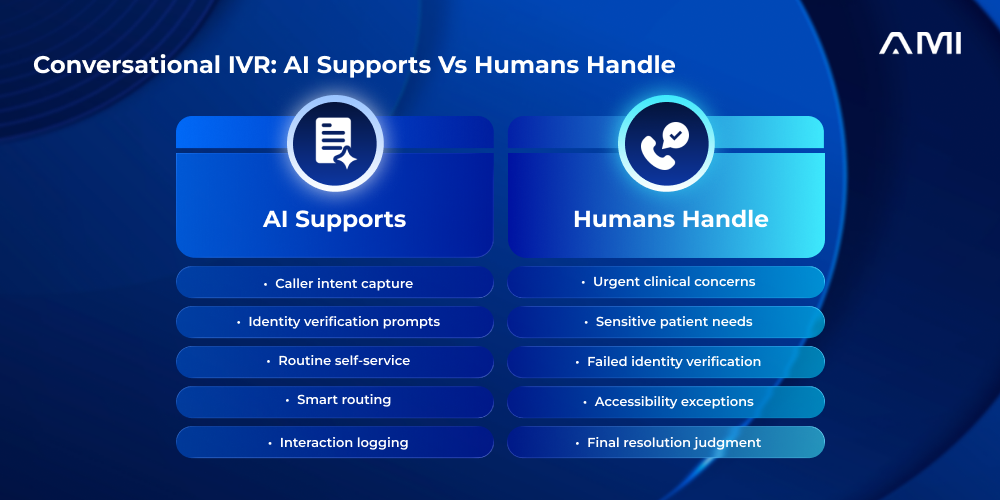
Escalation should occur when confidence falls below an approved threshold, authentication fails repeatedly, the caller requests an agent, the workflow encounters an exception, or the subject requires clinical or financial judgment.
Human transfer should preserve the recognized intent, completed verification steps, information already collected, and error history. Asking callers to restart undermines both efficiency and trust.
The receiving agent needs the authority, training, and system access to complete the interaction. Automation that transfers unresolved work to the wrong queue only relocates the bottleneck.
Which Metrics Show Whether Conversational IVR Works?
Useful measures include:
- Intent-recognition accuracy
- Successful self-service completion
- Authentication success and failure
- Transfer rate by reason
- Context-preserving transfer rate
- Caller abandonment by workflow step
- Repeat contact within a defined period
- Human escalation resolution rate
- Quality and compliance defects
- Caller satisfaction by interaction type
Containment should never stand alone. A high containment rate can hide abandoned calls, incorrect answers, or callers trapped in automation.
How Can AI and Human Agents Work Together?
AI can recognize intent, retrieve approved information, complete routine transactions, summarize the interaction, and prepare a contextual handoff. Skilled human agents handle ambiguity, empathy, exceptions, judgment, and sensitive decisions. Similar controls can improve provider and member experience when requests cross multiple payer teams.
This co-managed approach supports scale without making automation the only path. Human review can also improve intent libraries, escalation rules, scripts, and knowledge content based on real interaction outcomes.
For organizations redesigning broader workflows, lessons from healthcare payer automation reinforce the need for bounded use cases and measurable controls.
Need accountable AI-assisted patient support workflows? Explore AM InfoWeb’s AI Contact Center Operations.
How Should Healthcare Leaders Implement Conversational IVR?
Start with call-reason data and choose one repeatable workflow with a clear outcome. Map every data source, verification step, exception, transfer destination, and accountable owner before configuring automation.
Test with varied accents, languages, speech patterns, background conditions, and accessibility needs. Run controlled pilots, review failed interactions, and validate that urgent or sensitive scenarios reach the right human support.
Governance should approve changes to intents, scripts, integrations, disclosures, authentication, and escalation thresholds. Version history and testing evidence should be retained. Teams can also use patterns from claims-processing operations when defining exception ownership.

How Does AM InfoWeb Support Conversational IVR Operations?
AM InfoWeb supports healthcare organizations with AI-assisted contact center workflows, skilled human execution, quality assurance, and operational reporting.
With two decades of experience in the U.S. healthcare industry, AM InfoWeb uses a co-managed model where AI agents and skilled human agents work together to eliminate process bottlenecks and execute secure healthcare workflows.
AM InfoWeb can support:
- Call-reason and intent analysis
- Conversational workflow design support
- Identity-verification and escalation execution
- Human-agent exception handling
- Quality monitoring and interaction review
- Knowledge and script feedback loops
- Access, resolution, and compliance reporting
The goal is accessible, accurate support that uses automation where it helps and skilled people where judgment matters.
What Should Contact Center Leaders Do Next?
Identify the call types creating the most avoidable effort, then evaluate which can be completed safely through conversational automation. Define success around resolution, privacy, access, and patient experience rather than containment alone.
Conversational IVR works best as part of a connected operating model with reliable integrations, controlled decisions, transparent escalation, and accountable human support.
Need a safer path to conversational automation? AM InfoWeb combines AI-assisted contact center workflows, skilled human agents, QA, secure escalation, and operational reporting to improve patient access and resolution.
Get in TouchFrequently Asked Questions
About the Author

Written by
Urza Dey
Urza Dey is a content and copywriter with over five years of experience across marketing, B2B SaaS, HealthTech, EdTech, and related industries. At AMI, they contribute to content strategy, blog development, and marketing communication focused on healthcare operations, business process management, and AI-enabled service delivery.