

Healthcare Payer Services That Improve Provider and Member Experience
TL;DR — Better Experience Starts in Payer Operations
Healthcare payer services support enrollment, claims, provider data, inquiries, member assistance, documentation, and operational reporting.
The relationship between the payer and provider depends on accurate data, timely claims activity, and clear status communication.
Enrollment errors can create eligibility confusion, claim disruption, and member dissatisfaction.
Provider data management affects directories, claims routing, network visibility, and member access.
Claims processing influences provider cash flow, member questions, and trust in the health plan.
Strong member support requires accurate back-office information, documented ownership, and clear escalation pathways.
AI can help categorize, summarize, route, and analyze high-volume work while trained teams manage complex decisions and exceptions.
AM InfoWeb supports co-managed payer operations with claims, enrollment, provider data, member support, QA, and reporting visibility.
Provider and member experience are often shaped long before someone contacts a support team. An incomplete enrollment update, inaccurate provider record, delayed claim, unclear eligibility detail, or unresolved status inquiry can create friction across the entire healthcare journey. Strong healthcare payer services help manage the operational workflows behind those interactions so providers receive clearer answers and members experience fewer avoidable disruptions.
For payers, TPAs, health plans, and benefits administrators, experience is not only a front-office responsibility. It depends on how accurately enrollment, claims, provider data, documentation, escalation, and reporting work behind the scenes. When those operations are connected and consistently executed, the relationship between the payer, provider, and member becomes easier to manage.
What Are Healthcare Payer Services?
Healthcare payer services are operational support functions that help health plans, TPAs, benefits administrators, and other payer organizations manage the workflows behind coverage and benefit administration.
These services may include enrollment, eligibility updates, claims processing, provider data maintenance, provider inquiries, member support, documentation, escalation management, quality review, and reporting.
The purpose is not simply to complete administrative tasks. Reliable payer operations help keep information accurate as it moves between members, providers, employer groups, internal departments, and external partners. They also give payer leaders better visibility into where work is delayed and why providers or members are contacting support repeatedly.
Provider vs Payer: Why the Relationship Matters
The distinction between provider vs payer is straightforward: providers deliver healthcare services, while payers administer coverage, benefits, claims, and payment-related workflows.
In the relationship between the payer and provider in healthcare, each side depends on information from the other. Providers submit claims, clinical documentation, authorization information, demographic updates, and payment inquiries. Payers review coverage, process claims, maintain network information, communicate decisions, and support members.
When data is incomplete or communication is unclear, the impact can spread quickly. An outdated provider address may affect directory accuracy. A claim status issue may trigger repeat calls. A network mismatch may leave a member unsure where to receive care. Strong operations reduce this friction by keeping information, ownership, and next steps visible.
Why Payer Operations Affect Provider and Member Experience
Payer workflows are interconnected. A problem in one operational area often appears later as a provider complaint or member inquiry.
An enrollment error may prevent a claim from processing correctly. Inaccurate provider data may make it harder for members to find an in-network option. Poorly documented claim activity can force providers to contact the payer repeatedly. A member service team may struggle to answer a question because eligibility, benefits, or payment information is incomplete.
This is why improving experience requires more than better call handling. Contact center teams can only provide clear answers when the underlying operational data and workflows are accurate.
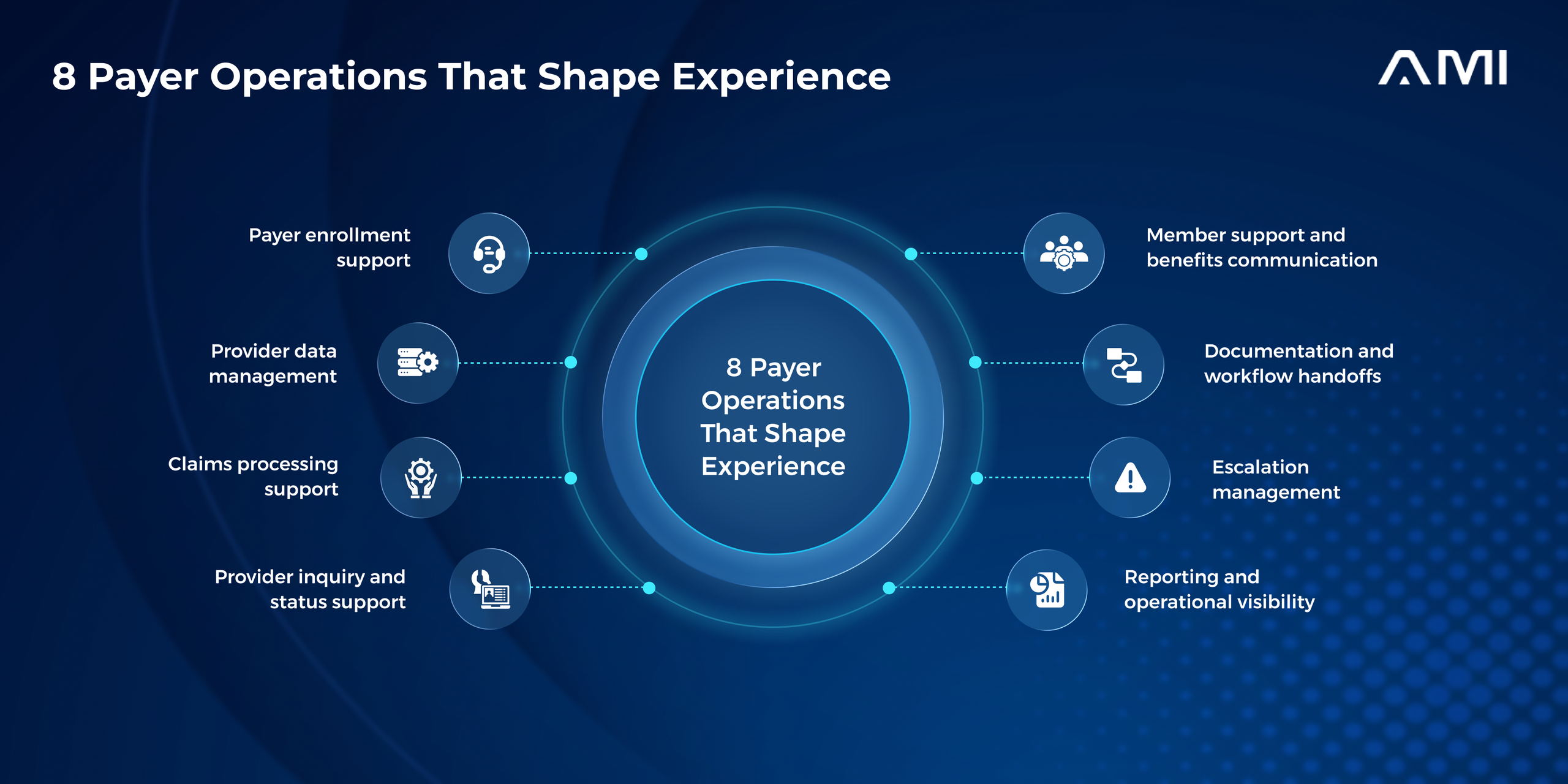
8 Payer Operations That Shape Experience
The following operations have a direct effect on provider trust, member confidence, and the payer organization’s ability to resolve issues efficiently. Each one supports a different part of the experience, but their value depends on how well they work together.
1. Payer enrollment support
Payer enroll services support new member enrollment, eligibility changes, dependent updates, plan changes, group or employer files, and discrepancy resolution.
Accuracy at this stage affects everything that follows. Missing information, delayed updates, or mismatched files can create coverage uncertainty, rejected claims, member complaints, and additional provider follow-up.
A disciplined enrollment workflow should document what was received, what is missing, which update was completed, and whether downstream systems reflect the change.
2. Provider data management
Provider data management supports accurate directories, claims routing, network information, provider communication, and member access.
Common data problems include outdated addresses, incorrect telephone numbers, specialty mismatches, inactive provider status, duplicate records, incorrect tax details, and network discrepancies. These may appear minor, but they can affect both claims and care navigation.
Payer leaders should track provider-data defects by type and identify which sources, systems, or update processes create the most rework.
3. Claims processing support
Claims processing is one of the most visible payer operations because delays or errors affect providers, members, and financial workflows at the same time.
Support teams may assist with claim intake, data validation, status review, payment follow-up, denial routing, documentation, and backlog management. The goal is not only to move claims faster. It is to make claim status, pending requirements, and next steps easier to understand.
Clear claim documentation also reduces repeated inquiries and prevents cases from moving between teams without ownership.
4. Provider inquiry and status support
Providers may contact payers about eligibility, claim status, authorization progress, payment details, denials, documentation requirements, or network information.
Strong provider support should connect the inquiry to the correct claim, member, authorization, or provider record. It should also document what was reviewed, what was communicated, and who owns the next action.
When the workflow is weak, providers receive inconsistent answers or must repeat the same issue across multiple contacts. Clear ownership and status visibility reduce that administrative burden.
5. Member support and benefits communication
Effective member support helps individuals understand eligibility, benefits, coverage, claim status, provider access, ID card issues, plan updates, and required next steps.
However, the quality of the interaction depends on the accuracy of back-office information. A well-trained support professional cannot resolve an eligibility issue if the enrollment record is incomplete or the claim status is unclear.
Member service therefore works best when it is connected to reliable documentation, current data, defined escalation rules, and responsive operational teams.
6. Documentation and workflow handoffs
Payer issues often remain unresolved because the case history does not clearly show what happened.
Good documentation should identify the member or provider, link the relevant claim or enrollment record, describe the inquiry, record the current status, assign ownership, capture the next step, and note when follow-up is required.
This creates continuity when a case moves between enrollment, claims, provider relations, member services, or escalation teams. It also helps reduce duplicate effort and inconsistent communication.
7. Escalation management
Some payer issues cannot be resolved through standard processing or basic lookup.
Urgent access problems, repeated provider contacts, disputed claim status, enrollment mismatches, network errors, and complex benefit questions may require escalation. A strong workflow defines which cases should escalate, where they should go, what documentation is required, and how progress will be communicated.
Escalation should not mean losing the case in another queue. The original team should retain enough visibility to explain what is happening and when the next update is expected.
8. Reporting and operational visibility
Payer leaders need more than high-level volume summaries. They need visibility into claims backlog, enrollment turnaround, provider-data defects, repeat inquiry drivers, escalation patterns, QA findings, and unresolved work.
Useful reporting can show whether member complaints originate in contact handling or in an upstream operational problem. It can also identify providers, claim types, or enrollment issues that generate recurring rework.
This allows leaders to move from reacting to individual complaints toward improving the underlying workflow.
Where Healthcare Payer Consulting and Operations Support Overlap
Healthcare payer consulting may help identify workflow problems, redesign processes, or recommend new controls. Operations support turns those recommendations into daily execution.
A payer may know that provider-data quality needs improvement, but the actual work still requires validation, updates, documentation, follow-up, QA, and reporting. Similarly, a claims review may identify bottlenecks, but progress depends on teams consistently managing the queue and escalating unresolved cases.
The strongest model connects diagnosis with execution. Leaders gain both insight into what should change and operational capacity to make the improvement sustainable.
Common Payer Gaps That Hurt Experience
Provider and member dissatisfaction often begins with outdated data, incomplete enrollment files, delayed claims, weak handoffs, inconsistent notes, disconnected systems, or unclear escalation ownership.
Untrained teams may give different answers to similar questions. Limited reporting may prevent leaders from seeing that one issue is driving repeat calls. Cases may appear closed even though the provider or member still lacks a resolution.
A practical way to identify the root cause is to trace one provider complaint and one member complaint backward through the workflow. The issue may begin in claims, enrollment, provider data, documentation, communication, or ownership rather than in the final support interaction.
Where AI Can Support High-Volume Payer Operations
High-volume payer workflows create pressure when every inquiry, case note, status review, routing decision, and quality check depends on manual effort. AI-assisted operations can help manage repetitive work while directing complex benefits, claims, and escalation decisions to trained teams.
AI can support payer operations through:
- Categorizing provider and member inquiries
- Summarizing calls, cases, and prior activity
- Flagging missing documentation or incomplete fields
- Routing claims, enrollment, and provider-data issues
- Identifying repeat contact drivers
- Supporting QA review across larger interaction volumes
- Surfacing backlog trends, aging work, and escalation patterns
AI should remain a support layer rather than the final decision-maker. Complex benefits interpretation, disputed claims, sensitive member situations, and exceptions still require experienced human review. The strongest model combines automation speed with operational judgment and leadership visibility.

Why do payer operations slow down even with more resources?
Because claims, provider inquiries, member support, and policy workflows need more than added capacity. AM InfoWeb helps payers improve accuracy, turnaround time, and operational visibility with co-managed support teams and workflow-focused execution.
How AM InfoWeb Supports Healthcare Payer Operations
AM InfoWeb supports payer organizations, health plans, and TPAs with co-managed operations designed to improve workflow consistency, provider communication, member assistance, claims follow-up, and operational visibility.
With trained healthcare teams, secure processes, documentation discipline, quality controls, escalation workflows, and reporting support, AM InfoWeb helps payer leaders manage high-volume operations while retaining governance and control.
AM InfoWeb support may include:
- Healthcare payer services and TPA back-office support
- Payer enroll services and eligibility workflows
- Provider data management
- Claims processing and status follow-up
- Provider inquiry handling
- Member support and benefits assistance
- Documentation and case-note discipline
- Escalation workflow support
- QA checks for accuracy and completeness
- Backlog, aging, and operational reporting
- Co-managed execution with client oversight
Need greater control across provider and member workflows? AM InfoWeb’s co-managed payer operations strengthen enrollment, claims, data quality, QA, and reporting without reducing client oversight.
Get in TouchFinal Thoughts
Provider and member experience are built through the consistency of the operations behind every interaction. Strong healthcare payer services connect enrollment, provider data, claims, inquiry handling, documentation, escalation, QA, and reporting so payer organizations can reduce friction, improve visibility, and strengthen trust across the healthcare ecosystem.
Frequently Asked Questions
About the Author

Written by
Urza Dey
Urza Dey is a content and copywriter with over five years of experience across marketing, B2B SaaS, HealthTech, EdTech, and related industries. At AMI, they contribute to content strategy, blog development, and marketing communication focused on healthcare operations, business process management, and AI-enabled service delivery.