
Healthcare Payer Automation: How AI Is Transforming Payer Operations
TL;DR — How AI Is Changing Payer Operations
Healthcare payer automation can reduce repetitive work across claims, support, data, authorization, and reporting.
AI can classify, summarize, route, and prioritize work while human teams handle complex exceptions.
Better payer data is essential because automation cannot reliably compensate for inaccurate underlying information.
Payer operations analytics can expose backlogs, repeat contacts, claims exceptions, and workflow bottlenecks.
Prior authorization is moving toward more electronic and interoperable workflows.
AI governance should define where automation acts, where humans review, and how decisions are documented.
The strongest operating model combines automation, domain expertise, QA, and operational oversight.
Private health plans manage thousands of interconnected activities across claims, enrollment, provider data, member support, prior authorization, payments, appeals, and reporting. As those workflows become more digital, healthcare payer automation is moving beyond simple rules-based processing toward AI-assisted operations that can interpret information, route work, identify patterns, and support human teams.
The opportunity is not to remove people from payer operations. It is to reduce repetitive administrative work, improve visibility, and give trained teams better information when claims, member requests, or exceptions require judgment. This distinction is becoming increasingly important as interoperability requirements, AI adoption, and administrative complexity reshape the payer environment.
The Current State of Healthcare Payer Operations
Healthcare payer operations are becoming increasingly dependent on electronic transactions and connected systems. CAQH has documented continued progress in automating healthcare administrative transactions while also emphasizing that further automation opportunities remain across activities such as eligibility, claims, prior authorization, and payments.
The technology environment is also changing. CMS requirements are pushing affected payer organizations toward faster prior authorization decisions and greater interoperability. Certain operational requirements took effect in 2026, while major API requirements generally begin in 2027.
For payer leaders, the challenge is no longer simply adopting more technology. It is determining which workflows should be automated, what information those workflows depend on, and where human expertise must remain involved.
| Payer Workflow | Automation Opportunity |
|---|---|
| Claims | Validation, routing, summarization, exception detection |
| Member support | Self-service, knowledge retrieval, interaction summaries |
| Provider operations | Inquiry routing, data updates, workflow tracking |
| Prior authorization | Intake, status, documentation, electronic exchange |
| Data management | Matching, validation, exception identification |
| Reporting | Backlog, quality, contact, and workflow trend analysis |
Where AI Creates the Most Value in Payer Operations
The real opportunity with healthcare payer automation is not simply to automate more tasks. It is to redesign payer workflows so routine activity moves faster, exceptions become easier to identify, and operational teams have better context when human judgment is required. That means looking at AI through the lens of workflow performance, data quality, visibility, and accountability rather than treating automation as a standalone technology initiative.
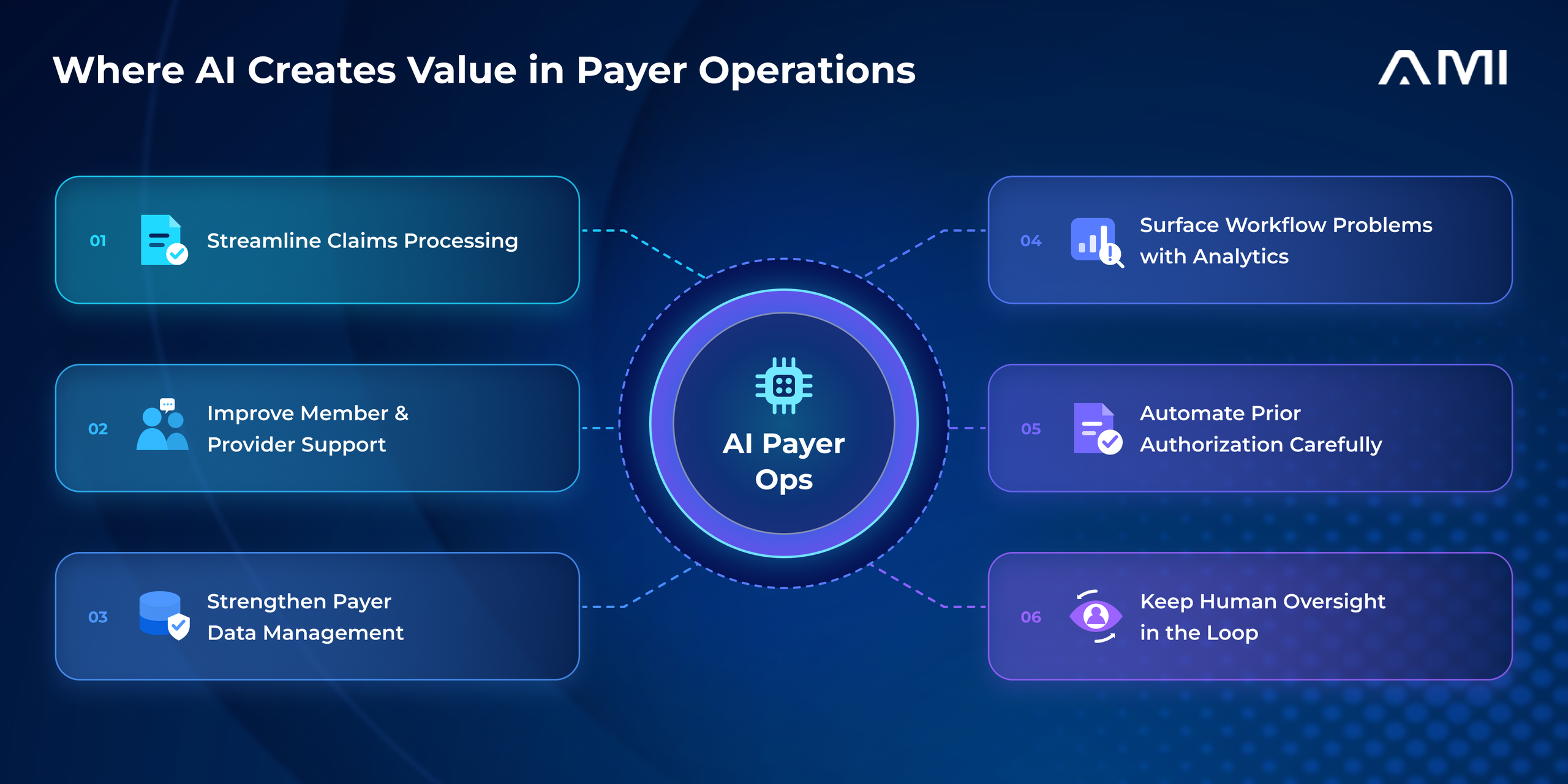
1. Use AI to streamline claims processing
Claims remain one of the largest opportunities for healthcare payer automation because routine transactions involve repeated validation, routing, documentation, and status activity.
AI-assisted claims workflows can help classify incoming information, extract relevant data, identify inconsistencies, prioritize exceptions, summarize previous activity, and support QA. This can reduce the amount of time experienced claims staff spend navigating repetitive tasks.
The key is separating routine processing from judgment-intensive work.
Automation Principle: Automate predictable activity. Escalate exceptions with enough context for a trained person to act.
Complex coverage questions, disputed claims, unusual coding situations, high-value exceptions, and appeals still require accountable human oversight. The goal of AI in claims processing should therefore be better orchestration, not uncontrolled auto-adjudication.
Looking beyond a single payer workflow? Explore AM InfoWeb’s broader healthcare services, spanning revenue cycle, payer support, release of information, litigation support, and AI-powered contact center operations.
2. Improve member and provider support with AI
Payer service teams handle questions about claims, benefits, eligibility, authorization, provider networks, and payment status. When information sits across multiple systems, even straightforward inquiries can create long handle times and repeat contacts.
AI-powered support can help retrieve relevant knowledge, summarize prior interactions, identify intent, suggest next actions, and route the case to the appropriate team. Conversational AI can also handle suitable routine inquiries while transferring more complex situations to trained representatives with the previous context intact.
For payer operations, the value comes from reducing unnecessary searching and repetition rather than simply containing more contacts.
3. Strengthen healthcare payer data management
Automation depends heavily on the quality of the data beneath it. Provider records, member information, eligibility, benefits, network status, and claims data can all create downstream problems when records are outdated, incomplete, or inconsistent.
Automated healthcare payer data management can help identify duplicates, validate fields, match records, flag missing information, and route discrepancies for review.
That matters because data quality affects more than one department. An inaccurate provider record, for example, can affect network directories, claims routing, provider inquiries, and member access.
Strong healthcare payer technology therefore needs both automated validation and clearly defined ownership for correcting exceptions.
4. Use payer operations analytics to find workflow problems
AI becomes more useful when it helps leaders understand why operational problems keep recurring.
Payer operations analytics can bring together information on claims exceptions, queue aging, provider inquiries, repeat member contacts, turnaround time, authorization activity, QA findings, and escalations.
Rather than asking only, “How much work did we process?”, leaders can ask:
- Where is work aging?
- Which exceptions keep recurring?
- Which workflow creates repeat contacts?
- Where is manual intervention highest?
- Which teams are receiving avoidable downstream work?
Strong payer operations analytics and reporting should therefore connect activity with outcomes and root causes.
Useful AI Question: What is creating the workload—not just how much workload exists?
5. Automate prior authorization workflows carefully
Prior authorization is becoming an important test of payer interoperability and workflow automation.
CMS now requires impacted payers to meet specific decision timelines, including 72 hours for expedited requests and seven calendar days for standard requests. CMS also requires relevant payers to implement Prior Authorization APIs, generally beginning in 2027, to help providers determine requirements and exchange authorization information electronically.
Healthcare payer automation can support administrative steps such as intake, document identification, routing, status communication, and workflow tracking.
Clinical determinations and complex coverage decisions, however, may continue to require appropriate reviewers. CMS itself notes that some prior authorization decisions will still require review and evaluation by clinical reviewers.
This makes prior authorization a strong example of AI-human orchestration: technology can reduce administrative friction while accountable expertise remains involved where judgment matters.
6. Build human oversight into healthcare payer automation
The most important healthcare payer technology trends are not simply about more powerful models. They are increasingly about how AI is governed inside real operating workflows.
Payers need clear rules covering:
- What AI can recommend or execute
- Which cases require human review
- How exceptions are escalated
- How actions are documented
- How output quality is monitored
- Who remains accountable for final decisions
CAQH has similarly highlighted that AI effectiveness depends on the quality of the underlying healthcare data and the practical conditions surrounding implementation.
Human-in-the-loop design is therefore not a limitation on automation. It is part of making automation operationally dependable.
Where Healthcare Payer Automation Should Create Value
Technology adoption should eventually produce measurable operational improvement. Simply counting automated transactions does not show whether the workflow works better.
Payer leaders should connect automation with measures such as:
| Measure | What It Shows |
|---|---|
| Turnaround time | Whether work moves faster |
| First-contact resolution | Whether inquiries are actually resolved |
| Exception rate | How much work still requires intervention |
| Backlog aging | Whether unresolved work is accumulating |
| QA accuracy | Whether automation maintains quality |
| Repeat contacts | Whether underlying issues remain unresolved |
| Cost per transaction | Whether efficiency improves economically |
The strongest measurement model examines speed, accuracy, resolution, and human workload together.
Need support across claims, member services, provider workflows, or payer back-office operations? Explore AM InfoWeb’s Healthcare Payer Support model for co-managed execution that combines payer expertise, automation, analytics, and client oversight.
When Automation Alone Is Not Enough
Technology does not automatically fix fragmented workflows, inconsistent documentation, unclear ownership, or insufficient operational capacity. In some environments, automation can simply move flawed work faster.
Organizations may need additional operational support when queues continue growing, manual exceptions remain high, provider or member contacts repeat, QA coverage is inconsistent, or internal teams cannot absorb rising volume.
That is where technology and operating capacity need to work together rather than as separate initiatives.

Why do payer operations slow down even with more resources?
Because claims, provider inquiries, member support, and policy workflows need more than added capacity. AM InfoWeb helps payers improve accuracy, turnaround time, and operational visibility with co-managed support teams and workflow-focused execution.
How AM InfoWeb Supports Healthcare Payer Automation
AM InfoWeb supports payer organizations through a co-managed orchestration model that combines domain-trained healthcare teams, AI voice and non-voice capabilities, analytics, QA, documentation, and client-controlled governance. AM InfoWeb’s payer operations expertise spans claims processing, policy administration, provider information management, healthcare data management, analytics, member support, and related operational workflows.
Rather than treating automation as a separate technology layer, the model coordinates AI and human execution around the workflow. Routine work can be automated or assisted, while exceptions, escalations, and judgment-intensive activities remain visible to trained teams and client stakeholders.
AM InfoWeb’s payer support capabilities include:
- Claims processing support
- Member and provider support
- Provider information management
- Eligibility and enrollment workflows
- Healthcare data management
- Payer analytics and reporting
- QA and structured escalation
Trying to automate payer workflows without losing human accountability? AM InfoWeb’s co-managed orchestration combines AI-assisted execution, trained healthcare teams, QA, and structured governance across high-volume operations.
Get in TouchFinal Thoughts
Healthcare payer automation is moving payer operations beyond simple task automation toward more connected AI-human workflows. Claims, support, data management, analytics, and prior authorization all offer opportunities to reduce repetitive effort and improve operational visibility.
The organizations that benefit most will be those that combine the right healthcare payer technology with accurate data, clear governance, measurable outcomes, and human expertise where judgment still matters.
Frequently Asked Questions
About the Author

Written by
Urza Dey
Urza Dey is a content and copywriter with over five years of experience across marketing, B2B SaaS, HealthTech, EdTech, and related industries. At AMI, they contribute to content strategy, blog development, and marketing communication focused on healthcare operations, business process management, and AI-enabled service delivery.