
Claims Processing: Strategies to Improve Accuracy and Efficiency
TL;DR — Building a More Efficient Claims Workflow
Strong medical claims processing begins with accurate eligibility, benefits, provider, authorization, and claim data.
Preventing errors upstream reduces downstream denials, rework, and provider inquiries.
Claims processing automation can accelerate routine activity while routing exceptions to trained teams.
Better interoperability reduces manual information gathering and duplicated work.
Analytics can identify denial patterns, high-risk claims, and growing Claims backlog.
AI should support claims teams rather than remove human oversight from judgment-intensive decisions.
Persistent inventory, rework, or staffing pressure may create a case for specialized claims processing services.
Claims processing sits at the center of the payer-provider relationship. Every claim moves through a series of checks involving member information, coverage, provider data, coding, authorization, documentation, benefits, adjudication, and payment. When one of these elements is incomplete or inconsistent, a relatively simple transaction can quickly become an exception, denial, provider inquiry, or piece of aging inventory.
The cost of that friction is significant. The American Hospital Association estimates that hospitals spent nearly $18 billion in 2025 trying to overturn denied claims and approximately $43 billion attempting to collect payments owed for care already delivered. For private payers, improving payer claims processing therefore means more than increasing transaction speed. It requires better data, clearer workflow ownership, smarter automation, and stronger exception management.
What Is Healthcare Claims Processing?
Healthcare claims processing is the workflow used to receive, review, adjudicate, and resolve claims submitted for healthcare services.
A typical health insurance claim process can involve claim intake, member and provider validation, coverage checks, coding review, benefit application, authorization verification, adjudication, payment determination, and communication of the result.
The process therefore connects several upstream and downstream functions. eligibility verification, benefit verification, provider information, and prior authorization can all influence whether a claim moves efficiently through adjudication or requires additional intervention.
Current Claims Processing Trends and Challenges
The claims environment is becoming increasingly digital, but automation has not eliminated administrative friction. CAQH reported in February 2026 that electronic administrative transactions helped U.S. healthcare avoid an estimated $258 billion in administrative costs during 2024, while additional opportunities for automation remain.
At the same time, providers continue to report rising denial-related burdens. AHA data found that between 2022 and 2023, care denials increased an average of 20.2% for commercial claims and 55.7% for Medicare Advantage claims.
| Current Pressure | Claims Processing Impact |
|---|---|
| Increasing denial activity | More exceptions, appeals, and rework |
| Incomplete or inconsistent data | Slower adjudication and manual review |
| Prior authorization requirements | Additional validation and documentation |
| Fragmented systems | More manual information gathering |
| Growing claim volumes | Larger work queues and Claims backlog |
| AI and automation adoption | Need for stronger governance and exception handling |
Claims Backlogs Can Hide Process Problems
A growing Claims backlog does not always mean the claims team simply needs more people. Inventory may accumulate because claims arrive with incomplete information, are routed incorrectly, repeatedly fail validation, or depend on another team for resolution.
That distinction matters because adding capacity without correcting the underlying cause can increase processing activity without improving actual resolution.
Claims Reality: Faster processing does not help if the same claim repeatedly returns for correction or manual review.
Regulatory Expectations Are Increasing Workflow Pressure
CMS requirements are also pushing certain payer workflows toward faster and more structured information exchange. Under the CMS Interoperability and Prior Authorization Final Rule, impacted payers must meet certain operational requirements beginning in 2026, while major API requirements generally begin in 2027.
Although prior authorization is distinct from claims adjudication, inaccurate or incomplete authorization information can create downstream claim exceptions. Better integration between authorization, eligibility, provider, and claims data can therefore reduce avoidable administrative work.
5 Strategies to Streamline Claims Processing
A sustainable claims processing strategy should reduce the number of claims requiring avoidable manual intervention while giving teams clearer control over legitimate exceptions.
The following five areas address the major weaknesses that commonly slow payer claims operations.
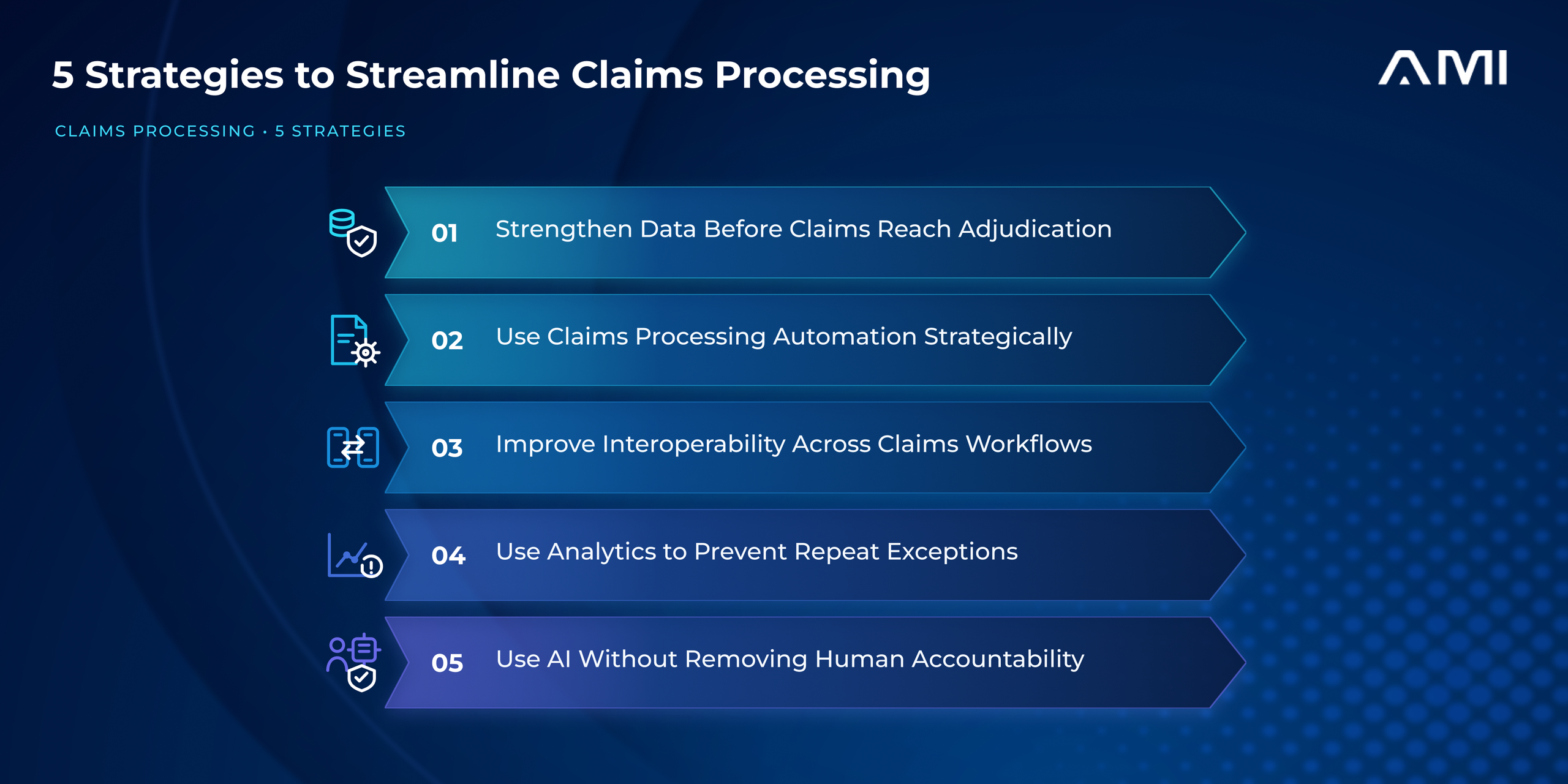
1. Strengthen Data Before Claims Reach Adjudication
Improving claims efficiency starts before adjudication. Errors introduced during the claim submission process, eligibility checks, provider setup, authorization, or benefit verification can move downstream and become denials or manual exceptions.
Claims teams should validate critical information early, including:
- Member and coverage data
- Provider identifiers
- Authorization status
- Required documentation
- Coding and service information
- Duplicate or inconsistent records
Cleaner upstream data reduces the amount of downstream claims rework.
2. Use Claims Processing Automation Strategically
Claims processing automation can reduce repetitive work by automating validation, routing, status updates, information extraction, and other rule-based activities.
The strongest claims process automation models separate routine activity from exceptions rather than trying to automate every claim identically.
| Automation Can Support | Human Oversight Remains Important |
|---|---|
| Initial validation | Complex exceptions |
| Work routing | Disputed claims |
| Duplicate detection | Coverage interpretation |
| Status updates | High-value cases |
| Pattern detection | Escalations |
This approach lets teams focus their attention where judgment creates the most value.
Seeing growing claim volume without faster resolution? AM InfoWeb’s co-managed payer operations combine trained teams, AI-assisted workflows, QA, documentation, and reporting to strengthen high-volume claims execution.
3. Improve Interoperability Across Claims Workflows
Claims teams often depend on information held across multiple systems. When eligibility, authorization, provider, clinical, and claim information cannot move efficiently, staff may need to search portals, request documentation, or manually reconcile records.
CAQH found that moving claim attachments from manual or portal-based methods to electronic data interchange can reduce transaction costs substantially.
Interoperability therefore supports more than technology modernization. It can help reduce handoffs, missing information, and duplicated administrative effort across claims and payments.
4. Use Analytics to Prevent Repeat Exceptions
Claims data can reveal where processing failures are occurring repeatedly.
Teams should examine denial reasons, payer rules, provider patterns, claim types, turnaround time, rework, aging inventory, and exception frequency. These patterns can show whether a problem originates during intake, authorization, adjudication, documentation, or another part of the workflow.
AHA recommends using denial data and aging reports to identify root causes and unresolved high-value claims rather than treating every denial independently.
The objective is to prevent tomorrow's exception instead of simply processing today's.
5. Use AI Without Removing Human Accountability
Interest in AI in claims processing is growing because AI can classify documents, summarize activity, detect patterns, support QA, prioritize work, and identify claims requiring further review.
The value of AI claims processing, however, depends on where it is applied.
AI may support:
- Claim and document classification
- Information extraction
- Work prioritization
- Anomaly detection
- Case summarization
- QA and pattern analysis
- Prior Authorization automation
Human review remains important for complex coverage questions, disputed claims, sensitive exceptions, appeals, and decisions requiring interpretation.
That is the practical goal of streamlining claims processing with AI: less repetitive administrative work, not less accountability.
Measure Claims Processing Beyond Speed
Fast turnaround matters, but speed alone can hide poor-quality outcomes. A team can process more transactions while still generating avoidable rework, repeat provider inquiries, and unresolved exceptions.
Useful claims metrics include:
| Metric | What It Helps Reveal |
|---|---|
| Claims turnaround time | Processing speed |
| First-pass resolution | Claims resolved without rework |
| Exception rate | Manual intervention requirements |
| Denial rate | Adjudication or upstream friction |
| Claims accuracy | Quality of processing |
| Rework rate | Repeat administrative effort |
| Backlog aging | Unresolved operational inventory |
The best measurement approach connects throughput with accuracy and durable resolution.
When Should Payers Consider Additional Claims Support?
Internal claims teams may need additional capacity when volumes rise faster than available resources or when growing queues begin affecting turnaround, QA, documentation, provider communication, or exception handling.
Common warning signs include persistent claims backlog, repeated manual work, inconsistent case notes, high exception volume, growing provider inquiries, limited QA coverage, and difficulty maintaining service levels.
At that stage, organizations may evaluate claims processing outsourcing or specialized claims processing services for selected workflows. External support should increase execution capacity while the payer retains control over policies, adjudication rules, exceptions, escalations, and governance.
Need broader support across healthcare operations? Explore AM InfoWeb’s healthcare services, spanning revenue cycle, payer support, release of information, litigation support, and AI-powered contact center operations.

Why do payer operations slow down even with more resources?
Because claims, provider inquiries, member support, and policy workflows need more than added capacity. AM InfoWeb helps payers improve accuracy, turnaround time, and operational visibility with co-managed support teams and workflow-focused execution.
How AM InfoWeb Supports Payer Claims Processing
AM InfoWeb supports health plans, TPAs, and payer organizations through co-managed orchestration designed to strengthen payer claims processing without separating execution from operational control. AM InfoWeb combines trained healthcare teams, AI-assisted workflows, structured QA, documentation discipline, reporting, and escalation management within an operating environment supported by SOC 2 Type II, ISO 27001, and HIPAA-aligned practices.
Claims-related support can include:
- Claims intake and validation support
- Claims status and exception handling
- Eligibility and benefits support
- Authorization-related administrative workflows
- Claims backlog management
- Provider inquiry and documentation support
- QA, reporting, and structured escalation
The objective is not simply to get more claims processed. It is to create a controlled workflow in which routine transactions move efficiently, exceptions remain visible, and complex cases reach the right human expertise.
Need more claims capacity without giving up operational control? AM InfoWeb’s co-managed orchestration model combines payer operations expertise, AI-assisted execution, QA, structured escalations, and client governance.
Get in TouchFinal Thoughts
Effective claims processing depends on more than speed. Accurate upstream data, automation, interoperability, analytics, and disciplined exception management all determine whether claims move toward resolution or create more administrative work.
For payer organizations, the strongest operating model is one that makes routine claims easier to process while giving complex exceptions clear ownership, visibility, and human oversight.
Frequently Asked Questions
About the Author

Written by
Urza Dey
Urza Dey is a content and copywriter with over five years of experience across marketing, B2B SaaS, HealthTech, EdTech, and related industries. At AMI, they contribute to content strategy, blog development, and marketing communication focused on healthcare operations, business process management, and AI-enabled service delivery.