
Revenue Code in Medical Billing: Prevent UB-04 Claim Errors
TL;DR: Revenue Code in Medical Billing
Revenue codes identify institutional service categories on UB-04 and 837I claims.
Revenue codes, procedure codes, units, charges, bill types, and documentation must align.
Controlled charge-master crosswalks reduce mapping defects before claim submission.
High-risk and exception lines need focused validation instead of blanket manual review.
Rejection and denial data should feed corrections into upstream configuration and workflows.
Balanced metrics track first-pass acceptance, edits, denials, corrections, and payment impact.
A revenue code in medical billing tells a payer which institutional department, accommodation, or service category produced a charge. It works alongside procedure codes, charges, units, bill types, and supporting documentation on facility claims. When those elements do not align, an otherwise valid service can trigger an edit, rejection, denial, or underpayment.
Revenue-code accuracy is not only a coding concern. Charge description master configuration, departmental workflows, clinical documentation, claim edits, and payer rules all influence the code that reaches the UB-04 or electronic 837I claim.
This guide explains how healthcare revenue codes work, where mapping defects originate, and how providers can build controls that protect institutional claim accuracy.
Need stronger operational support across healthcare workflows? Explore AM InfoWeb’s healthcare services.
What Is a Revenue Code in Medical Billing?
A revenue code is a four-digit code used on institutional claims to identify a service category or revenue center. Examples can represent room and board, pharmacy, laboratory, radiology, emergency services, therapy, operating room services, supplies, or observation care.
Revenue codes answer a different question from CPT and HCPCS codes. A CPT or HCPCS code identifies the specific procedure, service, supply, or drug. The revenue code identifies the institutional category under which that charge is reported.
CMS explains that the CMS-1450, commonly called the UB-04, is the uniform institutional claim form and directs billers to the Medicare Claims Processing Manual for its completion and coding requirements. See the official CMS-1450 billing guidance.
Where Do Revenue Codes Appear on UB-04 Claims?
On the paper UB-04, revenue codes appear in Form Locator 42. The corresponding charge appears on the same claim line, with additional fields used when a procedure code, units, service date, or other information is required. Electronic institutional claims carry equivalent information in the 837I transaction.
The claim line must make sense as a complete unit. The revenue code, procedure code, units, charge, date, bill type, and patient status may all influence payer processing. A valid code can still fail when it is paired with inconsistent data.
Providers should maintain a controlled crosswalk between departments, charge-master items, revenue codes, and required procedure codes. The crosswalk should also reflect material payer-specific requirements.
How Do Revenue Codes Differ From CPT and HCPCS Codes?
| Code Type | Primary Purpose | Common Claim Context |
|---|---|---|
| Revenue code | Identifies an institutional service or cost-center category | UB-04 and 837I facility claims |
| CPT code | Describes professional procedures and services | Professional and selected institutional claim lines |
| HCPCS Level II | Describes supplies, drugs, equipment, and services | Professional and institutional claims |
| ICD-10-CM | Explains diagnoses and clinical reasons for care | Professional and institutional claims |
| ICD-10-PCS | Describes inpatient hospital procedures | Inpatient institutional claims |
These code sets work together. Revenue-code accuracy cannot compensate for an incorrect procedure code, and a correct procedure code may not prevent an edit when the associated revenue category is wrong.
What Causes Revenue-Code Claim Errors?
Revenue-code errors usually begin upstream of final claim submission. Frequent causes include:
- Outdated charge description master mappings
- New services launched without billing validation
- Incorrect departmental ownership or cost-center setup
- Missing required HCPCS or CPT pairings
- Inconsistent units, dates, or bill types
- Manual charge entry using the wrong item
- Interface changes that alter mapped values
- Payer rules not reflected in claim edits
- Unsupported corrections made only to clear an edit
These defects often connect to broader healthcare charge capture controls. The code appearing on the claim may be technically valid while still misrepresenting the documented service or department.
How Should Providers Validate Revenue-Code and HCPCS Alignment?
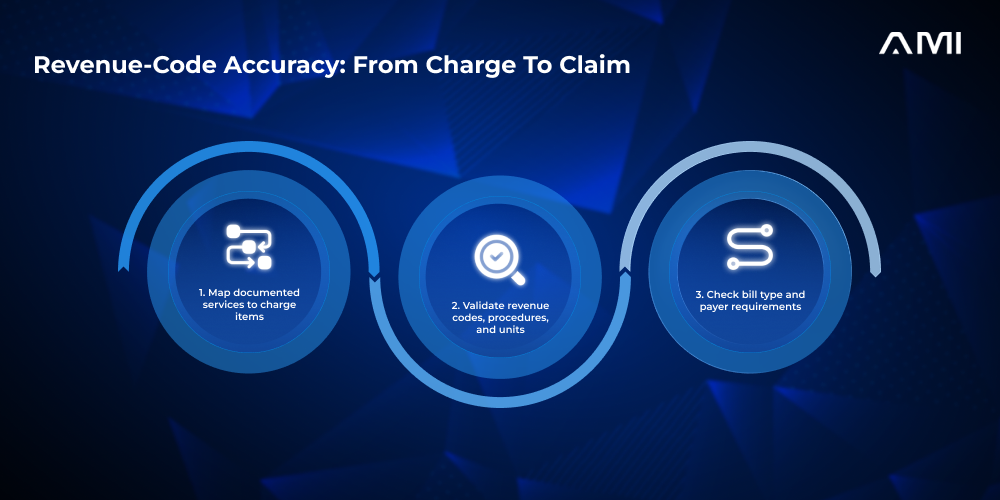
Validation should begin with the documented service and approved charge item. Teams should confirm that the selected revenue category is appropriate for the service, facility setting, claim type, and payer. When a procedure code is required, its relationship with the revenue code should be tested before submission.
Edits should identify missing combinations, incompatible mappings, invalid units, and payer-specific exceptions. Experienced reviewers must evaluate ambiguous cases instead of selecting a code simply because it clears the claim.
Rule changes need ownership, testing, approval, implementation evidence, and post-release monitoring. A poorly designed automated crosswalk can repeat the same error across thousands of claims.
How Does Charge-Master Governance Improve Revenue Coding?
The charge description master connects documented services with charge items, descriptions, prices, departments, procedure codes, and revenue codes. Governance should involve revenue integrity, coding, compliance, finance, clinical departments, and IT.
Every new or changed item should document its purpose, code support, department, effective date, approvals, test results, and downstream claim behavior. Annual code updates are important, but governance must also respond to new technology, service-line changes, payer edits, and workflow redesign.
Periodic audits should compare configured mappings with actual claims and source documentation. This helps detect inactive items, unexpected overrides, repeated corrections, and lines that route to the wrong revenue center.
Which Metrics Reveal Revenue-Code Problems?
Useful measures include:
- Claim edits caused by revenue-code relationships
- Rejections and denials by revenue code
- Manual revenue-code override rate
- Revenue-code correction volume
- Charges using unmapped or inactive items
- Underpayments linked to claim-line configuration
- Turnaround time for coding exceptions
- Repeat defects by department and service line
Metrics should connect errors with their upstream origin. A denial report alone may show the payer response but not whether the cause was documentation, charge entry, configuration, coding, or claim assembly.
How Can Revenue-Code Analytics Prevent Recurring Denials?
Group edits and denials by revenue code, procedure-code pairing, payer, facility, department, bill type, and root cause. High-frequency patterns can reveal broken mappings or training gaps, while high-value patterns may indicate underpayment exposure.
Findings should feed into claim scrubbing, charge-master governance, coding education, and payer-specific rules. The objective is to prevent the next error rather than repeatedly correct claims after submission.
Need disciplined coding, billing, and denial-prevention workflows? Explore AM InfoWeb’s Revenue Cycle Management services.
How Should Revenue-Code Exceptions Be Resolved?
Each exception should have a standardized reason, qualified owner, supporting evidence requirement, deadline, and escalation path. Technical mapping issues belong with configuration owners. Documentation gaps require clinical follow-up. Coding questions require qualified review.
Teams should monitor overrides because they may conceal faulty rules or unsupported billing changes. Quality assurance should sample corrected and overridden claims and confirm that the final line agrees with the record.
Patterns that reach adjudication should also inform claims denial management. This creates a feedback loop between payer outcomes and pre-bill controls.

How Does AM InfoWeb Support Revenue-Code Accuracy?
AM InfoWeb supports healthcare organizations with structured revenue cycle execution, quality controls, and operational visibility.
With two decades of experience in the U.S. healthcare industry, AM InfoWeb uses a co-managed model where AI agents and skilled human agents work together to eliminate process bottlenecks and execute secure healthcare workflows.
AM InfoWeb can support:
- Revenue-code and procedure-code validation workflows
- Charge-master exception research
- Pre-bill claim review and correction
- Payer-specific edit execution
- Rejection and denial root-cause analysis
- Quality assurance and override monitoring
- Department and payer performance reporting
The goal is accurate, supported institutional billing that reduces avoidable rework without encouraging unsupported coding.
What Should Revenue Cycle Leaders Do Next?
Inventory the revenue codes used across facilities and connect them to departments, charge items, procedure codes, bill types, and payer rules. Prioritize mappings with high edit volume, material reimbursement impact, frequent overrides, or unclear ownership.
Revenue-code performance improves when documentation, charge capture, coding, system configuration, claim edits, and denial feedback operate as one controlled workflow.
Need stronger control over institutional claim accuracy? AM InfoWeb combines trained RCM teams, AI-assisted workflows, QA, and operational reporting to reduce revenue-code defects and prevent avoidable rework.
Get in TouchFrequently Asked Questions
About the Author

Written by
Urza Dey
Urza Dey is a content and copywriter with over five years of experience across marketing, B2B SaaS, HealthTech, EdTech, and related industries. At AMI, they contribute to content strategy, blog development, and marketing communication focused on healthcare operations, business process management, and AI-enabled service delivery.