


Cost to Collect: Evaluating Your Healthcare Revenue Operations Partner
Key Highlights
Build the baseline from finance-approved expenses and posted patient service cash, net of refunds.
Price the partner fee alongside retained labor, technology, supervision, and correction work.
Use workflow-level measures to evaluate a partner responsible for only part of the revenue cycle.
Model transition expense, cash sensitivity, and fee triggers before signing.
Expand a pilot after its claim cohorts have had enough time to show collection and quality outcomes.
Two revenue cycle proposals can promise the same savings while asking your team to keep very different amounts of work. One partner may handle claim follow-up but send every documentation exception back to you. Another may include escalation support and quality review in its fee. The lower quote can leave you paying for more supervision, more corrections, and more time spent resolving the same accounts.
Cost to collect measures how much you spend on revenue cycle operations for each dollar of patient service cash you collect. It gives finance and revenue cycle leaders a common way to compare internal delivery and co-managed operations. The comparison becomes useful when both sides account for the same work, use the same cash rules, and show what happens to claim quality and open inventory.
What Is the Cost to Collect Formula?
Divide total revenue cycle cost by total patient service cash collected for the reporting period, then multiply by 100. If your organization spends $120,000 and collects $3 million, its cost to collect is 4.00%, or four cents per dollar collected. The Healthcare Financial Management Association’s MAP Key FM-6 uses patient service cash net of refunds and specifies how to treat items such as undistributed payments, bad debt recoveries, and certain supplemental payments. HFMA MAP Keys, FM-6
For a partner evaluation, maintain two views. The enterprise view tracks the overall ratio using your finance team’s reporting rules. The decision view shows what changes financially if a specific workflow moves to co-managed operations. For example, a partner working a selected denial queue can influence the handling and recovery of those accounts. Evaluate that contribution with queue-level cost, cash, and quality measures, while finance tracks the impact on the enterprise ratio separately.
Agree on the denominator first. Ask Finance and each bidder to reconcile one sample month to the same cash report. If the partner uses gross charges, projected reimbursements, or cash before refunds, resolve the difference before scoring its savings estimate.
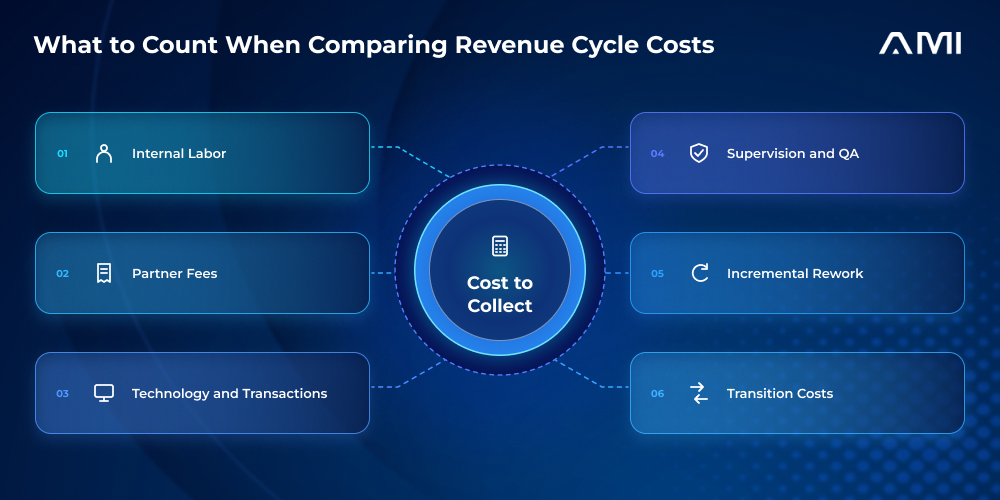
Which Revenue Cycle Management Costs Belong in the Model?
Start with the expenses finance already recognizes. Then identify where the proposed workflow will use staff time or systems that the general ledger may group under another department. A supervisor might oversee four queues, for example, while only one transfers to the partner. An allocation based on observed time or queue activity will give you a better estimate of retained supervision than assuming the whole role goes away.
| Cost Component | What to Capture | Evidence to Request |
|---|---|---|
| Internal labor | Wages, benefits, overtime, contractors, and cross-coverage | Payroll and staffing reports, plus time allocations for shared roles |
| Partner delivery | Base fee, volume bands, minimums, recovery fees, and exclusions | A sample invoice priced against your actual volumes |
| Technology and support | Software, transaction fees, interfaces, maintenance, and automation oversight | License inventory, renewal terms, and a responsibility map |
| Supervision and quality | Queue management, audit sampling, coaching, and escalation review | Hours by role and the proposed quality review schedule |
| Rework | Corrections, reopened accounts, repeat touches, and downstream fixes | Queue history and a sample tracing defects through resolution |
| Transition | Training, access setup, parallel work, and temporary backlog coverage | A phased implementation budget with named owners |
Count rework labor once. If staff spend 15% of their time correcting claims and their wages are already in the labor line, move that share into a rework category for visibility without increasing the total. Include incremental costs such as separately billed correction work or overtime when those expenses are genuinely additional. A claim sample can help you identify which corrections start in registration, coding, submission, or posting. Medical Billing Audit Checklist
Classify retained expenses by how and when they change. If a software agreement has a year left, carry that cost through the renewal date. If staff move into a different queue, report the capacity freed and identify the work it will absorb. Finance can then separate savings that reduce spending from capacity that helps the team avoid future hiring or clear an existing backlog.
How Do Internal and Co-Managed Costs Compare?
The following example models the same provider, workflow scope, and monthly collection base under two delivery models. The figures are illustrative.
| Monthly Cost or Outcome | Internal Delivery | Co-Managed Delivery |
|---|---|---|
| Direct execution labor retained in-house | $72,000 | $24,000 |
| Partner execution fee | $0 | $47,000 |
| Technology and transaction costs | $18,000 | $14,000 |
| Supervision and quality review | $20,000 | $14,000 |
| Incremental rework expense | $10,000 | $6,000 |
| Total recurring revenue cycle cost | $120,000 | $105,000 |
| Patient service cash collected, net of refunds | $3,000,000 | $3,000,000 |
| Cost to collect | 4.00% | 3.50% |
With cash held constant, the co-managed option lowers modeled recurring spend by $15,000 per month. That is a 12.5% reduction in expense and a 0.50 percentage-point improvement in the ratio. If setup and parallel delivery cost $36,000, the simple payback period is 2.4 months at steady-state savings. The actual calendar payback depends on when costs fall. A month of overlap in which internal expenses stay flat extends the time to recover the investment.
The cash side can change the decision. If co-managed collections fall to $2.7 million while costs stay at $105,000, the ratio is still below baseline at 3.89%. Yet cash less modeled revenue cycle expense drops from $2.88 million to $2.595 million for the month. That $285,000 difference warrants investigation even though the ratio improved. Look at whether the gap reflects delayed payments, a different claim mix, or balances that are becoming harder to collect.
Review the ratio and the dollars together. Ask for a monthly bridge showing changes in cash, recurring expense, and one-time costs. A lower ratio can coexist with weaker cash performance, especially during transition.
How Should You Use Revenue Cycle Benchmarks?
Start with your own comparable periods, then use external cost-to-collect revenue cycle benchmarks to investigate material differences. A hospital’s full-cycle ratio and a specialty group’s billing-only ratio answer different questions. Your peer comparison is more useful when you know the organization type, service mix, cost scope, cash definition, and reporting period behind the figure. HFMA also provides a companion measure, FM-7, for comparing functional costs against total patient service cash. HFMA MAP Keys, FM-6 and FM-7
Read changes in the ratio alongside the events that created them. A large recovery on old accounts can lift a month’s denominator even when current claims are taking longer to resolve. A payer payment delay can have the opposite effect. Show unusual cash movements separately, preserve the reported figure, and give leadership a view of ordinary operating performance for comparison. For a longer trend, divide total expenses across the selected months by total cash across those same months. Averaging monthly percentages gives a low-volume month the same weight as a high-volume month.
For a narrowly scoped partner, add a workflow measure such as cost per claim or cost per resolved account. Define what counts as accepted work. A claim released by an agent, a claim accepted for adjudication, and an account resolved with supporting documentation are distinct events. Ask bidders to price the event relevant to your workflow and show who pays when an item has to be worked again.
What Should You Test Before Signing an RCM Agreement?
Make each bidder price the same workload
Provide an approved workload profile with counts by payer, service line, aging band, and exception type. Ask bidders to show what happens when volumes fall below their minimums, exceed their base tier, or shift toward harder accounts. A low per-claim rate can change materially when attachments, payer calls, or additional touches trigger separate charges. Use a sample month with your typical mix, then run a second month with a heavier exception load.
Separate new recoveries from payments already in motion
For fees tied to collections, agree on what qualifies as attributable cash. A payment may post after a partner touches an account even though it was already scheduled to pay. Ask how the partner handles previously scheduled payments, refunds, reversals, and work shared by multiple teams. Have finance and the partner reconcile a sample fee calculation to account activity and remittance data. Posting accuracy matters here because the same records drive both vendor compensation and your performance reporting. Payment Posting in Medical Billing
Assign ownership for exceptions and corrections
Walk through a denied claim that needs additional clinical documentation. Identify who obtains the record, who checks it, who approves an appeal, and who monitors the filing deadline. Repeat the exercise for an incorrectly posted payment and a reopened account. This exposes work that may land on your internal team after the partner has marked its portion complete. Put approval rights, escalation deadlines, and responsibility for defect correction in the operating agreement.
Test automation with the people who will supervise it
Ask the partner to demonstrate an approved automation use case, such as categorizing incoming exceptions for human review. Include an ambiguous case and a case the workflow should route directly to a reviewer. Verify who can override the output, what evidence is logged, and who owns the fallback queue. Price monitoring, exception review, and recurring rule updates so the comparison reflects the cost of running the workflow in production.

See What Your RCM Proposal Leaves With You
Map the queues, exception owners, and quality checks before you commit to a delivery model. AM InfoWeb helps revenue cycle leaders define which work a co-managed team can handle and which decisions stay with their organization.
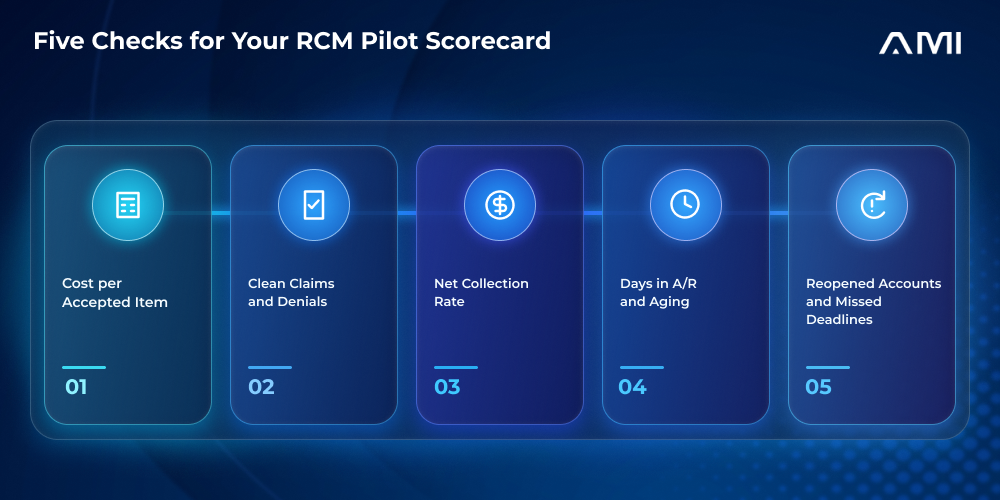
Which Revenue Cycle Management KPIs Belong in the Pilot?
Choose a pilot cohort with enough variation to test the work you intend to transfer. A denial pilot, for example, should include more than one payer, several aging bands, and the kinds of exceptions your team sees routinely. Compare it with similar internal accounts over the same follow-up window. Track opening backlog separately from new work so a one-time cleanup does not obscure how quickly the partner handles incoming volume.
| Pilot Measure | What It Tells You | How to Make It Comparable |
|---|---|---|
| Cost per accepted item | Whether completed work is economical after QA and corrections | Agree on the acceptance event and capture all assigned costs |
| Clean claim rate | Whether submission quality is holding as work moves | Specify the acceptance event, eligible claims, and treatment of resubmissions |
| Initial denial rate | Whether claims are being denied after submission | Use the same adjudicated-claim denominator and review by payer |
| Net collection rate | How much collectible value turns into payment | Use the same contractual adjustment rules and allow cohorts to mature |
| Days in accounts receivable and aging | Whether unresolved balances are accumulating | Review aging buckets and dollars alongside the average |
| Reopened accounts and missed deadlines | Whether closures and escalations are reliable | Audit a sample of closed work and review exceptions near filing limits |
Set the expansion criteria before the pilot starts. Give each measure an owner, source, review date, and threshold. Early reviews can establish whether queues are moving and corrections are being caught. Cash outcomes may take longer because payer response times vary. If your decision date arrives before enough accounts mature, extend the observation window or approve only the workflows where the evidence is sufficient.
How AM InfoWeb Supports Revenue Cycle Operations
AM InfoWeb brings 18 years of business experience to its work with healthcare organizations. Through Co-Managed Orchestrated Operations, it manages agreed revenue cycle workflows using trained teams and AI where it fits the workflow. You retain oversight and approval authority, while AM InfoWeb handles day-to-day execution within the agreed scope.
AM InfoWeb supports revenue cycle operations through the following services.
- Eligibility verification, medical coding, and billing support for agreed workflows.
- Claim follow-up and denial management with defined routing and escalation rules.
- Payment posting and accounts receivable follow-up within the assigned scope.
- Quality review and operating reports that make completed work, open exceptions, and corrective actions visible.
In AM InfoWeb’s published case study, a U.S. medical billing company adopted co-managed operations after encountering gaps in quality and communication with its previous provider. During diligence, ask how the reporting and escalation practices described in the case would apply to a queue your team manages today. AM InfoWeb Medical Billing Case Study
What Should You Approve Before Expanding the Partnership?
Approve a delivery scope that finance can price, and operations can supervise. At sign-off, your team should have a reconciled baseline, a sample invoice, a written assignment of exception ownership, and pilot results that account for both cash timing and work quality. Use those documents to agree on the next queues to transfer, the expenses that can actually come out, and when you will review the results again.
Evaluate Your RCM Operating Model. Bring a sample workload and your current cost assumptions. Discuss where co-managed delivery could fit and what you would measure in a pilot.
Discuss Your RCM WorkflowFrequently Asked Questions
About the Author

Written by
Urza Dey
Urza Dey is a content and copywriter with over five years of experience across marketing, B2B SaaS, HealthTech, EdTech, and related industries. At AMI, they contribute to content strategy, blog development, and marketing communication focused on healthcare operations, business process management, and AI-enabled service delivery.