


Co-Managed Revenue Cycle Management Outsourcing Strengthens Billing Company Operations
99%
Reported compliance rate in six months
25%
Reported customer satisfaction increase
10–15%
Estimated annual savings
20%
Projected annual growth over five years
A U.S. medical billing company had outsourced operational work but lost the visibility and control it needed to manage performance. Costly errors, slow communication, limited staffing flexibility, and declining customer satisfaction were weakening the relationship with its existing provider. The company selected AM InfoWeb for a co-managed approach to revenue cycle management outsourcing: the client retained oversight while AM InfoWeb handled daily execution. Training, quality discipline, and more responsive reporting helped build a stronger operating model.
Client Context
The client was an established U.S. medical billing company seeking a more reliable way to manage outsourced operations. Its priorities extended beyond staffing. It needed transparency, qualified resources, clearer communication, and the ability to adjust capacity as customer needs changed.
- Client: A U.S. medical billing company.
- Operational focus: Outsourced revenue cycle management and billing support.
- Business need: Restore client oversight while improving quality, cost control, and responsiveness.
Medical billing outsourcing works best when execution remains accountable to the business it supports. In this case, the client needed a partnership that made day-to-day work more visible and gave its leadership a practical role in directing operations.
Where Operations Were Struggling
The previous arrangement left the company facing several connected problems. Inadequate training contributed to errors and rework, while delayed reports made it harder to allocate work and respond to changes.
- Costly rework: Coding inaccuracies and billing discrepancies required additional time and resources to correct.
- Quality gaps: The original case account records quality audit scores of approximately 85% at the start of the partnership.
- Talent constraints: The company needed people with the relevant coding and revenue cycle credentials for assigned work.
- Limited scalability: Slow ramp-up and ramp-down processes made it difficult to match staffing to client demand.
- Communication delays: Late responses, unacknowledged process updates, and delayed operational reports reduced management visibility.
These issues made revenue cycle management solutions harder to govern. When staffing availability and task progress were unclear, the client had fewer opportunities to intervene before operational problems grew.
How AM InfoWeb Stepped In
AM InfoWeb introduced a co-managed operations model tailored to the billing company's requirements. The client retained necessary oversight and control, while AM InfoWeb took responsibility for daily execution within agreed processes.
The engagement paired workforce readiness with stronger reporting discipline. Simulation-based chart training prepared employees for account work, while qualified resources and a bench team supported changing capacity needs. Clear communication channels helped align execution with client expectations.
- Training focused on the work employees would handle in live accounts.
- Certified resources supported the skill requirements of coding and revenue cycle tasks.
- Quality measures and client rules guided operational reviews and calibration.
- Daily reporting and attendance visibility supported workload allocation.
- Flexible staffing options improved the team's ability to respond to demand.
The Optimized Workflow
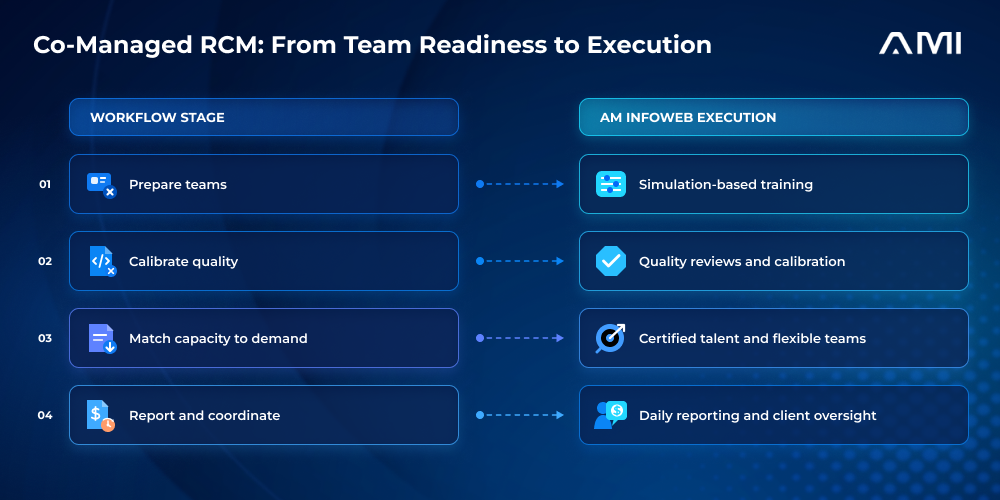
The revised workflow linked team readiness with ongoing client oversight. Each stage addressed a weakness in the previous outsourcing arrangement.
- Prepare teams for account work. Use simulation-based training and appropriately qualified resources to reduce the learning gap between training and live execution.
- Calibrate quality against client expectations. Apply partner rules, quality measures, and clear communication to keep execution aligned with the agreed operating requirements.
- Match capacity to demand. Use trained resources and flexible ramp-up or ramp-down arrangements to support changing workloads.
- Report and coordinate daily execution. Share task reports and staffing availability so the client can allocate volumes, communicate process updates, and retain operational oversight.
The value of the co-managed approach was the connection between these activities. Training addressed readiness, quality reviews reinforced expectations, and reporting made the work easier to manage. Together, they supported more efficient revenue cycle operations.
What Changed: Before and After
The engagement replaced a fragmented operating relationship with a more coordinated approach to medical billing outsourcing.
Before AMI | After AMI |
|---|---|
Training gaps contributed to coding inaccuracies and billing discrepancies. Correcting these errors consumed additional time and resources. | Simulation-based training prepared employees for live account work. Better preparation addressed the readiness gaps behind errors and rework. |
Initial quality audit scores were approximately 85%. Inconsistent execution reduced confidence in the outsourced operation. | Reported compliance reached 99% within six months. This is a separate measure from the initial quality audit score and should not be read as a direct percentage-point improvement. |
Skill gaps and slow staffing adjustments constrained responsiveness. The company struggled to match available resources to changing workloads. | Qualified resources and flexible staffing supported changing demand. Faster capacity adjustments gave the client more options for allocating work. |
Operational reports and staffing updates arrived late. Limited visibility made workload allocation and timely intervention more difficult. | Daily reports and attendance visibility supported workload allocation. Clearer updates helped the client coordinate execution and communicate process changes. |
The company lacked effective oversight of outsourced work. Slow communication and limited transparency weakened its ability to direct operations. | The client retained oversight while AM InfoWeb handled daily execution. The co-managed model restored a more active role in operational decisions. |
Results and Business Impact
The original case account reports improvements in compliance performance and customer satisfaction, alongside savings estimates and a growth forecast. These measures describe different aspects of the engagement and should be read separately.
Before AMI | After AMI |
|---|---|
Customer satisfaction was declining under the previous arrangement. The case account does not provide a numerical starting score. | Customer satisfaction reportedly increased by 25%. The improvement accompanied new services and a more responsive operating model. |
Errors and rework added to operating costs. The case account does not quantify the company’s total starting cost base. | The partnership reportedly generated $2 million in cumulative savings. The source does not specify the period over which these savings accumulated. |
Training gaps and inefficient execution consumed operational resources. No annual savings baseline is provided in the case account. | Improved efficiency was associated with estimated annual savings of 10% to 15%. This is an estimate rather than a separately verified achieved annual result. |
Operational constraints limited the company’s ability to respond to changing customer needs. The case account does not provide a historical annual revenue growth rate. | Annual revenue growth of 20% was projected over the following five years. This forecast describes expected growth rather than a measured outcome of the engagement. |
The operating changes also addressed the client's original concern: loss of control. Clearer reports, staffing visibility, and faster coordination gave the billing company a more active role in directing its outsourced operations.
This case illustrates why revenue cycle management outsourcing needs both execution capability and governance. Qualified teams are more useful when their work is supported by practical training, clear expectations, and reporting the client can act on.
How AM InfoWeb Supports Revenue Cycle Operations
AM InfoWeb has two decades of experience in the U.S. healthcare industry and uses a co-managed model that brings AI agents and skilled human agents together to eliminate process bottlenecks and execute secure healthcare workflows.
Its current revenue cycle support capabilities include:
- Medical billing and coding support aligned to client requirements.
- Trained operational teams and flexible capacity planning.
- Quality reviews, process calibration, and performance reporting.
- Client oversight and clear coordination across daily execution.
The documented intervention in this case centered on training, qualified resources, quality discipline, and co-managed reporting.
Explore AM InfoWeb's revenue cycle management services.
Conclusion
The billing company needed an outsourcing relationship it could manage with confidence. AM InfoWeb helped rebuild that relationship around training, qualified teams, flexible capacity, and transparent reporting. The reported results and improved operating visibility gave the company a stronger foundation for its next stage of growth.