


Payment Posting in Medical Billing: Catch Errors Before Reconciliation
TL;DR: Payment Posting in Medical Billing
Payment posting converts payer and patient receipts into accurate account-level financial transactions.
ERA automation improves speed only when payer mappings, adjustment rules, and exceptions are governed.
Daily reconciliation compares deposits, remittances, posted payments, adjustments, and unresolved variances.
Correct adjustment classification helps identify underpayments, denials, and patient responsibility.
Balanced metrics track turnaround, exceptions, unapplied cash, corrections, and reconciliation variance.
Root-cause analysis connects posting defects to payer files, configuration, training, and upstream claim quality.
Payment posting in medical billing turns payer and patient payments into accurate account-level transactions. It sounds like a closing step, but posting errors can distort accounts receivable, hide underpayments, misstate patient responsibility, and send teams toward the wrong follow-up action.
An effective payment posting process connects electronic remittance advice, electronic funds transfer, paper explanations, deposits, contractual adjustments, denials, and patient payments. The goal is not simply to clear a batch. It is to create a reliable financial record that supports reconciliation, follow-up, refunds, and reporting.
This guide explains how payment posting works, which controls prevent errors, and how providers can improve reconciliation without allowing unresolved exceptions to accumulate.
Need stronger support across complex healthcare workflows? Explore AMI’s healthcare services.
What Is Payment Posting in Medical Billing?
Payment posting is the process of applying payments, adjustments, denials, and patient-responsibility amounts to the correct claims and accounts. Insurance payment posting typically uses an electronic remittance advice, or ERA, while manual payment posting may rely on paper remittance documents, checks, lockbox files, or portal data.
CMS explains that an ERA reports adjudication and payment information at claim and line level, including adjustment reasons. Its payment and remittance guidance also notes that ERA data can be posted automatically into billing applications.
Accurate posting leaves each account with a defensible balance and a clear next step. That may be secondary billing, patient billing, denial follow-up, underpayment review, refund research, or closure.
How Does the Payment Posting Process Work?
The payment posting process in medical billing follows a controlled sequence:
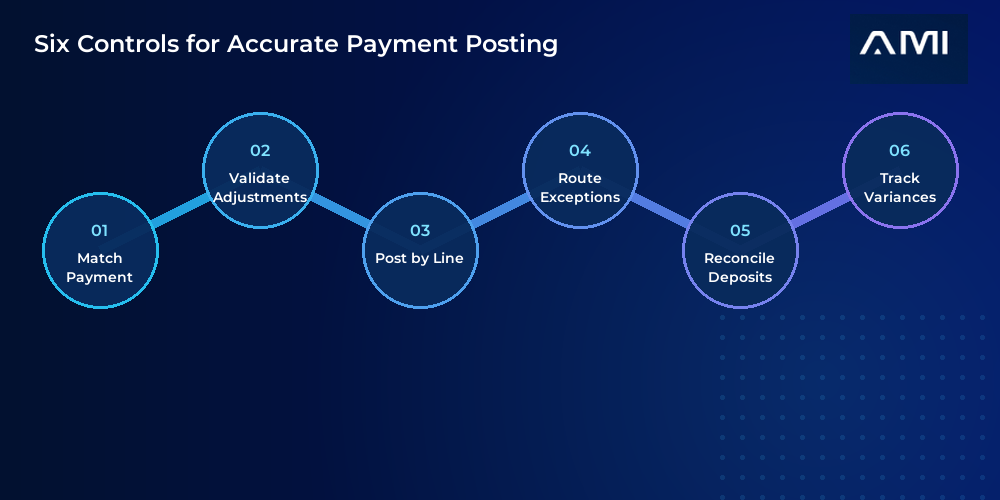
1. Receive and inventory the ERA, remittance, check, EFT, lockbox file, or patient payment.
2. Match the payment to the correct payer, deposit, batch, claim, and service line.
3. Post allowed amounts, payments, contractual adjustments, denials, and patient responsibility.
4. Route unmatched items, zero-pay claims, unusual adjustments, and variances to exception queues.
5. Reconcile the posted batch to the bank deposit, EFT, check total, and remittance total.
6. Document unresolved differences and assign them for timely follow-up.
Automation can accelerate standard transactions, but it should not silently force mismatches. Exceptions need clear ownership and traceable resolution.
Which Errors Occur During Medical Billing Payment Posting?
Common payment posting errors include applying a payment to the wrong patient, claim, payer, or service line; using an incorrect adjustment code; transferring responsibility incorrectly; duplicating a payment; and closing a balance before the deposit reconciles.
Other failures are less visible. A contractual adjustment may be posted where an appealable underpayment exists. A denial may be treated as a routine write-off. An unapplied cash item may remain in a holding account. A patient payment can be posted before insurance adjudication and later create a credit balance.
These errors affect more than accounting. They can delay accounts receivable follow-up, trigger incorrect statements, and hide patterns that should inform payer negotiations or denial prevention.
How Should ERA Payment Posting Be Controlled?
ERA payment posting should use validated payer mappings, adjustment-code rules, balancing controls, and exception thresholds. Automated posting rules should be tested whenever payer behavior, contracts, system configurations, or clearinghouse formats change.
Teams should review unusual contractual adjustments, noncovered amounts, reversals, takebacks, bundled payments, interest, sequestration adjustments, and secondary-payer activity. Zero-pay remittances also need action because they often carry denial or patient-responsibility information even when no funds arrive.
Control reports should compare expected transactions with actual system results. A successful file import does not prove that every line reached the right account or received the correct disposition.
How Does Reconciliation Catch Payment Posting Errors?
Reconciliation confirms that financial activity agrees across the bank, remittance, payment batch, and patient accounting system. It should compare total funds received, total payments posted, total adjustments recorded, and unresolved variances.
Daily reconciliation reduces the time between an error and its correction. Teams can research missing ERAs, split EFTs, duplicate files, unidentified deposits, and partial postings while source information is still available.
A good reconciliation process never hides a variance simply to close a batch. It records the amount, source, owner, aging, and resolution. Leaders can then distinguish temporary timing differences from recurring workflow defects.
Which Metrics Improve Payment Posting Performance?
Useful metrics balance speed, accuracy, and control.
| Metric | Question It Answers |
|---|---|
| Posting turnaround time | How quickly are receipts applied after arrival? |
| Auto-post rate | What share of eligible ERA transactions posts without manual work? |
| Exception rate | How often do transactions require investigation? |
| Unapplied cash | How much received cash lacks an account-level disposition? |
| Reconciliation variance | Do deposits, remittances, and posted batches agree? |
| Posting correction rate | How frequently must completed transactions be reversed or corrected? |
| Underpayment referrals | Are suspected payer shortfalls reaching follow-up teams? |
Metrics should be segmented by payer, facility, payment source, team, and exception type. A high auto-post rate is not a success if adjustments are mapped incorrectly or underpayments disappear.
How Can Payment Posting Reveal Underpayments and Denials?
The posting team sees the payer’s financial response before many downstream teams do. Correct classification of adjustment codes and remark codes can identify denials, partial payments, bundling, noncovered services, and differences between expected and actual reimbursement.
Contractual expectations should be compared with allowed and paid amounts. Material variances need a defined route to underpayment or denial specialists. This supports the same upstream learning used in claims denial management: patterns found after adjudication should improve documentation, coding, claim edits, and payer-specific workflows.
Need disciplined posting, reconciliation, denial, and follow-up workflows? Explore AMI’s Revenue Cycle Management services.
How Should Patient Payments and Credit Balances Be Handled?
Patient payments need the same account-matching and reconciliation discipline as insurance payments. Teams should verify the patient, encounter, payment source, date, amount, and remaining responsibility before applying funds.
When a payment creates or increases a credit, the account should enter a controlled review rather than being ignored or automatically moved. Staff need to determine whether the balance belongs to the patient, payer, another account, or a timing difference. The related credit balance process requires ownership, supporting documentation, and timely resolution.
How Can Providers Improve Payment Posting Quality?
Start with documented posting rules for each transaction type. Standardize payer mappings, adjustment handling, reconciliation evidence, exception categories, approval levels, and escalation timeframes. Limit access according to job responsibilities and retain an audit trail for reversals and corrections.
Use quality sampling that tests financial accuracy, not only throughput. Review high-value items, manual adjustments, zero-pay remittances, unidentified cash, reversals, and staff overrides. Root-cause analysis should connect recurring issues to payer files, system configuration, training, upstream claim quality, or unclear ownership.
Payment posting also benefits from workload planning. Separating routine transactions from complex exceptions allows automation to handle repeatable work while experienced staff focus on judgment-sensitive activity.

How Does AM Infoweb Support Payment Posting Operations?
AM Infoweb supports healthcare organizations with structured revenue cycle execution, quality controls, and operational visibility.
With two decades of experience in the U.S. healthcare industry, AM Infoweb uses a co-managed model where AI agents and skilled human agents work together to eliminate process bottlenecks and execute secure healthcare workflows.
AMI can support:
- ERA and manual payment posting workflows
- Payment, adjustment, and denial classification
- Batch and deposit reconciliation
- Unapplied cash and exception research
- Underpayment and denial referrals
- Quality assurance and correction tracking
- Payer-level performance reporting
The objective is a reliable account balance that guides the correct next action and protects both cash visibility and patient experience.
What Should Revenue Cycle Leaders Do Next?
Map every payment source from receipt through reconciliation. Identify where files fail, mappings override judgment, balances move without evidence, or exceptions age without ownership. Then prioritize defects by value, frequency, compliance risk, and downstream impact.
Accurate payment posting in medical billing creates trustworthy financial data. When posting, reconciliation, and exception management work together, teams can surface underpayments sooner, reduce incorrect patient balances, and focus follow-up where it matters.
Need stronger control over payment posting and reconciliation? AMI combines trained RCM teams, AI-assisted workflows, QA, and operational reporting to improve transaction accuracy and exception resolution.
Get in TouchFrequently Asked Questions
About the Author

Written by
Urza Dey
Urza Dey is a content and copywriter with over five years of experience across marketing, B2B SaaS, HealthTech, EdTech, and related industries. At AMI, they contribute to content strategy, blog development, and marketing communication focused on healthcare operations, business process management, and AI-enabled service delivery.